
Politics blog: Looking for Tom Barrett’s campaign site? Look carefully.
Monthly Archives: September 2010
City
Home-building permits tumble 22 percent — Walworth County Today
by JOHN ADAMS •
Anything that lessens construction burdens — up front — will be useful to communities hoping for a return to growth.
Building permits for new homes in Wisconsin’s biggest metro areas dropped 22% in August compared to the same time a year ago, the third consecutive month that home construction permits trailed totals from 2009.
Via Home-building permits tumble 22 percent — Walworth County Today.
City, Crime, Police
Filling Up Prisons Without Fighting Crime: Mark Kleiman on American’s Criminal Justice System
by JOHN ADAMS •
When you look around your community, do you feel that politicians’ and bureaucrats’ policies have reduced crime, or do you feel that they’re merely treading water, with every supposed ‘victory’ followed by subsequent crimes? Even small communities spend big sums on crime-fighting, but many of these efforts make no dent in crime. Carrying on as we have been doing only puts police officers and citizens at risk from a failed status-quo policy. There’s a better way than this.
Reason.tv offers an interview with author Mark Kleiman about what’s gone wrong, why, and what can be done.
Link: http://www.youtube.com/watch?v=G-lDr3DQnHo
UCLA Professor of Public Affairs Mark Kleiman is “angry about having too much crime and an intolerable number of people behind bars.” The United States is home to five percent of the world’s population and 25 percent of the world’s prisoners, yet, says Kleiman, our high incarceration rate isn’t making us safer.
In his book, When Brute Force Fails, Kleiman explains that, when it comes to punishment, there is a trade-off between severity and swiftness. For too long the U.S. has erred heavily on the side of severity, but if we concentrate enforcement and provide immediate consequences for law-breakers, Kleiman says we can both reduce the crime rate and put fewer people in prison.
Approximately 7 minutes.
Interview by Zach Weissmueller. Shot by Alex Manning. Edited by Weissmueller.
Quick note: Kleiman’s book is available in hardcover, paperback, or Kindle editions. more >>
Libertarians, Politics
“Murkowski not seeking Libertarian spot” – ktuu.com
by JOHN ADAMS •
Here’s a better title:
She’s not seeking what the Alaska LP executive committee unanimously denied her: a chance to run on the LP ticket. They denied her a line on the LP ballot because there’s nothing remotely libertarian about this cosseted incumbent who had a seat she didn’t deserve in the first place.
She’s not seeking? No, the LP’s not offering.
Daily Bread
Daily Bread for Whitewater, Wisconsin: 9-15-10
by JOHN ADAMS •
Good morning,
Today’s Whitewater forecast calls for a breezy day, with a high of seventy-six degrees.
Today in the Whippet City, there’s a meeting of the City of Whitewater’s public access station, from 7 to 8:30 p.m. The agenda for that meeting is available online.
There’s a book fair at Lincoln School’s LMC library today. At 7 p.m., Whitewater Middle School will have a PTO meeting.
The Wisconsin Historical Society recalls that on this day in 1832,
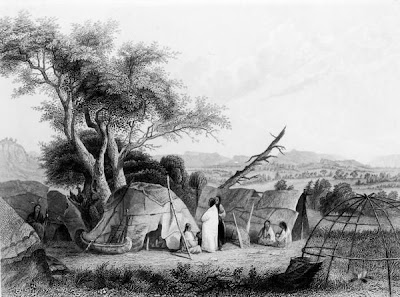
On this date a a treaty was signed between the Ho-Chunk [also referred to as Winnebago] and the United States that stipulated that the Ho-Chunk cede lands lying to the south and east of the Wisconsin river as well as lands around the Fox river of Green Bay. [Source: Oklahoma State University Library]
Here’s an illustration from Seth Eastman, from twenty years after the treaty, in 1852, entitled Winnebago Family:
Weird Tales
Bug Eaters Try to Get Some Buzz – WSJ.com
by JOHN ADAMS •
Here’s your chance to get in on what might be the American trend of the 21st Century. Wait too long, and you’ll be just another tag-along, without the cred that genuine trendsetters have and deserve.
Link:
Bug Eaters Try to Get Some Buzz – WSJ.com
Across the country, entomophagy—the eating of insects—has gained a small audience hopeful that the inclusion of bugs in global cuisine from Southeast Asia to Mexico inspires more of a following for such dishes in the U.S.
It’s been a slow crawl. For years, the idea has been pushed by champions such as David Gracer in Rhode Island, who has a company that sells processed edible insects, and David George Gordon, a Seattle-based science writer who published the Eat-a-Bug Cookbook in 1998. Buggy fare has been featured at the Audubon Insectarium in New Orleans and at events like BugFest at the North Carolina Museum of Natural Sciences and Bug Bowl at Purdue University in Indiana.
Uncategorized
Harley agrees to keep 2 Wisconsin plants open
by JOHN ADAMS •
Good news following difficult employee concessions:
MILWAUKEE — Harley-Davidson Inc. agreed Tuesday to keep open its two Wisconsin production facilities, saying it gained the cost savings it needed when union members agreed a day earlier to a concession-laden contract.
Haiku, Innovation Center/Tech Park
Innovation Center Haiku
by JOHN ADAMS •
Greenbacks take green space
Lobby, atrium, stone, steel
Pockets still empty
Economy, Free Markets, Tyranny
Wall Street Journal: Cuba Unveils Huge Layoffs in Tilt Toward Free Market
by JOHN ADAMS •
There could be few happier headlines than this: Cuba Unveils Huge Layoffs in Tilt Toward Free Market. Few happier because it signals the beginning of the end of the tyrannical regime that has so devastated Cuba. That Castro has lived to see the end of his oppressive life’s work is satisfying. There are, though, many miles ahead….
(This also lends credence, if any were needed, to the recent account from Jeffrey Goldberg that Castro said, “The Cuban model doesn’t even work for us anymore.” Of course, the Cuban model to which Castro refers never worked as well or as humanely as a free alternative would have. Castro has since tried to deny the remark, but Goldberg’s account was accurate, as confirmed by the remarks of the translator.)
From the WSJ story:
Economic growth could pick up if Cuba continues to open itself to privatization in coming years, but the process will be a slow one, said Arch Ritter, an economist who studies Cuba at Carleton University in Canada. Growth would “require a major change in the way the private sector is treated,” he says. Critical steps would be lowering taxes and loosening regulations for small businesses.
Daily Bread
Daily Bread for Whitewater, Wisconsin: 9-14-10
by JOHN ADAMS •
Good morning,
Whitewater’s forecast calls for a slight chance of showers and a high temperature of seventy-two degrees.
Wisconsin’s primary election today offers a chance to pick candidates and an end to some (defeated) candidates’ mediocre commercials.
There will be a school board meeting today at 4 p.m. to consider a “Resolution Cancelling Revenue Limit Referendum.” (Odd thing about the school district’s website: it’s design makes linking to documents, notices, agenda items difficult. It’s a website whose design defies the easy use of hypertext links.)
There’s a 6 p.m. PTA meeting at Lakeview School. At Lincoln School, proud home of the Leopards, there’s a Book Fair today, and then a 5-6 p.m. informational PTO meeting for parents. Washington School has its PATT meeting tonight at 6:30 p.m.
The Wisconsin Historical Society recalls a sad day in our state’s history, an incident in 1918 involving the Krueger family:
1918 – Lynched for Resisting WWI
On this day an armed mob estimated at 200 people surrounded the Clark Co. home of Mrs. Caroline Krueger and her sons, who had refused to serve in the First World War. “They said that if the war was in this country they would be among the first to volunteer,” reported a neighbor. “They declared however that it was not right to send American soldiers to France and that they never would go.” The family was known for its religious and pacifist views, but that didn’t matter to a mob of patriotic citizens. When the boys refused to respond to a draft notice, a crowd from nearby Owen, Wis., surrounded their home. A shootout followed, one of the mob was killed, one of the Kruegers shot through both legs, and their barn was burned down to smoke out the other sons. Two of the sons were convicted of murder and served 13 years before being transferred to a psychiatric institution, driven insane by their ordeal according to the press. The third son, Ennis, was believed killed when a youth matching his description was shot trying to escape authorities a few days later. This was, however, merely the final injustice in the sequence of events, as Ennis Krueger surfaced in 1933. When officials entered the farmhouse after the shootout, they found an American flag mounted above the family hearth. [Source: Wis. Local history & Biography Articles]
The Kruegers were mistaken about the war — Imperial Germany and her allies were a threat to the rest of Europe, and merited resistance, including armed resistance. Still, legitimate conscientious objectors should not be required to serve, and if found illegitimate (willing to fight in some places rather than others), they should have been found so only through due process. The account omits whether the Kruegers might have been sympathetic to Imperial Germany, but even so, they deserved better than a mob.
Libertarians, Politics
RealClearPolitics – In Blow to Murkowski, Alaska Libertarian Nominee Will Stay on Ballot
by JOHN ADAMS •
Haase should stay — Murkowski is not a libertarian and did not belong on the Libertarian Party line.
Ending weeks of speculation, Alaska Libertarian Party Senate nominee David Haase told RealClearPolitics on Monday that he would not allow Republican Sen. Lisa Murkowski to replace his name on the general election Senate ballot.
Via RealClearPolitics – In Blow to Murkowski, Alaska Libertarian Nominee Will Stay on Ballot.
Politics
Wisconsin State Journal: Tips on casting a primary ballot correctly
by JOHN ADAMS •
A Q & A about filling out the Wisconsin September 14th ballot:
Weird Tales
La Crosse Tribune: Five-Year-Old Boy Wins Alaska Moose-Calling Contest
by JOHN ADAMS •
Young Andrew Polasky won the contest at the Alaska Zoo in Anchorage.
From little acorns mighty oaks grow…
La Crosse Tribune: Five-Year-Old Boy Wins Alaska Moose-Calling Contest.
Government Spending, Politics, Taxes/Taxation
Milwaukee Journal Sentinel: Next Wisconsin Governor Faces Big Deficit
by JOHN ADAMS •
The Milwaukee Journal Sentinel has a story on Wisconsin’s difficult fiscal situation entitled, Next Wisconsin governor faces big deficit. The story has detail and analysis of all three major party candidates’ (Barrett, Walker, Neumann) views.
Here’s a summary from the story:
The gubernatorial candidates have unveiled plans to deal with a $2.7 billion projected shortfall in the 2011-’13 state budget. Assuming their plans work, here’s how much of the expected deficit that they have yet to solve:
Scott Walker (R): Has proposed about $1.5 billion in spending cuts over two years as well as a “sizable” across the board tax cut and more money for roads and bridges.
Amount left: Roughly $1.5 billion after accounting for a large tax cut.Mark Neumann (R): Has proposed holding the growth in overall state spending to 1 percentage point below the rate of inflation but given few specifics on how to do it. Also proposed major tax cuts and possible new spending on limited priorities such as infrastructure.
Amount left: Potentially none if the economy cooperates, but voters still don’t know exactly which programs would get squeezed.Tom Barrett (D): Has proposed $2.2 billion in spending cuts over two years and economic incentives worth at least $46 million.
Amount left: At least $500 million.