FREE WHITEWATER

Monthly Archives: September 2010

Official’s Misconduct: Calumet County District Attorney Ken Kratz’s Treatment of a Crime Victim (Update 2)

The Milwaukee Journal Sentinel has published an editorial about Ken Kratz, the lying and victim-abusing district attorney of Calumet County. Kratz sent dozens of vulgar, creepy text messages to a domestic abuse victim while he was prosecuting her former boyfriend for assaulting her. I wrote about Kratz’s obvious misconduct yesterday. See, Official’s Misconduct: Calumet County District Attorney Ken Kratz’s Treatment of a Crime Victim and Official’s Misconduct: Calumet County District Attorney Ken Kratz’s Treatment of a Crime Victim (Update).

In Crossing the Line, the Journal Sentinel wisely notes that

The Calumet County district attorney either needs to resign or be recalled after sending sexually suggestive text messages to a domestic violence victim while he was prosecuting the woman’s ex-boyfriend.

If he refuses to quit, voters should petition for a recall election to remove him from office. He has proven himself unfit for the job.

Yes, he has. Kratz has lied before about resigning voluntarily from a victims’ rights board (he was pushed out), so perhaps he’s so selfish and dim-witted that he’ll cling to the office as long as he can.

Of concern, also, is Kratz’s assertion, perhaps a lie, that he was ‘cleared’ by legal regulators. I don’t know if that’s true; if it should be true, then Wisconsin’s regulatory authorities owe the state an explanation.

Friday Comment Forum — Downsizing Government?

Here’s the Friday open comments post.

Today’s suggested topic is downsizing government. If you could cut, what would you cut? Alternatively, what would you preserve, other cuts (if any) not withstanding? Would you expand anything?

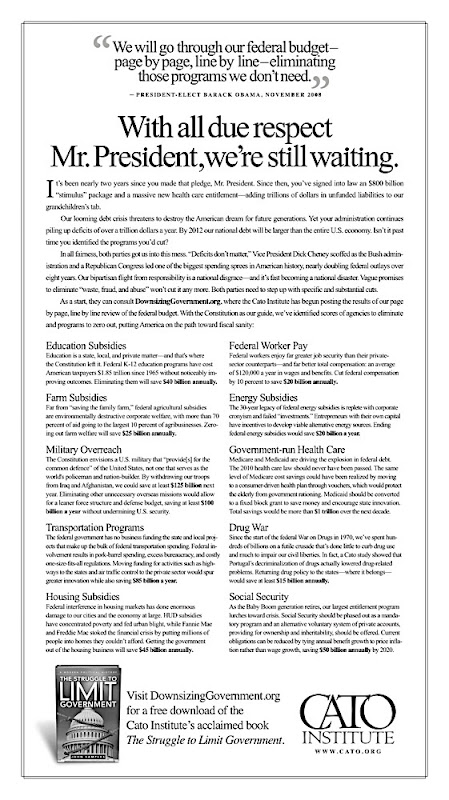
The Cato Institute has a fine new website, entitled DownsizingGovernment.org, offering a ‘department by department guide to cutting the federal budget.’

The focus today is on federal spending. (FREE WHITEWATER will focus on the City of Whitewater’s tax policy, its fiscal outlook, and municipal budget at a later time.)

Cuts represent far more than a savings in federal expenditures — they represent a reduction in meddlesome government, and a return to taxpayers of earnings (or alleviation of federal deficits from borrowing). Money returned and interest avoided will be better used in the hands of taxpayers than federal officials.

Consider just this one proposal, for a roughly 95% reduction in the size of the Department of Transportation, from Chris Edwards of Cato:

Most of the activities of the U.S. Department of Transportation are properly the responsibility of state and local governments and the private sector. There are few advantages in funding infrastructure such as highways and airports from Washington, but there are many disadvantages. Federal involvement results in political misallocation of resources, bureaucratic mismanagement, and costly one-size-fits-all regulations imposed on the states.

The Federal Highway Administration should be eliminated. Taxpayers and highway users would be better off if federal highway spending and gasoline taxes were ended. State governments could more efficiently plan their highway systems without federal intervention. The states should look to the private sector for help in funding and operating highways, and they ought to move forward with innovations such as expressways with electronic tolling.

The Federal Transit Administration should also be eliminated. Federal transit subsidies have caused local governments to make inefficient transportation choices. Federal aid favors rail systems, which are more expensive and less flexible than bus systems. The removal of federal subsidies and related regulations would spur local governments to discover more cost-effective transportation solutions, such as opening transit markets to private operators.

Air traffic control should be removed from the federal budget, and the ATC system should be set up as a stand-alone and self-funded agency or private company. Many nations have moved towards such a commercialized ATC structure, and the results have been very positive with regard to efficiency and safety.

Canada’s reform in the 1990s to create a private nonprofit ATC corporation is a good model for the United States to follow. U.S. ATC is currently overseen by the Federal Aviation Administration, which has serious funding problems and a poor record on implementing new technologies. Moving to a Canadian-style ATC system would help solve these problems and allow our aviation infrastructure to meet rising aviation demand.

Amtrak has provided second-rate rail service for decades, while consuming almost $40 billion in federal subsidies. It has a poor on-time record, and its infrastructure is in bad shape. As a government agency, it is hamstrung in its decisionmaking regarding routes, workforce polices, capital investment, and other aspects of business. Amtrak should be privatized to give it the management flexibility it needs to operate in a more efficient and competitive manner.

The table shows that federal taxpayers would save about $85 billion annually by closing down the agencies and programs listed. The department would retain its current activities regarding highway safety, aviation safety, and some other regulatory functions. Those functions could be reformed as well, but the most important thing is to end federal subsidies for transportation activities that would be better handled by the states and private sector. America should take heed of the market-based reforms being implemented abroad, and pursue similar solutions to its transportation challenges.

Department of Transportation
Proposed Spending Cuts
Program Spending in 2010

($ million)
Federal Highway Administration
Terminate entire agency $51,750
Federal Transit Administration
Terminate entire agency $15,476
Federal Aviation Administration
Air traffic control operations $7,299
Air traffic control capital grants $3,017
Airport grants $3,979
Passenger Rail
Amtrak $2,528
High-speed rail grants $339
Maritime Administration
Assistance to shipyards $104
Ocean freight differential $175
Title XI loans $108
Essential air service $53
Total proposed cuts $84,888
Total department outlays $90,944
Source: Estimated fiscal year outlays from the Budget of the U.S Government, FY2011.

The use of pseudonyms and anonymous postings are, of course, fine.

Although the comments template has a space for a name, email address, and website, those who want to leave a field blank can do so. Comments will be moderated, against profanity or trolls. Otherwise, have at it.

I’ll keep the post open through Sunday afternoon.

Have at it.

Cato Institute’s DownsizingGovernment.org

The Cato Institute has a fine new website, entitled DownsizingGovernment.org, offering a ‘department by department guide to cutting the federal budget.’

Faced with debilitating federal deficits, for years to come, there’s no better time to consider downsizing government than now. A smaller, more limited government would advance liberty and prosperity. Here’s an advertisement that Cato ran yesterday in the New York Times and Washington Post:


Click for larger image

Daily Bread for Whitewater, Wisconsin: 9-17-10 (Constitution Day Edition)

Good morning,

Today’s forecast calls for a foggy day, with chance of showers later in the day, and a high temperature of seventy-three degrees.

It’s coffee with the principal at Lincoln School, proud home of the Leopards, today at 8:15 a.m. At the Middle School, it’s school picture day.


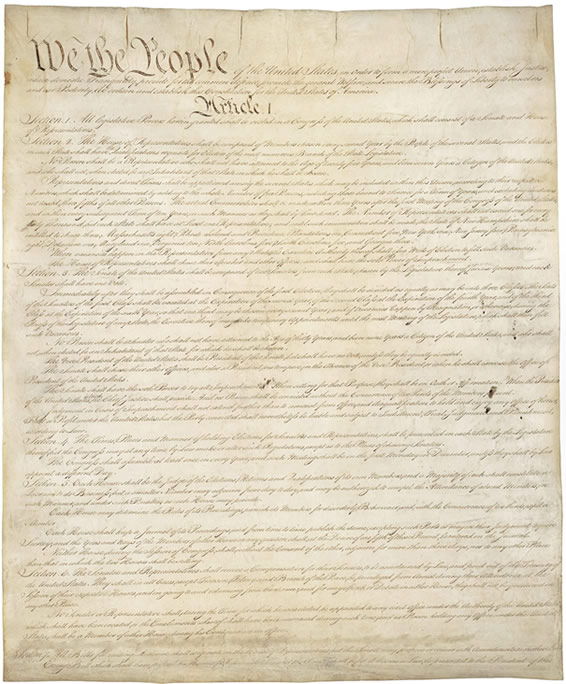
U.S. Constitution, first page

It’s Constitution Day, celebrating the signing of the United States Constitution in 1787.

Wisconsin, We Can Do Better! Swallow, Smallest Cow In The World, Is 33 Inches From Hind To Foot

Outrageous and inexplicable: Wisconsin is America’s Dairyland, and because anything American is 73% better than anything English, there’s no reason that Wisconsin shouldn’t have the world’s smallest and most-interesting cow.

If Wisconsin’s Governor Doyle wants to do something truly memorable before leaving office in January, then he should commit Wisconsin to a crash program in cow-miniaturization. Whitewater, Wisconsin, for example, has ample rental space available for the project.

This English cow (here I mean the animal, not any random Englishwoman) is only “33 inches (84 centimeters) from hind to foot.” She’s a “Dexter cow, a breed known for its diminutive stature, but is small even by Dexter standards.”

Here’s a video where her owners boast about their prized bovine:


Link: Really Small English Cow.

See, Swallow, Smallest Cow In The World, Is 33 Inches From Hind To Foot (VIDEO).

BBC News – Pigeon flies past broadband in data speed race

Sad, but true:

Broadband is the most modern of communication means, while carrier pigeons date back to Roman times.

But on Thursday, a race between the two highlighted the low speeds of rural broadband in the UK; the pigeon won.

Ten USB key-laden pigeons were released from a Yorkshire farm at the same time a five-minute video upload was begun.

An hour and a quarter later, the pigeons had reached their destination in Skegness 120km away, while only 24% of a 300MB file had uploaded..

The competition was carefully contrived, but makes a valid point — rural broadband can be disappointingly slow.

Via BBC News – Pigeon flies past broadband in data speed race.


The Winner!

Official’s Misconduct: Calumet County District Attorney Ken Kratz’s Treatment of a Crime Victim (Update)

Less than a day after his original story, the AP‘s Ryan Foley follows up, in E-mails show DA tried to keep ‘sexting’ quiet to show that District Attorney Ken Kratz tried to keep his conduct hidden from state officials, and lied to Foley about his willingness to accept responsibility for his conduct. (For my original post on the story, see Official’s Misconduct: Calumet County District Attorney Ken Kratz’s Treatment of a Crime Victim.

Foley writes:

Kratz said they [his texts] were “a series of respectful messages” that were not sexual at all.

Kevin Potter, administrator of DOJ’s division of legal services, rejected that and told Kratz the texts could have jeopardized the prosecution of Shannon Konitzer on a felony strangulation charge. Potter said Van Groll could have refused to cooperate or the messages could have become evidence used to question her motives and credibility….

Potter told Kratz he could have been seen by Van Groll as going easy on Konitzer if he reached a plea bargain because she rejected his overtures, or that he wanted the case to end quickly so they could start a relationship. If he would have prosecuted Konitzer to the fullest extent, that could have been seen as a way to ingratiate himself with Van Groll, Potter wrote.

Potter’s assessment could not be more clear or more accurate. Foley writes that Kratz insisted the risk was merely ‘potential.’ Kratz’s contention is absurdly stupid — at their inception, all actual risks are merely potential. That some do not come to pass does not relieve their creators from responsibility for recklessness.

Beyond the risk to the case, there was, of course, actual harm to the domestic abuse victim who complained of Kratz’s unwanted advances. There’s nothing potential about her further victimization at the hands of a Wisconsin district attorney.

Foley also catches Kratz in a self-serving lie: Kratz contended yesterday that he resigned from a victim rights board as a “self-imposed sanction.” That’s false. Foley shows that Kratz didn’t want to resign at all, and only did so after the Wisconsin Department of Justice threatened to reveal the text messages to the Wisconsin District Attorneys’ Association.

Official’s Misconduct: Calumet County District Attorney Ken Kratz’s Treatment of a Crime Victim

The misconduct of public officials is compounded when their colleagues shield them from accountability for their abusive, dishonest, and unethical behavior. Few actions undermine public trust more than officials’ refusal to hold themselves to the standards they declare for themselves, and insist for others.

In Calumet County, District Attorney Kenneth Kratz wrote dozens of text messages to a domestic abuse victim while he was prosecuting her ex-boyfriend for hitting her. Kratz’s messages were vulgar, creepy texts touting his supposed desirability. Crime victim Stephanie Van Groll naturally found his messages wrong, repulsive, and intimidating.

See, Calumet County DA ‘sexted’ abuse victim.

In this way, completely contrary to everything Kratz was sworn and elected to represent, he made Stephanie Van Groll a victim yet again.

There should not be the slightest doubt that Kratz is unfit to serve, and should resign from office. Not merely resign from a committee here or there (as he has apparently done), but from office. He’s elected, of course, but there’s no reason to wait until the next election to send him packing. He is unworthy of exercising responsibly the power he now holds, and should relinquish it.

He needs only the time it would take to write a single-line letter of resignation.

Consider these messages from Kratz to crime-victim Van Groll during the prosecution of her attacker, as reported by the AP:

“Are you the kind of girl that likes secret contact with an older married elected DA … the riskier the better?” and

“I would not expect you to be the other woman. I would want you to be so hot and treat me so well that you’d be THE woman! R U that good?” and

“I’m serious! I’m the atty. I have the $350,000 house. I have the 6-figure career. You may be the tall, young, hot nymph, but I am the prize!” and

“Remember it would have to be special enough to risk all”

Domestic abuse victims’ advocates see Kratz’s conduct for what it is, as the story notes:

If what’s being alleged is true, it’s sad a prosecutor would use the same sort of power and control over a woman who has already experienced that in her personal life,” said Patti Seger, executive director of the Wisconsin Coalition Against Domestic Violence.

Seger’s unquestionably right: Kratz’s conduct is an expression of illegitimate power and control. Having exceeding the bounds of lawful and principled authority, in his conduct toward a domestic abuse victim, Kratz is unworthy of office.

What happened when Van Groll reported Kratz’s conduct to police? Here’s what happened:

“Nothing really happened to him and I had three days of hell,” Van Groll said in a phone interview with the AP. “They gave him a slap on the wrist and told him not to do it again. If it was anybody else that did something like this, they’d lose their job.”

….Van Groll said she went to police on the third day after the messages started becoming “kind of vulgar.” She provided copies of 30 messages and her responses, which the department released in response to an AP request.

“Stephanie feels afraid that if she doesn’t do what he wants Kratz will throw out her whole case,” an officer who interviewed Van Groll wrote.

The department referred the complaint to the state Division of Criminal Investigation because it works with Kratz’s office on prosecutions. Van Groll, a college student and part-time preschool teacher who has moved to Merrill, said she has been told Kratz won’t be charged because “they didn’t think he did anything criminally wrong.”

Kratz contends that this is a “non-news story,” but admitted that he was “worried about it [the story] because of my reputational interests. I’m worried about it because of my 25 years as a prosecutor.”

That’s not the legitimate worry — the legitimate worry is that he’s still in office after abusing a crime victim. Her safety and care is what matters. There is no higher concern.

Kratz contends that legal regulators, perhaps from the Office of Lawyer Regulation, cleared him. I don’t know if they did, or if those of whom he speaks were from that office.

I do know that, in fact, he cannot be cleared while he remains in office: his conduct is inimical to the duties of a prosecutor.

Kratz is an elected prosecutor, with all the privilege in the world, and he treats victims as toys. If one fears the decline of justice, it’s because public officials are no longer properly accountable.

Until they are, they’ll be more of this, once being too often, from public officials in Wisconsin.

Daily Bread for Whitewater, Wisconsin: 9-16-10

Good morning,

Whitewater’s forecast for today calls for a day of showers with a high of sixty-four degrees.

The City of Whitewater’s Urban Forestry will hold another work session from 9 to 11 a.m. this morning. The agenda is available online, and lists two items under an “Urban Forestry Management Plan”: “A. Grasses/lawns/landscaping; quick overview of doc. For Parks and Rec. review” and “B. Tree policies.”

It’s Market Day at Lincoln School, with pickup from 5-6 p.m. in the upper gym.

Wired has a story on a genuine innovation: Dog Poop Powers Park Lights:

Conceptual artist Matthew Mazzotta is using dog feces to power lampposts in a park in Cambridge, Massachusetts.

Mazzotta’s Project Park Spark, which was funded through MIT and created in partnership with the City of Cambridge, comprises a special “methane digester” that converts freshly scooped poop into methane.

Dog owners collect their dog waste in a special biodegradable bag and throw it into the digester –- an air-tight cylindrical container, where the dog feces are broken down by anaerobic bacteria. A byproduct from that process is methane, which can then be released through a valve and burnt as fuel. In this case it is being used to power an old-fashioned gas-burning lamppost in a park.


Image courtesy Park Spark Project.

CNN Poll: Only quarter of public trusts government

Unsurprising, as officials’ and politicians’ claims have been too grand, too self-serving, and in contrast with actual, often mediocre performance.

Sensible people just don’t believe vainglorious declarations about public service, in which officials describe themselves as though they were saints, and every project as though it were a cathedral.

A new poll indicates that only one in four Americans say they trust the government to do what is right always or most of the time, one explanation for the anti-incumbent sentiment in the country today….

The survey indicates a partisan divide, with Democrats expressing more trust in the government, but even among Democrats, only four in ten express that level of trust in government.

Via CNN Poll: Only quarter of public trusts government.

Link: Full pdf poll results.

A Referendum for Whitewater’s Schools (Part 3)

There’s a story today about the removal from the ballot of one of two referendum questions concerning our public school district. (The story rightly describes this as a ‘pause.’) See, Whitewater referendum ‘paused’.

I’ve written about a referendum approved in August for Whitewater’s public schools. The first question of two authorized for the November ballot requested approval by extension, for five more years, of about six-hundred thousand in spending and taxation beyond the state revenue limits. (See, A Referendum for Whitewater, Wisconsin’s Schools and A Referendum for Whitewater, Wisconsin’s Schools (Part 2).)

About a week ago, the district announced that the school board would entertain a vote canceling the first referendum question. From that moment, I’d say two things were certain. First, that there would have been no proposal for cancellation unless the votes for cancellation were already in hand. Second, that cancellation depended on an additional source of revenue, not on a reduction in district expenditures.

There’s no skill in seeing anything of this.

The talk today is that the first referendum question been rescinded by unanimous vote of Whitewater’s school board.

It wouldn’t have passed, as results of a similar referendum for the much wealthier Williams Bay district show. (“Two-thirds of voters in the Williams Bay School District on Tuesday turned down a referendum to allow the district to exceed the state-imposed revenue cap.”) I don’t know what the margin would have been in the Whitewater vote, but it seems unlikely that the effort would have been successful.

I was waiting, however, for a solid and serious case in its favor, to consider that case on the merits. Such a case never came; the advocacy on behalf of exceeding the revenue limits was vague, with a bit of error mixed in. Not once did the school district’s website highlight points in favor of the referendum on its main page; the lieutenant governor, soon to leave office, got more attention for her brief visit. (It’s just odd to talk about an ‘anti-referendum group’ when there was no serious, detailed pro-referendum case. )

The district rightly touts a commitment to academics, athletics, and activities, but the referendum effort wasn’t up to a competent academic standard. Part of the district’s advocacy was misuse of terms of art: tax neutrality is a policy of imposing taxes so that they do not divert, don’t favor, present consumption between alternatives. Exceeding the revenue caps for another five years isn’t an exercise in making a tax neutral. It’s simply an exercise in taxing.

This question will be back again; there will be time to consider it another day.