FREE WHITEWATER

Monthly Archives: September 2010

Im Not Going to Be Interrogated As a Pre-Condition of Re-Entering My Own Country – Hit & Run : Reason Magazine

There’s justifiable pride in being an American citizen: America is an extraordinary place, a free, beautiful republic. There are countless reasons to be proud of being a citizen, so many reasons to love the American way of life.

Unfortunately, the encroachment of government regulations is so considerable that federal officials often assert authority that they do not have under the law. In doing so, they undermine the liberties and right to which all American citizens are entitled as citizens.

Reason has an example of this erosion in a post entitled, ‘I’m Not Going to Be Interrogated As a Pre-Condition of Re-Entering My Own Country’.

American citizen Paul Lukacs tried to return to America, from China, and was met with this question, from a passport control officer: “Why were you in China?” Lukacs told her that it was none of her business, and then said, “I’m not going to be interrogated as a pre-condition of re-entering my own country.”

Lukacs was right, of course, and after being detained for about half an hour he federal officials allowed him to go on his way. He should have been allowed — under the law — to go on his way without detention. The men and women paid as passport control officers, should not be a law unto themselves, simply declaring what they law is, and doing so while ignorant of actual law.

More and more photographers find themselves challenged, too, and told that they cannot take pictures in public places, must turn over their cameras, or find that government agencies are encouraging citizens to report lawful photography as though it were a crime.

Citizens don’t deserve diminished citizenship, and so these infringements on the rights and liberties of citizenship should be challenged. It’s often difficult and time-consuming, but a task worth undertaking.

Daily Bread for Whitewater, Wisconsin: 9-13-10

Good morning,

Today’s Whitewater forecast calls for a sunny day with a high temperature of seventy-seven degrees.

The City of Whitewater’s Planning Commission will meet tonight at 6 p.m. The meeting agenda and accompanying documents are available online.

Later, at 6:30 p.m., there will be a meeting of the LIbrary Board. That agenda is available online.

In our public schools, District Administrator Zentner will hold listening sessions tonight at the district’s Central Office, in English from 5 to 5:45 and in Spanish from 5:45 to 6:30 p.m.

Over at Wired, there’s a story about how revolting cockroaches can serve a medicinal purpose, in Cockroach Brains, Coming to a Pharmacy Near You:

Cockroaches may be nasty bugs, but they could help fight even nastier ones. New research finds that the rudimentary brains of cockroaches and locusts teem with antimicrobial compounds that slay harmful E. coli and MRSA, the antibiotic-resistant staph bacterium. The work could lead to new compounds for fighting infectious diseases in humans.

Arthur Brooks and Paul Ryan: The Size of Government and the Choice This Fall – WSJ.com

Well said:

As we move into this election season, Americans are being asked to choose between candidates and political parties. But the true decision we will be making—now and in the years to come—is this: Do we still want our traditional American free enterprise system, or do we prefer a European-style social democracy? This is a choice between free markets and managed capitalism; between limited government and an ever-expanding state; between rewarding entrepreneurs and equalizing economic rewards….

More and more Americans are catching on to the scam. Every day, more see that the road to serfdom in America does not involve a knock in the night or a jack-booted thug. It starts with smooth-talking politicians offering seemingly innocuous compromises, and an opportunistic leadership that chooses not to stand up for America’s enduring principles of freedom and entrepreneurship.

As this reality dawns, and the implications become clear to millions of Americans, we believe we can see the brightest future in decades. But we must choose it.

Via Arthur Brooks and Paul Ryan: The Size of Government and the Choice This Fall – WSJ.com.

More Absurd Excuses from Brunner and Telfer: “UW-Whitewater Breaks Ground on Technology Park”

Excuses made on behalf of Whitewater’s publicly-funded Innovation Center and Tech Park are growing increasingly absurd, and are easily refuted. Each attempt of officials to justify the project only shows, yet again, what a wasteful scheme it is. Serious and thorough examination of tech parks like this shows they’re money-draining failures.

The Milwaukee Journal Sentinel has a fine story, entitled “UW-Whitewater breaks ground on technology park,” that includes supposed justifications for the project from Whitewater City Manager Kevin Brunner and UW-Whitewater Chancellor Richard Telfer. Their explanations are risible, and the story points to a fine study showing the many ways a project like this is a very bad idea. The story also includes a picture of the construction site that’s worth far more than a thousand words. (More on that in a bit).

I’ll consider the remarks offered on behalf of the project.

The Anchor Tenant. There’s little doubt that using a state education agency — the publicly-supported school service agency, CESA 2 — as an anchor tenant has nothing to do with technology, not being a technology concern in any legitimate way. In this article, Whitewater’s city manager drops even the pretense that there’s something tech-related about CESA 2:

So far, the Innovation Center’s largest tenant is CESA 2, a state agency that provides teacher training. A smaller education agency also signed a lease recently. Prospective tenants are private firms, and Brunner said the public agency leases were needed to generate rental income.

“This helps pay the bills,” he said.

I’ve been a critic of this project, but it’s hard to imagine how obtuse Brunner’s justification really is. To justify public spending of millions in public money on a building that’s supposed to foster private tech firms, Brunner points to another public expense, the public cost of rent for a publicly-funded building!

This is just absurd, and is no justification at all. If Brunner thinks that it’s a sensible explanation that the Innovation Center took on a public tenant, on top of a public funding scheme, to get to a possible private set of tenants, then he can’t think clearly at all.

Here’s what might have made much more sense: A tech park building, needing an anchor tenant, takes on a private, non-tech business to provide rent to allow for other, genuine, private tech businesses. For example, the Innovation Center, needing money from an anchor tenant, takes on a private restaurant and bookstore to support a building that will house genuine tech businesses. Any variation like that would be a stretch as an anchor tenant, but at least it would be a private source of funding.

That’s not what’s happened here.

Brunner hasn’t found a private (anchor) business to pay the bills for a public project meant to attract private businesses — he’s found a taxpayer-supported agency to pay its rent through ordinary people’s taxes. Who pays the bills of the school agency that pays the bills of the public project?

Taxpayers.

The Prospective Fund. The story mentions a possible tenant, and here’s the relevant passage:

Prospective tenants include a start-up investment fund led by Patrick Monaghan, the university’s entrepreneur-in-residence.

Monaghan, working with UW-Whitewater professors and students, has created software that uses a quantitative technique known as predictive analytics to pick stocks and other investments. Monaghan envisions about a half-dozen employees working at the Innovation Center, with research conducted on campus, once the fund is launched in early 2011.

Monaghan, who lives in the Whitewater area, never considered using the university’s resources until an acquaintance introduced him to Choton Basu, an associate professor in information technology and business education. Monaghan now works out of the university’s Global Business Resource Center, which is based in the business college’s new building, Hyland Hall.

“It’s a small undergraduate state school. I just didn’t think of Whitewater,” he said.

One can only guess about the prospects of the fund, not yet launched. There’s so much speculation and uncertainty in this venture as a possible tenant that one see how shaky are the prospects of the Innovation Center. If this is the most certain prospect that the backers of the Innovation Center have to offer, then they’ve truly embarrassed themselves, and at the expense of those ordinary people who had taxes taken for this effort.

Telfer’s Lack of Choice. In describing the decision to go ahead with this public scheme, here’s what UW-Whitewater Chancellor Telfer had to say:

Telfer acknowledged that the public funding of Whitewater Technology Park involves “a little bit of a leap of faith.” Telfer, whose academic background is education, also said he would have never considered such a project 20 years ago. But the university’s role is changing, he said.

“I don’t think we have a choice,” Telfer said. “I really think universities need to be more explicitly involved in helping to grow more business opportunities.”

Telfer has no choice? He just had to get Whitewater to take a taxpayer grant, and for the community to issue millions in debt, so that he could have this project? There was no alternative except to have this, this way?

Of course there was an alternative — these gentlemen could have restrained themselves, and not sought millions in other people’s earnings to fund his project. Men who have spent years on the public tab, in fields other than businesses or technology, now insist that they had no choice but to have this project, now. All around our city, there’s child poverty, hunger, with unemployed blue collar workers, but these gentlemen just had to have this, now.

The selfishness of this project, with so many greater needs, is disgraceful. These middling few have funded their scheme on the backs, and from the pockets, of ordinary people. This project is merely a moment to their pride.

The Truth About These Projects: They Don’t Work!. There’s a solid study to which this story links, from Marc Levine, UW-Milwaukee history professor, and the director of the university’s Center for Economic Development, entitled “The False Promise of the Entrepreneurial University.” I read this paper near the time it was written, and its assessment is thorough and compelling. I’ll post more about this later, as there’s a series I have yet to complete on the funding of Whitewater’s park, and its supposed justification.

For now, consider Levine’s informed observation:

While proponents of academic commercialism routinely overstate its economic benefits for cities and regions, they rarely mention the significant costs. These include potential undermining of the system of basic research and open science that has been the cornerstone of scientific discovery in the US, and, ironically, undercutting innovation. Contrary to claims by many university leaders that research commercialization will generate revenues for their institutions, for most universities tech transfer is a money- losing proposition. Tech transfer is a classic example of jackpot or casino economics, with very few big winners, and over half of US universities lose money in academic commercialization. Research funding and commercialization revenues are heavily skewed to the same “top 15” universities that have dominated these statistics for decades, and, as one expert has argued, outside of this top group most universities are getting nothing out of tech transfer “except a lot of economic development rhetoric.”

The Accompanying Photo. Accompanying the story is photo of construction at the Innovation Center building. Nothing could be more appropriate than that photo: a worker grouts a hole for a fancy ‘geothermal heating and cooling system,’ paid for with ordinary people’s taxes, while the foreground shows a muddy construction site, of ruts and pools of water.

When this is all done, and the ground dries, there’ll be another photo, of another hole, that will be a suitable metaphor for the project:
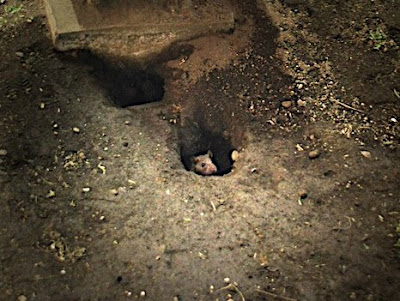


Rat hole avec rat

Recent Tweets: 9-5 to 9-11

Secret Places: Flesh-eating beetles on [UW-Madison] Bascom Hill http://bit.ly/9EdiK3
about 13 hours ago

No Whitewater, WI? That’s crazy! Social Media Savvy Cities: The 17 Most ‘Social’ Cities Ranked By NetProspex http://huff.to/9PlBTM
6:49 PM Sep 10th

Dockside Inspections, a Lost Decade, and Municipal Obstructionism » FREE WHITEWATER http://bit.ly/cIuERq
6:48 PM Sep 10th

Reason.tv: Anyone Care About Economic Liberty Anymore? George Thomas on the 14th Amendment » http://bit.ly/9IsjNw
6:48 PM Sep 10th

RealClearPolitics – More Like Hoover Than FDR http://bit.ly/baUMDx
6:32 PM Sep 10th

RT @CatoInstitute: Check out our FREE e-book “Downsizing the Federal Government” by Chris Edwards: http://bit.ly/aNsekZ #tlot
2:04 PM Sep 10th

RT @WiStateJournal: Property Trax: Two free local foreclosure prevention workshops later this month http://ow.ly/18USc8 A sign of sad times
12:31 PM Sep 8th

@WiStateJournal: Op-Ed: Taxpayers deserve a tight ship http://ow.ly/18TK5w. Private oversight requires ability to hire, fire, manage
8:43 AM Sep 7th

Otters: The Animals That Get Cuter With Anger (PHOTOS) http://huff.to/b7BvL3
7:40 PM Sep 6th

RT @WiStateJournal: Curiosities: Why are yellow jackets most noticeable in late summer? http://ow.ly/18T20T
10:19 AM Sep 6th

Reason.tv: Anyone Care About Economic Liberty Anymore? George Thomas on the 14th Amendment

George Thomas of Claremont McKenna College discusses economic liberties. Reason.tv’s interview is a solid contribution to the topic. I have embedded the video, and a description of it, below.

(By the way, if you’re looking for those who take economic liberties seriously, there’s no better place to start than the “merry band of litigators” at the Institute for Justice, a civil liberties public interest firm dedicated to defending economic liberty.)


Link: http://www.youtube.com/watch?v=je-a-0jPhtg

To take the original meaning of the Fourteenth Amendment seriously is to take economic liberties seriously,” says George Thomas, an associate professor of government at Claremont McKenna College.

Thomas notes that, for most of our nation’s history, there wasn’t a rigid distinction between civil and economic liberties. The Bill of Rights treated them all as fundamental rights, and, as can be seen in the famous passage, the Fourteenth Amendment continued this tradition: “No State shall make or enforce any law which shall abridge the privileges or immunities of citizens of the United States; nor shall any State deprive any person of life, liberty, or property, without due process of law; nor deny to any person within its jurisdiction the equal protection of the laws.”

Thomas explains that the separation between civil and economic liberties began during the Franklin Roosevelt era, when various economic liberties seemed to be written out of the Constitution. He shows how recent Supreme Court decisions, such as in Kelo v. City of New London, which granted governments wider economic domain powers, and McDonald v. Chicago, which extended the Second Amendment right to “keep and bear arms” to states and localities, figure in to how America defines and protects fundamental rights and economic liberties.

Approximately 10 minutes. more >>

Los Angeles Times: 41 White House Aides Owe $831,000 in Back Taxes – And They’re Not Alone

Apologists of big government wonder why there’s a gap between governors and the governed, why voters are dissatisfied. It’s because some bureaucrats behave as though the normal relationship is between rulers and ruled, and governors and governed.

Dozens of White House aides owe a total of eight-hundred thousand dollars in back taxes.

Nationally, federal workers owe over a billion dollars in back taxes.

Astonishing.

See, Los Angeles Times: 41 White House Aides Owe $831,000 in Back Taxes – And They’re Not Alone

Alaska Senator Lisa Murkowski’s Libertarian Credentials: None

There’s some talk about whether Republican U.S. Senator Lisa Murkowski, defeated in her party’s Alaska primary, should run as a Libertarian. To support this effort, a few dumb-as-a-doornail libertarians are trying to talk up Murkowski as a candidate on the LP line.

She’s not a libertarian, and so she doesn’t belong on a ballot as a candidate of the LP. She’s a big-government Republican, that particularly noxious political species.

Murkowski voted to spend hundreds of billions to fund the Troubled Asset Relief Program. That’s the opposite of a libertarian and a Libertarian Party candidate.

She’s just another desperate incumbent willing to say anything to convince gullible people that she’s not as foolish as she truly is.

Her father, a governor, apponted her to a United States Senate seat – she’s reaped enough from that nepotism for a lifetime.

She doesn’t deserve a possible reprieve from the LP.

Senator Murkowski’s Libertarian Credentials.