
Cat chases cyber mice.
Monthly Archives: November 2012
Poll
Friday Poll: Whitewater’s first accumulated snowfall in the 2012-13 season?
by JOHN ADAMS •
Here’s a 2012-2013 version of a poll first published last year: when will Whitewater see her first accumulated snowfall in the 2012-13 season?
It’s mild weather ahead for the weekend, but when will that change into an appreciable snowfall? (Let’s call an appreciable snowfall at least one inch.) Comments are available, including for those outside the city who’d like to predict for their own communities.
My guess for Whitewater: December 23rd.
What do you think?
Beautiful Whitewater, City, Holiday, Press Release
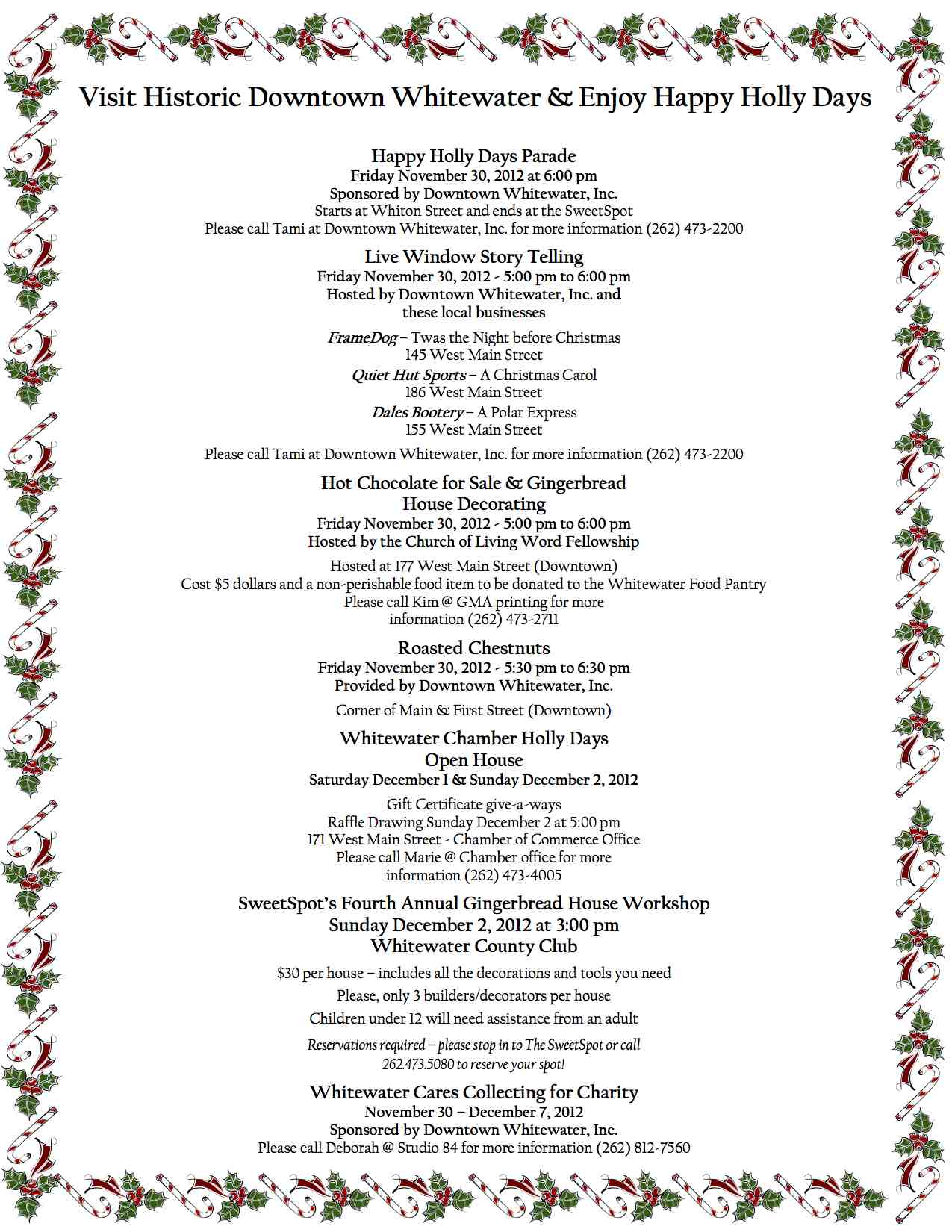
Whitewater’s Annual Holly Days Events
by JOHN ADAMS •
Tonight’s Whitewater’s annual Christmas parade, at 6 PM, beginning at Main & Whiton, traveling down Main, and turning on Whitewater Street toward the Cravath lakefront. Downtown Whitewater is the parade’s sponsor.
There’s a parade, of course, yet even more awaiting: live storytelling, hot chocolate for sale, gingerbread house decorating, roasted chestnuts, the Whitewater Chamber’s open house and raffle, a gingerbread house decorating workshop, and a collection for charity through 12.7. Clicking the list of activities below produces a full-size flyer.
Daily Bread
Daily Bread for 11.30.12
by JOHN ADAMS •
Good morning.
Whitewater’s week ends with mostly cloudy skies and a high of forty-eight.
Tonight at 6 PM, Whitewater will hold her annual Holly Days Christmas Parade, beginning at Main & Whiton, traveling down Main, and turning on Whitewater Street toward the Cravath lakefront.
On this day in 1954, a truly rare misfortune befalls Mrs. Elizabeth Hodges of Alabama:
The first modern instance of a meteorite striking a human being occurs at Sylacauga, Alabama, when a meteorite crashes through the roof of a house and into a living room, bounces off a radio, and strikes a woman on the hip. The victim, Mrs. Elizabeth Hodges, was sleeping on a couch at the time of impact. The space rock was a sulfide meteorite weighing 8.5 pounds and measuring seven inches in length. Mrs. Hodges was not permanently injured but suffered a nasty bruise along her hip and leg.
Ancient Chinese records tell of people being injured or killed by falling meteorites, but the Sylacauga meteorite was the first modern record of this type of human injury. In 1911, a dog in Egypt was killed by the Nakhla meteorite.
Google’s daily puzzle asks about a famous canine: “In 2005, Variety magazine issued its list of “100 Icons of the Century.” What was the name of only canine entry on the list?”
Public Meetings
Common Council
by JOHN ADAMS •
Business, City, Food, Liberty, Local Government
The Game of Thrones Food Trucks
by JOHN ADAMS •
The Institute of Justice, the nation’s leading libertarian public interest law firm, asks a question about Chicago that would be as fitting of other cities’ regulators:
Should the city of Chicago be in the business of protecting a few politically connected restaurateurs from competition?
That is the question to be answered by a major lawsuit filed Wednesday, November 14, 2012, in Cook County Circuit Court by the Institute for Justice (IJ)—a national public interest law firm—and three Chicago-area food truck entrepreneurs.
Cities nationwide are experiencing the benefits of food trucks. But for years Chicago had not embraced that movement. For example, Chicago did not allow cooking on food trucks and it told food truck entrepreneurs that they must stay more than 200 feet from brick-and-mortar restaurants. So in June 2012, when the city announced it would be revising its vending laws, food fans were excited.
The law that passed in July, however, continues to make it illegal for food trucks to operate within 200 feet of any fixed business that serves food. The fines for violating the 200-foot rule are up to $2,000—ten times higher than for parking in front of a fire hydrant. Further, the city is forcing food trucks to install GPS tracking devices that broadcast the trucks’ every move. According to the Chicago Tribune, “the ordinance doesn’t serve the needs of the lunch-seeking public. It benefits the brick-and-mortar eateries, whose owners don’t want the competition.”
Posted also at Daily Adams.
Daily Bread
Daily Bread for 11.29.12
by JOHN ADAMS •
Good morning.
Thursday brings a sunny day and a high of forty-eight to Whitewater.
This afternoon at 4:30 PM, Whitewater’s Community Development Authority meets.
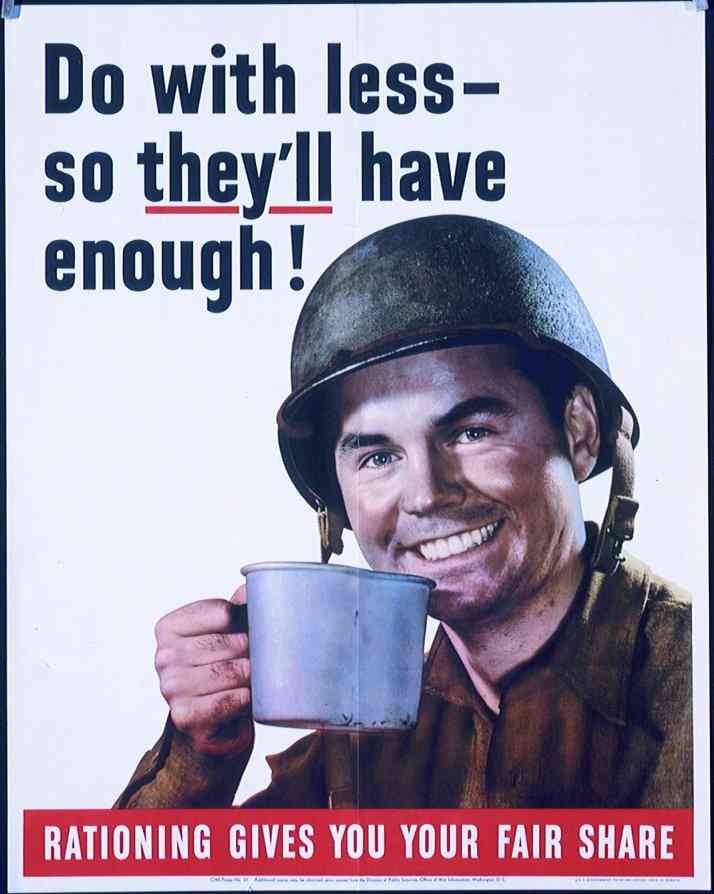
On this day in 1942 as World War II raged, rationing hit Americans in a specific way:
On this day in 1942, coffee joins the list of items rationed in the United States. Despite record coffee production in Latin American countries, the growing demand for the bean from both military and civilian sources, and the demands placed on shipping, which was needed for other purposes, required the limiting of its availability.
Scarcity or shortages were rarely the reason for rationing during the war. Rationing was generally employed for two reasons: (1) to guarantee a fair distribution of resources and foodstuffs to all citizens; and (2) to give priority to military use for certain raw materials, given the present emergency.
At first, limiting the use of certain products was voluntary. For example, President Roosevelt launched “scrap drives” to scare up throwaway rubber-old garden hoses, tires, bathing caps, etc.–in light of the Japanese capture of the Dutch East Indies, a source of rubber for the United States. Collections were then redeemed at gas stations for a penny a pound. Patriotism and the desire to aid the war effort were enough in the early days of the war.
But as U.S. shipping, including oil tankers, became increasingly vulnerable to German U-boat attacks, gas became the first resource to be rationed. Starting in May 1942, in 17 eastern states, car owners were restricted to three gallons of gas a week. By the end of the year, gas rationing extended to the rest of the country, requiring drivers to paste ration stamps onto the windshields of their cars. Butter was another item rationed, as supplies were reserved for military breakfasts. Along with coffee, the sugar and milk that went with it were also limited. All together, about one-third of all food commonly consumed by civilians was rationed at one time or another during the war. The black market, an underground source of rationed goods at prices higher than the ceilings set by the Office of Price Administration, was a supply source for those Americans with the disposable incomes needed to pay the inflated prices.
Some items came off the rationing list early; coffee was released as early as July 1943, but sugar was rationed until June 1947.
Google’s daily puzzle asks a history question: “Only one man was twice honored with the “Thanks of Congress” during the Civil War. To what rank was this individual promoted after the war?”
City, Government Spending, Local Government, Planning
Starting Backwards
by JOHN ADAMS •
Local governments find themselves, time and again, surprised when projects don’t go to plan. They’re often surprised when the politics of a project don’t go to plan.
That surprise may have a hundred causes, but I’d guess one is among the most common: that plans advance not on their merits, but through ill-considered deals between large organizations. Rather than look first at what someone’s proposing, some officials look to see if the proposal begins with another organization they support, need, or (sadly) fear.
It’s not the contents, but container, that determines how many officials line up behind an issue. If planners were always of the highest quality, and if they were infallible of judgment, then relying on past performance would be prudent. But, they’re not and not.
The impressionable, the over-awed, those who are mad for a place at table no matter how poor the fare, they’re the ones who will ignore contents for containers.
Did the idea come from another official? Back it, as we of government are all in this together.
Did the plan come from a big institution? Push it, as we can’t afford to question these (so-called) people of influence.
Support like this is almost a reflex, as mechanically predictable as the jerk of a leg following a tap by a rubber hammer.
Speak to this ilk in a certain way, and they’ll yield to just about anything. Obi Wan, while in Mos Eisley, used a jedi mind trick of this sort on storm troopers looking for two particular droids.
It’s better to start from the other direction, with a person and a well-conceived idea, the product of thought, study, experience, and later testing. One takes the plan – properly fleshed-out – and then presents it to others after all that work of thought, study, experience, and later testing.
One can quickly see the difference between these approaches. The institutional approach lines up supposedly big fish after big fish, but they’ll offer nothing but generalities or vague answers. That’s because they’re not asking for support on the merits, but expecting support from a sense of entitlement. That world’s nature: vague but demanding.
The individual approach begins with a well-formed idea, and it’s on the basis of specific and clear propositions that the planner seeks to convince others. This other world’s nature: thorough and persuasive.
A place without opportunity for review and scrutiny will favor the institutional but mediocre approach. A place of scrutiny and criticism will tend toward the more considered approach.
Starting backwards leaves a community finishing last.
Whitewater’s flowing down the long, but inexorable, course from the institutional to the individual approaches. Some people will be left behind, if they’ll not adjust, but many more will thrive.
Federal Government, Government Spending
Three Good Reasons to Abolish the Department of Homeland Security
by JOHN ADAMS •
As of November 25th, the department is ten years old. It’s also unnecessary, ineffective, and expensive. Not all its functions should (or ever would) go away, but the Homeland Security structure’s simply been a bad choice for America.
Also posted at Daily Adams.
Daily Bread
Daily Bread for 11.28.12
by JOHN ADAMS •
Good morning.
Midweek in Whitewater will be sunny with a high of thirty-six.
On this day in 1520, Magellan reached the Pacific:
After sailing through the dangerous straits below South America that now bear his name, Portuguese navigator Ferdinand Magellan enters the Pacific Ocean with three ships, becoming the first European explorer to reach the Pacific from the Atlantic.
On September 20, 1519, Magellan set sail from Spain in an effort to find a western sea route to the rich Spice Islands of Indonesia. In command of five ships and 270 men, Magellan sailed to West Africa and then to Brazil, where he searched the South American coast for a strait that would take him to the Pacific….
On October 21, he finally discovered the strait he had been seeking. The Strait of Magellan, as it became known, is located near the tip of South America, separating Tierra del Fuego and the continental mainland. Only three ships entered the passage; one had been wrecked and another deserted. It took 38 days to navigate the treacherous strait, and when ocean was sighted at the other end Magellan wept with joy. His fleet accomplished the westward crossing of the ocean in 99 days, crossing waters so strangely calm that the ocean was named “Pacific,” from the Latin word pacificus, meaning “tranquil.” By the end, the men were out of food and chewed the leather parts of their gear to keep themselves alive. On March 6, 1521, the expedition landed at the island of Guam.
Among his many accomplishments as an explorer and navigator, Magellan also had a penguin named in his honor:

Google’s daily puzzle asks about a river and a president’s son: “On what river is the graduate school attended by the eldest son of the 41st POTUS?”
Daily Bread
Daily Bread for 11.27.12
by JOHN ADAMS •
Good morning.
Tuesday brings mostly sunny skies and a high of thirty-three to our small city.
Whitewater’s Urban Forestry Commission meets this afternoon at 4:15 PM.
On this day in 1973, the United States Senate voted to confirm Gerald Ford as vice-president following the resignation of Spiro Agnew. One of the three voting against Ford was Sen. Gaylord Nelson of Wisconsin.
Wisconsin history includes two notable anniversaries, from the nineteenth and early twentieth centuries:
1882 – Ringling Brothers’ First Performance
On this date the Ringling brothers of Baraboo, Wisconsin performed their first show to an audience in Mazomanie. The brothers called their show the “Ringling Brothers Classic Comic Concert Company.” The show was barely a success, bringing in 59 paid admissions – just enough money to meet their hotel expenses. However, the brothers continued to tour and raised over $300 in three months, performing in Wisconsin, Iowa, and the Dakotas. After extensive investment and practice, the brothers launched their first circus in Baraboo on May 19, 1884. [Source: Badger Saints and Sinners by Fred L. Holmes, p.476-492]1903 – Green Bay Packer Johnny Blood Born
On this date Johnny Blood (aka John McNally) was born in New Richmond. Blood was an early NFL halfback playing for Green Bay from 1929 to 1933 and 1935 to 1936. He also played for the Milwaukee Badgers, Duluth Eskimos, Pottsville Maroons, and the Pittsburgh Pirates. An elusive runner and gifted pass receiver, he played a major role in the Packers’ drive to the first three championships in 1929, 1930 and 1931. Johnny Blood died on November 28, 1985, at the age of 82. Titletown Brewing Co. in Green Bay named their brew Johnny “Blood” Red Ale after the famed halfback. [Source: Packers.com]
Google’s daily puzzle asks about a writer’s friend: “A friend of J. R. R. Tolkien’s wrote a series of seven fantasy novels for children. By what nickname was this author known to his friends and family?”
Music
Monday Music: John Coltrane, Equinox
by JOHN ADAMS •
Public Meetings
Community Development Authority
by JOHN ADAMS •
Daily Bread
Daily Bread for 11.26.12
by JOHN ADAMS •
Good morning.
Monday in Whitewater will be partly sunny with a high of twenty nine.
On 11.26.1941, a Japanese naval force left for its mission against Pearl Harbor:
On this day in 1941, Adm. Chuichi Nagumo leads the Japanese First Air Fleet, an aircraft carrier strike force, toward Pearl Harbor, with the understanding that should “negotiations with the United States reach a successful conclusion, the task force will immediately put about and return to the homeland.”
….Nagumo had no experience with naval aviation, having never commanded a fleet of aircraft carriers in his life. This role was a reward for a lifetime of faithful service. Nagumo, while a man of action, did not like taking unnecessary risks—which he considered an attack on the American naval base at Pearl Harbor to be. But Chief of Staff Rear Adm. Isoruku Yamamoto thought differently; while also opposing war with the United States, he believed the only hope for a Japanese victory was a swift surprise attack, via carrier warfare, against the U.S. fleet. And as far as the Roosevelt War Department was concerned, if war was inevitable, it desired “that Japan commit the first overt act.”
On this day in 1838, a milestone in Wisconsin history:
1838 – Legislature Assembled in Madison for the First Time
On this date, after moving from the temporary capital in Burlington, Iowa, theWisconsin Territorial Legislature assembled in Madison for the first time. Two years earlier, when the territorial legislature had met for the first time in Belmont, many cities were mentioned as possibilities for the permanent capital — Cassville, Fond du Lac, Milwaukee, Platteville, Mineral Point, Racine, Belmont, Koshkonong, Wisconsinapolis, Peru, and Wisconsin City. Madison won the vote, and funds were authorized to erect a suitable building in which lawmakers would conduct the people’s business. Progress went so slowly, however, that some lawmakers wanted to relocate the seat of government to Milwaukee, where they also thought they would find better accommodations than in the wilds of Dane Co. When the legislature finally met in Madison in November 1838 there was only an outside shell to the new Capitol. The interior was not completed until 1845, more than six years after it was supposed to be finished. On November 26, 1838, Governor Henry Dodge delivered his first speech in the new seat of government. [Source: Wiskonsan Enquirer, Nov. 24 and Dec. 8, 1838]
For Google’s daily puzzle, a combination of sports and film: “Which baseball great has been played in films by both D.B. Sweeney and Ray Liotta?”