
Not far from the city is an artesian well, first dug in 1895. It flows to this day.
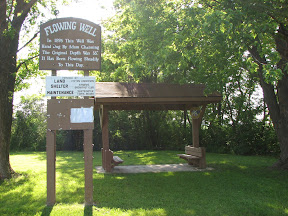

Not far from the city is an artesian well, first dug in 1895. It flows to this day.
Larry Meyer, the retired Whitewater police investigator at the center of the controversial Star Packaging raid, was involved, also, in an investigation of a local businessman who’s now suing Meyer for harassment. Both of the businesses had significant numbers of Mexican workers.
The shortest distance between two points is a straight line:
From The Week, January 24, 2007:
“A retired Whitewater police investigator destroyed evidence seized when executing a search warrant at a city business in 2005 and did not follow the advice of a Walworth County assistant district attorney, according to court documents. Larry Meyer admitted taking items from Stephen D. Cvicker’s business that were outside the scope of a search warrant and then destroyed them, according to a declaration by Assistant District Attorney Dennis Krueger….Krueger said he told Meyer to file an amended list with the clerk of courts to document everything taken and told him to return to Cvicker the seized items that were not evidence of crimes, according to Krueger’s declaration. Later that day, Krueger and Meyer talked again. “To my surprise and disbelief, (Meyer) advised me that I did not need to worry about this anymore because he destroyed the items taken that were outside the scope of the warrant,” Krueger wrote. The assistant district attorney was never allowed to examine what the items were.”
From the Janesville Gazette, June 7, 2007:
“Assistant Walworth County District Attorney Dennis Krueger submitted his resignation May 31. His last day is June 22….In March, Krueger went on “personal leave,” but his voicemail carried a message saying his extension was no longer in use. Neither he, nor his boss, District Attorney Phil Koss, will comment on the reason for the absence.
About two months before Krueger’s leave, he had filed an affidavit in a federal civil case supporting a man’s harassment case against retired Whitewater investigator Larry Meyer. Koss said the absence had nothing to do with Krueger’s involvement in the case.”
The Star Packaging raid offers insight into how Whitewater Police Chief Jim Coan presents his police force to the community, and as a consequence, the message he sends to his team. No action of Coan’s force has been as justly controversial as the Star Packaging raid, and at each stage his statements underlie an unwillingness to admit mistakes.
I have been asked why Coan is an arch-apologist for just about any police conduct, when so many who listen to him find him unconvincing and overly-defensive of the Whitewater police. The answer is that he’s not speaking to persuade the whole town, or even a large part of it; his words are reassurance for a small, mostly town-bred, elite. They want – and expect – that he will never yield or admit fault on any significant matter. Second, his simple, ceaseless defense of the Whitewater force has the consequence of dissuading common, thoughtful residents from the hope of correcting the problems within the force, and of making it truly professional. Finally, Coan may believe – perhaps correctly, too – that if he repeats the same contentions long enough, others will believe them.
There are two recorded sources of Coan’s comments on Star Packaging: published news accounts, and Coan’s editorial in the Whitewater Police Department Newsletter, Volume 48. (For now, I will only offer remarks on Coan’s ‘Police-Community Relations’ editorial in volume 48. It’s the medium most favorable to Coan, giving him every benefit of the doubt: it’s his newsletter, and he can write freely. If there’s a foolish statement in the WPD Newsletter, Coan can’t contend a reporter tricked or misquoted him, for example. The newsletter is available at the City of Whitewater website.)
I will list Coan’s remarks, and thereafter my comments.
Coan from WPD Newsletter, Volume 48, on Press Criticism:
I believe that our Department has been unfairly criticized and much maligned since the arrests made at Star Packaging last August. Accusations of racial profiling, bigotry, and bias-based enforcement persist in quotes provided to the media by certain people from both within and outside of our local Hispanic community.
Adams replies:
This is Coan’s opening paragraph from his editorial on “Police-Community Relations,” and it reveals much — much that’s disturbing — about Coan’s role as police chief. First, it’s a self-pitying opening. The raid caused tension in the Hispanic community in Whitewater, where families were removed from the community, but Coan’s first thoughts are about how his officers have been unfairly criticized and much maligned. Rather than open from a position of strength and reconciliation, Coan opens from one of weakness and accusation; he complains about how mere words have hurt him, and his officers. If they’re brave, and noble, and warriors, or whatever else he’s written about his force, then why would a few stories in the Week or Janesville Gazette matter?
Second, why smear the Hispanic community by writing that “certain people from both within and outside of our local Hispanic community?” Why not just write “local community?” Here’s one reasonable interpretation: Coan thinks that he wouldn’t have a problem if Hispanics and their defenders would just shut up. Coan doesn’t accept responsibility for mishandling any aspect of the raid; it’s all the fault of Hispanics and their defenders, here and beyond, who are talking and supposedly lying to the press.
I am neither Hispanic nor a defender of the Hispanic community, however Coan defines it. I am citizen, resident, and property owner, with a family ancestry on this continent stretching far back. I object to Coan’s view, but not because I am part of the Hispanic community; I object because his ceaseless apologia destroys the possibility of accountability. If this were baseball, Coan wouldn’t just be players’ manager, he’d be a weak players’ manager.
Coan from WPD Newsletter, Volume 48, on Deportation:
As you know, it was the Immigration and Customs Enforcement Agency that took into custody the illegal and/or undocumented workers at Star Packaging. Some of those taken into custody were deported, some incarcerated on separate charges, and some are awaiting hearings. All were provided due process and protection under the law.
Adams replies:
It’s hard to overstate how disgraceful and weak-kneed these words are. Coan’s now-retired detective, Larry Meyer, likely called ICE. Coan wants to absolve his force of responsibility by saying that although his force called ICE, they are not responsible for the consequences of the call. These are the words of a follower, not a leader. Coan lags behind his men, calling out to them the soothing words they want to hear. Here’s the truth, from ICE: “We went to assist the Whitewater police,” said Gail Montenegro a spokeswoman for Immigration and Customs Enforcement in Chicago. “They asked us to assist in anticipation of encountering illegal aliens, and we did that.” (See, Milwaukee Journal Sentinel, May 1, 2007, page B1.)
By the way, even months after the raid, Coan continues to heap praise on Larry Meyer, as May 18th’s Police Day ceremony demonstrated.
Coan from WPD Newsletter, Volume 48, on Extreme Confidence:
I am extremely confident that the members of our Department do not engage in racial profiling, bigotry, or bias-based enforcement. We have instituted too many checks and balances for that to happen anyway. More importantly, I believe in the integrity of our officers. We are a highly professional law enforcement agency that is comprised of very compassionate, exceedingly dedicated, well trained, and highly ethical men and women.
Adams replies:
Coan’s not just confident; he’s extremely confident. His officers aren’t just dedicated; they’re exceedingly dedicated. He’s so confident, that he knows, in advance, that no one in his force could ever commit “racial profiling, bigotry, or bias-based enforcement.” It’s not just unlikely to Coan; it’s his extreme confidence that it does not happen, and cannot happen. That’s not a police force; it’s a group of saints he must be describing. (If Coan says they’re like saints, I’ll respond that he falsely sanctifies worldly things and people.)
Notice, though, how Coan’s rush to defend his men is illogical. He tells us that he’s extremely confident that bias does not happen, but simultaneously declares that he has checks and balances in place to prevent it. No doubt, Coan would declare that the additional checks and balances are so that he can be extremely, extremely confident. Checks and balances, however, may not stop a racist action; they might prevent it from its full impact. Coan conflates two situations: where an officer commits a racist act like bias-based enforcement (he says no, not possible) and where checks and balances prevent the consequences of bias-based racial harm (which only applies when their is racism, but the checks, etc. prevent its impact on a person or community).
No one except the most abject apologist would believe that there cannot be bias-based enforcement in Whitewater, or that checks and balances could prevent it at a traffic stop late at night. Who would act as check and balance against a police officer at 2 a.m., in an isolated part of town? No one; it’s just a delusion to believe that it can’t happen.
This reveals Coan’s clear failure a manager, but great success as a cheerleader. Once a manager excludes the possibility that misconduct can happen, he sends the signal that he has no expectation of holding associates accountable for what he has already declared is an impossibility.
Coan from WPD Newsletter, Volume 48, on the ACLU:
Although the ACLU has made inquiries into the nature of the Star Packaging investigation, no charges have been brought. Nor has anyone come forward with specific complaints or examples of profiling or bias enforcement by members of our Department.
Adams replies:
After Coan’s blanket defense of his department — having already declared that there cannot be problems — why would anyone come forward? What would be the point; Coan’s already made up his mind, for goodness’ sake. He’s like the early 1960s sheriff of a small southern town — very much like, actually — declaring that since no black residents have complained about police misconduct, there must not be any.
As for the ACLU, well, that’s merely Coan battening on the ignorance of his officers. It’s possible to be a critic of Coan’s weak, self-congratulatory police force, and a critic of the ACLU, too. I am a perfect example. By Coan’s lights, I should probably be a supporter of him, and his force: citizen, resident, property owner, white. (By the way, would someone tell Coan that ‘Caucasian’ is an anachronism like ‘Negro?’) I could not, however, align myself with empty boosterism, weak leadership, and seemingly endless rationalizations, from this chief of police.
The toughest critics of Coan’s force that I have ever met in town are white, and moderate or conservative. The Star Packaging raid was a mess for the city, and Coan will, and can, do nothing to reform his praise-needy force. Coan’s problem doesn’t lie with supposedly out-spoken Hispanics, or the ACLU. It’s that Coan is a Mynah bird of excuses, rationalizations, and self-praise, of himself, and the Whitewater police.
On May 1st, the Milwaukee Journal Sentinel ran a thoughtful, informative story on the Star Packaging raid. Georgia Pabst wrote the story, running on page B1, of the paper.
Here are some nuggets from that story, that may not have been printed in local papers, with my comments following:
1. From City Councilman Maxwell Taylor, aged 20:
I was shocked because I didn’t see a bust of this proportion coming,” said Common Council member Maxwell Taylor, 20, a student at the University of Wisconsin-Whitewater. “It was real unfortunate because some of my Hispanic constituents were almost afraid to gather because of fears about what the police would do about immigration.”
But Taylor believes the police did the right thing.
“If people are in this country illegally, then they have to go back,” he said. “I think this sends a message to other business owners in town.”
John Adams:
If Taylor thought that anyone in the Whitewater Police Department was going to tell a twenty-year old anything about the raid, he’s kidding himself. A seat on Council means little from their point of view. By the way, if your constituents are afraid to come outside and gather to meet you, then maybe it has something to do with your opinion that some Hispanics “have to go back.” They may not be citizens, and they may not speak English well, but for goodness’ sake is it not obvious that they can put two and two together better than Taylor?
2. From Marilyn Kienbaum, City Council President, aged 80:
Council member Marilyn Kenbaum [sic], 80, worried about the fallout from the raid.
“I didn’t think it was handled right,” she said. “Some (of the workers) had children. It was a real hardship.”
She said the food pantry she runs got busy after the raid because “people who had been working all of a sudden weren’t.”
John Adams:
Sixty years produces a greater compassion from Kienbaum than Taylor. She’s right, of course — they had families and children. Kienbaum thinks about the full consequences; Taylor’s so young all he understands is a simple, crudely applied rule. I’ll wait sixty years, and see if he thinks it’s all that simple when he’s eighty.
3. Larry Meyer and the Whitewater Police Started this Action:
“We went to assist the Whitewater police,” said Gail Montenegro a spokeswoman for Immigration and Customs Enforcement in Chicago. “They asked us to assist in anticipation of encountering illegal aliens, and we did that.”
John Adams:
If someone in the Whitewater Police Department tries to tell you that it was not their operation, that it was basically an immigration matter, remind him or her that Immigration and Customs Enforcement disputes the WPD story.
4. Whitewater Police Wanted Our Social Security Numbers?
Police also agreed to stop asking motorists pulled over on traffic violations for Social Security numbers. Although it was meant as a way for the city to collect unpaid fines, it was viewed by Latinos as immigration related, he [Police Chief Coan] said.
John Adams:
They’re not serious, are they? We Wisconsinites have always prided ourselves on respecting the privacy of others. Many Wisconsinites will balk at giving a phone number or Social Security Number on a contract of sale! Why would anyone ever think that we’d give it easily at a traffic stop? Have you ever known anyone who was asked for a Social Security Number at a traffic stop? I’ll write separately on the Identity Theft Excuse in another post. For now, a few questions about SSNs at traffic stops: (1) how long were the Whitewater Police asking for these numbers, (2) how many people at traffic stops did they ask, (3) how many of those people they asked in Whitewater were white? If you doubt that Social Security Numbers likely were requested disproportionately from Hispanics, then you doubt the presence of the nose on your face.
Just beyond our skate park is a bike path, on which one finds cyclists, joggers, power-walkers, and residents walking dogs. Here’s the view, standing just beyond the skate park, and looking north:

Charming.
UPDATE, 6-4-07
I received a reply from the Community Development Authority to my open letter, and the reply related that the CDA website is in transition. There will always be some positive achievements from the past that should be continued, but other perspectives and legacies should be relegated only to distant memory.
Rome was not built in a day, I wish the CDA much success in its efforts to promote development and progress in Whitewater, and look forward to the new website.
To the City Manager of Whitewater, Wisconsin
Good evening, Mr. Brunner
I am a long-standing resident of Whitewater, Wisconsin, having lived in the city for more years than I can easily remember. I am also a blogger, and publisher of the FREEWHITEWATER.COM website, a blog dedicated to reform in our beautiful, but troubled, city. I write under the pseudonym JOHN ADAMS; anonymous commentary on matters in the public interest is a part of the American political tradition, and my very small efforts follow in the footsteps of larger-than-life Americans, who acted to improve their communities, and benefit their neighbors.
Our city of fourteen thousand seeks growth, progress, and civic improvement. It is easier said than done, however. We are beset by attitudes and opinions that recall another, less pleasant era. A description of my fair-minded purposes and concerns about our city may be found elsewhere on my website. For tonight, I wanted to write to you about a matter that I wrote about previously on FREEWHITEWATER.COM, and about which I emailed the Community Development Authority (with no reply being received).
Here’s what I wrote, a few days ago:
I believe strongly in growth for Whitewater, and in the the importance of attracting new businesses to our city.
The Whitewater Community Development Authority is part of that effort. Here is how the Community Development authority describes itself, from its website:
The Whitewater CDA is a Housing and Community Development Authority formed in 1983 by the City of Whitewater under Wisconsin State Statute 66.1335. It has a seven-member board appointed by the Common Council, and two full-time employees. Although technically a part of the city government, the CDA operates with a great deal of autonomy. Major decisions by the CDA Board must be ratified by the Common Council.
To attract businesses to our city, it makes sense to post information about Whitewater on a website, so that prospective business owners can learn more about our community. So far, so good.
What’s more than a bit troubling is how they describe our potential workforce, on the Community Development page entitled, “Work Force.” Here’s what it says, as of this evening, May 31st:

Our workforce is listed as “white, non-minority 95%.”
I have a few quick questions:
1. Why would the Community Development Authority describe our workforce as “white, non-minority” when the law itself forbids hiring based on racial preference?
2. Who are “non-minorities?” Would Jews, or Mormons, for example, be considered minorities?
3. If the goal were diversity in hiring, why not directly mention by group those who are “non-white, minority” rather than emphasize whites, and leave others out by express exclusion?
4. Who actually wrote this description of our workforce?
5. From the point of view of the free market, why would race matter? Education, or experience in previous jobs, of course. But race?
I can find no similar statistics (‘white, non-minority’) listed for neighboring Fort Atkinson’s website, and that’s unsurprising: the Whitewater Community Development description of our workforce speaks for itself, and its authors, and none too well.
That’s what I wrote then, and I find our Community Development Authority’s description of our workforce no less puzzling now. You must know, as I do, that the description appears to hold out the idea of a “white, non-minority” workforce as a positive thing. No dissembling could contest the point: the point of each characteristic of the workforce listed is meant to be appealing to incoming businesses. (The defense that it’s just a straightforward description is false and disingenuous — a childlike excuse, nothing more.)
When the Community Development Authority posted these words on its website, did no one bother to challenge what they assuredly mean? Will no one change them now? If not, then any reasonable person will conclude that we are a community that considers being white, and a ‘non-minority’ a better, more desirable trait. I do not share that belief, and our deepest American principles do not, either.
Now I am a citizen, resident, and property owner, with an ancestry that goes far back on this continent. If race, ethnicity, ancestry, and background compelled one’s destiny, then I would have remained — however wrongly — aligned with this town’s small, insular elite. Yet, now I find, one cannot be wholly committed to the values of this country, and do one’s best for this beautiful city, and not call out for reform. It is far better to write what I write, and be where I am, than wrongly to believe that one race is preferable for businesses over another.
Here’s your chance to make a small difference, quite easily. You may explain convincingly the Community Development Authority’s Work Force webpage, and justify it, and then I’ll be proved wrong. Alternatively, and far more likely, you may act to persuade others to change an odious description. You will not have changed the world, but you’ll have started to change a few minds about the difference a description makes.
Best regards,
JOHN ADAMS
Whitewater, Wisconsin is a place of natural and artificial beauty — what we have inherited from nature, and what we have made. One of our recent additions, just beyond our Old Armory, along the Whitewater Creek, is a skate park.
It’s popular; so much so, that it was part of a recent film on our cable access channel about skaters from across the country coming to visit our skate park, and others nearby.
I happily offer some photos of the park. (I took these pictures early in the morning, before the skaters arrived.)


The skate park was a great idea, and it shows that we can can create and maintain useful, contemporary public parks for the community.
In most cities and towns, a few organizations and institutions play the role of community watchdog. Whitewater has no one who plays that role, as the Whitewater Register — our hometown paper — doesn’t behave like a community watchdog.
In other towns nearby, the newspapers are willing to ask questions of elected and appointed officials. Consider the recent stories in the Janesville Gazette about whether a hockey coach’s contract should be renewed (after allegations that he was excessively harsh toward school-age players). Asking questions like that is merely one of the roles that the Gazette plays, and there are few people in Janesville who are surprised, and surely many who are grateful, that there’s a daily outlet that greets decisions with healthy scrutiny.
We have nothing like that in Whitewater, and the idea of it would be offensive, shocking, and almost unthinkable here. The longer we have gone without it, the more arrogant our municipal workers have become, and the more thin-skinned, too. In Whitewater, even ordinary questions are greeted as presumptuous, as lacking in civic-mindedness.
On the contrary, many healthy communities of our size, and even smaller (like Fort Atkinson), are not so hypersensitive to criticism. A community like ours becomes stultifying quickly, and will not accept reform-minded suggestions. The most typical –and vulgar — reaction is to claim that “if you don’t like it here, why don’t you leave?” Here’s what that really means: “To be here, you have to agree with me, and think like me, and be like me.”
We have no reason to accept a definition of civic-mindedness that implies there is only one right way to think or act, and that any criticism of municipal actions is wrong. Whitewater should be remembered as someplace more than a small town where the First Amendment goes to die, or play dead.
I, and others, will not leave: we will work to offer honest suggestions for a better, FREE WHITEWATER.
I believe strongly in growth for Whitewater, and in the the importance of attracting new businesses to our city.
The Whitewater Community Development Authority is part of that effort. Here is how the Community Development authority describes itself, from its website:
The Whitewater CDA is a Housing and Community Development Authority formed in 1983 by the City of Whitewater under Wisconsin State Statute 66.1335. It has a seven-member board appointed by the Common Council, and two full-time employees. Although technically a part of the city government, the CDA operates with a great deal of autonomy. Major decisions by the CDA Board must be ratified by the Common Council.
To attract businesses to our city, it makes sense to post information about Whitewater on a website, so that prospective business owners can learn more about our community. So far, so good.
What’s more than a bit troubling is how they describe our potential workforce, on the Community Development page entitled, “Work Force.” Here’s what it says, as of this evening, May 31st:
Our workforce is listed as “white, non-minority 95%.”
I have a few quick questions:
1. Why would the Community Development Authority describe our workforce as “white, non-minority” when the law itself forbids hiring based on racial preference?
2. Who are “non-minorities?” Would Jews, or Mormons, for example, be considered minorities?
3. If the goal were diversity in hiring, why not directly mention by group those who are “non-white, minority” rather than emphasize whites, and leave others out by express exclusion?
4. Who actually wrote this description of our workforce?
5. From the point of view of the free market, why would race matter? Education, or experience in previous jobs, of course. But race?
I can find no similar statistics (‘white, non-minority’) listed for neighboring Fort Atkinson’s website, and that’s unsurprising: the Whitewater Community Development description of our workforce speaks for itself, and its authors, and none too well.
Mike Heine of The Week has a good summary of developments in the Star Packaging raid, where the Whitewater police and other agencies, acted against Mexican workers, and the American owner of the business, leading to criminal charges against both.
Here’s Heine’s summary of the raid:
Whitewater businessman Allen L. Petrie, owner of Star Packaging, is charged with six counts of conspiracy to commit identity theft, a felony. He is accused of employing Mexican immigrants who allegedly used stolen or made up identities. An Aug. 8 Immigration and Customs Enforcement raid at the company led to the arrest of 25 suspected undocumented immigrants.
Heine quotes Assistant District Attorney Diane Donohoo, from an earlier interview, on the legal basis for charges against Petrie:
“Employers cannot knowingly employ people, continue to have them on staff or continue to facilitate their pay when they know that that person is using someone else’s Social Security number,” Donohoo said in an earlier interview.
Defense Attorney Stephen Glynn notes that the use of supposed identity theft charges in this case is unusual:
“This is one of these situations in which the state is using a statute that, I think, probably wasn’t too much to be used in this fashion,” Glynn said. “The typical use of identity theft (law) is somebody getting a copy of someone else’s charge card and securing property or goods or services on the bases of using it. That’s what most people have in mind. They don’t have in mind someone getting a job that the other’s aren’t seeking.”
There is one powerful consequence of plowing ahead with identity theft charges: it allows the Whitewater police and their supporters to use — and misuse — fear of identity theft to shield them from accusations that the raid targeted Mexicans. The raid has generated bad press, much to the surprise of the mostly town-bred elite. Repeating — over and over — that the raid was about identity theft distracts many people from thinking about the raid more seriously.
The Whitewater Register proudly proclaims that it’s in its 151st year, implying a place in our history, and entitlement to our respect, its present quality could never justify. Under editor Carrie Dampier, the Register is a fawning, uncritical paper. There’s no solid journalism in the Register, just laughable cheerleading, and ignorance of the challenges that face our community.
The May 24th, below-the-fold story on Police Day is an example — one of many — of cheerleading that descends to self-parody. Consider Dampier’s title, referring to the Whitewater Police Department, “What would we do without them?” No solid newspaper, of whatever size, and whatever politics, would run a fawning headline like that. Even the strongest, sensible editorial supporters of a police department would shy away from a headline that slips from praise to hero-worship.
No one questions that Whitewater needs a police force, but no rational person believes that the Whitewater police are the only thing holding the city together. If conditions are so bad that only the Whitewater police stand between us and ruin, then conditions are far worse than I had imagined. (And, if life is that precarious, then our police force has significantly exaggerated their own crime-fighting, and have concealed from us the threats that create our supposed dependency upon them.)
We are a small, common town, hardly beset by crime, and if our police force changed size by a few officers, we would all go on just as well. If a few officers were to go on vacation, or leave permanently, few of our fellow citizens — beyond the Municipal Building — would notice the difference. It’s false, but no doubt self-satisfying, for the occupants of our municipal offices to believe that this small town depends on them. On the contrary, the workers in our several municipal departments depend on the fourteen thousand residents of our city.
The body of the Register story is worse even than the headline. Dampier begins, as many high school term papers do, with an elegiac quotation. She quotes Ambrose Redman on courage: “Courage is not the absence of fear…but rather the judgment that something else is more important than fear.” I have no idea if Dampier read this in the original, or found it from a book of quotations. It scarcely matters, because she then tells us that “Redman may not have been thinking of police officers when he wrote that…” but in her mind it “certainly epitomizes their calling.” If the police are not Redman’s intended reference, why not find an apt quotation?
(For all the praise she aims to muster, her theology’s bad: police officers have a vocation, but they do not have a calling. It’s fine to respect their work, but it is not a calling.)
Dampier goes on to note that “the WPD lost two exceptional officers to retirement in the last year in Dave Haberman and Larry Meyer, both of whom were honored last Friday.” Leaving aside Haberman, how exactly was Meyer exceptional? Dampier might have written about published reports in the Janesville Gazette on accusations of destroying evidence, or in The Week on attorneys’ claims that Meyer and the WPD were targeting Mexican immigrants. The charges are noteworthy. If (as I suppose) Dampier rejects them, why not at least mention and rebut them?
What will we do without Meyer? Whitewater will have a better reputation and police force. That better day would start sooner if the Register started publishing like a worthy newspaper rather than like a press spokesman for a city department.
Whitewater has its own paper, the seventy-five-cents-a-copy Whitewater Register. Although it’s merely one part of the Southern Lakes Newspapers chain, the Register still lays claim to being Whitewater’s home paper. The Register‘s banner proudly proclaims that the paper is in its 151st year, proof that a century and a half of effort sometimes comes to nothing.
Consider the recent, May 24th edition. Although the newspaper comes in two principal section (plus numerous inserts), only the first section, pages 1 through 16, has news about Whitewater. The second section, entitled “Marketplace,” does not even purport to focus on Whitewater; the section’s subheading is “Southern Lakes Newspapers,” and most of the ads are for other communities in Walworth County.
If we return to the principal section, however, we’ll find that the lead story is hardly news unique to Whitewater; it’s a dull, generic story about cicadas, with an accompanying story on cicada recipes. The story could run in any small town paper in the Southern Lakes chain, offering nothing of unique interest to Whitewater. (Sleep easy: there’s nothing reported to suggest that the cicadas in Whitewater will be louder, or more prevalent, than in nearby towns.)
Carrie Dampier has two other front-page stories, a right column story on roadwork along our east side, and — below the fold — a story on Police Day in Whitewater. (I’ll post about Dampier’s Police Day story tomorrow, because at least it is unique; it’s a laughably bad, poorly written story.) The second part of main paper includes sports stories from Whitewater.
If you want news — school, city, town, community events, local sports — the Whitewater Banner is a much better choice. I believe that Jim Stewart’s Banner only took off last fall, but already it offers more Whitewater information — delivered more quickly — than the 151 year-old Whitewater Register. The Register‘s website is stale, and not worth a visit. I wouldn’t expect the Whitewater Banner to report any critical, detailed stories on the challenges in Whitewater, but then again, one doesn’t find that in the Register, anyway. Stewart delivers more information on the city, more quickly, than the Register, by leaps and bounds.
Merchants in our city understand how ineffectual the Register has become, as they’re unwilling to waste their money advertising in its principal pages. Of the more than sixty principal ads in the main section of the May 24th Register, a majority are for businesses located outside Whitewater. Many of our local businesses shun the Register, whose pages are crowded with advertisements for businesses in Fort Atkinson, Eagle, Palmyra, and Burlington, among other towns. Our local businesses are free to advertise in the Register; if they choose not to do so, it’s because they recognize that their advertising budgets are better spent elsewhere. If the Register were a better, more compelling paper for Whitewater, then it would attract more local advertising. The failure is not of our local businesses, but is the failure of the self-professed local paper that’s increasingly irrelevant to them.
Tomorrow: An example of how the Whitewater Register is so uncritically fawning that it fails our community.
 |
| From Free Whitewater |
We are a small town, without a good newspaper published within the city limits. There are some fine papers that provide limited coverage of Whitewater, but the city lacks a solid, responsible paper of its own. The Whitewater Register — part of a newspaper consortium — is sickeningly uncritical of real problems in the city, and as poorly written as a high school newspaper. I’ll devote another post to a discussion of the Register, but for now, let me describe the remaining papers that cover Whitewater.
The Daily Jefferson County Union. As its name suggests, it’s a daily paper. It’s not far away, and not bad. Still, the Daily Union has Fort Atkinson, Jefferson, and other cities to cover, so Whitewater will never dominate its pages. It offers a fair amount of stories about Whitewater, though, and it’s a paper with a moderately developed website.
The Janesville Gazette. The Gazette is farther away, but also bigger, than the Daily Union. One of the few newspapers willing to publish honestly about some of the problems in Whitewater, most recently the disgraceful matter of our municipal judge. It says much about how cautious — almost cowardly — press coverage of Whitewater is that the Gazette was nearly alone in publishing public information about criminal charges against Steve Spear. The Gazette also has a good website (free registration required), but as with the Daily Union, Whitewater will never be the paper’s main focus.
The Week. The Week focuses on Walworth County, and not merely Whitewater, but fortunately it’s a paper, and accompanying website, willing to report on a story without boosterism. Coverage of the Whitewater Police Department in the Star Packaging raid was even-handed, with the Week at least willing to quote opinions critical of police conduct.
The Whitewater Banner. Jim Stewart’s online ‘news and sports’ site. It’s not a site for journalism — I would be surprised to find any critical reporting — but it’s probably the best listing of happenings in town. Stewart’s not a journalist, and his site is as much community calendar as anything. It’s an online print publication, but it would be unfair and misguided to hold it to the same standard as as an established newspaper. For its role as a community calendar and bulletin board, it’s better than the websites of the Daily Union, Gazette, or Week. (Again, I will address the Register later, but I will note quickly that the Whitewater Register‘s website is stale, and amateurish.)