Sunday in Whitewater will be sunny with a high of 32. Sunrise is 6:30 and sunset is 5:44 for 11 hours 14 minutes of daytime. The moon is a waxing gibbous with 95.7 percent of its visible disk illuminated.
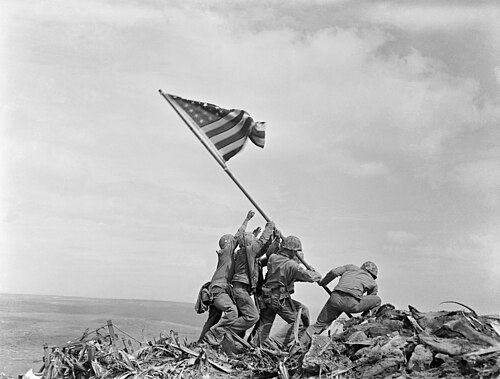
On this day in 1953, Soviet Premier Joseph Stalin suffers a stroke and collapses; he dies four days later.
Is it so hard, in these intense times, to call something true or false? More bluntly: is a backlash to the truth so worrisome that one dare not say true or false, yes or no? Americans have had difficult times before now,1 and yet during those times we did not recoil from candid assessments. Indeed, candid assessments allowed us to overcome those difficult times.2
Over at Wisconsin Watch, in partnership with the Journal Sentinel, there’s a new effort to assess plainly whether a statement is true in the way that matters (whether a claim corresponds, bluntly stated, to reality, to actual conditions in the world). That one sometimes cannot determine the truth or falsity of a proposition does not mean that one never can:
Wisconsin Watch has a new partner in the fight for facts.
Ahead of another pivotal election year, the Milwaukee Journal Sentinel and Wisconsin Watch are teaming up to produce more Fact Briefs, 150-word answers to yes/no questions based on claims made in the infosphere.
Wisconsin Watch has partnered with Gigafact since 2022 to produce more than 600 bite-sized fact checks. We’re part of a network of 18 nonprofit newsrooms across the country working to equip the public with accurate information to inform civic discussion.
The Journal Sentinel, part of the USA Today Network and the largest newsroom in Wisconsin, was an early adopter of PolitiFact, the Pulitzer Prize-winning fact-checking nonprofit founded in 2007.
As Journal Sentinel Editor Greg Borowski writes in a column today at jsonline.com, the switch to Fact Briefs will appeal to readers seeking accurate information quickly and with a clearer true-or-false format, rather than PolitiFact’s six-tiered “score card” for assessing whether a claimant is telling the truth. Fact Briefs focus less on the claimant, and more on the claim itself.
Quite welcome — one can often apply reason to evidence and make a firm conclusion. If it should be too hard in ordinary matters, then the first place to look is inadequate evidence gathering or deficient reasoning. It’s not the case, and never has been, that arriving at the truth is so hard that no one knows nothin’. Americans did not build a world-historical civilization across a continent because everything everywhere was unknowable.
NASA’s Perseverance rover can now precisely determine its own location on Mars without waiting for human help from Earth. This is possible thanks to a new technology called Mars Global Localization.
This technology rapidly compares panoramic images from the rover’s navigation cameras with onboard orbital terrain maps. It’s done with an algorithm that runs on the rover’s Helicopter Base Station processor, which was originally used to communicate with the Ingenuity Mars Helicopter. In a few minutes, the algorithm can pinpoint Perseverance’s position to within about 10 inches (25 centimeters). The technology will help the rover drive farther autonomously and keep exploring. Mars Global Localization was first used successfully for regular mission operations on Feb. 2, 2026, and the team expects related reliability techniques to inform future missions, including exploration on the Moon.
Saturday in Whitewater will be cloudy with a high of 39. Sunrise is 6:32 and sunset is 5:43 for 11 hours 11 minutes of daytime. The moon is a waxing gibbous with 90.5 percent of its visible disk illuminated.
On this day in 1844, a gun explodes on board the steam warship USS Princeton during a pleasure cruise down the Potomac River, killing six, including Secretary of State Abel Upshur. President John Tyler, who is also on board, is not injured from the blast.
Ten Wisconsin-based companies — including Kohl’s, Milwaukee Tool and Ashley Furniture — had sued the Trump administration over its tariff policy before the U.S. Supreme Court struck it down, according to court documents.
They are seeking refunds for the tariff duties. Some also accuse the import taxes of violating the U.S. Constitution.
President Donald Trump has imposed sweeping tariffs on international trade since his return to office, using the International Emergency Economic Powers Act to justify the move. But, the 10 companies suing his administration claim he had no jurisdiction to do so. In December, some Wisconsin companies started fighting the policy in court, hoping the litigation could help their chances of receiving compensation for paid tariffs.
[…]
The Wisconsin companies suing range in size, and include well known names like Kohl’s, Milwaukee Tool, Ashley Furniture and Duluth Holdings. Others include the HellermannTyton Corporation, Waukesha Bearings Corporation, Weyco Group Inc., Lamplight Farms and Colony Brands.
Weyco Group was one of the first of the companies to sue. Their suit requested that the U.S. Court of International Trade “declare the president’s unprecedented power grab illegal.”
The footwear company now wants an “immediate refund” with interest, according to the document.
Milwaukee Tool filed its suit last month. The complaint argues the imposed tariffs had “little relation” to the “purported national emergency” Trump used to justify them.
Tariffs are passed along from importers to consumers. See Douglas Baird, Who’s Really Paying for the Trump Administration’s Tariffs?, Univ. of Chi. News (Feb. 2026) and Scott Lincicome and Nathan Miller, The White House Still Can’t Grasp That Americans Pay US Tariffs, Cato at Liberty (Feb. 19, 2026): “In short, seven independent research teams have now examined the “who’s paying” question and have reached essentially the same answer: We are. The White House can attack the messengers, but it can’t change the data—and at this point, the data speaks for itself.”
American companies should be refunded promptly. They won’t be refunded promptly, of course, but they should be.
It’s not just shoes that squeak when they slide over a hard surface. Bike brakes, rubber tyres, even some biomedical implants like artificial hips have been known to squeal as soft and hard surfaces come into contact with each other. So to better understand exactly what is causing these noises, a team of researchers have used high speed photography to capture a rubber block sliding across a hard acrylic sheet. They found pulses more commonly associated with the dynamics of earthquakes driving the squeaks, and tiny bolts of lightning initiating those pulses. This understanding could lead to advances in engineering, metamaterials or earthquake research – or even new musical instruments.
Tuesday, March 3rd at 12:30PM, there will be a showing of King Kong @ Seniors in the Park, in the Starin Community Building:
(Epic/Action/Adventure)
Rated PG-13; 3 hours (2005)
The original “Kong” opened 93 years ago on March 2, 1933, at Radio City Music Hall in New York City. Film Critic Leonard Maltin writes “this is the rare remake that reinvents the original film while honoring it at the same time.” Oscar winner for best visual effects. Due to the length of this epic adventure (we WILL have an intermission).
Friday in Whitewater will be partly sunny with a high of 57. Sunrise is 6:33 and sunset is 5:42 for 11 hours 9 minutes of daytime. The moon is a waxing gibbous with 82.5 percent of its visible disk illuminated.
On February 27, 1782, a Whig motion to end the offensive war in America was carried by 19 votes. [Prime Minister Lord Frederick] North resigned, obliging the king to invite Lord Rockingham to form a government; a consistent supporter of the Patriot cause, he made a commitment to US independence a condition of doing so. George III reluctantly accepted and the new government took office on March 27, 1782; however, Rockingham died unexpectedly on July 1, and was replaced by Lord Shelburne who acknowledged American independence.
Whatever the delights of Instagram, it’s also a site of quack cures and bogus health advice. An example is to be found below, where Dr. Idrees Mughaldebunks the significance of the claim that “fruit is not natural” and so one should, by that shallow reasoning, avoid fruit in one’s diet:
A street collapsed in Omaha, Nebraska, on Tuesday, swallowing two vehicles waiting at a red light. Police say the drivers climbed out and weren’t injured.
Thursday in Whitewater will be partly sunny with a high of 40. Sunrise is 6:35 and sunset is 5:40 for 11 hours 5 minutes of daytime. The moon is a waxing gibbous with 73.2 percent of its visible disk illuminated.
On this day in 1815, Napoleon escapes from exile on the island of Elba.
The biggest split in politics/religion seems to be the people that actually believed in “truth, justice and the American way” and those that just used it to get ahead. There’s no bridging that bc those that used it for cover simply do not believe that the believers actually mean what they say.
A total lunar eclipse will occur on March 3, 2026. Learn more about it in this animated time-lapse of the event. — Lunar eclipse guide: https://www.space.com/total-lunar-ecl…
Wednesday in Whitewater will be sunny with a high of 31. Sunrise is 6:36 and sunset is 5:39 for 11 hours 3 minutes of daytime. The moon is a waxing gibbous with 62.7 percent of its visible disk illuminated.
Whitewater’s Lakes Advisory Committee meets at 4 PM.
On this day in 1933, the United States launches the USS Ranger at Newport News, Virginia. It is the first purpose-built aircraft carrier to be commissioned by the US Navy.
A preliminary point: A person of seriousness reviews information from near or far that informs an understanding of public policy in one’s own community. Those who ignore credible, professional accounts that inform policy, including our own past mistakes, ill-serve Whitewater. SeeThe Importance of Reviewing Past Policy Failures. (Admittedly, by encouraging ignorance of our own conditions, including our own past, they may well be serving their own friends and cronies.)
What was the problem with our former superintendent and the boards that tolerated her for five years? From this libertarian blogger’s perspective, her tenure represented a collapse of open government by the district and its board.
The district’s contract with the Donovan Group came up at Thursday’s board meeting. Resident Karen Topper asked, “Can you explain what the Donovan Group is providing that the district communication director is not and cannot provide to warrant these additional monthly charges.”
The Manheim Township board inked a contract with the Donovan Group on Nov. 20. At that time, former Republican board member Kim Romano posed a similar question to Pate-Hefty, noting that the monthly cost “seems excessive” for the district, which already employs a full-time communications director.
The contract originally extended through June with a $4,500 monthly cost. Last week, the board directed district staff to terminate the agreement with Donovan Group effective March 15.
The Donovan Group describes itself as “an award-winning communication, marketing, and public relations firm serving public schools nationwide.” It is headquartered in Milwaukee and has offices across the country, including in Philadelphia.
Topper on Thursday also questioned the prior relationship between Pate-Hefty and a Donovan Group employee.
“It seems interesting that the same Donovan partner who worked with the superintendent’s former employer is listed as the Donovan Group contact for the Manheim Township School District,” Topper said.
Donovan Group partner Lori Mueller is the district’s primary point of contact, according to the contract. Mueller also works closely with Whitewater Unified School District in Wisconsin, where Pate-Hefty was superintendent before being hired for her current job.
Mueller’s name appears in Whitewater Unified board documents dating back to at least 2022, and she was listed as a point of contact and “Communications & Media Specialist” for Whitewater when the district was searching for Pate-Hefty’s replacement, and she was advising the district on a strategic plan as recently as November.
Mueller, who is based in Florida, served six years as Superintendent to the School District of Baraboo in central Wisconsin. Mueller and the district were the center of national attention in 2018 after Baraboo High School students mimicked a Nazi salute in a prom photo that went viral.
Again, this is solid reporting from Ashley Stalnecker and LNP | LancasterOnline. That reporter and publication have done well by their readers.
The Donovan Group presented to the Whitewater School Board on Monday. This libertarian blogger will not speculate on what good might come of their continuing association with Whitewater. People choose freely, sometimes well, sometimes poorly…
Note well, Whitewater: The Manheim Township School District, although mistaken in hiring Pate-Hefty, acted more quickly to remedy its mistake than Whitewater did its own. We went through five years of what Manheim Township sensibly rejected after less than one year.
Enduring so much in Whitewater showed the poor judgment of our school board majorities over those years, when those boards variously had either right- or left-leaning majorities. Majorities on both sides of the aisle, so to speak, failed this community.
There is time, but only a little time, left for this board, this board president, these board members, and this superintendent to speak candidly to Whitewater. Principled men and women in Whitewater should not tolerate — must not tolerate — concealment through closed sessions, cease-and-desist actions, and threats of censure.
The Whitewater Unified School District’s board will soon have the opportunity to choose a new president. That board will be able to oversee the selection of a new superintendent at the earliest opportunity, either through her employment elsewhere, a settlement agreement, or if regrettably necessary through lawful public action of the board.
For Whitewater, the daunting — yet hopeful — building of a new administration in a new district awaits. We need not fear that a choice today will lead to worse outcomes tomorrow. This community can achieve for its students academic success, athletic accomplishment, and artistic achievement under principles of individual rights and tolerance for all, without prejudice toward race, ethnicity, gender, or orientation.
The principles of limited, open, responsible government and individual rights hold the commanding heights. They occupy good ground; they have a defensible position. Those who hold these values will over-match those who oppose them. We need not be afraid of what comes next — we will shape what comes next.
Tuesday in Whitewater will be windy with a high of 37. Sunrise is 6:38 and sunset is 5:38 for 11 hours 1 minutes of daytime. The moon is in its first quarter with 50.9 percent of its visible disk illuminated.
On this day in 1803, in Marbury v. Madison, the Supreme Court establishes the principle of judicial review.
This libertarian blogger wrote yesterday that the Whitewater School Board’s 224-word cautionary statement before public comment during meetings will never not be funny. Those words are so obviously designed to produce a chilling effect; they are so evidently condescending toward the public from which the board members themselves are drawn. (We are, all of us, the same: neither higher nor lower, neither greater nor lesser. We are, all of us, ordinary people in a beautiful place.)
Five years of closed-government practices brought the district to this low place. This preface to public comment first appeared at board meetings only during the tenure of the last superintendent. Those who say that the past is behind us are wrong: it yet lingers and afflicts the present. SeegenerallyThe Importance of Reviewing Past Policy Failures.
And yet, and yet, I’m struck by how dull, how pedestrian the board’s cautionary statement is. True belief usually brings exuberance and confidence.
When the Whitewater School Board delivers its cautionary words before public comment, those words are delivered without passion. The board, although wrong in its approach, doesn’t even try to advance its approach with enthusiasm.
How odd, how strange, that it now falls to someone who advocates an open-government position to demonstrate how a true devotion to this board’s own closed and cloistered position would sound. As I’ve no singing voice, I’ll call upon technology to overcome my musical deficiencies.
A genuine devotion of the board to its own stifling words would sound like this, and would be sung with conviction:
Click above to hear a suggested devotional rendition for the Whitewater School Board.
Far better still would be for the board to abandon its five-year descent into debilitating closed government, and return to an invigorating open-government position.
Monday in Whitewater will be partly sunny with a high of 26. Sunrise is 6:40 and sunset is 5:37 for 10 hours 57 minutes of daytime. The moon is a waxing crescent with 40 percent of its visible disk illuminated.
Whitewater’s Urban Forestry Commission meets at 5:30 PM and the Police & Fire Commission meets at 6 PM. The Whitewater School Board meets at 6 PM.
The Whitewater Unified School District’s board meets tonight at 6 PM. In the agenda item for public comment at tonight’s meeting, there are 224 words introducing that item:
Citizens may speak under Public Comments, but no School Board action will be taken. Issues raised may become a part of a future agenda. Participants are allotted a three-minute speaking period. A Citizen Comment Request should be filled out prior to speaking. In accordance to Board Policy 187, personal criticism and/or derogatory remarks directed at School Board members or employees of the district will not be tolerated. Should there be a number of citizens planning to speak, the President will announce the total time for citizen comments and divide the time between speakers equally with no more than three minutes allotted to each participant. The Board will not be able to respond to individual questions at the meeting. Complaints against an employee should be sent to the Superintendent or Board in writing with your signature.
Please keep in mind that students often attend or view board meetings. Speakers’ remarks should therefore be suitable for an audience that includes Kindergarten through 12th grade students. The Board President or officers of the Board may interrupt, warn or terminate speakers’ statements that are unrelated to the business of the School District or inappropriate for K-12 students or disruptive to an orderly, productive meeting. The time estimates noted for agenda items are for informational purposes only and may not be reflective of actual discussion during the meeting.
This is a small and smug effort to insulate board members and the superintendent from the legitimate public comments of parents and residents in the district. That’s all they are. It’s an obvious effort to dissuade through a chilling effect: can’t say this, can’t say that…
For some residents, these multiple cautions and warnings are likely insulting. By contrast, this libertarian blogger finds them funny, in the way that ridiculous claims are. They’re so nuttily defensive that they’ll never not be funny. Only Jonathan Swift could have crafted a parody so close to this genuine effort of something so self-defensive.
This is nearly the Whitewater School Board’s secular liturgy, recited in one form or another from board presidents and school boards whether left or right.
Whenever I read the words of this agenda item, I imagine them being sung, and the image never fails to delight in the way that ludicrous scenes often do.
An interruption in helium flow in the Artemis 2 Space Launch System (SLS) rocket’s interim cryogenic propulsion stage has been detected. It will require a rollback to the Vehicle Assembly Building (VAB) to fix.
Sunday in Whitewater will be windy with a high of 25. Sunrise is 6:41 and sunset is 5:35 for 10 hours 54 minutes of daytime. The moon is a waxing crescent with 29.8 percent of its visible disk illuminated.
On this day in 1980, in the Miracle on Ice, the United States Olympic hockey team defeats the Soviet team, 4–3.
(Update: America won again today in men’s Olympic hockey, defeating Canada, 2-1 in overtime. Obvious point: I’m happy for the U.S. team that they’ve won again, but nothing about celebrating this new victory is meant to suggest that Canada is somehow like the former Soviet Union. Some on X are making that morally bankrupt comparison; then again, there’s a lot of moral bankruptcy on X.)
In the political life of this beautiful city, there are two certainties. First, as politics is a human activity, there will be occasional failures. Second, when the city learns of a political mistake, there will be a few who sing that the city must ignore the failure, look away, and focus only on a positive future.
There is a tiny chorus singing this tune in every city, and there has been a tiny chorus like this in every generation. Indeed, even in the savage conditions of medieval Europe, during plagues and wars, there were likely in each village a few who sang that others should ignore those conditions, look away, and focus only on a positive future.
A tiny chorus like that argues against learning from a community’s mistakes and against responsibility and accountability.
If we don’t review the past thoroughly, especially past political and policy mistakes, then we will not learn from them, so that we do not repeat them. Those who say we should ignore, look away, and stay positive in our ignorance assume we can avoid future mistakes only through chance, only through luck. No and no again: we avoid future mistakes by studying and learning from past ones.
To each and every defender of a school district who calls for ignoring mistakes, looking away and focusing only on a positive future — your position is a betrayal of the very principles of learning to which any school should be committed. No one advances truth through lies, knowledge through ignorance, or science through witchcraft.
There is a second reason, apart from learning from mistakes, that demands a review of the past. A well-ordered society holds officials accountable for their actions without fear or favor, and demands that its officials be held accountable. Leaders in a free society are chosen only for limited times and with limited authority. They are accountable for their conduct in office.
If responsibility and accountability exist only for those outside of one’s faction and friends, then inside one’s faction and friends exist only irresponsibility and lack of accountability. If responsibility and accountability apply only for possible future actions, then responsibility and accountability will never apply to actual, past or present actions.
It’s regrettable that one has to write this way, but then it’s regrettable because there are still some for whom learning from mistakes, and defending standards of responsibility and accountability, are uncomfortable or inconvenient.
NASA astronaut Chris Williams shared this view of Beijing, China from the International Space Station cupola. Lunar New Year fireworks are twinkling in this amazing look. Credit: NASA
Saturday in Whitewater will be cloudy with a high of 31. Sunrise is 6:43 and sunset is 5:34 for 10 hours 51 minutes of daytime. The moon is a waxing crescent with 19.4 percent of its visible disk illuminated.
On this day in 1947, in New York City, Edwin Land demonstrates the first “instant camera,” the Polaroid Land Camera, to a meeting of the Optical Society of America.
Polaroid Land Camera Model 95, the first commercially available instant camera, with sales beginning in 1948. By Daderot – Own work, CC0, Link
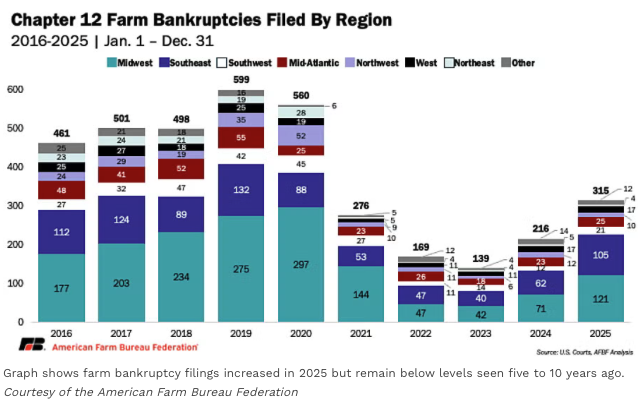
Farm bankruptcies are on the rise in Wisconsin, following a national trend.
A report from the American Farm Bureau Federation highlighted last year’s increase in Chapter 12 bankruptcies, a category of bankruptcy created specifically for farms and fisheries.
Bankruptcy filings were 46 percent higher than in 2024, according to the report, with more than a third of filings in the Midwest.
See Hope Kirwan, Farm bankruptcies tick up in Wisconsin, US (‘Industry experts say bankruptcy filings are ‘lagging indicator’ of high costs, low pay prices faced by farmers’), February 18, 2026.
While farm bankruptcies in 2025 were higher than in other years over the past decade, five of the six highest years in that decade occurred while Trump was president.
A man in Catania, Sicily, trained his dog to dump bags of rubbish by the roadside in an attempt to evade cameras installed by local authorities to combat fly-tipping [illegal dumping], municipal police have said. The episode was detailed in a Facebook post on the city of Catania’s official page. Accompanying a video of the dog was a remark from the police that ‘inventiveness can never become an alibi for incivility.’ The man has reportedly been identified and fined. Illegal dumping is a major problem in Italy, particularly in the south, with significant environmental and economic costs. In 2023, more than 9,300 waste-related offenses were recorded — a 66% increase on the previous year. In response, growing numbers of Italian municipalities are installing surveillance cameras, wildlife-style ‘camera traps’ and smart monitoring systems to curb fly-tipping and misuse of recycling points.
Friday in Whitewater will be windy with a high of 38. Sunrise is 6:44 and sunset is 5:33 for 10 hours 48 minutes of daytime. The moon is a waxing crescent with 11.4 percent of its visible disk illuminated.
One reads that Wisconsin Assembly Speaker Robin Vos will retire at the end of his current term. There’s a FREE WHITEWATER category of posts about Vos. There one can find posts on his many errors and transgressions against sound public policy.
And yet, and yet, the best summary of Vos’s career comes from Dr. Mark Copelovitch, Professor of Political Science & Public Affairs & Director of European Studies, University of Wisconsin – Madison:
Almost everything now happening at the federal level now has a direct antecedent in Wisconsin GOP politics under Scott Walker & Robin Vos in 2008-25. The lying. The defunding. The violating laws & norms. The demonizing some people as not being part of the Herrenvolk. It was all here first.
Yes.
Considering Vos’s career calls for a palate cleanser afterward. Here’s something incomparably better than a bad politician from Wisconsin — a good boy at the Winter Olympics: