
Author Archive for JOHN ADAMS
Daily Bread
Daily Bread for 3.26.17
by JOHN ADAMS •
Good morning.
Whitewater will have a rainy Sunday, with a high of fifty-seven. Sunrise is 6:45 AM and sunset is 7:15 PM, for 12h 29m 49s of daytime. The moon is a waning crescent with 3.4% of its visible disk illuminated. Today is the {tooltip}one hundred thirty-eighth day.{end-texte}Days since Trump’s election, with 11.9.16 as the first day.{end-tooltip}
On this day in 1881, famous Civil War mascot Old Abe dies from injuries he sustained during a fire at the State Capitol. He was the mascot for Company C, an Eau Claire infantry unit that was part of the Wisconsin 8th Regiment. His fame continued after the war:
After Wisconsin took possession of Old Abe, state officials classified him as a “War Relic” and created an “Eagle Department” in the Capitol building, which included a two-room “apartment,” a custom bathtub for the eagle, and a caretaker. Later John Hill served in this capacity.[23] Old Abe became a nationally known celebrity, whose presence at events was requested by individuals and organizations from the state and the country. Old Abe appeared at the 1876 Centennial Exposition in Philadelphia, Pennsylvania and the 1880 Grand Army of the Republic National Convention. Other events were fundraisers for charities, which included: the 1865 Northwest Sanitary Fair in Illinois, Soldiers’ Home Fair, Soldier’s Orphan’s Home, Harvey Hospital, and Ladies Aid Society of Chippewa Falls.[3] In February 1881, a small fire broke out in the basement of the Capitol. After Old Abe raised an alarm, the fire was quickly put out. However, the eagle inhaled a large amount of thick black smoke, and about a month later, lost strength and began to decline. On March 26, 1881, in spite of the efforts of numerous doctors, Old Abe died in the arms of caretaker George Gilles.[23]
On September 17, 1881, Old Abe’s stuffed remains were placed in a glass display case located in the rotunda of the Capitol. Four years later, Old Abe was moved, within the Capitol, from the rotunda to the G.A.R. Memorial Hall. In 1900, his remains were transferred to the new building of the State Historical Society of Wisconsin. However, pressure from veterans convinced Governor Robert M. Lafollette to return Old Abe to the Capitol building in 1903. That year, President Theodore Roosevelt viewed the remains and expressed his pleasure at being able to see the eagle he had studied in school as a child. In 1904, Old Abe’s remains and the glass case were destroyed in a fire that razed the Capitol building.[23]
Since 1915, a replica of Old Abe has presided over the
Wisconsin State Assembly Chamber in the Capitol, and another is on display at the Wisconsin Veterans Museum in Madison.[24] A stone sculpture of the eagle is at the top of the Camp Randall Arch.[11]

Recommended for reading in full —
Tim Alberta describes events from Inside the GOP’s Health Care Debacle: “Donald Trump had heard enough about policy and process. It was Thursday afternoon and members of the House Freedom Caucus were peppering the president with wonkish concerns about the American Health Care Act—the language that would leave Obamacare’s “essential health benefits” in place, the community rating provision that limited what insurers could charge certain patients, and whether the next two steps of Speaker Paul Ryan’s master plan were even feasible—when Trump decided to cut them off. “Forget about the little shit,” Trump said, according to multiple sources in the room. “Let’s focus on the big picture here.” The group of roughly 30 House conservatives, gathered around a mammoth, oval-shaped conference table in the Cabinet Room of the White House, exchanged disapproving looks. Trump wanted to emphasize the political ramifications of the bill’s defeat; specifically, he said, it would derail his first-term agenda and imperil his prospects for reelection in 2020. The lawmakers nodded and said they understood. And yet they were disturbed by his dismissiveness. For many of the members, the “little shit” meant the policy details that could make or break their support for the bill—and have far-reaching implications for their constituents and the country.”
Matt Flegenheimer and Thomas Kaplan contend that Paul Ryan Emerges From Health Care Defeat Badly Damaged: “Less than 18 months after being elected speaker, Mr. Ryan has emerged from the defeat of the health care bill badly damaged, retaining a grip on the job but left to confront the realities of his failure — imperiling the odd-couple partnership that was supposed to sustain a new era of conservative government under unified Republican rule.”
Graydon Carter contends that the Trump Presidency is Already a Joke (But It’s No laughing Matter): “Trump’s one brief moment of acting presidential—when he read off a teleprompter for 60 minutes and 10 seconds during his address to Congress—served only to show just how low the bar for presidential behavior has plummeted since January. Watching TV commentators applaud him for containing himself for a little over an hour was like hearing a parent praise a difficult child for not pooping in his pants during a pre-school interview. Besides, vintage Trump is not going anywhere anytime soon. A couple of weeks earlier, during a visit by the Japanese prime minister, Shinz? Abe, the president told an acquaintance that he was obsessed with the translator’s breasts—although he expressed this in his own, fragrant fashion.”
Hannah Levintova outlines The Long, Twisted, and Bizarre History of the Trump-Russia Scandal: “The Trump-Russia scandal—with all its bizarre and troubling twists and turns—has become a controversy that is defining the Trump presidency. The FBI recently disclosed that since July it has been conducting a counterintelligence investigation into possible coordination between Trump associates and Russia, as part of its probe of Moscow’s meddling in the 2016 election. Citing “US officials,” CNN reported that the bureau has gathered information suggesting coordination between Trump campaign officials and suspected Russian operatives. Each day seems to bring a new revelation—and a new Trump administration denial or deflection. It’s tough to keep track of all the relevant events, pertinent ties, key statements, and unraveling claims. So we’ve compiled what we know so far into the timeline below, which covers Trump’s 30-year history with Russia. We will continue to update the timeline regularly as events unfold. (Click here to go directly to the most recent entry.) Please email us at scoop@motherjones.com if you have a tip or we’ve left anything out.”
People on Twitter are mocking Trump for pretending to drive a big rig truck (instead of reading and comprehending the details of health care legislation that he dismissively described as “the little shit“):
City, Mendacity, Trump
A Reminder on Dealmaking
by JOHN ADAMS •
David Frum, writing about Trump’s failure to advance health care legislation, observes the truth about Trump:
Regular reminder that Donald Trump’s core competency is not dealmaking with powerful counter-parties. It is duping gullible victims.
— David Frum (@davidfrum) March 24, 2017
That’s right, and cannot be said enough: Trump’s a confidence man, and he preys on the unwary, desperate, or gullible.
 There’s a local angle in all this: although Whitewater’s policymakers and town notables want to portray themselves as advancing sophisticated (often tech-oriented programs), their plans rest mostly on false claims and third-tier work hawked to an economically struggling community. They claim job gains without describing them in detail, they claim economic benefits without enumerating them in detail, and they hide costs and setbacks that would place in context any benefits they hazily claim.
The few, self-described ‘Whitewater Advocates’ who push these policies aren’t selling community betterment: they’re selling their own social advancement at the cost of the disproportionately large number of indigent and struggling residents in this city. And Like Trump, when they meet capable counter-parties, their scheming fares poorly.
They’ve had over the years, from their own perspective one supposes, public-relations success with dodgy proposal after dodgy proposal. I’d guess the high watermark for them was several years ago, around 2010-2012. They should have quit then, while the tide was still high. The water’s receding now, and one sees how much waste litters the shore.
Daily Bread
Daily Bread for 3.25.17
by JOHN ADAMS •
Good morning.
Saturday in Whitewater will be cloudy, with a high of forty-none, and periods of rain. Sunrise is 6:46 AM and sunset is 7:13 PM, for 12h 26m 55s of daytime. The moon is a waning crescent with 8.4% of its visible disk illuminated. Today is the {tooltip}one hundred thirty-seventh day.{end-texte}Days since Trump’s election, with 11.9.16 as the first day.{end-tooltip}
On this day in 1911, the Triangle Shirtwaist Factory fire claims the lives of one hundred forty-six workers, most of whom were Jewish and Italian immigrant women aged 16 to 23. On this day in 1865, the 36th and 38th Wisconsin Infantry regiments participate in the Battle of Fort Stedman, Virginia, during the Siege of Petersburg.
Recommended for reading in full —
David Graham observes that for Trump, It’s Never Trump’s Fault: “Trump was very clear about who was not to blame: himself. “I worked as a team player,” the president of the United States said, demoting himself to bit-player status. He wanted to do tax reform first, after all, and it was still early. “I’ve been in office, what, 64 days? I’ve never said repeal and replace Obamacare within 64 days. I have a long time. I want to have a great health-care bill and plan and we will.” Strictly speaking, it is true that Trump didn’t promise to repeal Obamacare on day 64 of his administration. What he told voters, over and over during the campaign, was that he’d do it immediately. On some occasions he or top allies even promised to do it on day 1. Now he and his allies are planning to drop the bill for the foreseeable future….Trump’s quick disavowal of any role in the collapse fits with an emerging pattern: The president never takes the blame for anything that goes wrong….Assuming the public accepts it, this choice has both upsides and downsides. On the one hand, it means that Trump is never to blame for anything. On the other, if he’s so irrelevant, why should anyone pay attention to him or take his proposals and ideas seriously?”
Robert Costa, Ashley Parker and Philip Rucker report on ‘The closer’? The inside story of how Trump tried — and failed — to make a deal on health care: “For Trump, it was never supposed to be this hard. As a real estate mogul on the rise, he wrote “The Art of the Deal,” and as a political candidate, he boasted that nobody could make deals as beautifully as he could. Replacing Obamacare, a Republican bogeyman since the day it was enacted seven years ago, was Trump’s first chance to prove that he had the magic touch that he claimed eluded Washington. But Trump’s effort was plagued from the beginning. The bill itself would have violated a number of Trump’s campaign promises, driving up premiums for millions of citizens and throwing millions more off health insurance — including many of the working-class voters who gravitated to his call to “make America great again.” Trump was unsure about the American Health Care Act, though he ultimately dug in for the win, as he put it. There were other problems, too. Trump never made a real effort to reach out to Democrats, and he was unable to pressure enough of his fellow Republicans. He did not speak fluently about the bill’s details and focused his pitch in purely transactional terms. And he failed to appreciate the importance of replacing Obamacare to the Republican base; for the president, it was an obstacle to move past to get to taxes, trade and the rest of his agenda.”
Tim Mak reports that Devin Nunes Vanished the Night Before He Made Trump Surveillance Claims: “Hours before the chairman of the House Intelligence Committee announced his shocking claims about surveillance of the Trump transition team on Wednesday morning, he practically disappeared. Rep. Devin Nunes was traveling with a senior committee staffer in an Uber on Tuesday evening when he received a communication on his phone, three committee officials and a former national security official with ties to the committee told The Daily Beast. After the message, Nunes left the car abruptly, leaving his own staffer in the dark about his whereabouts. By the next morning, Nunes hastily announced a press conference. His own aides, up to the most senior level, did not know what their boss planned to say next. Nunes’ choice to keep senior staff out of the loop was highly unusual.”
Travis Dorman reports that Tennessee bills teen to replace guardrail that killed her: “LENOIR CITY, Tenn. — The state of Tennessee erroneously has billed a dead teen nearly $3,000 to replace the guardrail that killed her in a car crash in November. Her flabbergasted father said that he not only would not pay but also contends that the model of guardrail that struck his daughter was poorly designed and dangerous. Around 5:44 a.m. ET Nov. 1, Hannah Eimers, 17, was driving her father’s 2000 Volvo S80 on Interstate 75 northbound near Niota, Tenn., when the car left the road, traveled into the median and hit the end of a guardrail with the driver’s side door, according to a Tennessee Highway Patrol crash report. Instead of deflecting the car or buckling to absorb the impact, the guardrail end impaled the vehicle, striking the teen in the head and chest and pushing her into the back seat, according to the report. She died instantly.”
Opera? No, something even better: subway opera —
Elevating the Underground: Subway Opera from Great Big Story on Vimeo.
Cats
Heroic Cat Saves Wisconsin Family from Poisoning
by JOHN ADAMS •
A fluffy brown tabby cat is being hailed as a hero after she alerted her human family to dangerously high levels of carbon monoxide in their home last month.
Annette Shanahan of Reedsburg, Wisconsin, told Madison.com this week that around 1 a.m. on Feb. 4, she felt weak, ill and disoriented and wandered out of bed, collapsing into a chair in the bedroom.
Her husband, Kevin, said he would have slept through it if it weren’t for the family cat, Gracie.
American heroine. Via CBS.
”All of the sudden Gracie, I heard she was pounding, knocking, knocking, knocking at the door,” he told local news channel WREG. “And so I got out of bed and to stop her from pounding at the door, and I looked to my left and Annette was there in the chair.”
Gracie doesn’t usually try to get into the bedroom, so the pounding was out of the ordinary for her, the couple said.
They were barely able to call 911 to tell them they couldn’t breathe. When help arrived, firefighters discovered deadly carbon monoxide levels in their home, which was later attributed to a hot water heater malfunction.
 American heroine. Via CBS.
Via Huffington Post.
Daily Bread
Daily Bread for 3.24.17
by JOHN ADAMS •
Good morning.
Friday in Whitewater will be warm, with a high of seventy, and an even chance of afternoon thunder showers. Sunrise is 6:48 AM and sunset 7:12 PM, for 12h 23m 59s of daytime. The moon is a waning crescent with 15.7% of its visible disk illuminated.Today is the {tooltip}one hundred thirty-sixth day.{end-texte}Days since Trump’s election, with 11.9.16 as the first day.{end-tooltip}
On this day in 1989, the oil tanker Exxon Valdez strikes Prince William Sound’s Bligh Reef at and spills 10.8 million US gallons of crude oil over the next few days. On this day in 1874, legendary magician Harry Houdini (who claimed to be born in Appleton and actually lived there for a bit) is born in Budapest.
Recommended for reading in full —
Andrew Roth and Natalie Gryvnyak report that Days before his death, Putin critic said in interview he knew he was in danger: “KIEV — In the plush, crimson-decked lobby bar of Kiev’s five-star Premier Palace Hotel, Denis Voronenkov, a Russian lawmaker who had defected to Ukraine, knew he was in danger. “For our personal safety, we can’t let them know where we are,” he said Monday evening as he sat with his wife for an interview with The Washington Post. Less than 72 hours later, he was dead, shot twice in the head in broad daylight outside the same lobby bar. It was a particularly brazen assassination that recalled the post-Soviet gangland violence of the 1990s. His wife, dressed in black, sobbed as she stooped down to identify Voronenkov’s body, which lay beneath a black tarp in a pool of blood. Ukrainian President Petro Poroshenko, just hours later, called the attack an “act of state terrorism by Russia.” As of Thursday evening, police had not identified the assailant, who died in police custody after being shot by Voronenkov’s bodyguard. Dmitry Peskov, a spokesman for Russian President Vladimir Putin, called the accusation a “fabrication.” In the weeks before his death, Voronenkov, a former member of Russia’s pliant Communist Party, had told friends he was being targeted. Hackers had been trying to pry into his Twitter account and his wife’s email. He had received threatening text messages, and the police had recently assigned him a bodyguard. There were rumors he was under surveillance.”
James B. Stewart observes that Pages From Trump’s Tax Returns Raise a Decade’s Worth of Questions: “But scratch the surface, and a far more complicated and troubling picture emerges. On the line for “other income,” the Trumps reported negative $103 million. Tax experts told me that is almost certainly what was left of the $916 million loss reported on the 1995 returns reported by The Times, an amount that could be carried over and used to offset income in future years. “That’s my assumption,” said Leonard C. Green, a certified public accountant who is president of the Green Group, a tax and accounting advisory firm, and author of “The Entrepreneur’s Playbook.” That means that in the years between 1996 and 2005, Mr. Trump was able to use the enormous loss to offset $813 million in income. It’s possible, though unlikely, that some of those tax-loss carry-forwards, as they’re known, expired unused. In 1995 they could be used for up to 18 years, which means any of the losses incurred before 1987 would have expired by 2005. But there’s no evidence Mr. Trump had losses of anywhere near that magnitude that early in his career. Most of the losses are presumed to date from the problems his casino operations ran into in the early 1990s.”
Mark Sommerhauser reports concerning Wisconsin’s Fiscal bureau: Scott Walker’s budget leaves $1.1 billion hole starting in 2019: “Gov. Scott Walker’s proposal for the state’s next budget creates a larger structural deficit than previously thought, nearly $1.1 billion, in the ensuing budget cycle beginning in 2019, the state’s nonpartisan fiscal office said Thursday. The Legislative Fiscal Bureau released the findings in a memo made public late Thursday. It shows Walker’s plan for the 2017-19 budget, which back-loads spending and tax cuts into its second fiscal year, leaves a structural deficit of $1.1 billion that lawmakers would have to erase in crafting the 2019-21 budget. A previous estimate from Walker’s office pegged the number at about $740 million. The structural deficit figure compares projected revenue to expenditures if Walker’s plan were enacted this year as-is, and if no changes were made to its revenue or spending levels in the following budget in 2019. Both are unlikely to happen, but the figure gives policymakers “an indication of the beginning point for the budget of the succeeding biennium” under Walker’s plan, according to the memo.”
Michael D. Shear explains What Trump’s Time [Magazine] Interview Shows About His Thinking: “Just Quoting. ‘Why do you say that I have to apologize? I’m just quoting the newspaper, just like I quoted the judge the other day, Judge Napolitano. I quoted Judge Napolitano, just like I quoted Bret Baier. I mean Bret Baier mentioned the word wiretap. Now he can now deny it, or whatever he is doing, you know. But I watched Bret Baier, and he used that term. I have a lot of respect for Judge Napolitano, and he said that three sources have told him things that would make me right. I don’t know where he has gone with it since then. But I’m quoting highly respected people from highly respected television networks.’ — President Trump Among Mr. Trump’s more bizarre assertions in recent days — and repeated in the Time interview — is the idea that he should not be held accountable for merely quoting someone who makes a controversial, even unproven, claim or allegation.”
Sometimes there are alligators in the sewer:
America, Law, Liberty
Under the Gazette‘s Reasoning, Rosa Parks Should Have Stayed at the Back of the Bus
by JOHN ADAMS •
Over at the Gazette, there’s an editorial about whether a local school superintendent should have sent a message about immigration to residents without consulting his school board. See, Our Views: Superintendent sends the wrong message.
I’ll set aside the issue of immigration, and address the deeper issue of the Gazette‘s reasoning on obedience to the law. Here’s what the publication contends:
We’re certainly willing to concede problems with current immigration law, but we cannot support breaking laws we don’t like. That’s not how our democracy works.
Under this view, the law – indeed any law passed with a majority in its community – must be obeyed. There’s no room for civil disobedience here, so Parks should have stayed at the back of the bus, and King should not have marched in communities where a majority insisted against marches.
The Gazette may truly believe this, of course: that one must live with majoritarian rule, no matter how unjust, with no measures of civil disobedience. There’s something selfish, however, about men who (presumably) would claim a right of their forefathers to use military means to secure independence from a British majority who would now deny to living residents on this continent the right even to use the peaceful measures of civil disobedience.
It’s worth observing that the editorialist doesn’t confine the paper’s view to immigration only, but to all political and legal matters without qualification (“we cannot support breaking laws we don’t like”). That the paper ties support of the law not to justice but to the rule of the whole population begs the question of how the Gazette would object – if at all – to majority rule by legislation in places that oppress political, ethnic, or religious minorities. Shh, hush, hush: you mustn’t make a fuss, it just won’t do!
My forefathers fought in support of the Revolution centuries ago to establish the American Republic, and my family today recognizes a natural right of civil disobedience within the Republic for people, regardless of race, ethnicity, religion, or gender.
I’ve written before that most local publications are useful now not in themselves, but for what they tell about how local insiders think (however poorly) about political or social issues. The Gazette’s editorial is one more example of how shallow that thinking truly is.
America, City, Conflicts of Interest, Trump
How Foreign Powers Could Try to Buy Trump
by JOHN ADAMS •
Donald Trump is an unprecedentedly wealthy president, who owns or licenses his name to buildings, casinos, and luxury hotels around the world. An ethics watchdog group has already brought a lawsuit against him for violating the Constitution’s “Emoluments Clause,” which prohibits government officials from receiving gifts from foreign states. Trump has taken few steps to distance himself from his organization, and foreign governments could use the President’s business interests as bargaining chips to influence his policymaking. Atlantic writer Jeremy Venook has been monitoring the President’s growing list of conflicts of interests since November 2016, and breaks down some of the most alarming ones in this video.
There’s a local angle in all this: Whitewater is rife with possible conflicts of interest (although not of the same magnitude or kind as Trump’s, of course): from news sites that publishers claim have not simply advertisers but ‘sponsors’, dual roles as politicians and news people, and a general insider’s desire to boost well-positioned friends (even if the policy in question is, to use the technical term, a dog-crap policy).
Funnier still is the self-exonerating way that some try to avoid these conflict-of-interest problems (1) by insisting that they are immune from the psychological biases that would naturally beset billions of others on this planet or (2) by finding their way onto an ethics committee. (This latter way is not unique to Whitewater. After all, Saudia Arabia found her way onto the United Nations Human Rights Council.)
This is a way in which longstanding local mediocrity and the new national mediocrity present challenges in their respective venues. See, along these lines, The National-Local Mix (Part 2).
City, Economy
Preliminaries to a Discussion on Class
by JOHN ADAMS •
One finds a significant amount of information, in both lay publications and (of course) the careful studies on which they rely that working class Americans are faring poorly.
There are two broad aspects to this: (1) how working class Americans are faring, and (2) what this says about economic and fiscal policy at the federal, state, or local level.
A few recent accounts and studies come to mind (and these are only a few of a far larger number): New research identifies a ‘sea of despair’ among white, working-class Americans (Mortality and morbidity in the 21st century @ Brookings), The biggest beneficiaries of the government safety net: working-class whites (Poverty Reduction Programs Help Adults Lacking College Degrees the Most, @ Center on Budget and Policy Priorities), or Katherine J. Cramer’s Politics of Resentment: Rural Consciousness in Wisconsin and the Rise of Scott Walker.
On the first aspect (how some are faring), evidence from any credible source, including of the left, is worth evaluating: reason compels that one address studies and their data dispassionately, analytically. In a place like Whitewater, or nearby towns, there’s much too much ‘can’t read this,’ ‘can’t read that,’ based on the idea that it’s too far left or too far right.
On the second aspect (economic or fiscal policy), ample evidence of hard times does nothing to excuse a retreat into nativism, bigotry, or the daily chumming of lies that Trump, for example, spills into the water to attract struggling Americans.
Nor does it excuse the third-tier boosterism that politicians and local publications like the Gazette, Daily Union, Register, or Banner use to hawk any project, at any public expense, on the theory that it just has to be done. The longer one considers economic & fiscal policy in a town like Whitewater, the more one comes to see that not one of these publications offers anything more than empty cheerleading. They might as well be working a long con on their communities, with their own self-promotion as a good part of the game.
There are obvious similarities between failed local strategies and national ones. See, The National-Local Mix (Part 2).
However difficult the times, there are useful works yet to be finished about how local notables push destructive projects (waste-to-energy), empty economic development plans (millions in Whitewater with mostly headlines to show for it), and how desperate communities fall victim to weak reasoning in the place of careful consideration.
All of this is a spur to work harder.
Daily Bread
Daily Bread for 3.23.17
by JOHN ADAMS •
Good morning.
Thursday in Whitewater will be cloudy with a high of forty-five. Sunrise is 6:50 AM and sunset is 7:11 PM, for 12h 21m 04s of daytime. The moon is a waning crescent with 23.7% of its visible disk illuminated. Today is the {tooltip}one hundred thirty-fifth day.{end-texte}Days since Trump’s election, with 11.9.16 as the first day.{end-tooltip}
Whitewater’s Community Development Authority meets today at 5:30 PM.
On this day in 1775, Patrick Henry argues in Virginia’s House of Burgesses for mobilization against Britain : “Is life so dear, or peace so sweet, as to be purchased at the price of chains and slavery? Forbid it, Almighty God! I know not what course others may take; but as for me, give me liberty, or give me death!” On this day in 1865, the Campaign of the Carolinas ends victoriously for Wisconsin defenders of the Union: “the 21st Wisconsin Infantry, made up mostly of soldiers from the Oshkosh area, finished fighting their way through the South during Sherman’s March to the Sea and reached Goldsboro, N.C., where the campaign in the Carolinas ended.”
Recommended for reading in full —
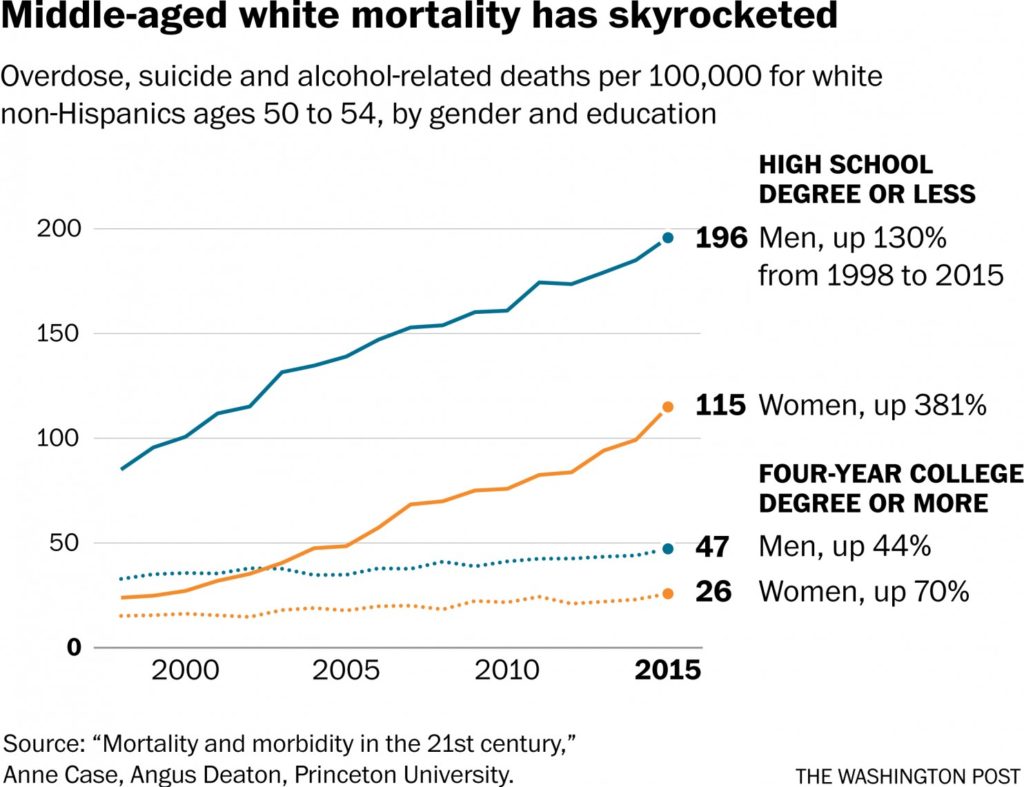
Sickness and early death in the white working class could be rooted in poor job prospects for less-educated young people as they first enter the labor market, a situation that compounds over time through family dysfunction, social isolation, addiction, obesity and other pathologies, according to a study published Thursday by two prominent economists. Anne Case and Angus Deaton garnered national headlines in 2015 when they reported that the death rate of midlife non-Hispanic white Americans had risen steadily since 1999 in contrast with the death rates of blacks, Hispanics and Europeans. Their new study extends the data by two years and shows that whatever is driving the mortality spike is not easing up. The two Princeton professors say the trend affects whites of both sexes and is happening nearly everywhere in the country. Education level is significant: People with a college degree report better health and happiness than those with only some college, who in turn are doing much better than those who never went. Offering what they call a tentative but “plausible” explanation, they write that less-educated white Americans who struggle in the job market in early adulthood are likely to experience a “cumulative disadvantage” over time, with health and personal problems that often lead to drug overdoses, alcohol-related liver disease and suicide.”
Christopher Mele reports that Art Supply Sales Jumped in January, Thanks to Protest Signs, Report Says: “The week before the Women’s March on Jan. 21 in cities across the United States, protesters who were making signs helped fuel increased sales of poster boards by 33 percent and foam boards by 42 percent compared with the same week last year, the consumer research group NPD reported recently. Poster and foam board sales from Jan. 15 to 21 totaled $4.1 million. More than 6.5 million poster boards were sold in January, with nearly one-third sold during the week of the march. Sales of easel pads and flip charts grew by 28 percent, Leen Nsouli, an office supplies industry analyst at NPD, said in a blog post. Sales of the materials used to make the messages on the posters also increased that week: Specialty markers were up by 24 percent; permanent markers, 12 percent; glue, 27 percent; and scissors, 6 percent.”
James B. Nelson reports that Amazon brings one-hour delivery to Milwaukee: “It might be easier – and faster – to get a socket wrench set from Amazon than from Sears. The online retailer announced Wednesday that customers in Milwaukee can receive one-hour deliveries from the Amazon Prime Now service. This comes as Sears warned investors that it has “substantial doubts” about its ability to stay in business because of a cash crisis. In January, Sears said it planned to close 150 stores. Amazon Prime Now delivery is $7.99 for one hour and free for two hours or later. The site was offering a $10 first time delivery credit code (10PRIMENOW) in the Milwaukee area Wednesday morning. A minimum order amount of $25 is required for the service. An Amazon press release said the Prime Now deliveries would be available for Milwaukee. It didn’t state which suburbs were included, but a spokeswoman said that customers could enter their zip code in their account and see if Prime Now is available. The service is available from 8 a.m. to 10 p.m. seven days a week. Amazon said it was possible to use the Alexa voice service to place the orders, saying: “Alexa, order (product) from Prime Now”.
Tech Insider contends that this mini-camper runs on retro vibes:
Politics, Poll, Wisconsin
Marquette Law Poll, March 2017 (First Marquette Poll Since 2016 Election)
by JOHN ADAMS •
Selected results below, from among Wisconsin registered voters; full results are available online.
Trump Approval
New Marquette Law School Poll puts approval among registered voters in WI of how President Trump is doing his job at 41%. #mulawpoll
— MULawPoll (@MULawPoll) March 22, 2017
Trump Disappproval
47% disapprove of Trump job performance, 11% don’t express opinion among WI voters. #mulawpoll
— MULawPoll (@MULawPoll) March 22, 2017
Trump’s Judgment
Does Trump show good judgment? 33% of all registered say yes, 62% no. #mulawpoll
— MULawPoll (@MULawPoll) March 22, 2017
Trump’s Concern
Does Trump care about “people like me”? 40% of WI voters say yes, 55% say no. In October, it was 35% and 62%. #mulawpoll
— MULawPoll (@MULawPoll) March 22, 2017
Congressional Health Care Legislation
What should Congress do about health care law? 6% favor keeping it, 54% keep and improve, 28% repeal and replace, 8% repeal & do not replace
— MULawPoll (@MULawPoll) March 22, 2017
How Description of Law Influences Respondents’ Views
When "Affordable Care Act" phrase was used, favorable views overall were 51%. When "Obamacare" was used, 40% were favorable. #mulawpoll
— MULawPoll (@MULawPoll) March 22, 2017
Undocumented Immigrants
Overall, 66% of WI voters say undocumented immigrants should be allowed to stay and eventually apply for citizenship. #mulawpoll
— MULawPoll (@MULawPoll) March 22, 2017
Mexican Border Wall
37% support building a wall along the Mexican border, 59% oppose that. #mulawpoll
— MULawPoll (@MULawPoll) March 22, 2017
Daily Bread
Daily Bread for 3.22.17
by JOHN ADAMS •
Good morning.
Midweek in Whitewater will be sunny with a high of forty. Sunrise is 6:52 AM and sunset 7:10 PM, for 12h 18m 09s of daytime. The moon is a waning crescent with 32.7% of its visible disk illuminated. Today is the {tooltip}one hundred thirty-fourth day.{end-texte}Days since Trump’s election, with 11.9.16 as the first day.{end-tooltip}
On this day in 1765, Britain passes the Stamp Act, an Act of the Parliament imposing a direct tax on the colonies of British America and requiring that many printed materials in the colonies be produced on stamped paper produced in London, carrying an embossed revenue stamp. On this day in 1854, Eugene Shepard, father of the Hodag, is born: “Although he made his career in the lumbering business near Rhinelander, he was best known for his story-telling and practical jokes. He told many tales of Paul Bunyan, the mythical lumberjack, and drew pictures of the giant at work that became famous. Shepard also started a new legend about a prehistoric monster that roamed the woods of Wisconsin – the hodag. Shepard built the mythical monster out of wood and bull’s horns. He fooled everyone into believing it was alive, allowing it to be viewed only inside a dark tent. The beast was displayed at the Wausau and Antigo county fairs before Shepard admitted it was all a hoax.”
Recommended for reading in full:
Jose DelReal reports that Trump’s budget targets rural development programs that provide a quiet lifeline: “HAGERHILL, Ky. — Chad Trador was, like many people here, a onetime coal miner struggling to find work. He, his three children and his wife had stayed afloat in a tough economy for years, but after he was laid off from his job managing a convenience store, the unemployment epidemic in this region appeared to have finally reached him, too. “The best opportunities I had were another convenience store, maybe as a clerk, making minimum wage,” said Trador, 43, reflecting on last year. “And then I heard that radio ad.” The intensive 33-week job training program being advertised — TechHire Eastern Kentucky — promised to teach him computer coding from scratch. It would even pay him decent money while he learned. Trador signed up, and he is on track to complete the training in April, when he will emerge with a job as an Apple iOS developer. Like many such programs and infrastructure projects here in Eastern Kentucky and across Appalachia, the job training course has the federal government’s fingerprints all over it. The Appalachian Regional Commission, an independent federal agency, helped jump-start it last year with a multiagency $2.75 million grant to a state organization that developed it. But after decades of work, the commission’s future is in doubt, with the Trump administration’s 2018 budget proposal threatening to eliminate funding for the commissions and other rural development endeavors. Voters in this part of the country, which overwhelmingly supports President Trump, could be disproportionately affected if that happens.”
Marc Fisher reports that Labor nominee Acosta cut deal with billionaire guilty in sex abuse case: “There was once a time — before the investigations, before the sexual abuse conviction — when rich and famous men loved to hang around with Jeffrey Epstein, a billionaire money manager who loved to party. They visited his mansion in Palm Beach, Fla. They flew on his jet to join him at his private estate on the Caribbean island of Little Saint James. They even joked about his taste in younger women. President Trump called Epstein a “terrific guy” back in 2002, saying that “he’s a lot of fun to be with. It is even said that he likes beautiful women as much as I do, and many of them are on the younger side.” Now, Trump is on the witness list in a Florida court battle over how federal prosecutors handled allegations that Epstein, 64, sexually abused more than 40 minor girls, most of them between the ages of 13 and 17. The lawsuit questions why Trump’s nominee for labor secretary, former Miami U.S. attorney Alexander Acosta, whose confirmation hearing is scheduled to begin Wednesday, cut a non-prosecution deal with Epstein a decade ago rather than pursuing a federal indictment that Acosta’s staff had advocated.”
Ryan Lizza describes How the White House Got James Comey Wrong: “Early on Monday morning, a couple of hours before the start of the first House Intelligence Committee hearing on Russia’s involvement in the Presidential election, one of Donald Trump’s closest White House advisers made a startling—and completely erroneous—prediction: James Comey, the F.B.I. director, would testify that there was no collusion between the Trump campaign and Russia. “The Russian collusion thing has always been bullshit,” the official said. “I think Comey will come down and say there absolutely was no contact, collusion, or anything like that with the campaign”….the larger takeaway from the White House’s spin is that the top people around Trump may have no idea how much exposure the President has on the issue of Russian collusion. Two hours after the White House official confidently predicted Comey would vindicate the Administration, Comey did the opposite, saying: ‘I have been authorized by the Department of Justice to confirm that the F.B.I., as part of our counterintelligence mission, is investigating the Russian government’s efforts to interfere in the 2016 Presidential election, and that includes investigating the nature of any links between individuals associated with the Trump campaign and the Russian government and whether there was any coördination between the campaign and Russia’s efforts. As with any counterintelligence investigation, this will also include an assessment of whether any crimes were committed.’ ”
Andrew Roth reports that New documents show Trump aide [his former campaign manager] laundered payments from party with Moscow ties, lawmaker alleges: “KIEV, Ukraine — A Ukrainian lawmaker released new financial documents Tuesday allegedly showing that a former campaign chairman for President Trump laundered payments from the party of a disgraced ex-leader of Ukraine using offshore accounts in Belize and Kyrgyzstan. The new documents, if legitimate, stem from business ties between the Trump aide, Paul Manafort, and the party of former Ukrainian president Viktor Yanukovych, who enjoyed Moscow’s backing while he was in power. He has been in hiding in Russia since being overthrown by pro-Western protesters in 2014, and is wanted in Ukraine on corruption charges. The latest documents were released just hours after the House Intelligence Committee questioned FBI Director James B. Comey about possible coordination between the Trump campaign and Moscow. The hearing that also touched on Manafort’s work for Yanukovych’s party in Ukraine. Comey declined to say whether the FBI is coordinating with Ukraine on an investigation of the alleged payments to Manafort.”
So how did tech become so male-dominated?
Since computing began in the 1940s, women have led major developments in programming and software development. In 1984, 37 percent of computer-science majors were women. What happened? The tech industry’s image shifted rapidly in the 1980s and ’90s, and society began to associate programming with men. Today, only one in four computing jobs is held by a woman. This short, animated history of women in tech explains how women—not just men—developed computer science. Programming isn’t a male or female job, and remembering that is necessary to fix the tech industry’s gender gap. Read more in The Atlantic’s April 2017 cover story, “Why Is Silicon Valley So Awful to Women?”
City, Elections, Politics
The Upcoming Spring Election in Whitewater
by JOHN ADAMS •
One, but only one, of Whitewater’s Common Council races is contested. Some readers have asked me, variously, if I would comment on the candidates in the contested race, and where one might find the candidate statements submitted to the local League of Women Voters chapter.
I’ll leave residents to consider the candidates (including the contested race between incumbent Patrick Wellnitz and challenger Carol McCormick in District 1) without comment.
For those who would like to see the statements that some candidates have submitted, they may be found at http://www.lwvwhitewater.org/elections.html.
It’s fair to say that I have conflicting views on the League of Women Voters: the national organization has done much good work, but the local chapter betrays some shopworn biases (probably without grasping that they’re biases at all). The local chapter also has a skewed-old problem that leads to, and exacerbates, their declining influence. For a discussion of the local chapter’s unfounded assumptions, see On the Whitewater League of Women Voters Questionnaire (Spring 2017).
The best approach for any candidate will always be to prepare his or her own statement, apart from any organization, and have it at the ready for distribution to residents.
Daily Bread
Daily Bread for 3.21.17
by JOHN ADAMS •
Good morning.
Tuesday in Whitewater will be partly cloudy with a high of forty-six. Sunrise is 6:54 AM and sunset 7:09 PM, for 12h 15m 13s of daytime. The moon is a waning crescent with 42.3% of its visible disk illuminated. Today is the {tooltip}one hundred thirty-third-third day.{end-texte}Days since Trump’s election, with 11.9.16 as the first day.{end-tooltip}
Whitewater’s Common Council meets tonight at 6:30 PM.
On this day in 1965, the third of three civil rights marches begins “[p]rotected by 1,900 members of the Alabama National Guard under federal command, and many FBI agents and Federal Marshals, the marchers averaged 10 miles (16 km) a day along U.S. Route 80, known in Alabama as the “Jefferson Davis Highway“. The marchers arrived in Montgomery on March 24 and at the Alabama State Capitol on March 25.[11] With thousands having joined the campaign, 25,000 people entered the capital city that day in support of voting rights. The route is memorialized as the “Selma To Montgomery Voting Rights Trail,” and is designated as a U.S. National Historic Trail.” On this day in 1865, the 21st, 22nd and 25th Wisconsin Infantry regiments take part as three Union armies totaling 100,000 men capture the city of Goldsborough, North Carolina and its railroad facilities.
Recommended for reading in full —
Benjamin Wittes explains How to Read What Comey Said Today [3.20.17]: “First off, the scope of the investigation explicitly includes not merely the Russian government’s hacking and attempts to interfere in the U.S. election. It also includes both “the nature of any links between individuals associated with the Trump campaign and the Russian government” and “whether there was any coordination between the campaign and Russia’s efforts.” These are framed as active investigative questions, not—as White House and Republican officials have repeatedly suggested in recent weeks—matters of investigative conclusion. Comey offered the White House no solace of any time of time frame for resolution. Indeed, he announced that there was no time frame. Second, Comey specifically included the fact that the investigation “will also include an assessment of whether any crimes were committed.” This is an interesting point for him to include, and it may (or may not) be a signal.”
Peter Stone and Greg Gordon report that FBI’s Russian-influence probe includes a look at far-right news sites: “WASHINGTON – Federal investigators are examining whether far-right news sites played any role last year in a Russian cyber operation that dramatically widened the reach of news stories — some fictional — that favored Donald Trump’s presidential bid, two people familiar with the inquiry say. Operatives for Russia appear to have strategically timed the computer commands, known as “bots,” to blitz social media with links to the pro-Trump stories at times when the billionaire businessman was on the defensive in his race against Democrat Hillary Clinton, these sources said. The bots’ end products were largely millions of Twitter and Facebook posts carrying links to stories on conservative internet sites such as Breitbart News and InfoWars, as well as on the Kremlin-backed RT News and Sputnik News, the sources said. Some of the stories were false or mixed fact and fiction, said the sources, who spoke on condition of anonymity because the bot attacks are part of an FBI-led investigation into a multifaceted Russian operation to influence last year’s elections. Investigators examining the bot attacks are exploring whether the far-right news operations took any actions to assist Russia’s operatives. Their participation, however, wasn’t necessary for the bots to amplify their news through Twitter and Facebook.”
Richard Cohen writes that Bannon’s origin story doesn’t add up: “It is a story oft-repeated and, at first, quite moving. It is the story of Marty Bannon, father of the White House chief strategist, Stephen K. Bannon, and how he lost much of his nest egg when the financial system cratered in 2008. He had worked for AT&T for 50?years, buying the stock when it was as safe as gold (only gold paid no dividend) and was now watching it go south at such an alarming rate that he decided to sell it. In a flash, the system turned on Marty and a lifetime of savings was gone. For his son Steve, it was an unforgettable lesson. It made him the revolutionary he is today….I have heard too many people in business and finance complain about excessive regulation not to think there is something of a problem there. Maybe Dodd-Frank is too burdensome. Maybe class-action suits need to be limited. Maybe Obamacare really was a fiasco. Maybe. Maybe. Maybe. But Bannon’s “administrative state” boogeyman is not what flattened his father’s nest egg. It was not excessive regulation that fleeced his father or, for that matter, changed AT&T from Ma Bell into just another business behemoth. Go home, Steve. You need to think.”
David Leonhardt ponders All the President’s Lies: “The ninth week of Donald Trump’s presidency began with the F.B.I. director calling him a liar. The director, the very complicated James Comey, didn’t use the L-word in his congressional testimony Monday. Comey serves at the pleasure of the president, after all. But his meaning was clear as could be. Trump has repeatedly accused Barack Obama of wiretapping his phones, and Comey explained there is “no information that supports” the claim. I’ve previously argued that not every untruth deserves to be branded with the L-word, because it implies intent and somebody can state an untruth without doing so knowingly. George W. Bush didn’t lie when he said Iraq had weapons of mass destruction, and Obama didn’t lie when he said people who liked their current health insurance could keep it. They made careless statements that proved false (and they deserved much of the criticism they got). But the current president of the United States lies. He lies in ways that no American politician ever has before. He has lied about — among many other things — Obama’s birthplace, John F. Kennedy’s assassination, Sept. 11, the Iraq War, ISIS, NATO, military veterans, Mexican immigrants, Muslim immigrants, anti-Semitic attacks, the unemployment rate, the murder rate, the Electoral College, voter fraud and his groping of women. He tells so many untruths that it’s time to leave behind the textual parsing over which are unwitting and which are deliberate — as well as the condescending notion that most of Trump’s supporters enjoy his lies.”
How would humans size up compared to dinosaurs? Like this —