Our work week in town begins with morning fog, afternoon clouds, and a high of forty-seven. Sunrise is 7:05 and sunset 7:01, for 11h 55m 26s of daytime. The moon is a waxing crescent with 36.5% of its visible disk illuminated.
Whitewater’s Planning Commission at 6:30 PM tonight, and her school board in open session at 7 PM.
According to Sauk County’s Web site, “On the night of March 14, 1859, the Baraboo River, greatly swollen by spring rains and melting snow, went on a rampage, taking out a dam that supplied power for the flour mill of Bassett and Pratt. The flour mill was then the ‘largest institution of its kind for many miles around and about it centered the interest of the entire community’. Nearly 500 men responded to the catastrophe. The progress of the water was checked by the felling of trees. The flour in the mill was hauled to safety with team and wagons. The flood caused damage to the lower Maxwell Dam.” To see what life was like then in Baraboo — and throughout much of southern Wisconsin at the time — read this letter by settler Charles Abbott to his family in New Hampshire. “It is a universal rule here to help one another…,” he writes. You can find materials about the history of your own community in our online collection of Wisconsin Community Histories.
Sunday in town will be rainy with a high of forty-eight. Sunrise is 7:07 and sunset 7:00 for 11h 52m 30s of daytime. The moon is a waxing crescent with 26.4% of its visible disk illuminated.
Friday’s FW poll asked whether readers thought that it was legitimate or illegitimate for a senior citizens center in Rhode Island to dress a middle-aged man as an elderly woman during a public presentation. A majority of respondents (89.36%) thought that it was illegitimate.
Only a generation ago, sending email was a cumbersome process, but to someone in Britain in 1984 it seemed speedy (it wasn’t):
Uranus had been observed on many occasions before its recognition as a planet, but it was generally mistaken for a star. Possibly the earliest known observation was by Hipparchos, who in 128 BC may have recorded it as a star for his star catalogue that was later incorporated into Ptolemy‘s Almagest.[18] The earliest definite sighting was in 1690 when John Flamsteed observed it at least six times, cataloguing it as 34 Tauri. The French astronomer Pierre Lemonnier observed Uranus at least twelve times between 1750 and 1769,[19] including on four consecutive nights.
Sir William Herschel observed Uranus on March 13, 1781 from the garden of his house at 19 New King Street in Bath, Somerset, England (now the Herschel Museum of Astronomy),[20] and initially reported it (on April 26, 1781) as a comet.[21] Herschel “engaged in a series of observations on the parallax of the fixed stars”,[22] using a telescope of his own design.
He recorded in his journal “In the quartile near … Tauri … either [a] Nebulous star or perhaps a comet”.[23] On March 17, he noted, “I looked for the Comet or Nebulous Star and found that it is a Comet, for it has changed its place”.[24] When he presented his discovery to the Royal Society, he continued to assert that he had found a comet, but also implicitly compared it to a planet:[22]
“The power I had on when I first saw the comet was 227. From experience I know that the diameters of the fixed stars are not proportionally magnified with higher powers, as planets are; therefore I now put the powers at 460 and 932, and found that the diameter of the comet increased in proportion to the power, as it ought to be, on the supposition of its not being a fixed star, while the diameters of the stars to which I compared it were not increased in the same ratio. Moreover, the comet being magnified much beyond what its light would admit of, appeared hazy and ill-defined with these great powers, while the stars preserved that lustre and distinctness which from many thousand observations I knew they would retain. The sequel has shown that my surmises were well-founded, this proving to be the Comet we have lately observed”.
Herschel notified the Astronomer Royal, Nevil Maskelyne, of his discovery and received this flummoxed reply from him on April 23: “I don’t know what to call it. It is as likely to be a regular planet moving in an orbit nearly circular to the sun as a Comet moving in a very eccentric ellipsis. I have not yet seen any coma or tail to it”.[25]
Although Herschel continued to describe his new object as a comet, other astronomers had already begun to suspect otherwise. Finnish-Swedish astronomerAnders Johan Lexell, working in Russia, was the first to compute the orbit of the new object[26] and its nearly circular orbit led him to a conclusion that it was a planet rather than a comet. Berlin astronomer Johann Elert Bode described Herschel’s discovery as “a moving star that can be deemed a hitherto unknown planet-like object circulating beyond the orbit of Saturn”.[27] Bode concluded that its near-circular orbit was more like a planet than a comet.[28]
The object was soon universally accepted as a new planet. By 1783, Herschel acknowledged this to Royal Society president Joseph Banks: “By the observation of the most eminent Astronomers in Europe it appears that the new star, which I had the honour of pointing out to them in March 1781, is a Primary Planet of our Solar System.”[29] In recognition of his achievement, King George III gave Herschel an annual stipend of £200 on condition that he move to Windsor so that the Royal Family could look through his telescopes.[30]
Saturday in Whitewater will be cloudy with a high of sixty-three. Sunrise is 6:09 and sunset 5:59, for 11h 49m 42s of daytime. The moon is a waxing crescent with 16.8% of its visible disk illuminated.
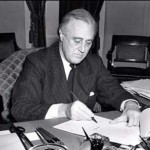
Fireside chats is the term used to describe a series of 30 evening radio addresses given by U.S. President Franklin D. Roosevelt between 1933 and 1944. The fireside chats represent the first time in history that a chief executive communicated directly with a large number of citizens. Roosevelt spoke with familiarity to millions of Americans about the promulgation of the Emergency Banking Actin response to the banking crisis, the recession, New Deal initiatives, and the course of World War II. On radio, he was able to quell rumors and explain his policies comprehensibly. His tone and demeanor communicated self-assurance during times of despair and uncertainty. Roosevelt was one of radio’s greatest communicators, and the fireside chats kept him in high public regard throughout his presidency.
The series of fireside chats was among the first 50 recordings made part of the National Recording Registry of the Library of Congress, which noted it as “an influential series of radio broadcasts in which Roosevelt utilized the media to present his programs and ideas directly to the public and thereby redefined the relationship between the President and the American people.”
1862 – (Civil War) 2nd Wisconsin Cavalry Mustered In
The 2nd Wisconsin Cavalry mustered in at Milwaukee. It would go on to participate in the Battle of Prairie Grove, Arkansas, on December 7, 1862, and in the siege of Vicksburg, Mississippi, the following year. The regiment would lose 312 men during service. Twenty-four enlisted men were killed in combat, and four officers and 284 enlisted men died from disease.
In Rhode Island, a local senior affairs director, Sue Stenhouse, persuaded a middle-aged, male van driver to dress as an elderly woman during an event highlighting services for senior citizens. The story is now viral, and the senior affairs director is now out of her job. (Ms. Stenhouse was also accused of using students “gleefully [to shovel] snow from a pile Stenhouse arranged despite the lack of snowfall.”)
Was dressing the van-driver as an elderly woman a legitimate technique to boost the senior affairs center?
Our week ends with partly cloudy skies and a high of fifty-seven. Sunrise is 6:11 and sunset 5:57, for 11h 46m 47s of daytime. The moon is a waxing crescent with 8.7% of its visible disk illuminated.
The Lend-Lease policy, formally titled “An Act to Promote the Defense of the United States”, (Pub.L. 77–11, H.R. 1776, 55 Stat.31, enacted March 11, 1941)[1] was a program under which the United States supplied Free France, the United Kingdom, the Republic of China, and later the USSR and other Allied nations with food, oil, and materiel between 1941 and August 1945. This included warships and warplanes, along with other weaponry. It was signed into law on March 11, 1941 and ended in September 1945. In general the aid was free, although some hardware (such as ships) were returned after the war. In return, the U.S. was given leases on army and naval bases in Allied territory during the war.
A total of $50.1 billion (equivalent to $659 billion today) worth of supplies were shipped, or 17% of the total war expenditures of the U.S.[2] In all, $31.4 billion went to Britain, $11.3 billion to the Soviet Union, $3.2 billion to France, $1.6 billion to China, and the remaining $2.6 billion to the other Allies. Reverse Lend-Lease policies comprised services such as rent on air bases that went to the U.S., and totaled $7.8 billion; of this, $6.8 billion came from the British and the Commonwealth. The terms of the agreement provided that the materiel was to be used until returned or destroyed. In practice very little equipment was returned. Supplies that arrived after the termination date were sold to Britain at a large discount for £1.075 billion, using long-term loans from the United States. Canada operated a similar program called Mutual Aid that sent a loan of $1 billion and $3.4 billion in supplies and services to Britain and other Allies.[3][4]
This program effectively ended the United States’ pretense of neutrality and was a decisive step away from non-interventionist policy, which had dominated United States foreign relations since 1931. (See Neutrality Acts of 1930s.)
Here’s the final game in Puzzability’s Contain Yourself series:
This Week’s Game — March 7-11
Contain Yourself
Hey, hold it! Each day’s answer this week is a title, name, or phrase whose initial letters spell the three-letter name of a container.
Example:
What documentary about Wikipedia takes its name from a phrase indicating that statistics don’t lie?
Answer:
Truth in Numbers? (TIN)
What to Submit:
Submit the title, name, or phrase (as “Truth in Numbers?” in the example) for your answer.
Friday, March 11
What 1990 Robert Altman film was about the relationship between a famous painter and his art dealer brother?
Thursday in town will be cloudy with a high of fifty-four. Sunrise is 6:12 and sunset 5:56, for 11h 43m 51s of daytime. The moon is a waxing crescent with 3.2% of its visible disk illuminated.
Whitewater’s Police and Fire Commission meets at 6:30 PM, and there is a Fire Department business meeting at 7 PM.
On this day in 1864, President Abraham Lincoln signs a brief document officially promoting then-Major General Ulysses S. Grant to the rank of lieutenant general of the U.S. Army, tasking the future president with the job of leading all Union troops against the Confederate Army.
The rank of lieutenant general had not officially been used since 1798; at that time, President John Adams assigned the post to former President George Washington, in anticipation of a possible French invasion of the United States. One of Grant’s predecessors in the Civil War, Winfield Scott, had briefly earned the rank, but the appointment was only temporary—really, use of the rank had been suspended after George Washington’s death in 1799.
In 1862, Lincoln asked Congress to revive the rank of lieutenant general in order to distinguish between the general in charge of all Union forces and other generals of equal rank who served under him in the field. Congress also wanted to reinstate the rank of lieutenant general, but only if Lincoln gave the rank to Grant. Lincoln had other ideas.
Lincoln preferred to promote then-Commanding General Henry Wagner Halleck to lead the Union Army, which had been plagued by a string of ineffective leaders and terrible losses in battle. He was reluctant to promote Grant and risk boosting the general’s popularity; at the time Washington was abuzz with rumors that many northern senators were considering nominating Grant instead of Lincoln at the 1864 Republican National Convention. After Grant publicly dismissed the idea of running for the presidency, Lincoln submitted to Congress’ choice and agreed to give Grant the revived rank. As lieutenant general of the U.S. Army, Grant was answerable only to Lincoln. Well-respected by troops and civilians, Grant earned Lincoln’s trust and went on to force the South’s surrender in 1865.
Although Grant enjoyed a distinguished career in the military, he later wrote that he never consciously chose the life of a soldier. As a student at West Point, he never expected to graduate, let alone lead the entire U.S. Army in a desperate but ultimately successful struggle to preserve the Union.
In 1869, Grant became the 18th president of the United States.
Midweek in town will grow increasingly sunny, with a high of sixty-one. Sunrise is 6:14 and sunset 5:55, for 11h 40m 56s of daytime. It’s a new moon again today, with just .3% of its visible disk illuminated.
Whitewater’s Parks & Recreation Board meets tonight at 7 PM.
Here’s time-lapse video of yesterday’s solar eclipse, an eclipse that was visible over parts of the Pacific:
NASA also keeps an eclipse website with records about past and upcoming eclipses.
On March 9, the two vessels engaged each other, and both the Monitor and the Virginia suffered direct hits that failed to penetrate their iron shells. Finally, after four hours, a cannon blast from the Virginia hit the Monitor‘s pilothouse, temporarily blinding the ship’s captain, Union Lieutenant John L. Worden. The Virginia was thus allowed to escape to Norfolk, Virginia, and the Battle of the Ironclads ended in a draw. Two months later, the Virginia was trapped in Norfolk by advancing Union forces, and its Confederate crew blew up the fearful vessel rather than allow it to fall into Union hands.
Here’s the Wednesday game from Puzzability, in a series entitled, Contain Yourself:
This Week’s Game — March 7-11
Contain Yourself
Hey, hold it! Each day’s answer this week is a title, name, or phrase whose initial letters spell the three-letter name of a container.
Example:
What documentary about Wikipedia takes its name from a phrase indicating that statistics don’t lie?
Answer:
Truth in Numbers? (TIN)
What to Submit:
Submit the title, name, or phrase (as “Truth in Numbers?” in the example) for your answer.
Wednesday, March 9
What tingling “falling asleep” feeling in a limb is technically known as paresthesia?