
Cartoons & Comics
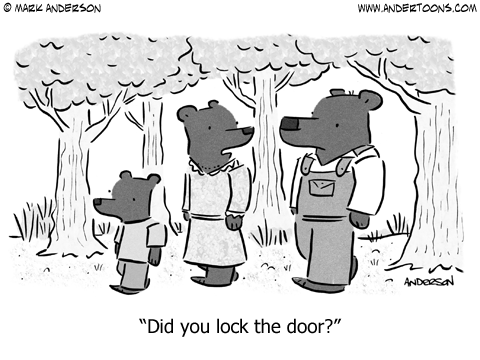
Door
by JOHN ADAMS •
Good morning, Whitewater.
Our Independence Holiday events begin today, on a day of sunny skies, a high of seventy-four, and winds of ten to fifteen mph.
Lightning stikes…Manhattan:
The Battle of Gettysburg ended on this day in 1863. Thereafter, the New York Times published reports between leading Union commanders, including this message from Maj. Gen. George Meade, the Union’s commanding general at Gettysburg:
July 4 — Noon
Maj.-Gen. Halleck:
The position of affairs is not materially changed since my last dispatch of 7 A.M.
We now hold Gettysburgh.
The enemy has abandoned large numbers of his killed and wounded on the field.
I shall probably be able to give you a return of my captures and losses before night, and a return of the enemy’s killed and wounded in our hands.
George G. Meade, Major-General
Here’s Puzzability‘s Thursday game in its C to Shining C series:
|
This Week’s Game — June 30-July 4
|
|||||
|
From C to Shining C
|
|||||
|
Some words are declaring their independence this July Fourth week. For each day, we started with a word or phrase that contains two C’s and in which the letters between the C’s spell a word or phrase. The answer phrase, described by each day’s clue, is the longer two-C piece followed by the shorter word or phrase.
|
|||||
|
Example:
|
|||||
|
Romantic flower that lasts for a tiny fraction of time
|
|||||
|
Answer:
|
|||||
|
Microsecond rose
|
|||||
|
What to Submit:
|
|||||
|
Submit the phrase, with the longer piece first (as “Microsecond rose” in the example), for your answer.
|
|||||
 |
|||||
|
Thursday, July 3
|
|||||
|
Here’s how:

Good morning, Whitewater.
We have an even chance of scattered showers this Wednesday, with a crisp high temperature of sixty-five. Sunrise today is 5:21 AM and sunset is 8:37 PM. The moon is a waxing crescent with twenty-four percent of its visible disk illuminated.
It turns out, perhaps, that some animals have set musical preferences. Chimpanzees, it seems, are among those animals:
…researchers found that while chimpanzees shun the steadily strong beats common in Western genres, they like Indian ragas and Akan tunes from West Africa.
“Our objective was not to find a preference for different cultures’ music,” study co-author Frans de Waal, a primatologist at Emory University in Atlanta, said in a statement. Rather, the researchers used music from Africa, India and Japan to test how the primates reacted to specific acoustic characteristics, such as the ratio of strong to weak beats (or stressed to unstressed beats).
De Waal and colleagues said that similar studies in the past only tested how chimpanzees reacted to Western music. But even though the sounds of Western pop and classical might seem different to the casual listener, they share similar rhythmic patterns and intervals. Musical traditions from other cultures, however, may have fundamentally different properties. While a typical Western song might have one strong beat for every one to three weak beats, an Indian raga (or series of notes in a classical composition) might have one strong beat for every 31 weak beats in a long rhythmic cycle.
Previous studies that focused on Western tunes found that primates preferred silence over any kind of human music. One study, published in the journal Cognition in 2007, found that marmosets and tamarins would rather listen to no music than Mozart or a lullaby.
For the new study, the researchers looked outside the Western canon and used Indian ragas, Japanese taiko, and music from the Akan culture in West Africa…
On this day in 1964, Pres. Johnson signs the Civil Rights Act.
Here’s the Wednesday game in Puzzability‘s C to Shining C series:
|
This Week’s Game — June 30-July 4
|
|||||
|
From C to Shining C
|
|||||
|
Some words are declaring their independence this July Fourth week. For each day, we started with a word or phrase that contains two C’s and in which the letters between the C’s spell a word or phrase. The answer phrase, described by each day’s clue, is the longer two-C piece followed by the shorter word or phrase.
|
|||||
|
Example:
|
|||||
|
Romantic flower that lasts for a tiny fraction of time
|
|||||
|
Answer:
|
|||||
|
Microsecond rose
|
|||||
|
What to Submit:
|
|||||
|
Submit the phrase, with the longer piece first (as “Microsecond rose” in the example), for your answer.
|
|||||
|
|||||
|
Wednesday, July 2
|
|||||
|
The risk of reliance on a big outside vendor for a big project in a small town is easily described:
The vendor will be everywhere initially, will purr contentedly during work, but disappear quickly after the final check clears.
It will want the money, will say anything to get it, but without any respect for those paying the bill.
The vendor will – falsely – assume a superiority over those local officials with whom it deals. Those local officials will – falsely – assume the vendor’s genuine respect and partnership, and so will lazily forgo due diligence over the project’s terms, work provided, and consequences thereafter.
It shouldn’t be this way; it often is.
Good morning, Whitewater.
Tuesday in Whitewater will be partly sunny with a high of seventy-seven.
Common Council i scheduled to meet tonight for a planning session @ 6 PM.
On this day in 1863, the Battle of Gettysburg begins:
The Battle of Gettysburg … was fought July 1–3, 1863, in and around the town of Gettysburg, Pennsylvania between Union and Confederate forces during the American Civil War. The battle involved the largest number of casualties of the entire war[7] and is often described as the war’s turning point.[8] Union Maj. Gen.George Meade‘s Army of the Potomac defeated attacks by Confederate Gen.Robert E. Lee‘s Army of Northern Virginia, ending Lee’s attempt to invade the North.
Here’s Puzzability‘s Tuesday game:
|
This Week’s Game — June 30-July 4
|
|||||
|
From C to Shining C
|
|||||
|
Some words are declaring their independence this July Fourth week. For each day, we started with a word or phrase that contains two C’s and in which the letters between the C’s spell a word or phrase. The answer phrase, described by each day’s clue, is the longer two-C piece followed by the shorter word or phrase.
|
|||||
|
Example:
|
|||||
|
Romantic flower that lasts for a tiny fraction of time
|
|||||
|
Answer:
|
|||||
|
Microsecond rose
|
|||||
|
What to Submit:
|
|||||
|
Submit the phrase, with the longer piece first (as “Microsecond rose” in the example), for your answer.
|
|||||
|
|||||
|
Tuesday, July 1
|
|||||
|
Update, 7.15.14: for a discussion of this rule as most fittingly applicable to full-time staff, see, Administration, Council, and the Tenth Man Rule.
In the science fiction novel World War Z, humanity fights a zombie war, and the book describes a look back after the war is over, with interviews of those who fought against the undead. (The film with Brad Pitt is loosely based on the book, but does not take a retrospective approach.)
One of the interviews in the book describes a supposed Israeli ‘Tenth Man Rule’ for planning: if nine in authority agree on a course of action, it’s the duty of the tenth to adopt a contrary approach, considering an opposite course of action or risk that the nine others have dismissed.
(There’s even some talk that Israel has an actual version of this rule for some strategic planning, but it’s mostly sketchy and nebulous talk.)
Regardless, consider what a Tenth Man Rule means, at a minimum:
It means that an organization will work to overcome group-thinking through a deliberate, required commitment to the exposition of an alternative view.
There’s nothing like this concept, so far as anyone can see, in any local government in our area.
Nothing.
There may be dissent from a conventional view, but no city or county in our area has a structure that by design requires a zealous and diligent exposition of an alternative view.
That alternative view may, of course, prove unfounded; it’s significant that no one locally even ponders alternatives as a formal and regular process of review.
On the contrary, most local institutions begin with a rough majority, and that majority works to impose its will by cajoling and badgering others within the group into acquiescence.
The failure to entertain alternatives initially means that local governments and institutions risk committing early and fully to ill-considered projects, only to be surprised when a program goes bad, lacks true public support, or meets with public scorn.
(In these situations, insular officials typically double and re-double their foolish initial positions, only exacerbating their distance from the communities they claim to serve.)
This failure also means that despite vast millions in funding, institutions that rush projects through an enforced consensus squander resources that might have helped them research alternatives more effectively than one person.
They waste their resource advantage, and worse, their cajoled consensus leads them in the wrong direction and prevents them from changing course.
Looking at local planning, the need for a mandatory, internal process of review is glaring.
In the end, neither nine nor ninety lemmings can match even a single man or woman considering alternatives initially.


