FREE WHITEWATER

Author Archive for JOHN ADAMS

Daily Bread for 6.30.14

Good morning, Whitewater.

Our month ends on a partly sunny day, with a high in the mid eighties, and southwest winds at five to ten mph. There is a probability of strong thunderstorms this evening.

What happens if you need to land your Harrier jet on the deck of a ship, only to find that your plane’s landing gear has malfunctioned? If you’re assigned to the USS Bataan, then your ship has a plan for just such a situation:

On this day in 1962, a no-hitter from a pitcher who’ll throw still more of them:

On June 30, 1962, Sandy Koufax strikes out 13 batters and walks five to lead the Brooklyn Dodgers to victory over the New York Mets 5-0 with his first career no-hitter. Koufax went on to throw three more no-hitters, including a perfect game on September 9, 1965, in which he allowed no hits and no walks.

Puzzability starts a new series entitled, From C to Shining C:

This Week’s Game — June 30-July 4
From C to Shining C
Some words are declaring their independence this July Fourth week. For each day, we started with a word or phrase that contains two C’s and in which the letters between the C’s spell a word or phrase. The answer phrase, described by each day’s clue, is the longer two-C piece followed by the shorter word or phrase.
Example:
Romantic flower that lasts for a tiny fraction of time
Answer:
Microsecond rose
What to Submit:
Submit the phrase, with the longer piece first (as “Microsecond rose” in the example), for your answer.
Monday, June 30
Groove made in the ground by a walking aid

Daily Bread for 6.29.14

Good morning, Whitewater.

Sunday will be partly cloudy, with a high of eighty-seven, and an even chance of rain tonight.

Here’s a recap of how the World Cup has progressed, through the initial, group rounds:

On this day in 1943, Pres. Roosevelt writes to J. Robert Oppenheimer, assuring him and his scientific colleagues of full support:

THE WHITE HOUSE
WASHINGTON
June 29, 1943

SECRET

My dear Dr. Oppenheimer:

I have recently reviewed with Dr. Bush the highly important and secret program of research, development and manufacture with which you are familiar. I was very glad to hear of the excellent work which is being done in a number of places in this country under the immediate supervision of General L.R. Groves and the general direction of the Committee of which Dr. Bush is Chairman. The successful solution of the problem is of the utmost importance to the national safety, and I am confident that the work will be completed in as short a time as possible as the result of the wholehearted cooperation of all concerned.

I am writing to you as the leader of one group which is to play a vital role in the months ahead. I know that you and your colleagues are working on a hazardous matter under unusual circumstances. The fact that the outcome of your labors is of such great significance to the nation requires that this program be even more drastically guarded than other highly secret war development. I have therefore given directions that every precaution be taken to insure the security of your project and feel sure that those in charge will see that these orders are carried out. You are fully aware of the reasons why your endeavors and those of your associates must be circumscribed by very special restrictions. Nevertheless, I wish you would express to the scientists assembled with you my deep appreciation of their willingness to undertake the tasks which lie before them in spite of the dangers and the personal sacrifices. I am sure that we can rely on their continued wholehearted and unselfish labors. Whatever the enemy may be planning, American science will be equal to the challenge. With this thought in mind, I send this note of confidence and appreciation.

Though there are other important groups at work, I am writing only to you as the leader of one which is operating under very special conditions, and to General Groves. While this letter is secret, the contents of it may be disclosed to your associates under pledge of secrecy.

Very Sincerely Yours

Franklin Delano Roosevelt

Dr. J. R. Oppenheimer
Post Office Box 1663
Santa Fe,
New Mexico

Daily Bread for 6.28.14

Good morning, Whitewater.

Today we’ll have a four-in-ten chance of afternoon showers, and a high of eighty-four.

Astronaut Reid Wiseman recently took a photo of thunderstorms as he saw them from the International Space Station.

On this day in 1914, a pair of killings lead to far worse:

On 28 June 1914, Archduke Franz Ferdinand of Austria, heir presumptive to the Austro-Hungarian throne, and his wife, Sophie, Duchess of Hohenberg, were shot dead in Sarajevo by Gavrilo Princip, one of a group of six assassins (five Serbs and one Bosnian Muslim) coordinated by Danilo Ili?. The political objective of the assassination was to break off Austria-Hungary’s south-Slav provinces so they could be combined into a Yugoslavia. The assassins’ motives were consistent with the movement that later became known as Young Bosnia. The assassination led directly to the First World War when Austria-Hungary subsequently issued an ultimatum against Serbia, which was partially rejected. Austria-Hungary then declared war, marking the outbreak of the war.

On this day in our own history, Gen. Atkinson advances:

1832 – Atkinson starts up Rock River in Black Hawk War

On this date General Henry Atkinson and the Second Army began its trip into the Wisconsin wilderness in a major effort against Black Hawk. The “Army of the Frontier” was formed of 400 U.S. Army Regulars and 2,100 volunteer militiamen in order to participate in the Black Hawk War. The troops were headed toward theLake Koshkonong area where the main camp of the British Band was rumored to be located. [Source: Along the Black Hawk Trail by William F. Stark, p. 93-94]


Friday Poll: Is There an Unjustified Bias in Favor of Inside Candidates?


On our campus, Christine Clements is leaving her position as dean of the College of Business and Economics to take a job elsewhere. Lois Smith, associate dean of that same college, will serve as the interim dean until the selection of a permanent replacement.

(I’ll assume that both Ms. Clements and Ms. Smith are wonderful people who are kind to children and small animals, and recycle plastics whenever possible.)

The change prompted a sharp reader kindly to suggest a poll about the selection of replacement officials for those who take jobs elsewhere or retire: How likely is it that Whitewater (city government or university) would choose an inside candidate rather than an outside candidate for a given position?

After all, American has 318 million people, the planet over seven billion, but Whitewater only fifteen-thousand residents; shouldn’t those numbers suggest that most replacement officials would be outside candidates?

And yet, it doesn’t seem to go that way, does it? Time after time, it’s one inside candidate after another getting job after job, or committee post after committee post.

What do you think? I there an unjustified bias in favor of inside candidates?

Daily Bread for 6.27.14

Good morning, Whitewater.

Friday brings us a partly sunny day, with a high of eighty-four, and a one-third chance of afternoon showers.

On this day in 1950, following a Communist invasion of the south, Pres. Truman orders U.S. forces to defend South Korea. The New York Times reported his decision:

Washington, June 27–President Truman announced today that he had ordered United States air and naval forces to fight with South Korea’s Army. He said this country took the action, as a member of the United Nations, to enforce the cease-fire order issued by the Security Council Sunday night.

Then acting independently of the United Nations, in a move to assure this country’s security, the Chief Executive ordered Vice Admiral Arthur D. Struble to form a protective cordon around Formosa to prevent its invasion by Communist Chinese forces.

Along with these fateful decisions, Mr. Truman also ordered an increase of our forces based in the Philippine Republic, as well as more speedy military assistance to that country and to the French and Vietnam forces that are fighting Communist armies in Indo-China.

Puzzability‘s Camp Out series ends with Friday’s game:

This Week’s Game — June 23-27
Camp Out
Hey, take a hike! For each day this first week of summer, we started with a phrase, removed the four letters in CAMP, and rearranged all the letters to get a new word or phrase. Both pieces are described in each day’s clue, with the longer one first.
Example:
Automobile that your employer lets you use; preschool writing implement
Answer:
Company car; crayon
What to Submit:
Submit both pieces, with the longer one first (as “Company car; crayon” in the example), for your answer.
Friday, June 27
Quintessentially British late afternoon refreshments; make something sound less important than it is

Show Your Work

We’re in a new round of big-project proposals for Whitewater.

Here’s a suggestion, that this municipal administration would do well to follow, for any large-scale proposal:

(1) Release any feasibility study, analysis, or performance contract on the city’s website a month (thirty calendar days) before Council consideration.

(2) Hold a public hearing specifically and exclusively on any major proposal.

(3) For proposals with a long-term environmental impact upon current residents and the next generation of residents, submit a final proposal to a city-wide vote no earlier than two months’ time after the release publicly of all feasibility studies, analyses, and performance contracts, etc.

If municipal leaders believe in their proposals, they will submit them into the marketplace of ideas with ample time for public consideration.

That’s not what’s happened with the initial performance contract from Trane, for example: that company didn’t have its document ready for the respective meeting packet at which it was to be discussed.

No doubt, a hungry pooch foiled that vast corporation’s original plan. They would have provided their documents sooner, I suppose, if only those papers hadn’t found themselves in a canine’s tummy.

(On a smaller financial scale, Dave Mumma of Janesville Transit has done the same thing to Whitewater: he’s sometimes held back his shoddy work until the last minute, literally bringing documents to Council just before he was about to speak.)

It’s a convenient way for a big vendor, etc., to conceal its work from those who will foot the bill.

Watching this municipal administration, one sees a contrast with the last one. Our former municipal manager was his own cheerleader, boosting ill-considered projects as though civilization depended on them. (He collected a few of similar ilk along the way.)

Our current municipal manager is better educated and more affable than his predecessor, and more outwardly cautious, too. He holds back at meetings, allowing his department heads to do the cheering for him.

Cheer they do – watching some of them, one might be forgiven for thinking that those department leaders worked for the very vendors whose projects the city administration should be scrutinizing.

They are so very eager, and at least one so callow, that one wonders: do you not understand these matters, or do you hope that others won’t?

It’s worthwhile to approach these proposals methodically and dispassionately. Here’s my method for blogging on a topic: (1) read, (2) walk around, (3) write initially, (4) ask informally of government (if useful), (5) submit formal requests if necessary, and (6) consider action at law as a regrettable but necessary last recourse.

(See, for an elaboration of these steps, Steps for Blogging on a Policy or Proposal.)

Deliberate, disciplined, determined.

If these gentlemen believe in their ideas – and they very much want the city to believe they do, and to support them – then surely they have the confidence to show their proposals to others for consideration.

It’s a simple suggestion:

Show your work.

Daily Bread for 6.26.14

Good morning, Whitewater.

Thursday will be mostly cloudy, with a high in the upper seventies, and winds from the east at 5 mph.

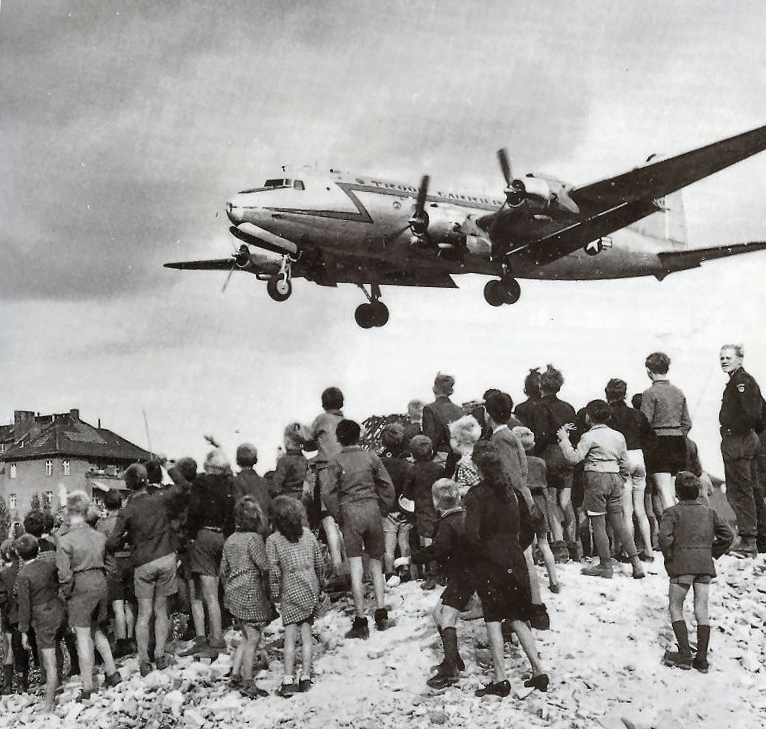
C-54landingattemplehof
Berliners watch a C-54 Skymaster land at Tempelhof Airport, 1948.
Via Wikipedia.

On this day in 1948, the United States and her allies begin the Berlin Airlift in response to a Soviet blockade of West Berlin:

The Berlin blockade (24 June 1948 – 12 May 1949) was one of the first major international crises of the Cold War. During the multinational occupation of post–World War II Germany, the Soviet Union blocked the Western Allies‘ railway, road, and canal access to the sectors of Berlin under allied control. Their aim was to force the western powers to allow the Soviet zone to start supplying Berlin with food, fuel, and aid, thereby giving the Soviets practical control over the entire city.

In response, the Western Allies organized the Berlin airlift to carry supplies to the people in West Berlin.[1][2] Aircrews from the United States Air Force, the British Royal Air Force, the Royal Canadian Air Force, the Royal Australian Air Force, the Royal New Zealand Air Force, and the South African Air Force[3]:338 flew over 200,000 flights in one year, providing up to 4700 tons of necessities daily, such as fuel and food, to the Berliners.[4]

By the spring of 1949 the airlift was clearly succeeding, and by April it was delivering more cargo than had previously been transported into the city by rail. The success of the Berlin Airlift brought embarrassment to the Soviets who had refused to believe it could make a difference. The blockade was lifted in May 1949 and resulted in the creation of two separate German states.[4] The Federal Republic of Germany (West Germany) and the German Democratic Republic (East Germany) split up Berlin.[4] Following the airlift, three airports in the former western zones of the city served as the primary gateways to Germany for another fifty years.[5]

Here’s Thursday’s Puzzability game:

This Week’s Game — June 23-27
Camp Out
Hey, take a hike! For each day this first week of summer, we started with a phrase, removed the four letters in CAMP, and rearranged all the letters to get a new word or phrase. Both pieces are described in each day’s clue, with the longer one first.
Example:
Automobile that your employer lets you use; preschool writing implement
Answer:
Company car; crayon
What to Submit:
Submit both pieces, with the longer one first (as “Company car; crayon” in the example), for your answer.
Thursday, June 26
Performer at The Punch Line or Carolines; price cut

Feasting on Wholly Unjustified Insecurities

I don’t know – truly – what need or desire causes a few people to yearn for the mere things of other places. 

Whitewater’s goal should be not a collection of objects, but an embrace of standards.  This should be so very clear: we don’t need to build new buildings, we need to assure sound institutions in conformity with America’s highest standards. 

What do you have, how do you look? 

No, and no again — a different question matters: What do you believe? 

(See, along these lines, How Many Rights for Whitewater?, What Standards for Whitewater?, and Why Whitewater?)

These local men who prey on the unjustified insecurities of others, or suffer an insatiable need to exaggerate to satisfy their own pride, are ignorant of what makes our city, state, and country exceptional: our liberties and the sound institutions flourishing through them. 

I think, sometimes, that such hucksters would try to sell ice to an Inuit if they had the chance.

We don’t need the buildings of Los Angeles; we need the best practices of America.

In any event, there is no fashion, no striking beauty of Los Angeles, and few objects therefrom that would not fade in our Wisconsin climate. 

We may be grateful for it. 

So much of policy here depends on convincing people that they need a particular project, all the while neglecting both those truly distressed and the higher standards that are the sound foundation of a better, more prosperous life.

We can and will do better.  One may be very sure of it.

Why Not Build Another Los Angeles (by the Bridge to Nowhere)?

image

Typical Los Angeles Resident

Los Angeles is America’s second-largest city, and is world-renowned for her diverse economy and global role in commerce, entertainment, and art.  All its people are reputed to be exceptionally beautiful, talented, and clever (at least by their own, uniform accounts).

If Los Angeles should be so valuable – and it is – why not build a second Los Angeles just outside Whitewater?  We could start the gateway to the project at the very spot where the Bridge to Nowhere ends.

If one city of the angels is good, wouldn’t two be far better? 

What if, since this project would be pricey, the U.S. Government would lend us the money?  Let’s say Uncle Sam would lend us a trillion dollars ($1,000,000,000,000.00) to start.  After all, America spent well over a trillion dollars in Iraq over the last decade. 

Should we start a Los Angeles 2.0?

If we build it, will they (super-smart, trendy people) not come to us in wave after wave?

There’s the big-talking developers’ problem: it’s only worthwhile if the gain (accurately measured) is more than the expense (fully calculated) of L.A. Part Deux. 

If simply building more of an expensive thing brought prosperity, every Whitewater resident would be building Phantoms, Ghosts, and Wraiths – and every resident would be prosperous by consequence.  

The climate of these times is filled with ‘if you build it, they will come’ projects. 

It’s so easy to say, so simple to talk up, and so few people press for details.

So, why not, big talkers? 

Just apply for some federal money.

If you don’t try to build another Los Angeles on the taxpayers’ tab, some other community might get that money.

Hurry now, there’s no time to lose…