Author Archive for JOHN ADAMS
Public Meetings
Landmarks Commisison
by JOHN ADAMS •
Public Meetings
Urban Forestry
by JOHN ADAMS •
Daily Bread
Daily Bread for 12.3.12
by JOHN ADAMS •
Good morning.
The week begins with an even chance of showers and a high of sixty-three.
At 5 PM this afternoon, Whitewater’s Parks & Rec Board meets.
On this day in 1776, Gen. Washington arrived at the banks of the Delaware River:
In a letter dated December 3, 1776, General George Washington writes to Congress from his headquarters in Trenton, New Jersey, to report that he had transported much of the Continental Army’s stores and baggage across the Delaware River to Pennsylvania.
In his letter Washington wrote, ‘Immediately on my arrival here, I ordered the removal of all the military and other stores and baggage over the Delaware, a great quantity are already got over, and as soon as the boats come up from Philadelphia, we shall load them, by which means I hope to have every thing secured this night and tomorrow if we are not disturbed.’
CNN has the story of a dog who’s a toddler’s best friend:
In 1947, a first for Wisconsin:
1947 – First TV Station in Wisconsin Established
On this date the first TV station in Wisconsin, WTMJ-TV in Milwaukee, was established. The seventeenth television station in the country, WTMJ-TV was the first in the Midwest. [Source: University of Wisconsin, Milwaukee Libraries]
Google’s Monday question is on geography: “The Canal Street Ferry will take you over to Algiers Point. Since when has this ferry been in service?”
Public Meetings
Parks & Rec Board
by JOHN ADAMS •
Sports
Pasadena
by JOHN ADAMS •
ROSE BOWL BOUND! #Badgers #champions pic.twitter.com/5xcekLej
— UW-Madison (@UWMadison) December 2, 2012
Recent Tweets, 11.25 to 12.1
by JOHN ADAMS •
— John Adams (@DailyAdams) December 2, 2012
Five myths about Apple – The Washington Post http://t.co/wN7Naauk
— John Adams (@DailyAdams) December 1, 2012
This Man Could Serve More Than 80 Years for Growing Medical Marijuana – National – Atlantic Wire http://t.co/fIkkEwAr
— John Adams (@DailyAdams) December 1, 2012
Sign of better times: 90% of Companies Will Throw Holiday Parties This Year – Atlantic Wire http://t.co/ILrXGEjw
— John Adams (@DailyAdams) December 1, 2012
When Internal Polls Mislead, a Whole Campaign May Be To Blame – Nate Silver @ http://t.co/YyIHs6Na http://t.co/fpuV3fiv
— John Adams (@DailyAdams) December 1, 2012
@TPM can't seem to find the libertarians…
— John Adams (@DailyAdams) November 30, 2012
Top Romney strategist: Failure to reach out to women, Hispanics biggest mistake #hindsight http://t.co/rEpHWSCr
— John Adams (@DailyAdams) November 29, 2012
Conservative Cronyism: America’s Sugar Policy – By @veroderugy– NRO http://t.co/kV1AUZlj via @#”
— John Adams (@DailyAdams) November 29, 2012
USA Today Publisher Larry Kramer: We're Not 'Unique Enough' to Charge for Web Access #paywall http://t.co/Zoqdhhs4
— John Adams (@DailyAdams) November 28, 2012
The Secret to Iranian Drone Technology? Just Add Photoshop http://t.co/bBy9vo1a
— John Adams (@DailyAdams) November 28, 2012
Why not just # ? Couple names baby Hashtag http://t.co/qZNL9mpM
— John Adams (@DailyAdams) November 28, 2012
Enemy of my enemy: China Teaching Asia to Fall in Love with Japan’s Military Buildup | Via Meadia http://t.co/BVWOzDKB
— John Adams (@DailyAdams) November 27, 2012
“Lincoln” and the Law | Marquette Law School Faculty Blog http://t.co/DvOTHiOJ
— John Adams (@DailyAdams) November 27, 2012
Fitting: Darter species found, named for politicians http://t.co/N1TadiHU http://t.co/Mm51LoBQ
— John Adams (@DailyAdams) November 27, 2012
Intrade shuts out American bettors http://t.co/EEF52vS1
— John Adams (@DailyAdams) November 27, 2012
Moving parts: What’s ahead for healthcare in Wisconsin? | The Wisconsin Happy Farm http://t.co/1ZiDhYJj
— John Adams (@DailyAdams) November 27, 2012
Online Black Friday sales top $1 billion http://t.co/cftWxPzj
— John Adams (@DailyAdams) November 26, 2012
Most People Are Pessimistic Over Fiscal Cliff Deal http://t.co/XUOFQZke
— John Adams (@DailyAdams) November 26, 2012
Cartoons & Comics
Sunday Morning Cartoon: The Snow Man (1940)
by JOHN ADAMS •
John Oakes offers a succinct description of the plot: “A group of furry South Pole animals build a snow man. They begin to throw snowballs at it. This make him come to life and oh what a vengence he has. Stomps around scaring the living daylights out of everyone. How will they stop him?”
The IMDB also catches a continuity goof at approx. 4:50 in the cartoon: “When the snow man sits down at the church organ, the stovepipe on his head disappears. It reappears in the next scene.”
Daily Bread
Daily Bread for 12.2.12
by JOHN ADAMS •
Good morning.
Whitewater’s Sunday looks to be cloudy with gradual clearing, and a high of fifty-four. We’ll have 9h 14m of sunlight, and 10h 17m of daylight. Tomorrow will be one minute shorter/.
On this day in 1954, the U.S. Senate voted to censure Wisconsin Senator Joe McCarthy. Here’s how the New York Times reported McCarthy’s politically fatal day:
Washington, Dec 2–The Senate voted 67 to 22 tonight to condemn Joseph R. McCarthy, Republican Senator from Wisconsin.
Every one of the forty-four Democrats present voted against Mr. McCarthy. The Republicans were evenly divided–twenty-two for condemnation and twenty-two against. The one independent, Senator Wayne Morse of Oregon, also voted against Mr. McCarthy.
In the ultimate action the Senate voted to condemn Senator McCarthy for contempt of a Senate Elections subcommittee that investigated his conduct and financial affairs, for abuse of its members, and for his insults to the Senate itself during the censure proceeding.
Google’s puzzle for today brings a geography puzzle: “What “autonomous region” includes nine major islands and an islet cluster, in three main groups?”
Animals
Dog imitates baby
by JOHN ADAMS •
h/t The Atlantic Wire. more >>
Daily Bread
Daily Bread for 12.1.12
by JOHN ADAMS •
Good morning.
It’s an even chance of Saturday rain for Whitewater, with a high of fifty-two.
On this day in 1824, Congress decides the outcome of a presidential election:
….Congress acts to decide a presidential election for the first time in history, giving the presidency to John Quincy Adams. A clause in the Constitution’s 12th Amendment puts the power of deciding an election in the hands of Congress if no candidate receives a majority of the Electoral College votes….
On Election Day, Adams and Jackson led the pack in electoral votes, but Clay and Crawford had garnered enough votes to prevent either from winning a majority. Adams received 84 electoral votes; Jackson won 99. By the terms of the 12th Amendment, Congress was tasked with deciding between the two candidates, who could not have been more different in style or policy. Adams, described by his opponents as a cold, calculating Yankee elitist contrasted with Jackson, who was portrayed (not inaccurately) as hot-headed and hell-bent on destroying federal institutions (such as the National Bank) that George Washington and the Federalists had worked hard to establish.
In the end, Speaker Clay used his influence to convince fellow lawmakers to cast their vote for Adams and he emerged victorious. Not surprisingly, Adams chose Henry Clay to be his secretary of state, an act that enraged Jackson and helped to unite what had been a fragmented Democratic Party. In the election of 1828, Jackson easily beat the incumbent Adams, and went on to serve until 1837.
On 12.1.1884, a fire changed life (temporarily) for students at UW-Madison:
1884 – Fire Destroys UW Building
On this date fire destroyed Science Hall on the UW-Madison campus. As a result, engineering students were forced to use the cramped space of the former dormitory, North Hall, for the next four semesters. [Source: College of Engineering, University of Wisconsin-Madison]
From Google’s daily puzzle, a question of bio-science: “What animal uses several layers of chromataphores to change its color based on its emotional state?”
Cats
Friday Catblogging: iPad-Playing Feline
by JOHN ADAMS •
Cat chases cyber mice.
Poll
Friday Poll: Whitewater’s first accumulated snowfall in the 2012-13 season?
by JOHN ADAMS •
Here’s a 2012-2013 version of a poll first published last year: when will Whitewater see her first accumulated snowfall in the 2012-13 season?
It’s mild weather ahead for the weekend, but when will that change into an appreciable snowfall? (Let’s call an appreciable snowfall at least one inch.) Comments are available, including for those outside the city who’d like to predict for their own communities.
My guess for Whitewater: December 23rd.
What do you think?
Beautiful Whitewater, City, Holiday, Press Release
Whitewater’s Annual Holly Days Events
by JOHN ADAMS •
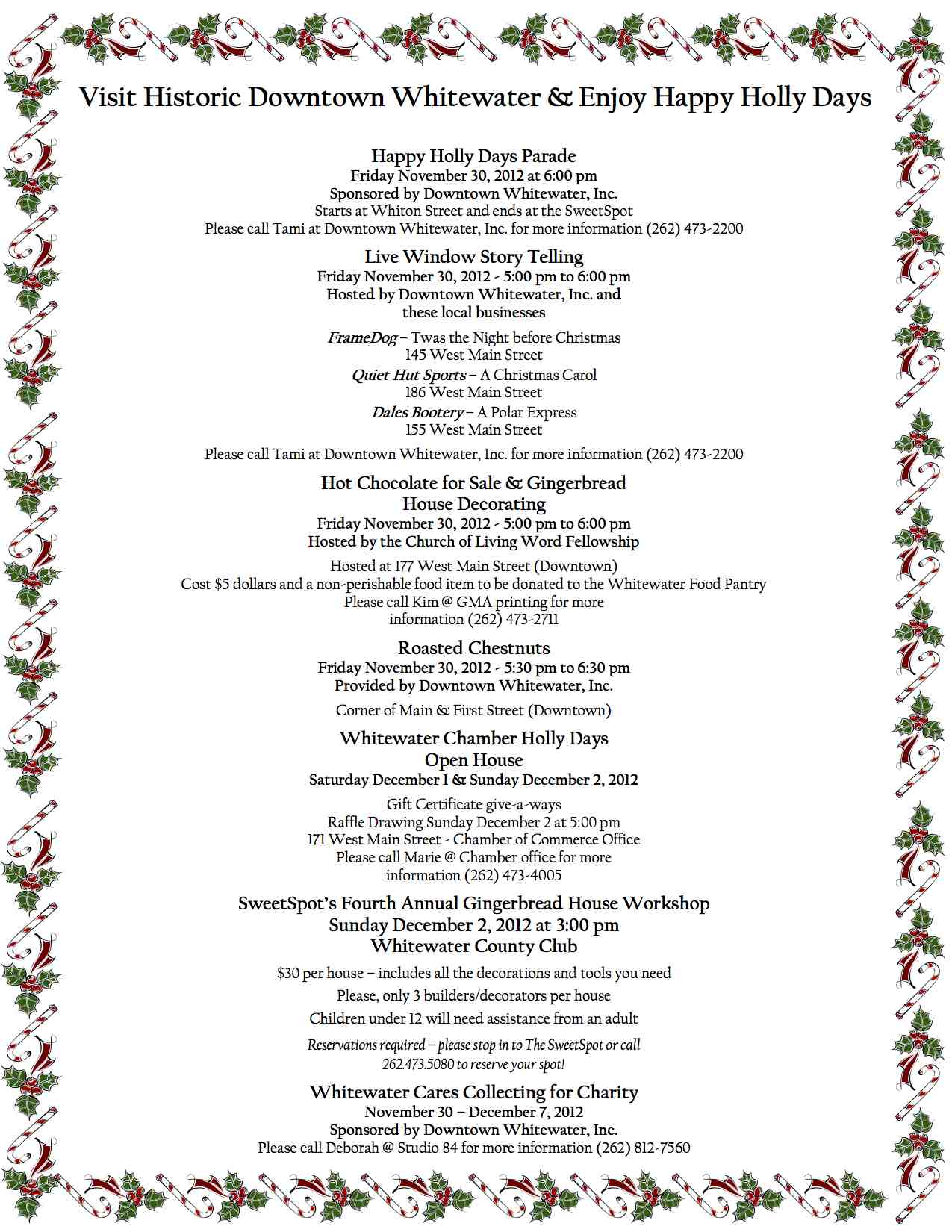
Tonight’s Whitewater’s annual Christmas parade, at 6 PM, beginning at Main & Whiton, traveling down Main, and turning on Whitewater Street toward the Cravath lakefront. Downtown Whitewater is the parade’s sponsor.
There’s a parade, of course, yet even more awaiting: live storytelling, hot chocolate for sale, gingerbread house decorating, roasted chestnuts, the Whitewater Chamber’s open house and raffle, a gingerbread house decorating workshop, and a collection for charity through 12.7. Clicking the list of activities below produces a full-size flyer.