At Whitewater’s January 18th common council meeting, City Manager Brunner offered remarks on Whitewater’s taxpayer-funded Innovation Center. Those remarks are recorded from 6:48 to 8:55 in the video embedded above.
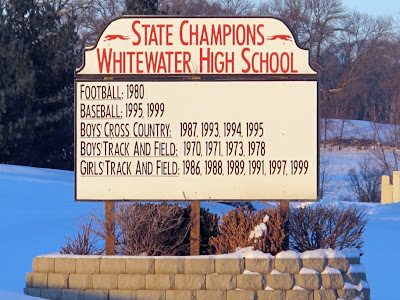
(Quick note: the best part of the session was a recognition ceremony for the national champion Warhawks, beginning around 3:30 into the video.)
But as for the Innovation Center, here are excerpts of City Manager Brunner’s remarks:
“…based upon some leases pending as well as the university’s commitment to putting some labs in the building, we have pre-leased 64.2% of the building…”
“…we have remaining about eighty-five hundred square feet…about 36%…”
“…we are looking for an open house, grand-opening for mid to late March…”
“…hope to have the governor and other dignitaries come to Whitewater for this event…”
I’ve a few questions.
What’s the use of this building?
It’s called an Innovation Center, so I’d guess taxpayers spent millions for a greater purpose than simply filling up space. (It’s not, after all, called the Storage Center.) First one heard that it would produce new and innovative products, then that it would be a business incubator, now the goal’s closer to the pedestrian one of finding anyone to take up space. The majority of the space has gone to existing public agencies that are not — by any stretch — tech companies.
Changing the name of the nearby street to ‘Innovation Drive’ is about as innovative as this project will be.
If the goal for the project has been lowered simply to filling space, then there are far worthier occupants than a public-agency anchor tenant relocated from another town. Whitewater would do better — considering how many poor people there are in Whitewater — to make the building a shelter and community center.
Here, I am wholly serious. Even with general doubts about public spending, I have no doubt that aid to the poor would be a better use of the millions spent than this flimsy excuse for a tech park.
What kind of tenant is the university, one of the parties to this project?
One can hardly have confidence in use of rental space that goes to one of the very parties to the deal, to put “some labs in the building.” If a man opened a shop to sell hats, and purchased twelve from his own inventory, those sales would hardly be considered proof of twelve paying customers.
What did the parties to the tech park promise in exchange for the millions they received from the federal government?
They promised the creation of a thousand jobs: the numeral one with three zeros behind it. That’s right — the federal grant’s “goal of the project is to create jobs to replace those lost in the floods of 2008 and those lost from recent automotive plant closures…”
What’s the incremental job gain from relocating a publicly-funded educational agency from one town (Milton) to another (Whitewater)?.
Nothing. The only gain is that public employees will find themselves in a nicer building, courtesy of taxpayer funds meant to create real jobs for struggling people.
So how big is this building anyway?
The city manager’s remarks inadvertently reveal not just his ever-lower standards for this building, but also show that usable office space in the building is far less than the touted total of thirty-seven thousand square feet.
Brunner’s remarks show that if there are about 8,500 square feet left, and that’s a remainder of 36% of the total rentable space, then this building only had about 24,000 square feet of rental space.
Now one sees — so very clearly — what it meant when a local politician crowed about the large size of the reception area and atrium! Those extra thousands of square feet for which you’ve paid may create a spacious look, but that view will only be useful to the unsuitable, shoe-horned tenants scraped up as occupants.
Another party.
The city manger observes that “we are looking for an open house, grand-opening for mid to late March…” That would be the third ceremony for this project, counting two — yes two — ground-breaking events.
Does Whitewater have a City Manager, or a Party Planner?
Dignitaries on the way!
There are public officials who may show up for an open house, I’d guess, especially if there’s free food.
And yet, what does this say about the city manager’s outlook, that he mentions ‘dignitaries’ but not ordinary residents? (On the matter of so-called ‘dignitaries,’ could one find a more fawning and servile expression, excepting perhaps the epithets ‘Overlords’ or ‘Very Important People’?)
The federal money for this grant was meant to create private jobs, but it will be people on the public tab who’ll show up to lap drinks, back-slap cronies, and map plans for their next big thing.
How’s that supposed second building coming along?
There was some breathless talk, months ago, about a second building, ‘on the heels’ of the Innovation Center. Even as baseless speculation, that rumor was particularly insubstantial. One can only find so many millions to waste on unsuitable tenants.
Eventually, someone’s likely to conclude: why not just throw all this money in a furnace, or down a rat hole, and save the trouble about excuses, exaggerations, rationalizations, and diverted city time and resources on another empty project?