
Daily Bread, Gubernatorial Race 2026, Wisconsin, WisDems, WISGOP
Daily Bread for 12.21.25: A Working Theory — The 2026 Wisconsin Gubernatorial Race Will Be a Referendum on Federal Policy
by JOHN ADAMS •
Good morning.

Winter1 begins in Whitewater with sunny skies and a high of 28. Sunrise is 7:22 and sunset is 4:23 for 9 hours 1 minute of daytime. The moon is a waxing crescent with 2.4 percent of its visible disk illuminated.
On this day in 1913, Arthur Wynne, a journalist born in Liverpool, England, publishes a “word-cross” puzzle in the New York World that embodied most of the features of the modern crossword puzzle genre. This puzzle is frequently cited as the first crossword puzzle, and Wynne as the inventor. An illustrator later reversed the “word-cross” name to “cross-word.”
Yesterday, FREE WHITEWATER published PBS Wisconsin Interviews of Candidates Running for Governor.
This libertarian blogger holds the working theory (shared by many) that the 2026 Wisconsin gubernatorial race will be a referendum on federal policy. See It’s Who Was Missing from That Candidates’ Forum That Matters Most (11.9.25: “Our state politics is a proxy for national politics. There’s no evidence that this will change by next November, or for years afterward”) and Assessing Teasers and Speculation About Wisconsin Elections for 2026 (10.6.25: “There’s much about 2026 that’s yet to be decided, but one influence that’s certain. Wisconsin voters’ views of federal policy will shape the 2026 state races, whichever candidates are nominated”).
There are contrary views (that this candidate or that, that this state matter or another) may be decisive. They’re unpersuasive. See The Wisconsin Gubernatorial Race Will Be a National Race.
It’s true that particular statewide candidates, some stronger and some weaker than others, will make a difference. Mostly, however, the degree to which they more effectively support or reject federal policy will be their path to success.
Local races may remain local (although that will vary across the state).
Statewide, however? That’s national now.
_____
- Winter: the second-best season, after fall. In your hearts, you know I’m right about this. Even now, you’re probably wishing it were colder. ↩︎
Vladdie the Canadian Adventure Cat in Training is prepping for the season:
Click image to play video.
Daily Bread, Gubernatorial Race 2026, Wisconsin, WisDems, WISGOP
Daily Bread for 12.20.25: PBS Wisconsin Interviews of Candidates Running for Governor
by JOHN ADAMS •
Good morning.
Saturday in Whitewater will be mostly cloudy with a high of 38. Sunrise is 7:22 and sunset is 4:23 for 9 hours 1 minute of daytime. The moon is a waxing crescent with 0.4 percent of its visible disk illuminated.
On this day in 1940, Captain America Comics #1, containing the first appearance of the superhero Captain America, is published.
Organized by party, then alphabetically.
WISGOP
WISDEMS
CDA, City, Daily Bread, Open Government
Daily Bread for 12.19.25: What a Thorough Review Looks Like
by JOHN ADAMS •
Good morning.
Friday in Whitewater will be partly sunny with a high of 22. Sunrise is 7:21 and sunset is 4:23 for 9 hours 2 minutes of daytime. The moon will be new this evening.
On this day in 1972, the last crewed lunar flight, Apollo 17, carrying Eugene Cernan, Ronald Evans, and Harrison Schmitt, returns to Earth.
It takes time beforehand, and time in presentation, to address an organization’s condition, finances, and outlook. When that organization is a public one, then the presentation should be a public one (conducted as frequently as necessary to apprise the community).
On December 18, Whitewater’s current Community Development Authority heard a presentation on outstanding loans, the condition of loan fund accounts, and a discussion of selected CDA programs. See Video from 7:22 to 1:14:49.
The key points: someone has to believe that a presentation is owed to the community, has to perform the background research, and thereafter present his or her findings.
Whitewater will do best with good research, good analysis, and good discussion.
That’s what happened here; that’s as it should be.
Hubble captures pair of large bodies colliding in nearby star system:
Accidents, Cats, Weird Tales
Friday Catblogging: Cat in Maine Rescued After Being Frozen to a 95-Foot-Tall Tree
by JOHN ADAMS •
It’s all true.
See Christopher Burns, Lincoln firefighter rescues tuxedo cat stuck 95 feet up in a tree for 2 days, Bangor Daily News, December 17, 2025.
Budget, City, Daily Bread
Daily Bread for 12.18.25: A Baseless Speculation About the City of Whitewater’s Salary Scale
by JOHN ADAMS •
Good morning.
Thursday in Whitewater will see light rain with a high of 48. Sunrise is 7:20 and sunset is 4:22 for 9 hours 2 minutes of daytime. The moon is a waning crescent with 2.1 percent of its visible disk illuminated.
Whitewater’s Community Development Authority meets at 5:30 PM.
On this day in 1865, Secretary of State William Seward proclaims the adoption of the Thirteenth Amendment, prohibiting slavery throughout the United States.
Yesterday’s post mentioned that there were other points about the City of Whitewater’s budget to consider. I’ll take up one of those points today, about City of Whitewater employees’ positions on the city salary scale.
CLAIM: “I think you have gone in a lot of your employment brackets where you’re hiring or you have staff that you are moving a lot of people up to the top part of the bracket.” See Video @ 28:13, December 2, 2025 Common Council meeting.
CITY REPLY:
As of December 5, 2025, the City employs 119 individuals, of whom only 10 employees are currently
compensated at the top of their designated salary range. Of these 10 employees:
- 2 are recent hires, whose placement reflects market conditions and the qualifications necessary to
successfully recruit for their positions; and- 8 employees have served the City for no fewer than 18 years, with the majority exceeding 20 years
of service. These individuals have reached the top of their respective ranges through long-term
tenure, sustained performance, and adherence to the City’s established compensation structure.- On average, employees across the City are positioned at 53.74% of their respective salary ranges.
This means that, on average, employee pay sits just over halfway between the minimum and
maximum of each position’s established range.
Salary placement decisions are influenced by various factors including, but not limited to, market
competitiveness, availability and qualifications of applicants, internal equity, and the City’s ability to
recruit and retain skilled employees.
(Emphasis added.) See Employee Salary Ranges Memo, City of Whitewater, December 16, 2025.
ASSESSMENT: The claim on December 2 came from a student-rental landlord who was, it turns out, speculating baselessly. (About what he thought, which it turned out had no factual basis.) ‘Just asking questions,’ that sort of thing. It’s as though Edna and Gertrude took their across-the-clothesline conversation to the Whitewater Common Council lectern.
The speculation was always an improbability: an organization of the City of Whitewater’s size is too small to hire heavily at the top of the scale; that practice comes, if at all, only in much larger organizations with far more employees to bear the weight of top-scale salaries for a few. It’s only a much larger organization — public or private — that would be able to do so (or would even try to do so). The December 2 question comes from a failure to understand the load-bearing requirements of scale.
For an employer like the City of Whitewater (or Fort Atkinson, Milton, etc.) the best you’re hoping for is to attract employees who like public work and (this is key) stay in public work because they like their colleagues. (Legal and medical clinics attract talent the same way — dedication to the work and affection for colleagues. It’s not for salary, honest to goodness; they’d make far more in the private sector.)
Although the claim about the salary scale was easily refuted, it has another attribute. It’s uncreative. If someone wants to advance a conspiratorial claim, why not go big?
Something like this: Is it true that Bigfoot keeps an office in Whitewater’s municipal building?
‘Cause, you know, I saw something on the internet…

Budget, City, Daily Bread, Fire Dept, Police, Public Safety
Daily Bread for 12.17.25: Public Safety, Referendums, and Responsibility in Whitewater
by JOHN ADAMS •
Good morning.
Wednesday in Whitewater will be mostly sunny with a high of 37. Sunrise is 7:20 and sunset is 4:22 for 9 hours 2 minutes of daytime. The moon is a waning crescent with 5.7 percent of its visible disk illuminated.
Whitewater’s Parks and Recreation Board meets at 5:30 PM.
On this day in 1665, the first account of a blood transfusion is published, in the form of a letter from physician Richard Lower to chemist Robert Boyle, in Philosophical Transactions of the Royal Society.
Some of our fellow residents this December opened their property-tax bills and felt an uncomfortable jolt. How did taxes jump like this? That reaction is natural and understandable. A few remarks follow about taxes.
Portions of these increases are from operations (day-to-day functions of the city) and others are from necessary — often delayed from the last decade — capital expenses (renovation or construction projects). A significant part of the operational-level increase came from a referendum for police and emergency services that voters approved this spring in April 2025.
(In fact, Whitewater’s voters have approved two public safety referendums — one for Fire & Emergency Services staffing on November 8, 2022, and one for Police and Fire & Emergency Services staffing on April 1, 2025. I supported both referendums. See In Support of Whitewater’s Fire & EMS Referendum, Fire & Rescue, Whitewater’s Most Important Public Policy Accomplishment of the Last Generation, and Referendums: “The loss of the municipal referendum [on police staffing] would have increased burdens on the workforce (as rejection would have worked an attitudinal burden all its own on existing employees.”)
My remarks concern policies of and within the City of Whitewater, where I am a resident and property owner: residing here in the city, not across the town line; owning a home here in the city, not elsewhere; voting as part of this city’s electorate, not with a different one; loving this small and beautiful community, above any other. Here now forever, happily and thankfully so.
Neither of my votes rested on what city officials, other city employees, police officers, firefighters, or emergency responders might want — my votes rested on my own judgment and discernment. I chose freely — and with confidence — as I felt best1. That’s all anyone can do, and all anyone should do.
Yet, I understand that these operational referendums came at a cost. No decision on public costs is an easy one.
This libertarian2 blogger has been a sometime critic of policing in Whitewater, but that criticism of policing was always grounded in wanting a better force, not a diminished or overburdened one3. Indeed, the traditional — and candidly correct — understanding of government’s chief role is to provide for public safety. A society that cannot or will not establish a government to advance public safety (at home and from abroad) is a society that does not understand government’s paramount justification.
When a community cannot staff emergencies reliably — when it can’t cover multiple calls, when it can’t sustain patrol, when dispatch is stretched, when responders are pulled from one crisis to gamble on another — then the rest of civic life becomes empty theater.
If anything, many of these public safety additions should have come by the end of the last decade.
These safety referendums led to most of the City of Whitewater’s increase in the operational tax levy. From 2021 to 2025, the operational levy increased $2.73 million. Of that, $2.4 million (90%) comes from the two voter-approved public referendums. The remaining 10% comprises ordinary contributors like property value changes and new construction. (Of the April 2025 safety referendum, the City of Whitewater even pared back an initial recommendation for staffing, doing what it could to request fewer personnel through its referendum.)
This matters because it punctures the easiest accusation: that Whitewater’s city council acted recklessly by going to referendum. It did not. On the contrary, this has been a cautious body. The world is full of reckless people; they are not sitting on this council. (For those seeking the reckless, I’d be happy to point readers in the right direction.)
Whitewater is a whole community of fifteen thousand, and to remain a viable community of fifteen thousand she requires stable, secure services. Voters acted sensibly by approving these measures.
Of capital costs, one can say sincerely and straightforwardly, without the slightest sarcasm — one wishes that buildings and capital lasted longer and cost less to repair. That’s not anyone’s situation — not anyone in America. It’s all costly. If some of our hiring should have come sooner (five or ten years sooner), then the same is even more true about capital projects that we might have done earlier, at less expense. The last decade’s mistakes are, however, past mistakes — all people act only from the margin of the present, looking forward.
There are other concerns some have raised about staffing additions that I’ll address in another post.
That part of the December 16 meeting of the Whitewater Council included residents’ tax and budget questions should neither surprise nor startle; we do not live in easy times. It’s not mere platitude to say so, but rather an acknowledgement of society’s collective condition.
Partway into the meeting, our community heard that this council will “see what the world would look like with a no tax increase option going into next year…two budgets, the one with nothing, no increase, and then the one with the net new construction increase, the small amount allowed under levy limits, and that’ll both go through finance committee.”
That commitment is from a local government taking matters seriously and responding prudently.
This is a budget, and these are safety referendums, deserving ongoing support.
See City of Whitewater, Understanding the Impact of the Recent Referendum on Your Property Taxes, December 2025 and Referendum Tax Outcome Explained (Video). See also FREE WHITEWATER, Whitewater Common Council Adopts a Modern Budget.
_____
- Nothing about my views on public policy over these many years has depended on pleasing a few (obviously); it’s enough to make (what one believes) are the right choices. ↩︎
- Tenets, plainly summarized. ↩︎
- I have never once called for the abolition of any American police force, anywhere. Critical of former leaders sometimes, but of the necessity of police forces, never. ↩︎
Daily Bread, Law, Misconduct, Wisconsin
Daily Bread for 12.16.25: Wisconsin Now Requires Schools to Notify Parents Promptly of Sexual Misconduct Allegations
by JOHN ADAMS •
Good morning.
Tuesday in Whitewater will be partly cloudy with a high of 36. Sunrise is 7:19 and sunset is 4:21 for 9 hours 2 minutes of daytime. The moon is a waning crescent with 10.3 percent of its visible disk illuminated.
The Whitewater Common Council meets at 6 PM.
On this day in 1864, the Battle of Nashville ends as the Union Army of the Cumberland under General George H. Thomas routs and destroys the Confederate Army of Tennessee under General John Bell Hood, ending that army’s effectiveness as a combat unit.
At long last, it is Wisconsin law that schools must notify parents promptly of sexual misconduct toward children in the school’s care:
Wisconsin schools must now notify a student’s parent or guardian promptly if their child is the alleged victim of a sexual offense by a school employee or volunteer, under a bill signed into law this month.
Gov. Tony Evers signed the Republican-led bill into law Dec. 9. The new requirements set a timeline for public, charter and private schools to notify parents when allegations of sexual misconduct by school staff involve their children.
A co-sponsor of the measure, Rep. David Steffen, R-Howard, said in a statement the bill was “eminently necessary” because the state previously had no specific timeline to notify parents of such incidents.
Under the new law, schools must provide notice no later than 5 p.m. the same day if a report is received during school hours, or by noon the next calendar day if the report is received after school hours.
See Kayla Huynh, Schools must notify parents of sexual misconduct under new Wisconsin law, Milwaukee Journal Sentinel, December 16, 2025.
In a well-ordered school district, officials would promptly, as a matter of moral obligation, report alleged injuries to the parents of affected children even without any legal requirement to do so. Wisconsin institutions and officials are too often lacking, so the law must enter to compensate as best as it can for deficiencies of individual character. There will still be efforts to evade legal responsibility as there have been efforts to evade moral responsibility.
Some officials, however, will be persuaded under law to act rightly on this fundamental duty where they would not have done so otherwise.
In the video below, Kristin Brey addresses the companion issue of the Wisconsin Department of Public Instruction’s many failures to track cases and inform communities of misconduct:
Conspiracy Theories, Daily Bread, Health, Sen. Ron Johnson, Wisconsin
Daily Bread for 12.15.25: Ron Johnson Endorses Discredited Medical Claims (Yet Again)
by JOHN ADAMS •
Good morning.
Monday in Whitewater will be windy with a high of 24. Sunrise is 7:18 and sunset is 4:21 for 9 hours 3 minutes of daytime. The moon is a waning crescent with 16.7 percent of its visible disk illuminated.
The Whitewater School Board meets at 6 PM. Whitewater’s Police and Fire Commission also meets at 6 PM and the Library Board at 6:30 PM.
On this day in 1791, the Bill of Rights becomes law following ratification by the Virginia General Assembly.
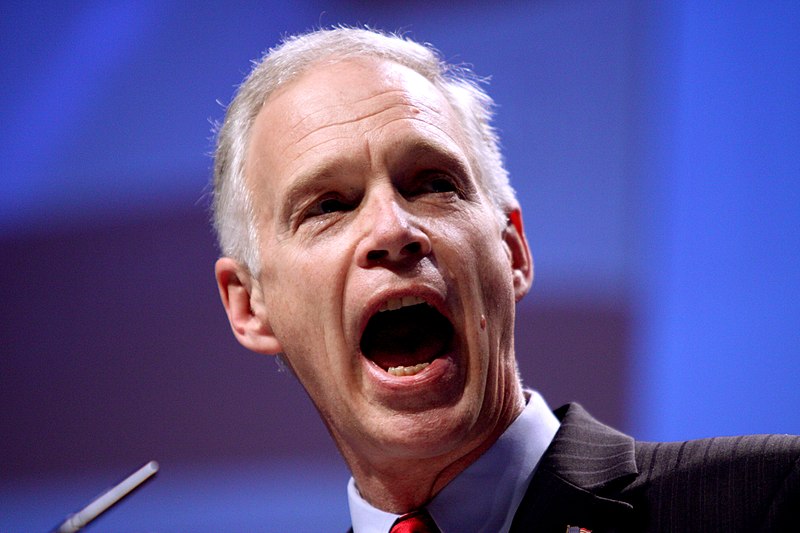
Sen. Ron Johnson’s habit of endorsing and promoting unfounded and discredited claims is unmatched in Wisconsin. He’s working to extend his lead among conspiracy theorists:
For years, Sen. Ron Johnson has been spreading conspiracy theories and misinformation about COVID-19 and the safety of vaccines.
He’s promoted disproven treatments for COVID-19 and claimed, without evidence, that athletes are “dropping dead on the field” after getting the COVID-19 vaccination. Now the Wisconsin politician is endorsing a book by a discredited doctor promoting an unproven and dangerous treatment for autism and a host of ailments: chlorine dioxide, a chemical used for disinfecting and bleaching.
The book is “The War on Chlorine Dioxide: The Medicine that Could End Medicine” by Dr. Pierre Kory, a critical care specialist who practiced in Wisconsin hospitals before losing his medical certification for statements advocating using an antiparasite medication to treat COVID-19. The action, he’s said, makes him unemployable, even though he still has a license.
Kory has said there’s a globally coordinated campaign by public health agencies, the drug industry and the media to suppress evidence of the medicinal wonders of chlorine dioxide. His book, according to its website, contends that the “remarkable molecule” works “to treat everything from cancer and malaria to autism and COVID.”
The book jacket features a prominent blurb from Johnson calling the doctor’s treatise: “A gripping tale of corruption and courage that will open eyes and prompt serious questions.”
Chlorine dioxide is a chemical compound that has a range of applications, including as a disinfectant and deodorizer. Food processing plants apply it to sanitize surfaces and equipment. Hospitals use it to sterilize medical devices, and some municipalities use low levels to treat public water supplies. Paper mills rely on it to whiten wood pulp. Safety experts advise those who handle it to work in well-ventilated spaces and to wear protective gloves.
Concentrations in drinking water systems higher than 0.8 milligrams per liter can be harmful, especially to infants, young children and fetuses, according to the Environmental Protection Agency.
…
It is not medicinal, despite Kory’s contention. “It is all lunacy. Absolutely, it’s 100% nonsense,” said Joe Schwarcz, director of McGill University’s Office for Science and Society in Montreal and an expert on the threat of pseudoscience.
See Megan O’Matz, Senator Endorses Discredited Doctor’s Book on a Chemical He Claims Treats Everything From Autism to Cancer (‘Wisconsin’s Ron Johnson has a history of spreading vaccine misinformation. Now he’s giving credence to assertions about the therapeutic powers of chlorine dioxide, a disinfectant and deodorizer. “It is all lunacy,” one expert said’), ProPublica, December 11, 2025.
Sen. Joe McCarthy was a destructive conspiracy theorist, yet Johnson overmatches even McCarthy for the number of ludicrous claims made in one lifetime. There is an entire FREE WHITEWATER category dedicated to Johnson and his many false claims.
Turn aside, now, from a conspiracy theorist’s latest dark composition to something enduringly bright. Sophia Smith Galer discusses Handel’s Ariodante:
Click image to play video.
Holiday, Music
Monday Music: Charlie Parker Plays White Christmas
by JOHN ADAMS •
Congress, Courts, Daily Bread, Litigation, Wisconsin
Daily Bread for 12.14.25: Plaintiffs in Wisconsin Congressional Redistricting Cases Propose Different Timelines
by JOHN ADAMS •
Good morning.
Sunday in Whitewater will be mostly sunny with a high of 9. Sunrise is 7:18 and sunset is 4:21 for 9 hours 3 minutes of daytime. The moon is a waning crescent with 25.1 percent of its visible disk illuminated.
On this day in 1911, Roald Amundsen‘s team, comprising himself, Olav Bjaaland, Helmer Hanssen, Sverre Hassel, and Oscar Wisting, becomes the first to reach the South Pole.
By order of the Wisconsin Supreme Court, there are two judicial panels (composed of three circuit court judges) with each panel hearing one of two challenges to Wisconsin’s current congressional districts. See Wisconsin Supreme Court Appoints Redistricting Panels. The different plaintiffs in the two cases have proposed different timelines for remedies for their claims:
While both lawsuits are being filed by liberal firms, the attorneys handling the cases are raising different arguments and suggesting very different timelines.
Should judges in both cases follow a more protracted schedule, neither would be resolved until 2027.
One lawsuit, filed by the national Democratic firm Elias Law Group on behalf of Wisconsin voters, argues Republicans gerrymandered the state’s eight congressional districts so six of them favor GOP candidates. Elias attorney Julie Zuckerbrod called for scheduling the case in two phases so that a new map could be enacted before November 2026.
An attorney for the Wisconsin Elections Commission told judges it needs to know what that map looks like before March 1. Attorneys representing the state’s six Republican congressmen and the GOP-controlled Legislature said that’s impossible.
Zuckerbrod said “it’s absolutely possible” and pointed to the Wisconsin Supreme Court’s 2023 decision striking down Republican-drawn state Assembly and Senate maps as a roadmap. She said in that case, justices considered legal arguments for what new legislative maps should look like “over the course of just a couple weeks.”
…
The other lawsuit, filed by the liberal firm Law Forward on behalf of a group called Wisconsin Business Leaders for Democracy, argues Wisconsin’s congressional map was drawn to favor incumbents above all else.
But in a hearing on that case Friday, all parties agreed on a calendar stretching well past the 2026 midterms with a potential trial date of March 29, 2027.
Dane County Circuit Court Judge David Conway, one of the three judges considering that lawsuit, thanked the attorneys for the joint scheduling recommendations, noting that he and the two other county judges on the panel will work as quickly as possible.
“Nevertheless, we’re circuit court judges,” Conway said. “We do not have the resources of federal court judges. We don’t have a full staff of clerks, and we’re going to need time to work across county lines to make decisions together.”
In the other case being brought by Elias, Dane County Judge Julie Genovese signaled her panel may follow a similar timeline.
“We’ll do the best that we can,” Genovese said. “But you know, we have to digest these issues.”
See Rich Kremer, Judges hold hearings on Wisconsin map lawsuits, but signal decisions will take time (‘Democratic firm Elias Law Group says new maps possible before 2026 midterms. Liberal firm Law Forward agrees with 2027 trial date’), Wisconsin Public Radio, December 12, 2025.
See also Bothfeld v. Wisconsin Elections Commission, 2025 WI 53, No. 2025XX1438 (Wis. Nov. 25, 2025) (order) and Wis. Business Leaders for Democracy v. Wisconsin Elections Commission, 2025 WI 52, No. 2025XX1330 (Wis. Nov. 25, 2025) (order).
Reasoned estimate, grounded in both the legal basis and political implications of these proceedings: if the panels were to decide for the plaintiffs in either case, the choice would be the later, 2027, timeline.
Gas explosion caught on doorbell camera destroys home in California:
Blogging, City, Daily Bread, Reading, Reasoning, Writing
Daily Bread for 12.13.25: An Anecdote About Design
by JOHN ADAMS •
Good morning.
Saturday in Whitewater will be cloudy with a high of 7. Sunrise is 7:17 and sunset is 4:21 for 9 hours 4 minutes of daytime. The moon is a waning crescent with 33.2 percent of its visible disk illuminated.
On this day in 1962, NASA launches Relay 1, the first active repeater communications satellite in orbit.
There is, or there should be, a calculated order to writing. Reasonable patience underlies that calculated order: not too soon, not too late. In the language of the law, some questions are not yet ripe. They may seem so, but they’re not yet so, if thoroughly considered.
This brings me to an anecdote, from around the time FREE WHITEWATER first began, in 2007. A resident emailed me back then, expressing a concern about this website. She observed that another website in town at that time was a revealing expression of its author’s personality: colorful, exuberant, a kind of heart-on-one’s-sleeve publication.
By contrast, she saw FREE WHITEWATER‘s design as cold, distant, and unrevealing of my personality.
I thought after considering her message: hasn’t she considered the possibility that cold and distant are expressions of my personality?
Her observation comes to mind now and again, even these many years later, and it always delights.
When and how to present is a discipline and requires discipline. There’s design but underneath design lies by design.
Before pen hits paper, and before fingers strike the keyboard, there’s much that’s simply observing, reading, listening, and considering. Empirical comes before, and shapes, the polemical. Not too soon; not too late. All of this is, or at least should be, by design.
December in Whitewater is almost always a fraught time1. It’s Hanukkah and Christmas, but it’s also, not uncommonly, a time of heightened political concern in this town.
These concerns matter, of course. They matter enough, truly, to hear the full discussion and argumentation about them.
_____
- Late March in Whitewater is typically another time like this. I take gear with me when I travel — phone, laptop, pens, pencils, notebook, reference books on Kindle — and there has never been a March vacation where they’ve not come in handy for one local controversy or another. Whitewater is always on my mind. ↩︎
Aerial video shows severe flooding in Washington state:
Daily Bread, Health, Vaccines, Wisconsin
Daily Bread for 12.12.25: Wisconsin Sensibly Stays the Course on Childhood Vaccination
by JOHN ADAMS •
Good morning.
Friday in Whitewater will be mostly cloudy with a high of 25. Sunrise is 7:16 and sunset is 4:20 for 9 hours 4 minutes of daytime. The moon is a waning crescent with 42.9 percent of its visible disk illuminated.
On this day in 2000, the United States Supreme Court releases its decision in Bush v. Gore.
Wisconsin health officials have sensibly ignored a loud faction’s campaign against childhood vaccinations:
Wisconsin health officials say all babies should be vaccinated against hepatitis B at birth despite a recent change from federal vaccine advisers.
Last week, the Advisory Committee on Immunization Practices recommended that babies receive the hepatitis B shot in the first 24 hours of life if their mothers tested positive for the virus or if the mothers’ status is unknown. The recommendation, which goes to the Centers for Disease Control and Prevention, says women who test negative for the virus should talk to their doctors about the vaccine.
Dr. Ryan Westergaard, chief medical officer at the Wisconsin Department of Health Services, said Thursday that decades of evidence supports hepatitis B vaccination as a safe and effective strategy to protect infants.
…
Hepatitis B is a serious viral infection that affects the liver, and can lead to lifelong disease including liver failure and cancer. Up to 90 percent of infants who are infected will develop chronic liver disease. But in adults, an infection can be asymptomatic. Roughly half of people with hepatitis B don’t know they carry the virus.
Since the universal birth dose recommendation was adopted in the 1990s, pediatric hepatitis B infections have declined by 99 percent, according to Westergaard. He said there were no cases in Wisconsin newborns last year, and the state has seen between 0 and 2 cases annually over the last decade.
“That success reflects a simple, reliable approach that aims to protect every baby, including when screening and follow up doesn’t go perfectly in the real world,” Westergaard told reporters.
See Hope Kirwan, Wisconsin reaffirms support of hepatitis B vaccine for newborns, defying federal advisers (‘CDC advisory committee voted last week to end recommendation of a universal birth dose. But state health officials are directing Wisconsin doctors to carry on with the 30-year standard of care’), Wisconsin Public Radio, December 11, 2025.
Hiker mired in quicksand in Utah’s Arches National Park is rescued unharmed:
Accidents, Cats
Friday Catblogging: A Virginia Kitten Behaving Badly
by JOHN ADAMS •
He had his reasons.