Sunday in Whitewater will be partly sunny with a high of 67. Sunrise is 5:15 and sunset is 8:34 for 15 hours 19 minutes of daylight. The moon is new this evening with none of its visible disk illuminated.
On this day in 1777, the Second Continental Congress passes the Flag Act of 1777 adopting the Stars and Stripes as the flag of the United States:
Resolved, That the flag of the thirteen United States be thirteen stripes, alternate red and white; that the union be thirteen stars, white in a blue field, representing a new Constellation.
The Wisconsin Supreme Court’s decision to take up the case comes nearly a year after it denied Elias’ petition asking justices to take the case up directly. In November, the majority appointed a panel of three county judges to hear the Elias suit and another to hear a different map challenge brought by liberal Wisconsin firm Law Forward.
It was an untested path to get a redistricting case before the Supreme Court, which relied on a 2011 law passed when Republicans controlled the Legislature and governorship. The panels dismissed both cases, citing the inability of lower-court judges to overrule the Supreme Court, which enacted the congressional map in 2022 during another redistricting legal battle.
While Elias filed a notice that it will appeal the panel’s ruling, no briefs had been filed as of Thursday evening explaining what parts of the panel’s decision it disagrees with.
Attorney Bryna Godar with the State Democracy Research Initiative at the University of Wisconsin-Madison told WPR the Supreme Court will have to decide if Elias’ partisan gerrymandering claims can proceed.
“That doesn’t necessarily mean that the court will resolve all of the issues in these cases right away,” said Godar. “If the court concludes that these claims are available under the Wisconsin Constitution, then it’s possible that they would send the case back to the three judge panels for further fact finding and a specific ruling on whether these maps violate the state constitution.”
Two points come to the fore. First, the disposition of these cases will not affect the 2026 congressional district maps. Any decision here would apply to the maps for our 2028 congressional election.
Second, when conservative justices on the court call these appeals ‘political,’ and thus illegitimate, they should recall that the least-change doctrine they created and imposed on Wisconsin’s prior maps was an unprecedented alteration of our elections law perpetuating political decisions from a decade earlier. For a critique of that former conservative majority’s approach, see Johnson v. Wisconsin Elections Commission, 136 Harv. L. Rev. 998 (2023) (‘Wisconsin Supreme Court Adopts New Election Maps that Change Existing Districts Least, Regardless of Partisan Bias’):
In Johnson I, the Wisconsin Supreme Court carved out a new form of entrenchment protecting the state’s biased maps. Scholars have called entrenchment “the fundamental problem . . . that defines . . . election law.”97 Partisan gerrymanders, for instance, are insidious in part because they entrench themselves politically. Voters who want to get rid of the gerrymander often must vote out a party that has stacked elections in its favor. Just as partisan gerrymanders advantage gerrymanderers politically, Johnson I’s doctrinal gerrymander — selectively moving a disfavored remedy into a more demanding rights test — advantaged gerrymanderers in court. The justices thereby created a new form of entrenchment: a doctrinal skew that tilts the legal playing field against arguments for unwinding a gerrymander and toward arguments for perpetuating it. That choice, in turn, entrenches Wisconsin’s biased maps more deeply than ever.
Consideration of an appeal against our current congressional maps is, at bottom, to redress a lingering unfairness in those maps.
Upcomingposts (in no decided order): A Whitewater Comparative Analysis, Whitewater’s Workforce, Outcome-Driven Argumentation, and a New Ethics Ordinance.
FIFA is spending millions to create consistent, natural-grass playing surfaces across all 16 stadiums hosting the 2026 World Cup. Because many of these venues in the U.S. were designed for NFL football rather than soccer pitches, the project requires massive transformations at each venue. Grass for the new playing surfaces must be grown at specialized turf farms, transported across the continent, and installed in stadiums across North America, each with its own unique climate, design, and challenges.
Saturday in Whitewater will be partly sunny with a high of 84. Sunrise is 5:15 and sunset is 8:34 for 15 hours 19 minutes of daylight. The moon is a waning crescent with 4 percent of its visible disk illuminated.
Upcomingposts (in no decided order): A Whitewater Comparative Analysis, Whitewater’s Workforce, Outcome-Driven Argumentation, and a New Ethics Ordinance.
Friday in Whitewater will see sunny skies with a high of 80. Sunrise is 5:15 and sunset is 8:33 for 15 hours 18 minutes of daylight. The moon is a waning crescent with 9.9 percent of its visible disk illuminated.
The dandy-horse was a two-wheeled vehicle, with both wheels in line, propelled by the rider pushing along the ground with the feet as in regular walking or running. The front wheel and handlebar assembly was hinged to allow steering. The dandy horse was capable of more than doubling the average walking speed, to around 10 mph (16 km/h) on level ground.
Performative lying — where someone lies boldly — is the order of the day at 1600 Pennsylvania Avenue, N.W., Washington, D.C. and 1100 S. Ocean Blvd, Palm Beach, Florida. Perhaps Derrick Van Orden would have been a blatant liar without inspiration, but one supposes it’s easier for him when he need only mimic the style so much in fashion at those addresses.
Did Donald Trump’s signature 2025 legislation cut Medicaid spending by $1 trillion over a decade?
Yes.
Federal legislation known as the “One Big Beautiful Bill Act” included an estimated $1 trillion in cuts to Medicaid spending over the next decade.
Passed in 2025, the bill included tax cuts and increased spending on immigration enforcement and the military, offset by nearly $1 trillion in cuts to Medicaid, according to the Congressional Budget Office.
If the bill were truly beautiful, Van Orden would have no reason to deceive. Assuming that Van Orden is not in his cups when speaking (and at least he appears sober in the clip embedded above), then he’s simply lying.
_____
Upcomingposts (in no decided order): A Whitewater Comparative Analysis, Whitewater’s Workforce, Outcome-Driven Argumentation, and a New Ethics Ordinance.
Feline features stare out from the covers of umpteen novels, they have an officially designated day devoted to their mystique and popularity, and have outnumbered dogs as pets for a decade.
The influence of cats is evident across every corner of Japanese society, with a recent report crediting them with generating an expected ¥3tn ($18.8bn) in value to the Japanese economy this year – a phenomenon dubbed “catnomics.”
The power of the paw is especially evident in one retro neighbourhood of Tokyo, where on a recent afternoon North American, Australian and European visitors milled around the capital’s self-proclaimed “cat town.”
[…]
In a nation of pet lovers – where domesticated dogs and cats outnumber children aged under 15, Japanese households kept 8.8 million cats in 2025, compared with 6.8 million dogs, according to a survey by the Japan Pet Food Association. The average cat-owning household, the survey said, spends almost ¥1.8m ($11,300) over the course of their moggy’s life.
It is that level of devotion that makes cats big business. In his most recent report on “catnomics”, Katsuhiro Miyamoto, professor emeritus at Kansai University, estimates that animals will add just under ¥3tn ($18.8bn) in value to the Japanese economy in 2026.
Combining estimates of consumer spending at cat cafes and on items such as photo books with sales and salaries among cat food manufacturers and related companies, Miyamoto noted that the estimate fell just short of beating the economic impact of the 2025 World Exposition in Osaka.
Thursday in Whitewater will see evening thunderstorms with a high of 80. Sunrise is 5:16 and sunset is 8:33 for 15 hours 17 minutes of daylight. The moon is a waning crescent with 18.4 percent of its visible disk illuminated.
On this day in 1936, inventor Edwin Armstrong demonstrates FM broadcasting to an audience of engineers at the FCC in Washington, DC.
Jeffrey Dahmer was accused of multiple murders committed in Milwaukee. He was tried in Milwaukee County in 1992 on the question of whether he was responsible for his actions, and was found responsible for his crimes, without mental disease or defect. Dahmer received a fair trial. His actions were all over the news, yet he received a fair trial.
Now along comes James Troupis, charged in Dane County with multiple felony counts for his alleged role in a fraudulent electors’ scheme after Biden carried Wisconsin in the 2020 election. Troupis claims, among other defenses, that he cannot get a fair trial in Dane County. He’s asking for a change of venue to another county.
Does James Troupis believe that he’s more notorious than Jeffrey Dahmer? Dahmer received a fair trial in Milwaukee County; Troupis — far less known or controversial than a cannibalistic killer — would receive a fair trial in Dane County.
In one brief, Troupis’ attorneys argued that the publicity that has surrounded the case for the last half-decade has irreparably hurt Troupis’ ability to get a fair trial. They argue that Dane County public figures including state Supreme Court justices and Madison Mayor Satya Rhodes Conway disparaged Troupis, and that local media has tainted public opinion.
I’ll not venture whether any of Troupis’s defense motions will be granted (he has through counsel filed more than one motion).
It’s enough to know that other Wisconsin counties have held trials — fairly and efficiently — for acts and culpability alleged within their borders by defendants far more notorious than Jim Troupis will ever be.
_____
Upcomingposts (in no decided order): A Whitewater Comparative Analysis, Whitewater’s Workforce, Outcome-Driven Argumentation, and a New Ethics Ordinance.
Whale bones and ancient fossils have been discovered on the ocean floor, concentrated in a deep groove known as the Diamantina Zone. Researchers used the Fendouzhe submersible to descend into the largely unexplored depths and were amazed to find deep-sea creatures living on fallen whale bones as well as hundreds of fossils. The oldest fossil was dated to over 5 million years and another represented a previously unknown species of extinct beaked whale. Read the paper: https://www.nature.com/articles/s4158… 0:00 The whale necropolis 1:10 Journey to the bottom of the ocean 1:49 Deep-sea creatures living on whale falls 2:50 Discovering fossils 4:12 A million-year-old map of beaked whale evolution 5:39 The mystery of the Diamantina Zone’s huge whale graveyard 7:32 The deepest whale fall ecosystem and a unique site in paleontology
Wednesday in Whitewater will see intermittent afternoon and evening thunderstorms with a high of 85. Sunrise is 5:16 and sunset is 8:33 for 15 hours 17 minutes of daylight. The moon is a waning crescent with 27.9 percent of its visible disk illuminated.
On this day in 1999, in the Kosovo War, NATO suspends its airstrikes after Slobodan Milosevic agrees to withdraw Serbian forces from Kosovo.
The greatest trick that Whitewater’s special-interest men ever pulled was convincing anyone, even themselves, that they had any credible economic insights to offer.1 They have been the champions of Trump’s losing ideas.2 It’s been hocus pocus all the way down. Yet again, one sees how much damage their candidates and their outlook have inflicted on American consumers:
U.S. inflation accelerated for a third-straight month in May amid a stalemate in negotiations to end the war with Iran, likely keeping interest rate cuts from the Federal Reserve at bay.
The Consumer Price Index report rose 4.2 percent in May from a year earlier, new data from the Bureau of Labor Statistics showed on Wednesday. That is up from a 2.4 percent annual increase before the conflict in the Middle East started in February and is the fastest pace since April 2023. Over the course of the month, overall prices jumped 0.5 percent.
Energy prices drove the bulk of the increase in May. Once those were stripped out alongside food prices, the “core” index rose 2.9 percent on a year-over-year basis, a 0.1 percentage point decrease from April’s annual rate. Core prices rose 0.2 percent for the month.
Energy costs have been spilling into categories where they make up a large chunk of the ultimate price tag, including food and airline fares. For the Federal Reserve, which will vote next week on whether to change interest rates, the most important question is whether stickier categories like manufactured goods and services — the core inflation — are also being affected.
The war in the Middle East is not the only factor pushing prices up. The data center boom has created demand for the memory chips that go into nearly all consumer electronics, reversing a long slide in the cost of technology. And a persistent drought has thinned out production of some crops and livestock, especially beef.
Upcomingposts (in no decided order): A Whitewater Comparative Analysis, Whitewater’s Workforce, Outcome-Driven Argumentation, and a New Ethics Ordinance.
The conflict in the Middle East is causing price hikes and product shortages across the global economy, from fertilizer to semiconductors. For medical supply company Gentell, which sources raw materials from around the world, the crisis at the Strait of Hormuz is causing volatility for its business. CNBC’s Pippa Stevens takes a look at how the company is faring amid the latest global supply chain disruptions.
Tuesday in Whitewater will be mostly cloudy with a high of 84. Sunrise is 5:16 and sunset is 8:32 for 15 hours 16 minutes of daylight. The moon is a waning crescent with 38.4 percent of its visible disk illuminated.
On Monday evening, Whitewater’s Planning and Architectural Commission recommended amending Whitewater’s zoning ordinances to allow for family child care centers as a conditional use within enumerated residential districts. See Planning Commission Agenda Packet, Items 5 and 6, (Jun. 8, 2026). The amendments would incorporate existing state standards for these family-based centers. The Whitewater Common Council should adopt the Planning Commission’s recommendations and amend the city’s zoning ordinances as proposed.
While this libertarian blogger does not have, and will not have, particular suggestions1 about the operation childcare in the city, the easing of zoning restrictions for family-based care has long been a libertarian proposal to expand childcare opportunities. See generally Chelsea Follett, Childcare and Child Raising, Cato Inst. (Apr. 16, 2026). Regarding zoning, Follet proposes:
Make home-based childcare legal “by right” and override exclusionary zoning. Home day cares are among the fastest ways to expand childcare capacity because they have lower fixed costs than large centers. Zoning and permitting hurdles choke off this supply channel. Allowing home-based childcare by default increases entry, expands neighborhood options, and broadens quality-price bundles for parents.
Whitewater’s Planning Commission recommended these changes as a conditional use. That’s a step in the right direction, but only if planning approval of conditional use permits isn’t a slow process. It should not be — pondering how many conditions can dance on the head of a pin only impedes opportunities (and discourages businesses of all kinds from choosing Whitewater).
Legal by right would have been an optimal proposal; these recommended changes to the city’s ordinances are, nonetheless, a confident step toward more opportunities for childcare. The Whitewater Common Council would be sensible to adopt Planning’s recommendations.
_____
One doesn’t have to be a watchmaker to grasp that it’s hard to make a watch. A single part wrongly placed confounds the device. ↩︎
_____
Upcomingposts (in no decided order): A Whitewater Comparative Analysis, Whitewater’s Workforce, Outcome-Driven Argumentation, and a New Ethics Ordinance.
Monday in Whitewater will be rainy with a high of 81. Sunrise is 5:16 and sunset is 8:31 for 15 hours 15 minutes of daylight. The moon is in its last quarter with 49.1 percent of its visible disk illuminated.
Whitewater’s Plan & Architectural Review Commission meets at 6 PM.
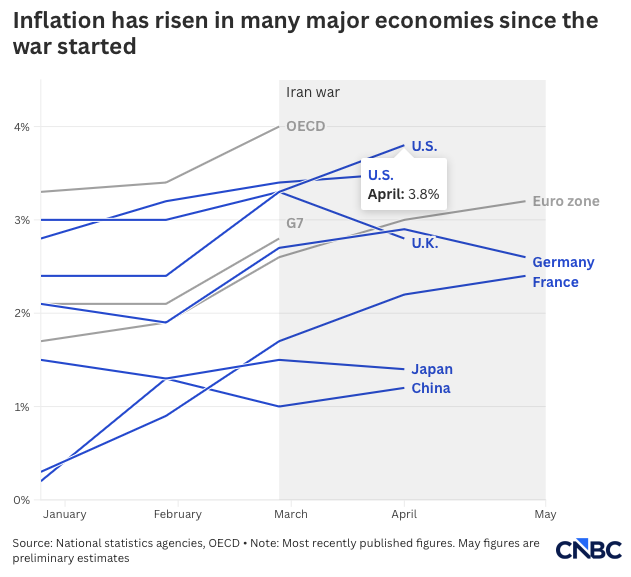
Economic data has started to show the broader impact the war is having beyond financial markets.
As the ongoing war keeps energy costs high, inflation prints across various major economies have begun to show prices rising — driven by surging costs of oil, gas, jet fuel and gasoline.
In the U.S., the consumer price index hit an annual rate of 3.8% in April, its highest level in almost three years.
Dwindling energy supplies from the Middle East have been a major driver of inflation upticks, although surging prices have prompted government interventions from some countries, including Germany and India.
It’s almost as though this calm, cool, and collected gentleman’s election was a mistake.
_____
Upcomingposts (in no decided order): A Whitewater Comparative Analysis, Whitewater’s Workforce, Outcome-Driven Argumentation, and a New Ethics Ordinance.
Sunday in Whitewater will see a mixture of clouds and sun with a high of 81. Sunrise is 5:16 and sunset is 8:31 for 15 hours 15 minutes of daylight. The moon is a waning gibbous with 60.1 percent of its visible disk illuminated.
On this day in 1975, Sony launches Betamax, the first videocassette recorder format.
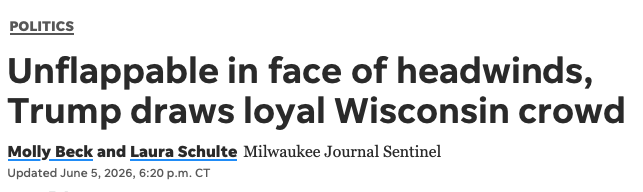
There’s a silly headline at the Journal Sentinel for a story on Trump’s Friday visit to Wisconsin:
At the Journal Sentinel and other newspapers, a headline isn’t always a reporter’s choice, but may instead be a decision between reporter and editor, or editor alone. (USA Today Co., Inc., formerly known as Gannett, publishes the Journal Sentinel.) In any event, choosing a headline that describes Trump as unflappable reveals a deficient grasp of an ordinary English word.
As with millions of others, English is my first language, and I’ve spoken it for a considerable time. Having met many other English-language speakers, I’ll venture confidently that no one with even a rudimentary grasp of that large-vocabulary language would describe Trump as unflappable. (That is, “persistently calm, whether when facing difficulties or experiencing success; not easily upset or excited.”)
There’s nothing about a temperamental, whining, excuse-making, vindictive Mar-a-Lago man that meets the definition of unflappable. He’s certainly not persistently calm, and a setting among devotees and sycophantic officials was hardly a test of remaining calm.
The Journal Sentinel has fallen on hard times, and their circulation is in steep decline. Misusing the language in which the paper is published cannot be helping their prospects.
_____
Upcomingposts (in no decided order): A Whitewater Comparative Analysis, Whitewater’s Workforce, Outcome-Driven Argumentation, and a New Ethics Ordinance.
Saturday in Whitewater will be mostly sunny with a high of 86. Sunrise is 5:17 and sunset is 8:30 for 15 hours 13 minutes of daylight. The moon is a waning gibbous with 68.9 percent of its visible disk illuminated.
On this day in 1944, the Allied invasion of Normandy begins with the execution of Operation Neptune — commonly referred to as D-Day — the largest seaborne invasion in history. Nearly 160,000 Allied troops cross the English Channel with about 5,000 landing and assault craft, 289 escort vessels, and 277 minesweepers participating. By the end of the day, the Allies have landed on five invasion beaches and are pushing inland.
He promised a quick end to the war in Iran. He held up photographs of various Washington improvement projects, including the “reflecting pond.” He complimented the physiques of male athletes. He listened as people praised him.
At an event held at a rural farm in Wisconsin on Friday, President Trump treated his supporters to a rhetorical lineup very similar to most of his recent Oval Office appearances, and reminded them that he could be doing something else.
“I don’t need this, I got elected, what the hell do I have to be here for?” Mr. Trump said to a crowd of people who had braved a rainy day to hear him speak. “I’m doing this because I like the farmer,” he said, adding: “I could be home right now in the beautiful White House, enjoying watching somebody else on television talking.”
Upcomingposts (in no decided order): A Whitewater Comparative Analysis, Whitewater’s Workforce, Outcome-Driven Argumentation, and a New Ethics Ordinance.
Friday in Whitewater will see scattered showers with a high of 76. Sunrise is 5:17 and sunset is 8:29 for 15 hours 12 minutes of daylight. The moon is a waning gibbous with 77.7 percent of its visible disk illuminated.
On this day in 1947, in a speech at Harvard University, Secretary of State George Marshall calls for economic aid to war-torn Europe, a proposal that would come to be developed and known as the Marshall Plan.
It says nothing good about the quality of prior leadership in this city that a former school board president and former chairman of the Community Development Authority has been perseverating for months over a contrived, counterfactual scenario. Embedded below are this gentleman’s relevant public comments from the February 3 and June 2 meetings of the Whitewater Common Council.
In December of last year, on 12.16.25, the Whitewater Common Council heard a presentation from residents about using a portion of the Innovation Center for an early childhood project. While the Council did not act on the proposal itself, at that very meeting the municipal administration proposed to confer with the United States Economic Development Administration (EDA) about that possible use of the Center. (A portion of the funds to build the Center came from the Economic Development Administration; such grants often have conditions on their use.)
Here is an accurate timeline of events:
12.16.25: Presentation from leaders of the early childhood project.1 See Video 2025-12-16-Common Council at 3:14.
12.16.25: Statement from the city administration that they were drafting a letter to the EDA inquiring about the permissibility of a childcare operation within the Center. See Video 2025-12-16-Common Council at 50:46.
1.26.26: Email reply from the EDA informing the City of Whitewater that “childcare centers are not within EDA’s authorities, and using the proposed portion of the building for this purpose would take the grant out of compliance.” SeeCommon Council Meeting Agenda Packet, Item 16, Request for EDA Review and Guidance on Innovation Center Use Modification (Feb. 3, 2026).
1.26.26 and 1.28.26: City of Whitewater tells proponents of the early childhood project and existing tenants, respectively, that the early childhood project would not be a possibility for the Innovation Center. SeeCommon Council Meeting Agenda Packet, Item 15, Status of Innovation Center EDA Grant and ECEC (Feb. 3, 2026).
2.3.26: City of Whitewater describes this account of events in open-meeting remarks during that evening’s session. See Video 2026-2-03-Common Council at 14:36.
2.3.26: Despite the accurate account in the Common Council packet for 2.3.26, the former school board president and former chairman of the Community Development Authority claims, despite the explanation earlier in that very meeting, and contrary to the matter-of-fact EDA response to the city, that the city might have faced a claim for return of a portion of the Innovation Center’s grant money. See Video 2026-2-03-Common Council at 24:22.
6.2.26:Four months later, the former school board president and former chairman of the Community Development Authority continues to claim that the city might have faced a claim for return of a portion of the Innovation Center’s grant money. See Video 2026-6-02-Common Council at 37:03.
This gentleman’s argument rests on a hypothetical so contrived that it tells more about manufactured contentions than about real events. A weak claim is a weak claim no matter how often it’s repeated, and no matter how much it satisfies the claimant.
There was never a genuine risk to the City of Whitewater for loss of the Innovation Center’s grant money. Not even the risk of a single copper coin: the Council entertained a single presentation on the use of the Center, the administration thereafter inquired promptly of the EDA, received a cordial, businesslike reply from the EDA, and the matter was thereafter closed.
Claims to the contrary are like insisting that a woman who carried an umbrella would have become wet if she hadn’t carried the umbrella. And yet, and yet —she did carry the umbrella, she did open it promptly, and so she did stay dry.
This libertarian blogger saw the presentation that evening; I am familiar with the claims presented. Today’s post, however, does not address the project; this is a post on the city’s inquiry about locating the project at the Innovation Center, and parade-of-horribles accusations since. My purpose should be clear. ↩︎
_____
Upcomingposts (in no decided order): A Whitewater Comparative Analysis, Whitewater’s Workforce, Outcome-Driven Argumentation, and a New Ethics Ordinance.