
New Shepard flight on April 2, 2016 showing flight of the booster from just ahead of reentry through descent and landing. Video is from the GH2 vent camera located just below the booster’s ring fin.
Daily Bread
Daily Bread for 5.14.16
by JOHN ADAMS •
Good morning, Whitewater.
Saturday in town will be partly cloudy and windy with a high of forty-nine. Sunrise is 5:31 AM and sunset 8:10 PM, for 14h 39m 21s of daytime. The moon is a waxing gibbous with 57.6% of its visible disk illuminated.
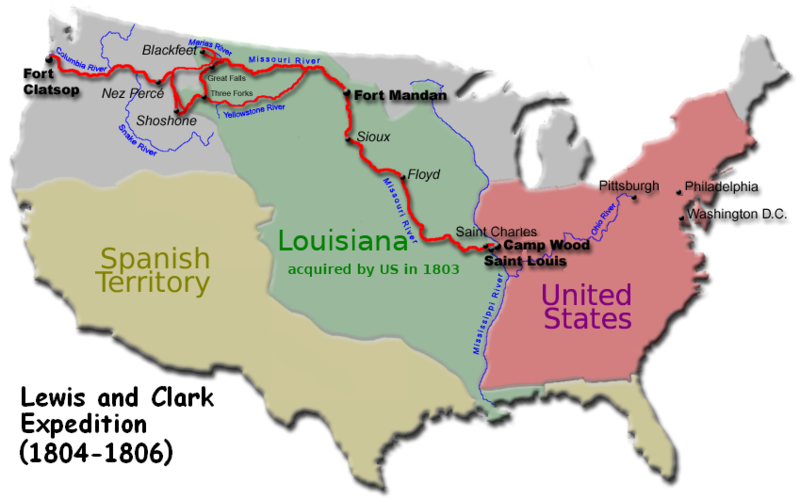
The Corps of Discovery departed from Camp Dubois at 4 p.m. on May 14, 1804, and met up with Lewis in St. Charles, Missouri, a short time later, marking the beginning of the voyage to the Pacific coast. The Corps followed the Missouri River westward. Soon they passed La Charrette, the last Euro-American settlement on the Missouri River.
The expedition followed the Missouri through what is now Kansas City, Missouri, and Omaha, Nebraska. On August 20, 1804, Sergeant Charles Floyd died, apparently from acute appendicitis. He was the only member of the expedition to die, and was among the first to sign up with the Corps of Discovery. He was buried at a bluff by the river, now named after him, in what is now Sioux City, Iowa. His burial site was marked with a cedar post on which was inscribed his name and day of death. A mile up the river the expedition camped at a small river which they named Floyd’s River.[40][41][42] During the final week of August, Lewis and Clark reached the edge of the Great Plains, a place abounding with elk, deer, bison, and beavers.
The Lewis and Clark Expedition established relations with two dozen Indian nations, without whose help the expedition would have risked starvation during the harsh winters and/or become hopelessly lost in the vast ranges of the Rocky Mountains.[43]
On this day in 1953, Milwaukee brewery workers strike:
Milwaukee brewery workers begin a 10-week strike, demanding contracts comparable to those of East and West coast workers. The strike was won when Blatz Brewery accepted their demands, but Blatz was ousted from the Brewers Association for “unethical” business methods as a result. The following year Schlitz president Erwin C. Uihlein told guests at Schlitz’ annual Christmas party that “Irreparable harm was done to the Milwaukee brewery industry during the 76-day strike of 1953, and unemployed brewery workers must endure ‘continued suffering’ before the prestige of Milwaukee beer is re-established on the world market.”
Cats
Friday Catblogging: Why Do Cats Act So Weird?
by JOHN ADAMS •
Drink, Marketing, Poll
Friday Poll: A New (Temporary) Name for Budweiser?
by JOHN ADAMS •
One reads that for the next several months, Budweiser beer cans will be labeled not with Budweiser, but with America. See, Budweiser has a new name, and that name is America @ CNBC:
Daily Bread
Daily Bread for 5.13.16
by JOHN ADAMS •
Good morning, Whitewater.
The end of the week brings rain, with a high of sixty-one, to town. Sunrise is 5:32 AM and sunset 8:09 PM, for 14h 37m 16s of daytime. The moon is a waxing crescent with 47.2% of its visible disk illuminated.
On this day in 1940, Churchill declares his resolve:
…as Winston Churchill takes the helm as Great Britain’s new prime minister, he assures Parliament that his new policy will consist of nothing less than “to wage war, by sea, land and air, with all our might and with all the strength that God can give us; to wage war against a monstrous tyranny, never surpassed in the dark, lamentable catalogue of human crime.”
Emphasizing that Britain’s aim was simply “victory, victory at all costs, victory in spite of terror, victory however long and hard the road may be.” That very evening, Churchill was informed that Britain would need 60 fighter squadrons to defend British soil against German attack. It had 39.
Within a couple of weeks, the conservative, anti-Socialist Churchill, in an effort to make his rally cry of victory a reality, proceeded to place all “persons, their services, and their property at the disposal of the Crown,” thereby granting the government the most all-encompassing emergency powers in modern British history….
On this day in 1864, Wisconsinites defending the Union engage in Georgia:
1864 – (Civil War) Battle of Resaca, Georgia, Opens
The Battle of Resaca was part of the Union’s Atlanta Campaign. From May 13-16, 1864, more than 150,000 soldiers clashed outside Georgia’s capital city, including 10 Wisconsin regiments. On May 13, the Union troops reconnoitered the Confederate lines to prepare for the next day’s combat.
A Google a Day asks a history question: “The general who directed the project responsible for the “Fat Man” graduated from what alma mater in 1918?”
Film, Restaurant
Spinning Plates
by JOHN ADAMS •
The hour-and-a-half film shows the ambition and intensity, but also the financial, emotional, and even health concerns as the restaurateurs grown their establishments.
Daily Bread
Daily Bread for 5.12.16
by JOHN ADAMS •
Good morning, Whitewater.
Thursday in town will be sunny with a high of sixty-eight. Sunrise is 5:33 AM and sunset is 8:08 PM, for 14h 35m 09s of daytime. The moon is a waxing crescent with 37.4% of its visible disk illuminated.
Whitewater’s Lock Box Ordinance Committee meets this afternoon at 5:30 PM.
It’s Florence Nightingale’s birthday:
Florence Nightingale, OM, RRC … 12 May 1820 – 13 August 1910) was a celebrated English social reformer and statistician, and the founder of modern nursing. She came to prominence while serving as a nurse during the Crimean War, where she tended to wounded soldiers. She was known as “The Lady with the Lamp” after her habit of making rounds at night.
Early 21st century commentators have asserted Nightingale’s achievements in the Crimean War had been exaggerated by the media at the time, to satisfy the public’s need for a hero, but her later achievements remain widely accepted. In 1860, Nightingale laid the foundation of professional nursing with the establishment of hernursing school at St Thomas’ Hospital in London. It was the first secular nursing school in the world, now part of King’s College London. The Nightingale Pledge taken by new nurses was named in her honour, and the annual International Nurses Day is celebrated around the world on her birthday. Her social reforms include improving healthcare for all sections of British society, improving healthcare and advocating for better hunger relief in India, helping to abolish laws regulating prostitution that were overly harsh to women, and expanding the acceptable forms of female participation in the workforce.
Nightingale was a prodigious and versatile writer. In her lifetime much of her published work was concerned with spreading medical knowledge. Some of her tracts were written in simple English so they could easily be understood by those with poor literary skills. She also helped popularise the graphical presentation of statistical data. Much of her writing, including her extensive work on religion and mysticism, has only been published posthumously.
On this day in 1903, Pres. Theodore Roosevelt becomes the first president recorded on film:
A cameraman named H.J. Miles filmed the president while riding in a parade in his honor. The resulting short move was titled The President’s Carriage and was later played on “nickelodeons” in arcades across America. The film showed Roosevelt riding in a carriage and escorted by the Ninth U.S. Cavalry Regiment, which was unusual for the time, according to the Library of Congress and contemporary newspapers, because it was an all-black company.
Roosevelt was the first president to take advantage of the impact motion pictures could have on the presidency. The photogenic president encouraged filmmakers to document his official duties and post-presidential personal activities until his death in 1919. He purposely played directly to the camera with huge gestures and thundering speeches. The Library of Congress holds much of the original film footage, including that of his second inaugural ceremony in 1905, a visit to Panama in 1906 and an African safari in 1909….
Film, Technology
Film: Before Apple
by JOHN ADAMS •
Daily Bread
Daily Bread for 5.11.16
by JOHN ADAMS •
Good morning, Whitewater.
Midweek in town will be partly sunny with a high of seventy-one. Sunrise is 5:34 AM and sunset 8:07 PM, for 14h 32m 59s of daytime. The moon is a waxing crescent with 27.2% of its visible disk illuminated.
Whitewater’s Urban Forestry Sub-Committee on Landscaping meets today at 4 PM.
On this day in 1947, B.F. Goodrich publicizes a true automotive innovation:
…the B.F. Goodrich Company of Akron, Ohio, announces it has developed a tubeless tire, a technological innovation that would make automobiles safer and more efficient.
Pneumatic tires–or tires filled with pressurized air–were used on motor vehicles beginning in the late 1800s, when the French rubber manufacturer Michelin & Cie became the first company to develop them. For the first 60 years of their use, pneumatic tires generally relied on an inner tube containing the compressed air and an outer casing that protected the tube and provided traction. The disadvantage of this design was that if the inner tube failed–which was always a risk due to excess heat generated by friction between the tube and the tire wall–the tire would blow out immediately, causing the driver to lose control of the vehicle.
The culmination of more than three years of engineering, Goodrich’s tubeless tire effectively eliminated the inner tube, trapping the pressurized air within the tire walls themselves. By reinforcing those walls, the company claimed, they were able to combine the puncture-sealing features of inner tubes with an improved ease of riding, high resistance to bruising and superior retention of air pressure. While Goodrich awaited approval from the U.S. Patent Office, the tubeless tires underwent high-speed road testing, were put in service on a fleet of taxis and were used by Ohio state police cars and a number of privately owned passenger cars.
The testing proved successful, and in 1952, Goodrich won patents for the tire’s various features. Within three years, the tubeless tire came standard on most new automobiles. According to an article published in The New York Times in December 1954, “If the results of tests…prove valid in general use, the owner of a 1955 automobile can count on at least 25 per cent more mileage, easier tire changing if he gets caught on a lonely road with a leaky tire, and almost no blowouts.” The article quoted Howard N. Hawkes, vice president and general manager of the tire division of the United States Rubber Company, as calling the general adoption of the tubeless tire “one of the most far-reaching changes ever to take place in the tire industry.” The radial-ply tire, a tubeless model with walls made of alternating layers–also called plies–of tough rubber cord, was created by Michelin later that decade and is now considered the standard for automobiles in all developed countries.
Despite similar designs, but Goodrich received and successfully defended Patent No. US2859792 A.
On this day in 1955, Milwaukee loses a basketball team:
1955 – Milwaukee Hawks Relocate to St. Louis
On this date the NBA approved transferring the financially strapped Milwaukee Hawks to St. Louis. The Hawks stayed in St. Louis until 1968, then moved to Atlanta. [Source: Milwaukee Journal Sentinel Online]
A Google a Day asks about a person: “Who is known as the “father” of the country whose national drink is a strong alcoholic beverage made from pomace?”
Nature, Space
Mercury’s Transit Across the Sun
by JOHN ADAMS •
NASA’s Solar Dynamic Observatory tracked Mercury making a rare transit across the face of the Sun [on May 9th]. The last time this event happened was in 2006, and NASA predicts it will happen again in 2019.
Via CNN @ YouTube.
Education
Minecraft, Education Edition
by JOHN ADAMS •
 Post 16 in a series.
We often say, and mostly rightly, that work should come before play. That’s true for school, too: study and homework typically comes before play. Sometimes, however, play is a kind of study, and has educational value.
Microsoft’s Minecraft (Education Edition) is a video game that’s more than a game:
A hundred schools will start testing Minecraft Education Edition in May, but more can get it in June when a free early-access program begins, Microsoft and its Mojang game studio said Thursday….
“During the summer months, we are also going to be focused on working with educators on building out lesson plans, sharing learning activity ideas and creating reusable projects,” Microsoft said.
Minecraft players turn trees, animals and minerals resources into tools, weapons and shelter to survive nightly monster onslaughts. It’s a major hit, with more than 70 million copies sold. It’s not just about survival, though. A creative mode lets players build fanciful structures, automate pig farming and even reproduce the complicated internal workings of computer logic circuitry.
This open-endedness has made Minecraft adaptable to everything from computer programming to art history. Especially because kids take the initiative to learn with Minecraft on their own, it’s no wonder schools like it and parents don’t freak out so much when kids get obsessed….
See, School’s out for summer? Not for Minecraft Education Edition @ CNET and Minecraft: Education Edition.
Electronic doesn’t always mean better, but rather sometimes it is advantageous. Most people see this, but not everyone. I am often surprised to meet well-schooled people who are sure that there is one way to approach something, a small number of ways to categorize something, and that approaches and categories are so fixed that they might as well be immutable natural laws.
There is no field of advanced study in America (or elsewhere) that does not have within it competing schools of thought, each advanced by equally talented academics. In fact, we would be surprised to find otherwise: one graduate department might align one way or another, but we’d expect that there would be an acknowledgement and engagement with competing theories elsewhere.
And yet, and yet, regarding teaching young children, one sometimes encounters those who see only one view, one method, one possibility. (I’m speaking generally, not of one person or place.) I’d say, in my experience, most teachers are open to creative options, but when one encounters someone who’s not, it’s quickly apparent, and always disappointing.
Minecraft, other games, electronic presentations, etc. are not the solution to all our educational challenges. They’re not even close. They are, however, partial solutions, and worthy reminders that what we once did isn’t an unalterable impediment against what we may yet do.
Daily Bread
Daily Bread for 5.10.16
by JOHN ADAMS •
Good morning, Whitewater.
Tuesday in town will be rainy with a high of fifty-three. Sunrise is 5:35 AM and sunset 8:06 PM, for 14h 30m 48s of daytime. The moon is a waxing crescent with 18.1% of its visible disk illuminated.
Whitewater’s Tech Park Board Site Committee meets today at 7 AM.
center>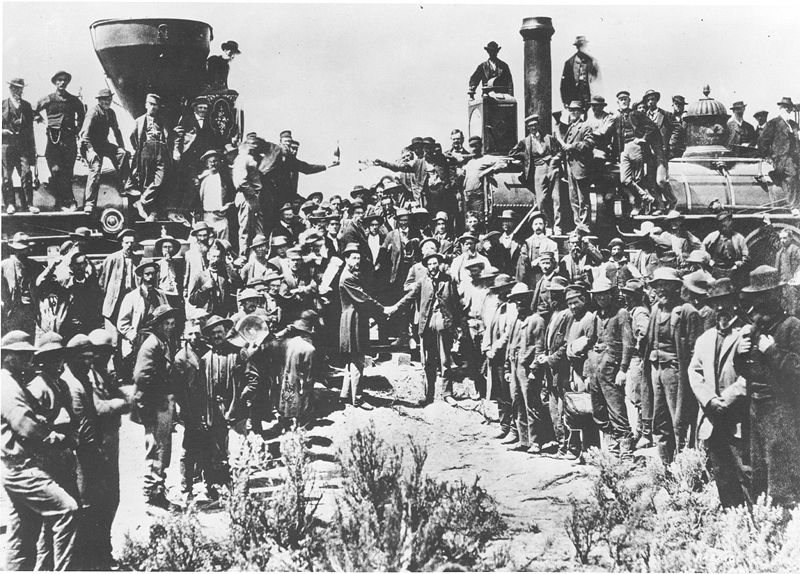
On this day in 1869, America has a transcontinental railroad:
…the presidents of the Union Pacific and Central Pacific railroads meet in Promontory, Utah, and drive a ceremonial last spike into a rail line that connects their railroads. This made transcontinental railroad travel possible for the first time in U.S. history. No longer would western-bound travelers need to take the long and dangerous journey by wagon train, and the West would surely lose some of its wild charm with the new connection to the civilized East.
Since at least 1832, both Eastern and frontier statesmen realized a need to connect the two coasts. It was not until 1853, though, that Congress appropriated funds to survey several routes for the transcontinental railroad. The actual building of the railroad would have to wait even longer, as North-South tensions prevented Congress from reaching an agreement on where the line would begin.
One year into the Civil War, a Republican-controlled Congress passed the Pacific Railroad Act (1862), guaranteeing public land grants and loans to the two railroads it chose to build the transcontinental line, the Union Pacific and the Central Pacific. With these in hand, the railroads began work in 1866 from Omaha and Sacramento, forging a northern route across the country. In their eagerness for land, the two lines built right past each other, and the final meeting place had to be renegotiated….
On this day in 1865, the Wisconsin 1st Cavalry helps capture Jefferson Davis:
1865 – (Civil War) Confederacy President Jefferson Davis Captured
The 1st Wisconsin Cavalry was one of the first units sent to search for Jefferson Davis, the president of the Confederacy, after the surrender of General Robert E. Lee. A Michigan unit, also sent to find Davis, accidentally attacked the cavalry before dawn. A few hours later, both units captured the Confederate president in Irwinville, Georgia.
A Google a Day asks a question about baseball: “What left-handed outfielder, pinch-hitter and first baseman, with a colorful nickname, played his final game in September of 1963?”
Nature, Weather
Tornado Near Wray, Colorado
by JOHN ADAMS •
May 7th —
WGTB, WHEN GREEN TURNS BROWN
Door County
by JOHN ADAMS •
 Post 73 in a series.
The Wisconsin Center for Investigate Journalism has an ongoing series about the condition of Wisconsin’s water supply, with three main topics, one of which is entitled, Failure at the Faucet. I’ve mentioned the full series before. See, Water Watch Wisconsin.
Reading that series – the work of many journalists over many months, is astounding. One would think that the series was describing an undeveloped and impoverished place, far from Wisconsin or America. In fact, the series focuses on conditions in our own state.
Consider their latest story, Human waste pollutes some Wisconsin drinking water. Veteran journalist Ron Seely describes the problem:
Manure has been blamed for much of the bacteria and viruses that pollute Wisconsin drinking water, but contamination from human waste is a problem, too.
Failing septic systems, leaking public sewer pipes and landspreading of septic waste can introduce dangerous pathogens into both rural and urban water systems.
In June 2007, 229 people were sickened by a norovirus in Door County while eating at a restaurant. Seven were hospitalized as a result of a pathogen known for spreading illness on cruise ships. The source: a leaky septic system.
In 2012, a microbiologist published research that linked widespread gastrointestinal illnesses in 14 Wisconsin communities to viruses in the public water systems. Further research showed the contaminants were likely coming from leaking municipal sewage lines….
He doesn’t stop there – his story and the full series are a catalog of statewide pollution.
Now not every community has these problems (any more than every community has Waukesha’s problem of radium contamination in some wells).
These problems are problems, so to speak, when an environment cannot manage safely or cheaply the results of human activity. These environments are more fragile – and thus more expensive to maintain – than initial, overly-optimistic projects assume. Even wealthy communities face these same, physical problems. Door County, for example, is a desirable area with high property values, but that’s no immunity from the risks of contaminants.
Producing more waste, or bringing more waste into an environment, produces costs initially ignored but later impossible to ignore. That’s not speculation: it’s the actual experience of Wisconsin communities.