
Daily Bread
Daily Bread for 5.18.16
by JOHN ADAMS •
Good morning, Whitewater.
Midweek in town will be mostly sunny with a high of sixty-five. Sunrise is 5:27 AM and sunset 8:14 PM, for 14h 47m 17s of daytime. The moon is a waxing gibbous with 89.4% of its visible disk illuminated.
The Birge Fountain Committee meets today at 3 PM.
On this day in 1980, the Mount St. Helens volcano explodes, causing significant losses:
1863 – (Civil War) Siege of Vicksburg, Mississippi, Begins
After nearly three weeks spent encircling Vicksburg, Mississippi, Union forces had bottled up their enemy inside the city and prepared to attack it. Seventeen different Wisconsin regiments were involved in the assault that began the next day (8th, 11th, 12th, 14th, 16th, 17th, 18th, 20th, 23rd, 25th, 27th, 29th and 33rd Wisconsin Infantry regiments and the 1st, 6th and 12th Wisconsin Light Artillery batteries as well as the 2nd Wisconsin Cavalry).
A Google a Day poses a question on geography: “What town, once a fishing mecca, is now a desert with a “cemetery of ships” due to the shrinking Aral Sea?”
Daily Bread
Daily Bread for 5.17.16
by JOHN ADAMS •
Good morning, Whitewater.
Tuesday brings partly cloudy skies and a high of sixty-two. Sunrise is 5:28 AM and sunset 8:13 PM, for 14h 45m 22s of daytime. The moon is a waxing gibbous with 82.9% of its visible disk illuminated.
Common Council meets tonight at 6:30 PM.
On this day in 1954, the U.S. Supreme Court handed down its unanimous opinion in Brown v. Board of Education, 347 US 483 (1954).
On this day in 1673, a great expedition begins:
1673 – Jolliet and Marquette Expedition Gets Underway
On this date Louis Jolliet, Father Jacques Marquette, and five French voyageurs departed from the mission of St. Ignace, at the head of Lake Michigan, to reconnoitre the Mississippi River. The party traveled in two canoes throughout the summer of 1673, traveling across Wisconsin, down the Mississippi to the Arkansas River, and back again. [Source: Historic Diaries: Marquette & Joliet, 1673]
A Google a Day asks about a business name: “What was the previous name of the shipping company, whose ferry sank off the coast of Papua New Guinea on February 2, 2012?”
Nature, Weather
Waterspout on Napa Valley Lake
by JOHN ADAMS •
Water, WGTB, WHEN GREEN TURNS BROWN
Update on Waukesha’s Water
by JOHN ADAMS •
 Post 74 in a series.
Three weeks ago, I wrote about Waukesha’s need for water from the Great Lakes, due significantly because some of that community’s wells had become contaminated with radium. See, Waukesha’s Water. A prosperous area thereby finds itself a supplicant for water supplies from the Great Lakes, because part of her own supply has become undrinkable.
As it turns out, her request has been trimmed, and she’s not only dependent on the consortium that regulates supplies from the Great Lakes (in this case, Lake Michigan), but she’s to receive less than she hoped:
Representatives of Great Lakes states and provinces meeting Tuesday in Chicago reached preliminary agreement to remove additional portions of adjoining communities from Waukesha’s planned area to be served with Lake Michigan water.
A straw vote of the officials also found preliminary consensus to further cut the volume of water that would be delivered to Waukesha, as part of the city’s request to switch to a Lake Michigan water supply.
See, Panel further reduces area in Waukesha’s bid for Lake Michigan water @ Journal Sentinel.
It doesn’t matter that Waukesha is a prosperous community: nature’s fragility is independent of assumptions of what may happen, ignorance of what may happen, or rosy projections of that there will be no risks and no problems.
Although one hears ample insistence that potential problems are unfounded, one actually sees confirmation not of potential but actual environmental and economic hardships.
The stronger argument is to be found in actual conditions, and sadly actual conditions deriving from natural and physical limitations are worse for many communities than optimists contend.
Music
Monday Music: Vance Joy, Fire and the Flood
by JOHN ADAMS •
Daily Bread
Daily Bread for 5.16.16
by JOHN ADAMS •
Good morning, Whitewater.
Monday brings showers with a high of sixty-eight to town. Sunrise is 5:29 AM and sunset 8:12 PM, for 14h 43m 24s of daytime. The moon is a waxing gibbous with 75.3% of its visible disk illuminated.
It’s the anniversary, from 5.16.1929, of the first Academy Awards ceremony:
The official Academy Awards banquet took place in the Blossom Room of the Hollywood Roosevelt Hotel. Some 270 people attended, and tickets cost $5 each. After a long dinner, complete with numerous speeches, Douglas Fairbanks, the president of the Academy of Motion Picture Arts and Sciences, which had been formed in 1927, handed out 15 awards in a five-minute ceremony. The awards presentation was somewhat anticlimactic compared to today’s Academy Award ceremonies, as the winners had already been announced in February.
In 1929, movies were just making the transition from silent films to so-called “talkies,” but all the nominated films were without sound. For the only time in Academy history, Best Picture honors were split into two categories: Best Picture – Unique and Artistic Production, and Best Picture – Production. The winner in the first category was F.W. Murnau’s romantic drama Sunrise: A Song of Two Humans, starring George O’Brien and Janet Gaynor. William Wellman’s film Wings, set in the World War I-era and starring Clara Bow, Charles “Buddy” Rogers and Richard Arlen, won in the second category. Other winners of the night included the German actor Emil Jannings as Best Actor for two films, The Last Command and The Way of All Flesh; and Gaynor as Best Actress. She had received three of the five nominations in the category, and was honored for all three roles, in Sunrise, Seventh Heaven and Street Angel. The Academy also presented an honorary award to Charles Chaplin; it would be the only honor the great actor and filmmaker would receive from the organization until 1972, when he returned to the United States for the first time in two decades to accept another honorary award.
Starting with the following year’s awards, the Academy began releasing the names of the winners to the press on the night of the awards ceremony to preserve some suspense. That practice ended in 1940, after the Los Angeles Times published the results in its evening edition, which meant they were revealed before the ceremony. The Academy then instituted a system of sealed envelopes, which remains in use today.
On this day in 1913, Woody Herman is born:
On this date Woody Herman was born in Milwaukee. A child prodigy, Herman sang and tap-danced in local clubs before touring as a singer on the vaudeville circuit. He played in various dance bands throughout the 20s and 30s and by 1944 was leading a band eventually known as the First Herd. In 1946, the band played an acclaimed concert at Carnegie Hall but disbanded at the end of the year. The following year, Herman returned to performing with the Second Herd that included a powerful saxophone section comprised of Herbie Steward, Stan Getz, Zoot Sims, and Serge Chaloff. He died in 1987. [Source: WoodyHerman.com].
A Google a Day asks a question about art: “While lead architect of the new St. Peter’s project, what was Michelangelo’s design contribution to the project?”
Animation
Sunday Animation: Once Upon A Blue Moon
by JOHN ADAMS •
Once upon a blue moon from steve boot on Vimeo.
Daily Bread
Daily Bread for 5.15.16
by JOHN ADAMS •
Good morning, Whitewater.
Sunday in town will be mostly sunny with a high of fifty-eight. Sunrise is 5:30 AM and sunset 8:11 PM, for 14h 41m 24s of daytime. The moon is a waxing gibbous with 67.1% of its visible disk illuminated.
Friday’s FW poll asked readers whether they thought Budweiser would see a sales gain from temporarily relabeling their beer from Budweiser to America. A majority of respondents (76%) thought that there would be no sales advantage in doing so.
On 5.15.1911, the U.S. Supreme Court orders, under the Sherman Act, the dissolution of Standard Oil within six months. The New York Times reported the news to readers:
Washington, May 15 — Final decision was returned late this afternoon by the Supreme Court of the United States in one of the two great trust cases which have been before it for so long — that of the Standard Oil Company. The decree of the Circuit Court for the Eighth Circuit directing the dissolution of the Oil Trust was affirmed, with minor modifications in two particulars. So far as the judgment of the court is concerned the action was unanimous, but Justice Harlan dissented from the argument on which the judgment was based.
The two modifications of the decree of the Circuit Court are that the period for execution of the decree is extended from thirty days to six months, and the injunction against engaging in inter-State commerce on petroleum and its products pending the execution of the decree is vacated. This latter modification is made distinctly in consideration of the serious injury to the public which might result from the absolute cessation of that business for such a time.
Broadly speaking, the court determines against the Standard Oil Company on the ground that it is a combination in unreasonable restraint of inter-State commerce….
Also in 1911, on 5.15, Janesville’s city council moved to rid that city of fortune tellers:
1911 – Janesville Prohibits Fortune Tellers
On this date the Janesville City Council proposed ordinances banning fortune tellers and prohibiting breweries from operating bars in the city. For more on Wisconsin brewing history, see the Brewing and Prohibition page at Turning Points in Wisconsin History. [Source: Janesville Gazette].
Space, Technology
Blue Origin Rocket Landing
by JOHN ADAMS •
New Shepard flight on April 2, 2016 showing flight of the booster from just ahead of reentry through descent and landing. Video is from the GH2 vent camera located just below the booster’s ring fin.
Daily Bread
Daily Bread for 5.14.16
by JOHN ADAMS •
Good morning, Whitewater.
Saturday in town will be partly cloudy and windy with a high of forty-nine. Sunrise is 5:31 AM and sunset 8:10 PM, for 14h 39m 21s of daytime. The moon is a waxing gibbous with 57.6% of its visible disk illuminated.
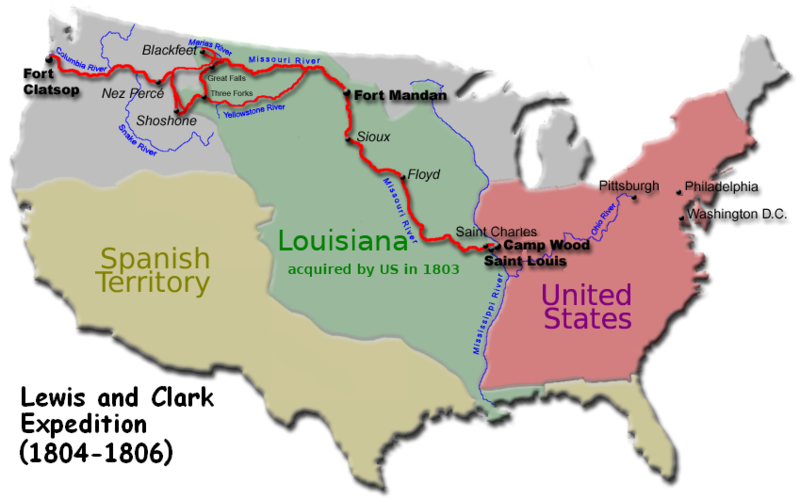
The Corps of Discovery departed from Camp Dubois at 4 p.m. on May 14, 1804, and met up with Lewis in St. Charles, Missouri, a short time later, marking the beginning of the voyage to the Pacific coast. The Corps followed the Missouri River westward. Soon they passed La Charrette, the last Euro-American settlement on the Missouri River.
The expedition followed the Missouri through what is now Kansas City, Missouri, and Omaha, Nebraska. On August 20, 1804, Sergeant Charles Floyd died, apparently from acute appendicitis. He was the only member of the expedition to die, and was among the first to sign up with the Corps of Discovery. He was buried at a bluff by the river, now named after him, in what is now Sioux City, Iowa. His burial site was marked with a cedar post on which was inscribed his name and day of death. A mile up the river the expedition camped at a small river which they named Floyd’s River.[40][41][42] During the final week of August, Lewis and Clark reached the edge of the Great Plains, a place abounding with elk, deer, bison, and beavers.
The Lewis and Clark Expedition established relations with two dozen Indian nations, without whose help the expedition would have risked starvation during the harsh winters and/or become hopelessly lost in the vast ranges of the Rocky Mountains.[43]
On this day in 1953, Milwaukee brewery workers strike:
Milwaukee brewery workers begin a 10-week strike, demanding contracts comparable to those of East and West coast workers. The strike was won when Blatz Brewery accepted their demands, but Blatz was ousted from the Brewers Association for “unethical” business methods as a result. The following year Schlitz president Erwin C. Uihlein told guests at Schlitz’ annual Christmas party that “Irreparable harm was done to the Milwaukee brewery industry during the 76-day strike of 1953, and unemployed brewery workers must endure ‘continued suffering’ before the prestige of Milwaukee beer is re-established on the world market.”
Cats
Friday Catblogging: Why Do Cats Act So Weird?
by JOHN ADAMS •
Drink, Marketing, Poll
Friday Poll: A New (Temporary) Name for Budweiser?
by JOHN ADAMS •
One reads that for the next several months, Budweiser beer cans will be labeled not with Budweiser, but with America. See, Budweiser has a new name, and that name is America @ CNBC:
Daily Bread
Daily Bread for 5.13.16
by JOHN ADAMS •
Good morning, Whitewater.
The end of the week brings rain, with a high of sixty-one, to town. Sunrise is 5:32 AM and sunset 8:09 PM, for 14h 37m 16s of daytime. The moon is a waxing crescent with 47.2% of its visible disk illuminated.
On this day in 1940, Churchill declares his resolve:
…as Winston Churchill takes the helm as Great Britain’s new prime minister, he assures Parliament that his new policy will consist of nothing less than “to wage war, by sea, land and air, with all our might and with all the strength that God can give us; to wage war against a monstrous tyranny, never surpassed in the dark, lamentable catalogue of human crime.”
Emphasizing that Britain’s aim was simply “victory, victory at all costs, victory in spite of terror, victory however long and hard the road may be.” That very evening, Churchill was informed that Britain would need 60 fighter squadrons to defend British soil against German attack. It had 39.
Within a couple of weeks, the conservative, anti-Socialist Churchill, in an effort to make his rally cry of victory a reality, proceeded to place all “persons, their services, and their property at the disposal of the Crown,” thereby granting the government the most all-encompassing emergency powers in modern British history….
On this day in 1864, Wisconsinites defending the Union engage in Georgia:
1864 – (Civil War) Battle of Resaca, Georgia, Opens
The Battle of Resaca was part of the Union’s Atlanta Campaign. From May 13-16, 1864, more than 150,000 soldiers clashed outside Georgia’s capital city, including 10 Wisconsin regiments. On May 13, the Union troops reconnoitered the Confederate lines to prepare for the next day’s combat.
A Google a Day asks a history question: “The general who directed the project responsible for the “Fat Man” graduated from what alma mater in 1918?”