FREE WHITEWATER

Daily Bread for 11.15.15

Good morning, Whitewater.

Sunday in town will be sunny and mild, with a high of sixty-one.  Sunrise is 6:47 and sunset 4:31, for 9h 43m 57s of daytime.  The moon is a waxing crescent with 14.4% of its visible disk illuminated.

Friday’s FW poll asked readers what they thought about several odd Guinness World Record attempts.  Of those attempts listed in the poll, respondents thought Tightest reverse parallel park (46.43%) and Longest basketball shot made blindfolded (25%) were the most admirable records.  Largest gathering of people dressed as penguins in the UK impressed a smaller number of respondents (3.57%).

On this day in 1887, Georgia O’Keeffe is born:

Georgia O’Keeffe was born on November 15, 1887[2] in a farmhouse located at 2405 Hwy T in the town of Sun Prairie, Wisconsin.[3][4] Her parents, Francis Calyxtus O’Keeffe and Ida (Totto) O’Keeffe, were dairy farmers. Her father was of Irish descent. Her maternal grandfather, George Victor Totto, for whom O’Keeffe was named, was a Hungarian count who came to America in 1848.[5]

O’Keeffe was the second of seven children and the first daughter. She attended Town Hall School in Sun Prairie.[6] By age ten she had decided to become an artist,[7] and she and her sister received art instruction from local watercolorist Sara Mann. O’Keeffe attended high school at Sacred Heart Academy in Madison, Wisconsin, as a boarder between 1901 and 1902. In the fall of 1902, the O’Keeffes moved from Wisconsin to the close-knit neighborhood of Peacock Hill inWilliamsburgVirginia. O’Keeffe stayed in Wisconsin with her aunt and attended Madison High School, then joined her family in Virginia in 1903. She completed high school as a boarder at Chatham Episcopal Institute in Virginia (now Chatham Hall), and graduated in 1905. She was a member of the Kappa Delta sorority.[6]

O’Keeffe studied at the School of the Art Institute of Chicago from 1905 to 1906.[7] In 1907, she attended the Art Students League in New York City, where she studied under William Merritt Chase. In 1908, she won the League’s William Merritt Chase still-life prize for her oil painting Dead Rabbit with Copper Pot.[8] Her prize was a scholarship to attend the League’s outdoor summer school in Lake George, New York. While in the city in 1908, O’Keeffe attended an exhibition of Rodin‘s watercolors at the gallery 291, owned by her future husband, photographer Alfred Stieglitz.

On this date in 1869, a fire takes two lives in Milwaukee:

1869 – Gaiety Theater Burns in Milwaukee

On this date the Gaiety Theater burned during a theatrical performance that included a sword duel. During a particularly chaotic fight sequence, a kerosene lamp was broken, igniting the scenery. The flames spread quickly, causing panic to ensue among the capacity-filled crowd. As a result, two people died and many others were injured. [Source: History of Milwaukee, Vol. II, p.276]


Daily Bread for 11.14.15

Good morning, Whitewater.

Saturday will be sunny with a high of fifty-five.  Sunrise today is 06:46 and sunset is 4:32, for 9h 46m 07s of daytime.  The moon is a waxing crescent with 8% of its visible disk illuminated.

On this day in 1851, Moby-Dick is published in America:

Moby-Dick; or, The Whale (1851) is a novel by Herman Melville considered an outstanding work of Romanticism and the American Renaissance. A sailor calledIshmael narrates the obsessive quest of Ahab, captain of the whaler Pequod, for revenge on Moby Dick, a whitewhale which on a previous voyage destroyed Ahab’s ship and severed his leg at the knee. Although the novel was a commercial failure and out of print at the time of the author’s death in 1891, its reputation as a Great American Novel grew during the 20th century. William Faulkner confessed he wished he had written it himself,[1] and D. H. Lawrence called it “one of the strangest and most wonderful books in the world”, and “the greatest book of the sea ever written”.[2] “Call me Ishmael” is one of world literature’s most famous opening sentences.

The product of a year and a half of writing, the book is dedicated to Nathaniel Hawthorne, “in token of my admiration for his genius”, and draws on Melville’s experience at sea, on his reading in whaling literature, and on literary inspirations such as Shakespeare and the Bible. The detailed and realistic descriptions ofwhale hunting and of extracting whale oil, as well as life aboard ship among a culturally diverse crew, are mixed with exploration of class and social status, good and evil, and the existence of God. In addition to narrative prose, Melville uses styles and literary devices ranging from songs, poetry and catalogs toShakespeareanstage directions, soliloquies and asides.

Melville drew upon multiple accounts for his story:

In addition to his own experience on the whaling ship Acushnet, two actual events served as the genesis for Melville’s tale. One was the sinking of the Nantucket ship Essex in 1820, after it was rammed by an enraged sperm whale 2,000 miles (3,200 km) from the western coast of South America. First mate Owen Chase, one of eight survivors, recorded the events in his 1821 Narrative of the Most Extraordinary and Distressing Shipwreck of the Whale-Ship Essex.[50]

The other event was the alleged killing in the late 1830s of the albino sperm whale Mocha Dick, in the waters off the Chilean island of Mocha. Mocha Dick was rumored to have twenty or so harpoons in his back from other whalers, and appeared to attack ships with premeditated ferocity. One of his battles with a whaler served as subject for an article by explorerJeremiah N. Reynolds in the May 1839 issue of The Knickerbocker or New-York Monthly Magazine.[51]

Of the sinking of the Essex, there is a major motion picture to be released this December, In the Heart of the Sea:

On this day in 1861, a great historian is born:

1861 – Frederick Jackson Turner Born

On this date Frederick Jackson Turner was born in Portage. Turner spent most of his academic career at the University of Wisconsin. He published his first article in 1883, received his B.A. in 1884, then his M.A. in History in 1888. After a year of study at Johns Hopkins (Ph.D., 1890), he returned to join the History faculty at Wisconsin, where he taught for the next 21 years. He later taught at Harvard from 1910 to 1924 before retiring. In 1893, Turner presented his famous address, “The Significance of the Frontier in American History,” at the Chicago World’s Fair. Turner died in 1932.

Daily Bread for 11.13.15

Good morning, Whitewater.

Friday will bring partly cloudy, and windy, skies to Whitewater, with a high of forty-three. Sunrise is 6:45 and sunset 4:33, for 9h 48m 19s of daytime. The moon is a waxing crescent with 3.2% of its visible disk illuminated.

On this day in 1956, the U.S. Supreme Court struck down a law requiring racial segregation on buses:

Washington, Nov. 13th An Alabama law and a city ordinance requiring segregation of races on intrastate buses were declared invalid by the Supreme Court today.

The Court affirmed a ruling by a three-judge Federal court that held the challenged statutes “violate the due process and equal protection clauses of the Fourteenth Amendment to the Constitution of the United States.”

The Fourteenth Amendment provides that no state shall deprive any person of life, liberty, or property without due process of law nor deny to any citizen the equal protection of the laws.

In upholding the lower court’s judgment, the Supreme Court cited its 1954 decision outlawing racial discrimination in public parks and on public golf courses.

[Officials of several Southern states indicated they would continue to enforce bus segregation laws despite the court’s decision. Segregationist leaders were bitter in their denunciations of the court and its ruling.]

On this day in 1858, a famous brewery gets its start:

1858 – Heileman Brewery Founded

On this day, one of Wisconsin’s best-known breweries was established by John Gund and Gottlieb Heileman (1824-1878). By the time Gund retired in 1872, the firm’s annual beer production had increased from 500 barrels in 1860 to 3,000. By the turn of the century, as this postcard shows, it had become one of the city’s largest manufacturing concerns, and throughout the 20th century its storage tanks (painted to resemble a six-pack of beer) were a LaCrosse landmark. At its peak, Heileman’s annual sales of 7.5 million barrels brought in $900 million, making it a target for purchase by a series outside investors whose management eventually forced it into bankruptcy in 1991. The brewery officially closed in 1999, throwing more than 500 workers out of work. Today the former Heileman Brewery is home to City Brewing Co., which manufactures and packages beers, teas, soft drinks, energy drinks and other new age beverages. Its packaging capacity of over 50 million cases makes the LaCrosse firm one of the largest beverage producers in the country. [Sources: History of LaCrosse Co. (Chicago, 1881); City Brewing Co.; N. Y. Times, Nov. 2, 1993; Modern Brewery Age, March 4, 1996; Food & Drink Weekly, Aug. 16, 1999]

Here’s the final game in Puzzability‘s Chinese Takeout series:

This Week’s Game — November 9-13
Chinese Takeout
May we take your reorder? For each day this week, we started with a phrase, removed the seven letters in CHINESE, and rearranged the remaining letters to get a new word or phrase. Both pieces are described in each day’s clue, with the longer one first.
Example:
Google or Bing, for example; wrath
Answer:
Search engine; anger
What to Submit:
Submit both pieces, with the longer one first (as “Search engine; anger” in the example), for your answer.
Friday, November 13
Antiterrorism cabinet department; honorable feeling of obligation

Brookings on ‘7 trends in old and new media’

The liberal-leaning Brookings Institution, in a paper from Elaine Kamarck and Ashley Gabriele, offers insight into 7 trends in old and new media.

Their seven observations are solid, and broadly similar to the assessments of Clay Shirky, in Last call: the end of the printed newspaper.

Brookings summarizes their work:

The following are seven essential truths about the news today that Kamarck and Gabriele explore in detail:

  1. Print newspapers are dinosaurs
  2. Hard news is in danger
  3. Television is still important
  4. And so is radio
  5. News is now digital
  6. Social media allows news (and “news”) to go viral
  7. For the younger generation, news is delivered through comedy

It’s worth noting that print is failing both because it’s not interactive, and because it no longer has even the inquisitive sensibility toward the powerful of once-lauded, but still top-down, publications. (When online publications ape the incurious, fawning presentations of print publications, they consign themselves to the same fate as print.)

I’ve embedded the full white paper below –

Daily Bread for 11.12.15

Good morning, Whitewater.

Thursday will be cloudy and windy, with a high of forty-nine.  Sunrise is 6:43 and sunset 4:34, for 9h 50m 33s of daytime. We’ve a new moon again today, with just .6% of its visible disk illuminated.

On this day in 1954, Ellis Island ceases processing immigrants to America:

…Ellis Island, the gateway to America, shuts it doors after processing more than 12 million immigrants since opening in 1892. Today, an estimated 40 percent of all Americans can trace their roots through Ellis Island, located in New York Harbor off the New Jersey coast and named for merchant Samuel Ellis, who owned the land in the 1770s.

On January 2, 1892, 15-year-old Annie Moore, from Ireland, became the first person to pass through the newly opened Ellis Island, which President Benjamin Harrison designated as America’s first federal immigration center in 1890. Before that time, the processing of immigrants had been handled by individual states.

Not all immigrants who sailed into New York had to go through Ellis Island. First- and second-class passengers submitted to a brief shipboard inspection and then disembarked at the piers in New York or New Jersey, where they passed through customs. People in third class, though, were transported to Ellis Island, where they underwent medical and legal inspections to ensure they didn’t have a contagious disease or some condition that would make them a burden to the government. Only two percent of all immigrants were denied entrance into the U.S.

Immigration to Ellis Island peaked between 1892 and 1924, during which time the 3.3-acre island was enlarged with landfill (by the 1930s it reached its current 27.5-acre size) and additional buildings were constructed to handle the massive influx of immigrants. During the busiest year of operation, 1907, over 1 million people were processed at Ellis Island….

On this day in 1836, our territorial legislature passes its first law, both over-broad and ineffectual:

1836 – Governor Dodge Signs First Law

On this date territorial governor, Henry Dodge, signed the first law passed by the Wisconsin Territorial Legislature. The law prescribed how the legislators were to behave, and how other citizens were to behave towards them. For example, it authorized “the Assembly to punish by fine and imprisonment every person, not a member, who shall be guilty of disrespect, disorderly or contemptuous behavior, threats, in the legislature or interference with witnesses to the legislature; also to expel on a two thirds majority in either house a member of its own body…” This did not keep the members from vociferous arguments, fist fights, or even shooting one another (see this This Day in Wisconsin History for February 11th).

Here’s the Thursday game from Puzzability‘s Chinese Takeout series:

This Week’s Game — November 9-13
Chinese Takeout
May we take your reorder? For each day this week, we started with a phrase, removed the seven letters in CHINESE, and rearranged the remaining letters to get a new word or phrase. Both pieces are described in each day’s clue, with the longer one first.
Example:
Google or Bing, for example; wrath
Answer:
Search engine; anger
What to Submit:
Submit both pieces, with the longer one first (as “Search engine; anger” in the example), for your answer.
Thursday, November 12
Breakfast pastry with creamy topping; Greek god of the underworld


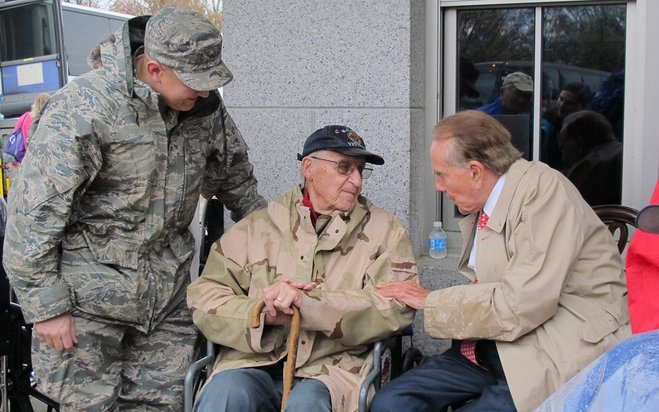
Happy Veterans’ Day

The Journal Sentinel was a sponsor of a recent Honor Flight, a program that takes veterans to Washington, D.C. without charge to see some of our nation’s principal monuments and meet with other veterans:

Photo from Meg Jones of the Journal SentinelWashington — World War II is always with Erv Casper.It’s in the memories he carries in his heart and it’s in his leg, where he still carries shrapnel from a daisy cutter bomb that landed near him and his comrades on Okinawa.

A member of the 2nd Marines, Casper was heading to Japan to take part in the expected invasion when he noticed his ship was turning around. The war was over. He wasn’t going back into battle, he was going home.

And in a way, on Saturday he had another homecoming.

“Now I understand it more,” an emotional Casper, 89, said Saturday at the World War II Memorial in Washington, D.C. “All the heroes are dead. That’s the sad part. We all tried our damndest to survive.”

Casper was among 76 veterans who traveled to the nation’s capital Saturday on a Stars and Stripes Honor Flight. The organization provides a free one-day trip to Washington for World War II and Korean War era veterans.

So far the group has taken 4,200 veterans on 37 flights. The Milwaukee Journal Sentinel was a sponsor of Saturday’s flight….

See, in full, Honor Flight carries 76 WWII, Korean War vets to Washington @ Journal Sentinel.

Daily Bread for 11.11.15

Good morning, Whitewater.

We’ll have an even chance of afternoon showers, and a high of sixty-one this Wednesday.  Sunrise is 6:42 and sunset 4:35, for 9h 52m 49s of daytime.  We’ve a new moon today.

On this day in 1918, the First World War ends:

At the 11th hour on the 11th day of the 11th month of 1918, the Great War ends. At 5 a.m. that morning, Germany, bereft of manpower and supplies and faced with imminent invasion, signed an armistice agreement with the Allies in a railroad car outside Compiégne, France. The First World War left nine million soldiers dead and 21 million wounded, with Germany, Russia, Austria-Hungary, France, and Great Britain each losing nearly a million or more lives. In addition, at least five million civilians died from disease, starvation, or exposure.

On this day in 1964, a part of Britain arrives in Milwaukee:

1964 – Rolling Stones Play Milwaukee

On this date the Rolling Stones first performed in Wisconsin, to a crowd of 1,274 fans at Milwaukee Auditorium. Although Brian Jones remained in a Chicago hospital with a high fever, the rest of the band performed. According to a dubious reporter for the Milwaukee Journal, “Chances are, few in the audience missed his [Jones’] wailing harmonica. Screams from a thousand throats drowned out all but the most insistent electronic cacophony and the two-fisted smashes of drummer Charlie Watts.” The reporter continued, “Unless someone teaches guitar chords to chimpanzees, the visual ultimate has been reached in the Rolling Stones. With shoulder length hair and high heeled boots, they seemed more feminine than their fans. The Stones make the Beatles look like clean cut kids. You think it must be some kind of parody – but the little girls in front paid $5.50 a seat.” [Source: Milwaukee Journal November 12, 1964, p.14]

Here’s the midweek game from Puzzability:

This Week’s Game — November 9-13
Chinese Takeout
May we take your reorder? For each day this week, we started with a phrase, removed the seven letters in CHINESE, and rearranged the remaining letters to get a new word or phrase. Both pieces are described in each day’s clue, with the longer one first.
Example:
Google or Bing, for example; wrath
Answer:
Search engine; anger
What to Submit:
Submit both pieces, with the longer one first (as “Search engine; anger” in the example), for your answer.
Wednesday, November 11
Trying to fall asleep; classic Navy pilots movie

GOP in MKE: Tonight at the Milwaukee Theatre

POLITICO has answers to likely questions about tonight’s debate: Everything you need to know about Tuesday’s Republican debate.

Here are the two important answers about the main debate (an undercard debate will begin at 6 PM CST):

When and how long is the debate?
The prime-time debate will last two hours and begins at 9 Eastern time [8 CST]. There are a few changes to the format: Candidates will not make opening statements, but they will have more time to make arguments. For an initial answer to a question, they get 90 seconds, in addition to 60 seconds for rebuttals. There will be short closing statements at the end of the debate.

How can I watch the debate?
It will air on Fox Business Network and be streamed for free on foxbusiness.com. No cable subscription is necessary. To capitalize on the ratings surges from earlier debates, FBN is also widening access to the channel for its pay-TV partners such as DirecTV. This will allow viewers who normally can’t access the network a chance to tune into the debate.