
Via Space.com.
WGTB, WHEN GREEN TURNS BROWN
The December 2014 Presentation
(Part 2)
by JOHN ADAMS •
 Post 37 in a series. When Green Turns Brown is an examination of a small town’s digester-energy project, in which Whitewater, Wisconsin would import other cities’ waste, claiming that the result would be both profitable and green.
In this post, I’ll consider only a portion of the public comments at the 12.16.14 meeting.
There are two reasons for a deliberate approach. First, Whitewater’s city officials (at least some of them) contend that they’ve considered this project in detail, and carefully. Those claims deserve in reply a careful review. Second, the public comments about which I’ll write today caught my attention at the time, and have been notable to me since.
Today’s questions derive from discussion beginning at the 36-minute mark, and that continued until 46:21. (The 12.16.14 discussion is embedded at the bottom of this post for ready reference.)
(Every question in this series has a unique number, assigned chronologically based on when it was asked. All the questions from When Green Turns Brown can be found in the Question Bin. Today’s questions begin with No. 223.)
At just over thirty-six minutes in (36:15), one hears the first public comment (from Jeff Knight, chair of Whitewater’s Community Development Authority, and President & CEO of a local business lobby, the Greater Whitewater Committee.)
I’ll transcribe a portion of his remarks (beginning at 37:24):
And question two I’d have is the phosphorus treatment that you’ve included in here. Other communities have done significant treatment of their phosphorus by putting it out on land so that it trickles and does its cleaning itself. What’s the process you’ve decided on the phosphorus in this? And, cause I think that’s a very expensive component of what’s being proposed. And so, have you looked what are the options on the phosphorus treatment and has the city been able to consider we’ve got a big industrial park with a lot of vacant land…there is land that could be used to treat that phosphorus. I just would like for the Common Council to understand those decisions.
223. Is Knight serious in his contention that a possible method of treatment for Whitewater is “putting it out on land so that it trickles and does its cleaning itself?”
224. Does he really think that a possible solution is spreading phosphorus on vacant land in the business park?
225. Where does Knight, after all, think that the phosphorus “trickles?”
226. On 7.15.14 – five months before this December meeting – Donohue explained the options for addressing phosphorus (actually removing it at the source or paying a charge for non-removal above regulatory-defined limits). Donohue explained those same options in this very December meeting, shortly before Knight speaks. Why doesn’t CDA Chair Knight – voluntarily speaking on this issue – know the phosphorus option that Donohue presented (and the city administration accepted) five months earlier?
227. Why doesn’t Knight understand how the method Donohue recommends – and the city administration accepted five months earlier – addresses phosphorus not by removal, but by paying a charge for non-removal? Isn’t Mr. Knight who’s the one who doesn’t understand this subject?
228. If spreading phosphorus on the ground so that it “trickles” is an effective solution, will the executive members of the Greater Whitewater Committee (among them Knight, CDA member Larry Kachel, and councilman Dr. Kidd) spread it on their lawns and properties?
229. If Whitewater wants to market the town to residential development, is it an effective marketing presentation to offer Whitewater as a town where the phosphorus plan is “putting it out on land so that it trickles and does its cleaning itself.”)
(Two points worth making: (1) I know that there’s no chance of this bizarre idea as an actual plan – the problem is that CDA Chair Knight actually suggests it, and (2) how can any community have confidence in supposed public-relations – especially directed toward attracting residential home sales – with ideas of this absurd kind?)
Next, on Sunday, 10.4.15: The December 2014 Presentation (Part 3).
WHEN GREEN TURNS BROWN: Mondays @ 10 AM, here on FREE WHITEWATER.
Cats
Friday Catblogging: Starting at the Beginning
by JOHN ADAMS •
Poll
Friday Poll: Suspended for the Wrong Color of Green?
by JOHN ADAMS •
Should a child in a public school be suspended for wearing the wrong color of blue or green?
At a public school in New Jersey, a child was suspended over a dispute about the color of her shirt:
8-year-old Kylie and her twin sister Karlie don’t look like troublemakers, but Kylie was suspended from school. The reason, according to her mother: a violation of the dress code Monday. Their mother, Crystal, says she got a call from the vice principal at Winslow Township School 4.
“He wanted me to know that she can’t wear that shirt and if she does wear that shirt again, she would be suspended,” she told FOX 29.
The district’s policy states that shirts or blouses be white, dark green or navy blue with collars only. Kelly green is a violation. Crystal admits her conversation with the assistant principal and then the principal did get a bit heated.
“My child messed up, I messed it up for my child, and she be suspended next time for it, but to suspend a child over the shade of a shirt. I found it a little ridiculous,” she explained.
The girls missed the bus Tuesday morning, and when they arrived at school a few minutes late– properly dressed– they were met by the principal.
“She told me don’t bother to sign her in and told Kylie that she’s not in school today,” the mother explained.
“I got suspended for wearing the different color they wanted me to wear,” said Kylie. “The principal told me that I don’t have to stay here and I could leave.”
(The school, by the way, disputes parts of the story as ‘incorrect,’ but offered no explanation to a reporter.)
Daily Bread
Daily Bread for 10.2.15
by JOHN ADAMS •
Good morning, Whitewater.
Friday in town will be partly sunny with a high of sixty-one. Sunrise is 6:53 and sunset 6:34, for 11h 40m 07s of daytime. The moon is a waning gibbous with 74.9% of its visible disk illuminated.
On this day in 1959, the Twilight Zone debuts on CBS:
The series was produced by Cayuga Productions, Inc., a production company owned and named by Serling. It reflects his background in Central New York State and is named after Cayuga Lake, on which Ithaca College is located.
Aside from Serling, who wrote or adapted nearly two-thirds of the series’ total episodes, writers for The Twilight Zone included leading authors such as Charles Beaumont, Ray Bradbury, Earl Hamner, Jr., George Clayton Johnson, Richard Matheson, Reginald Rose, and Jerry Sohl. Many episodes also featured new adaptations of classic stories by such writers as Ambrose Bierce, Jerome Bixby, Damon Knight, John Collier, and Lewis Padgett.
Twilight Zone???’??s writers frequently used science fiction as a vehicle for social comment, as networks and sponsors who censored controversial material from live dramas were less concerned with seemingly innocuous fantasy and sci-fi stories. Frequent themes on The Twilight Zone included nuclear war, McCarthyism, and mass hysteria, subjects that were avoided on more serious primetime television. Episodes such as “He’s Alive” or “The Monsters Are Due on Maple Street” offered specific commentary on current events and social issues. Other stories, such as “The Masks“, “I Dream of Genie“, or “Mr. Denton on Doomsday” were allegories, parables, or fablesthat reflected the moral and philosophical choices of the characters.
Despite his esteem in the writing community, Serling found the series difficult to sell. Few critics felt that science fiction could transcend empty escapism and enter the realm of adult drama. In a September 22, 1959, interview with Serling, Mike Wallace asked a question illustrative of the times: “…[Y]ou’re going to be, obviously, working so hard on The Twilight Zone that, in essence, for the time being and for the foreseeable future, you’ve given up on writing anything important for television, right?” While Serling’s appearances on the show became one of its most distinctive features, with his clipped delivery still widely imitated today, he was reportedly nervous about it and had to be persuaded to appear on camera. Serling often steps into the middle of the action while the characters remain oblivious to him, but on one notable occasion, they are aware of his presence: In the episode “A World of His Own“, a writer (Keenan Wynn) with the power to alter his reality objects to Serling’s narration, and promptly erases Serling from the show.
In season two, due to budgetary constraints, the network decided – against Serling’s wishes – to cut costs by shooting some episodes on videotape rather than film. The requisite multicamera setup of the videotape format precluded location shooting, severely limiting the potential scope of the storylines, and the experiment was abandoned after just six episodes (“Twenty Two“, “Static“, “The Whole Truth“, “The Lateness of the Hour“, “The Night of the Meek“, and “Long Distance Call“).
The original series contains 156 episodes. Unlike seasons one through three, season four (1962–63) consists of one-hour episodes. Season five returned to the half-hour format.
On this day in 1861, the first train of the Wisconsin Central Railroad runs:
On this date the first train of the Wisconsin Central Railroad ran between Menasha and Waupaca. The railroad was important in the development of railroads in Wisconsin. [Source: History Just Ahead: A Guide to Wisconsin’s Historical Markers edited by Sarah Davis McBride, p.69]
Here’s the final puzzle in this week’s Puzzability series, Blended Wines:
|
This Week’s Game — September 28-October 2
|
|||||
|
Blended Wines
|
|||||
|
We have some lovely pairings this week. For each day, we’ve taken the name of a wine, added a letter, and scrambled all the letters to get a new word. The answer phrase, described by each day’s clue, is the wine followed by the longer word. The clue includes the lengths of the answer words in parentheses.
|
|||||
|
Example:
|
|||||
|
Person attending a party in honor of a dry red wine (8,9)
|
|||||
|
Answer:
|
|||||
|
Cabernet celebrant
|
|||||
|
What to Submit:
|
|||||
|
Submit the phrase, with the wine first (as “Cabernet celebrant” in the example), for your answer.
|
|||||
 |
|||||
|
Friday, October 2
|
|||||
|


Adventure, Animals, Nature
Hypnotizing Sharks
by JOHN ADAMS •
WGTB, WHEN GREEN TURNS BROWN
The December 2014 Presentation
(Part 1)
by JOHN ADAMS •
Post 36 in a series. When Green Turns Brown is an examination of a small town’s digester-energy project, in which Whitewater, Wisconsin would import other cities’ waste, claiming that the result would be both profitable and green.
In this post, I’ll consider the Donohue firm’s December 2014 public presentation to Whitewater on a wastewater upgrade. The full presentation is embedded immediately below. As the discussion is long, in this post I’ll consider the first 36 minutes from the discussion. (This is the initial portion during which Donohue and then City Manager Clapper describe the project. Thereafter, the discussion opens to public comments.)
(Every question in this series has a unique number, assigned chronologically based on when it was asked. All the questions from When Green Turns Brown can be found in the Question Bin. Today’s questions begin with No. 217.)
217. Donohue’s first technical memo mentions that a goal of Whitewater’s city officials is to sell water (“[t]he value of water was discussed in detail….The option of producing a sellable water product is of major interest to the city.”). Why no mention of that goal here?
218. Donohue’s presentation, by their account, addresses the ‘liquids train’ portion of the project (that is, not the biosolids processing at the plant). Can one have a liquids train project without a biosolids train? (It’s a rhetorical question.) More directly: does a particular liquids train method require a definite biosolids train method? If so, when and which methods are bound in this way?
219. Whitewater, as Donohue outlines it, has two options for phosphorus management: (1) Option One (immediate compliance with phosphorus reduction upon construction) or (2) Option Two, using the so-called “Clean Waters, Healthy Economy Act” without any capital costs. Donohue recommends Option Two.
The obvious question: how much phosphorus does Option Two remove, in absolute terms and relative to Option One? Since Option Two requires a payment in lieu of physical reductions, for Whitewater’s environment doesn’t Option Two’s solution really mean no practical, significant phosphorus reduction at all?
220. Why did Whitewater’s officials choose paying to allow continued levels of phosphorus discharge in the local environment rather than commit to actual, physical reductions in levels of phosphorus discharge?
221. When did City Manager Clapper first choose Option Two? (He presumably chose Option Two – payment in lieu of significant phosphorus reductions – by the time of this 12.16.14 presentation. If it were otherwise, Donohue would be advocating a key approach without the assent of Whitewater’s full-time staff.)
222. What record, if any, does City Manager Clapper have of the basis of his decision on or before 12.16.14 in favor of Option Two (payment in lieu of significant phosphorus reductions)?
Next: The December 2014 Presentation (Part 2).
WHEN GREEN TURNS BROWN: Mondays @ 10 AM, here on FREE WHITEWATER.
Food
How to Eat Artichokes
by JOHN ADAMS •
There’s always something new to learn –
Daily Bread
Daily Bread for 10.1.15
by JOHN ADAMS •
Good morning, Whitewater.
A new month begins with partly cloudy skies and a high of sixty. Sunrise is 6:52 and sunset 6:35, for 11h 42m 59s of daytime. The moon is a waning gibbous with 84% of its visible disk illuminated.
Whitewater’s Landmarks Commission meets this evening at 6:00 PM.
On this day in 1908, Henry Ford reveals a production model car that will transform American and global transportation:
On October 1, 1908, the first production Model T Ford is completed at the company’s Piquette Avenue plant in Detroit. Between 1908 and 1927, Ford would build some 15 million Model T cars. It was the longest production run of any automobile model in history until the Volkswagen Beetle surpassed it in 1972.
Before the Model T, cars were a luxury item: At the beginning of 1908, there were fewer than 200,000 on the road. Though the Model T was fairly expensive at first (the cheapest one initially cost $825, or about $18,000 in today’s dollars), it was built for ordinary people to drive every day. It had a 22-horsepower, four-cylinder engine and was made of a new kind of heat-treated steel, pioneered by French race car makers, that made it lighter (it weighed just 1,200 pounds) and stronger than its predecessors had been. It could go as fast as 40 miles per hour and could run on gasoline or hemp-based fuel. (When oil prices dropped in the early 20th century, making gasoline more affordable, Ford phased out the hemp option.) “No car under $2,000 offers more,” ads crowed, “and no car over $2,000 offers more except the trimmings.”
The design was revolutionary:
The Model T was designed by Childe Harold Wills, and Hungarian immigrants Joseph A. Galamb[17] and Eugene Farkas.[18] Henry Love, C. J. Smith, Gus Degner and Peter E. Martin were also part of the team.[19] Production of the Model T began in the third quarter of 1908.[20] Collectors today sometimes classify Model Ts by build years and refer to these as “model years“, thus labeling the first Model Ts as 1909 models. This is a retroactive classification scheme; the concept of model years as we conceive it today did not exist at the time. The nominal model designation was “Model T”, although design revisions did occur during the car’s two decades of production….
The Model T had a front-mounted 177-cubic-inch (2.9 L) inline four-cylinder engine, producing 20 hp (15 kW), for a top speed of 40–45 mph (64–72 km/h). According to Ford Motor Company, the Model T had fuel economy on the order of 13–21 mpg-US (16–25 mpg-imp; 18–11 L/100 km).[21] The engine was capable of running on gasoline, kerosene, or ethanol,[22][23] although the decreasing cost of gasoline and the later introduction of Prohibition made ethanol an impractical fuel for most users.
The ignition system used an unusual trembler coil system to drive the spark plugs, as used for stationary gas engines, rather than the expensive magnetos that were used on other cars. This ignition also made the Model T more flexible as to the quality or type of fuel it used. The need for a starting battery and also Ford’s use of an unusual AC alternator located inside the flywheel housing encouraged the adoption of electric lighting, rather than oil or acetylene lamps, but it also delayed the adoption of electric starting.
Here’s the Thursday game from Puzzability:
|
This Week’s Game — September 28-October 2
|
|||||
|
Blended Wines
|
|||||
|
We have some lovely pairings this week. For each day, we’ve taken the name of a wine, added a letter, and scrambled all the letters to get a new word. The answer phrase, described by each day’s clue, is the wine followed by the longer word. The clue includes the lengths of the answer words in parentheses.
|
|||||
|
Example:
|
|||||
|
Person attending a party in honor of a dry red wine (8,9)
|
|||||
|
Answer:
|
|||||
|
Cabernet celebrant
|
|||||
|
What to Submit:
|
|||||
|
Submit the phrase, with the wine first (as “Cabernet celebrant” in the example), for your answer.
|
|||||
|
|||||
|
Thursday, October 1
|
|||||
|

Adventure, Food, Religion
Dinner at Hogwarts
by JOHN ADAMS •
Culture, University
The University Gateway Near Whiton & Main
by JOHN ADAMS •
Five years ago, this community considered whether there should be changes at the intersection of Main and Whiton, where there was then a stone gateway to the university.
One now sees that the gateway is being moved back from near Main, farther up the hill from the street. Moving the gateway assures greater visibility nearer the road.
It’s good that it’s being done; it should have been done years ago.
Now people are naturally proud of commemorative walls, and sentimental over them. That’s understandable. I was once at university, and there are spots on my campus that I will always recall fondly.
And yet, and yet, I and my friends – it is to be hoped – would not place a sentimental attachment to a wall over a practical concern for the human condition.
That’s why, five years ago, I wrote that it would be better to tear down the wall, adding a proper traffic signal if needed, and leaving only a small, unobtrusive sign nearby:
THIS SIGNAL IS A MONUMENT OF OUR DEDICATION TO PUBLIC SAFETY
CONCERN FOR OUR FELLOW CITIZENS IS OUR FINEST ART
RESPECT FOR THEIR BASIC WELL-BEING IS OUR MOST ADMIRABLE DESIGN
It’s better still, of course, if the wall can be moved and safety still be equally improved.
University life should amount to more than decorative objects, more than sentiment, more than stone and mortar.
If that’s not been clear to a few, those who argued against changes to the gateway wall years ago, then they’ve been at university in vain: the experience has been wasted on them.
WGTB, WHEN GREEN TURNS BROWN
The Donohue Firm’s Second Public Presentation of 7.15.14
by JOHN ADAMS •
Post 35 in a series. When Green Turns Brown is an examination of a small town’s digester-energy project, in which Whitewater, Wisconsin would import other cities’ waste, claiming that the result would be both profitable and green.
In this post, I’ll consider the Donohue firm’s second public presentation to Whitewater on a wastewater upgrade.
(Every question in this series has a unique number, assigned chronologically based on when it was asked. All the questions from When Green Turns Brown can be found in the Question Bin. Today’s questions begin with No. 205.)
205. The twenty-five minute presentation begins with mention that it will be for approval of a contract with Donohue. Why presume approval?
206. Donohue representative Mike Gerbitz mentions the forty-five-minute 6.17.14 presentation to Council (the only other one Donohue had yet made to the full Council) as “lengthy.” Is forty-five minutes for a plan that would cost $18.6 million really lengthy? Doesn’t it seem short, in fact?
207. At the 6.17.14 presentation, Gerbitz, Wastewater Superintendent Reel, or City Manager Clapper spoke for over 41 minutes of a 45 minute Donohue presentation. How is less than four minutes of Council discussion due diligence for an initial public presentation? (Even then, wasn’t part of that four minutes occupied with observations from a resident, rather than a questions from Council?)
208. The whole presentation on 7.15.14 is 25 minutes, but aren’t 15 of those minutes just a rehash of the earlier, 6.17.14 presentation?
209. Gerbitz mentions that the digester complex is a separate project (presumably at this point under the aegis of Trane). Later in this same discussion, Gerbitz says that there have been – by his account – three meetings with Donohue, Trane, Black & Veatch, and city officials about the digester. So how separate has the digester project really been, up through 7.15.14?
210. Ken Kidd, councilman-physician, is one of the few people to speak, and declares (regarding the digester) that “you guys play well.” Is that Dr. Kidd’s level of oversight, to observe that others play well? (Hasn’t Kidd, after all, has been a digester-project supporter from at least the earliest moments of public discussion?)
211. Gerbitz tells Council at this 7.15.14 meeting that a plan based on their approval will be submitted to state officials “next week.” What does this say about Gerbitz’s presumption about approval? What does it say about the full Council’s role as an inquisitive, diligent, thorough point of review?
(Gerbitz mentions during the meeting, where his firm is looking to have a million-dollar contract approved, that Donohue has already started with design. Council awards Donohue a $1.168 million contract at this meeting.)
212. Gerbitz tells Council that he’ll not bother them with details or line-items about the project. Does he think those details are insignificant, or does he think that those details are either insignificant or uninteresting to Whitewater’s Common Council?
213. How unimportant are those details, after all? Would Gerbitz be willing to delete or ignore some of them in his planning? That seems unlikely; so why would he presume that they’re unimportant to Council?
214. One knows from City Manager Clapper’s remarks on 6.23.15 that two councilpersons played a role in selecting Donohue. Did a smaller group than the whole of Council play a role in selecting Trane? If so, which ones?
215. How often did that smaller number meet with Trane, Donohue, or Black & Veatch by the time of this meeting? Did anyone take notes?
216. If Whitewater had the choice between removing phosphorous or paying a set amount for its continued presence, which would be the superior option for health and the environment? Gerbitz describes city officials as preferring the least-expensive choice. Are either City Manager Clapper or Wastewater Superintendent Reel qualified to determine which choice is better as a matter of health and safety?
Next: Beginning tomorrow, and continuing for several posts, The Council Discussion of 12.16.14.
WHEN GREEN TURNS BROWN: Mondays @ 10 AM, here on FREE WHITEWATER.
Anderson, Cartoons & Comics
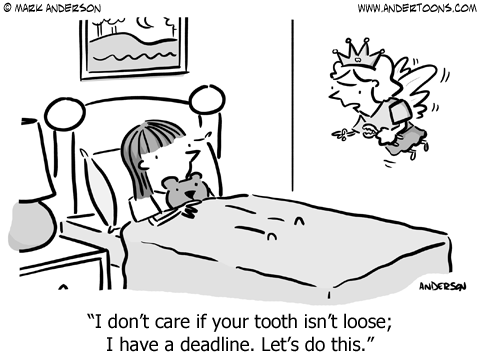
Deadline
by JOHN ADAMS •
Daily Bread
Daily Bread for 9.30.15
by JOHN ADAMS •
Good morning, Whitewater.
Midweek in town will be mostly sunny with a high of sixty-three. Sunrise is 6:51 and sunset 6:37, for 11h 45m 52s of daytime. The moon is waning gibbous with 91.9% of its visible disk illuminated.
The Tech Park Board meets this morning at 8 AM.
On this day in 1889, Wyoming approves a state constitution that grants women the right to vote:
…the Wyoming state convention approves a constitution that includes a provision granting women the right to vote. Formally admitted into the union the following year, Wyoming thus became the first state in the history of the nation to allow its female citizens to vote.
That the isolated western state of Wyoming should be the first to accept women’s suffrage was a surprise. Leading suffragists like Susan B. Anthony and Elizabeth Cady Stanton were Easterners, and they assumed that their own more progressive home states would be among the first to respond to the campaign for women’s suffrage. Yet the people and politicians of the growing number of new Western states proved far more supportive than those in the East….
By 1914, the contrast between East and West had become striking. All of the states west of the Rockies had women’s suffrage, while no state did east of the Rockies, except Kansas. Why the regional distinction? Some historians suggest western men may have been rewarding pioneer women for their critical role in settling the West. Others argue the West had a more egalitarian spirit, or that the scarcity of women in some western regions made men more appreciative of the women who were there while hoping the vote might attract more.
On this day in 1859, Lincoln speaks in Wisconsin:
On this date Abraham Lincoln delivered an address at the Wisconsin State Fair. In his speech, he connected agriculture to education: “Every blade of grass is a study; and to produce two, where there was but one, is both a profit and a pleasure.” The rising political star (who was elected the following year), also stressed the importance of free labor. This was Lincoln’s last visit to Wisconsin. In 1861, after winning the presidential election, Lincoln signed the bill establishing the U.S. Department of Agriculture. [Source: AbrahamLincoln.org]
Here’s the Wednesday game in this week’s Puzzability series, Blended Wines:
|
This Week’s Game — September 28-October 2
|
|||||
|
Blended Wines
|
|||||
|
We have some lovely pairings this week. For each day, we’ve taken the name of a wine, added a letter, and scrambled all the letters to get a new word. The answer phrase, described by each day’s clue, is the wine followed by the longer word. The clue includes the lengths of the answer words in parentheses.
|
|||||
|
Example:
|
|||||
|
Person attending a party in honor of a dry red wine (8,9)
|
|||||
|
Answer:
|
|||||
|
Cabernet celebrant
|
|||||
|
What to Submit:
|
|||||
|
Submit the phrase, with the wine first (as “Cabernet celebrant” in the example), for your answer.
|
|||||
|
|||||
|
Wednesday, September 30
|
|||||
|

