
Film
Film: The Trailer for Macbeth (2015)
by JOHN ADAMS •
See, Macbeth (2015) @ IMDb.
Daily Bread
Daily Bread for 9.8.15
by JOHN ADAMS •
Good morning, Whitewater.
Tuesday will bring thunderstorms to Whitewater, with a daytime high of seventy-six. Sunrise is 6:27 and sunset 7:16, for 12h 49m 04s of daytime. The moon is a waning crescent with 20.1% of its visible disk illuminated.
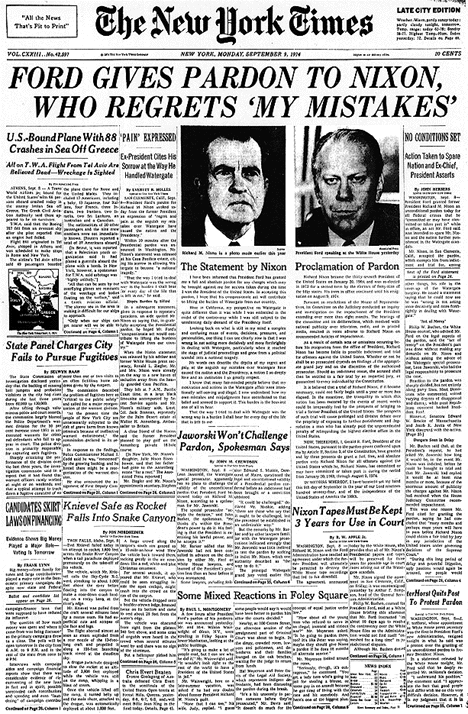
On this day in 1974, Ford Pardons Nixon:
Washington, Sept. 8–President Ford granted former President Richard M. Nixon an unconditional pardon today for all Federal crimes that he “committed or may have committed or taken part in” while in office, an act Mr. Ford said was intended to spare Mr. Nixon and the nation further punishment in the Watergate scandals.
Mr. Nixon, in San Clemente, Calif., accepted the pardon, which exempts him from indictment and trial for, among other things, his role in the cover-up of the Watergate burglary. He issued a statement saying that he could now see he was “wrong in not acting more decisively and more forthrightly in dealing with Watergate.”
On this day in 1860, hundreds are lost in Lake Michigan:
1860 – Sinking of the Lady Elgin
On this date the steamship Lady Elgin was lost on Lake Michigan and was one of the lake’s most tragic maritime disasters. The ship had been chartered by Milwaukee’s Irish Union Guards who had been in Chicago attending a fund raiser in order to purchase weapons to arm their unit. Their ship was struck by an unlit lumber schooner and sank. At least 300 lives were lost, many from Milwaukee’s Irish Third Ward community. [Source: History Just Ahead: A Guide to Wisconsin’s Historical Markers edited by Sarah Davis McBride, p. 17]
Here’s Puzzability‘s Tuesday game:
|
This Week’s Game — September 7-11
|
|||||
|
Open Admissions
|
|||||
|
Here’s a mixed doubles challenge for this week’s U.S. Open. Each day, we started with a word or phrase, added the six letters in U.S. OPEN, and rearranged the remaining letters to get a new phrase. Both pieces are described in each day’s clue, with the shorter one first.
|
|||||
|
Example:
|
|||||
|
A bit open; fruits sold near the Boscs and Bartletts
|
|||||
|
Answer:
|
|||||
|
Ajar; Anjou pears
|
|||||
|
What to Submit:
|
|||||
|
Submit both pieces, with the shorter one first (as “Ajar; Anjou pears” in the example), for your answer.
|
|||||
 |
|||||
|
Tuesday, September 8
|
|||||
|


Science/Nature, Space
The Scale of the Universe (a Three-Minute Animation)
by JOHN ADAMS •
WGTB, WHEN GREEN TURNS BROWN
The Least Possible Information
by JOHN ADAMS •
 Post 29 in a series. When Green Turns Brown is an examination of a small town’s digester-energy project, in which Whitewater, Wisconsin would import other cities’ waste, claiming that the result would be both profitable and green.
There is a story, an editorial, and an editorial reply at the Janesville Gazette about concentrated animal feeding operations (CAFOs). In effect, CAFOs are factory farms with thousands of animals.
There’s a factory farm near Bradford, the owners (from Nebraska) want another one in Green County, and the Gazette aims to reassure anyone in Green County who might accidentally stumble on the Gazette that a factory farm nearby would be just delightful.
The story is Does it smell? Neighbors to 5,000 cows get questions from neighbors of proposed farm (subscription req’d). The editorial is Our Views: Green County residents should welcome big dairy (subscription req’d). In reply, Kara O’Connor, representing small farmers in Wisconsin, writes Local views: New giant dairy would benefit Nebraska family, not Green County.
Part, but not all, of a waste-importation plan would likely rely on trucking waste from CAFOs into Whitewater.
An examination of CAFOs is a big subject, one that I will undertake later in this series. Wisconsinites, both researchers and ordinary residents, have spent thousands of hours studying concentrated animal feeding operations and their effects on human health and the environment. If anything, that’s a conservative estimate of the amount of time collectively spent.
If one read only the Gazette‘s story and editorial, one wouldn’t know about any of that research. One would have only a tissue-thin story about how a few residents are quoted as saying that a nearby factory farm doesn’t smell so bad. Smell, as though the risks were only those of odor (one that commenters point out is far worse than the reporter’s few quotes suggest).
The original story, by the way, looks like an intentional downplaying of risks so that the paper’s editorial board could flack a local big business’s efforts for another factory farm (‘see, it’s not so bad’).
Go ahead, read all three and compare.
What’s telling here is that if one read only the Gazette‘s story and editorial, one would have no idea about the widespread criticism of these huge farms. (In fact, even O’Connor’s reply highlighting problems is brief and mild compared with accounts across the state.)
Downplaying criticism is effective for factory farmers only if information about hazards to people and the environment can be concealed.
It can’t be.
WHEN GREEN TURNS BROWN: Mondays @ 10 AM, here on FREE WHITEWATER.
Music
Monday Music: Ana Popovic, Bring Your Fine Self Home
by JOHN ADAMS •
Daily Bread
Daily Bread for 9.7.15
by JOHN ADAMS •
Good morning, Whitewater.
Monday in town will present scattered thunderstorms and a high of eighty-three. Sunrise is 6:26 and sunset 7:18, for 12h 51m 55s of daytime. The moon is a waning crescent with 28% of its visible disk illuminated.
On this day in 1957, NBC first broadcast the animated peacock logo with which that network became so closely identified:
On this day in 1977, Wisconsin saw her first recall election:
On this date Wisconsin’s first judicial-recall election was held. Dane County citizens voted Judge Archie Simonson out of office. Simonson called rape a normal male reaction to provocative female attire and modern society’s permissive attitude toward sex. He made this statment while explaining why he sentenced a 15-year-old to only one year of probation for raping a 16-year-old girl. After the recall election, Simonson was replaced by Moria Krueger, the first woman judge elected in Dane County history. [Source: Initiative & Referendum Institute]
Puzzability begins a new week-long series entitled, Open Admissions. Here’s the game for Monday:
|
This Week’s Game — September 7-11
|
|||||
|
Open Admissions
|
|||||
|
Here’s a mixed doubles challenge for this week’s U.S. Open. Each day, we started with a word or phrase, added the six letters in U.S. OPEN, and rearranged the remaining letters to get a new phrase. Both pieces are described in each day’s clue, with the shorter one first.
|
|||||
|
Example:
|
|||||
|
A bit open; fruits sold near the Boscs and Bartletts
|
|||||
|
Answer:
|
|||||
|
Ajar; Anjou pears
|
|||||
|
What to Submit:
|
|||||
|
Submit both pieces, with the shorter one first (as “Ajar; Anjou pears” in the example), for your answer.
|
|||||
|
|||||
|
Monday, September 7
|
|||||
|

Animation, Film
Sunday Animation: Tribute to Hayao Miyazaki
by JOHN ADAMS •
Daily Bread
Daily Bread for 9.6.15
by JOHN ADAMS •
Good morning, Whitewater.
Sunday in the Whippet City will be sunny and hot with a high of ninety. Sunrise is 6:25 and sunset 7:20, for 12h 54m 45s of daytime. The moon is a waning crescent with 38% of its visible disk illuminated.
Friday’s FW poll asked if, contrary to the views of police in the German city of Bad Oeynhausen, a Shetland pony should be allowed to ride in the back of a Fiat hatchback. Just over seventy percent of respondents (70.83%) said, sure, they love it.
On this day in 1916, Clarence Saunders begins to revolutionize grocery shopping in America:
After leaving Clarksville, Tennessee, on September 6, 1916, Saunders launched the self-service revolution in the United States by opening the first self-service Piggly Wiggly store, at 79 Jefferson Street in Memphis, Tennessee, with its characteristic turnstile at the entrance. Customers selected goods for themselves from the shelves and paid cash.
The store incorporated shopping baskets, self-service branded products, and checkouts at the front. Removing unnecessary clerks, creating elaborate aisle displays, and rearranging the store to force customers to view all of the merchandise were just some of the characteristics of the early Piggly Wiggly stores. The concept of the “Self-Serving Store” was patented by Saunders in 1917.
Though this format of grocery market was drastically different from its competitors, the style became the standard for the modern grocery store and later supermarket. By 1922, six years after opening the first store, Piggly Wiggly had grown into 1,200 stores in 29 states. By 1932, the chain had grown to 2,660 stores doing over $180 million annually. Piggly Wiggly stores were both owned by the firm and franchised.
The success of Piggly Wiggly encouraged a raft of imitators, including Handy Andy stores, Helpy Selfy stores, Mick-or-Mack stores and Jitney Jungle, all of which operated under patented systems.[1]
Saunders then listed Piggly Wiggly on the New York Stock Exchange.
Animals
Bat Enjoys a Grape
by JOHN ADAMS •
Business, Corporate Welfare, Gluttony, Government Spending, WEDC
The New Crony Capitalist
by JOHN ADAMS •
Gov. Scott Walker on Thursday appointed banking executive and frequent GOP donor Mark Hogan to lead the state’s troubled job-creation agency [WEDC]…..
M&I Bank faced its own problems several years ago with bad loans and a crashing stock price and ended up being absorbed by BMO Harris of Canada in 2011.
M&I loan losses during the real estate bust — concentrated heavily in Arizona and Florida — totaled $4.8 billion across its portfolio from Dec. 31, 2007, through December 2010, according to a Milwaukee Journal Sentinel review.
Hogan has given $24,125 to Walker’s campaigns for governor since 2009, state records show.
He gave another $10,000 this year to the super PAC backing Walker’s presidential run. His son, Patrick, has worked for Walker’s office and campaign.
Walker spokeswoman Laurel Patrick said the contributions and Hogan’s son’s work for the campaign played no role in Hogan’s appointment.
Via Scott Walker appoints banking executive to lead state jobs agency @ JSOnline.
Cross-posted at Daily Wisconsin.
Daily Bread
Daily Bread for 9.5.15
by JOHN ADAMS •
Good morning, Whitewater.
Saturday will bring morning clouds but afternoon sunshine to Whitewater, with a daytime high of eighty-seven. Sunrise is 6:24 and sunset is 7:22, for 12h 57m 35s of daytime.
On this day in 1666, the days-long Great Fire of London finally relents:
The Great Fire of London was a major conflagration that swept through the central parts of the English city of London, from Sunday, 2 September to Wednesday, 5 September 1666.[1] The fire gutted the medieval City of London inside the old Roman city wall. It threatened, but did not reach, the aristocratic district of Westminster, Charles II‘s Palace of Whitehall, and most of the suburban slums.[2] It consumed 13,200 houses, 87 parish churches, St Paul’s Cathedral and most of the buildings of the City authorities. It is estimated to have destroyed the homes of 70,000 of the City’s 80,000 inhabitants.[3] The death toll is unknown but traditionally thought to have been small, as only six verified deaths were recorded. This reasoning has recently been challenged on the grounds that the deaths of poor and middle-class people were not recorded, while the heat of the fire may have cremated many victims leaving no recognisable remains. A melted piece of pottery on display at the Museum of London found by archaeologists in Pudding Lane, where the fire started, shows that the temperature reached 1700 °C.[4]
The Great Fire started at the bakery of Thomas Farriner (or Farynor) on Pudding Lane, shortly after midnight on Sunday, 2 September, and spread rapidly west across the City of London. The use of the major firefighting technique of the time, the creation of firebreaks by means of demolition, was critically delayed owing to the indecisiveness of theLord Mayor of London, Sir Thomas Bloodworth. By the time large-scale demolitions were ordered on Sunday night, the wind had already fanned the bakery fire into a firestorm which defeated such measures. The fire pushed north on Monday into the heart of the City. Order in the streets broke down as rumours arose of suspicious foreigners setting fires. The fears of the homeless focused on the French and Dutch, England’s enemies in the ongoing Second Anglo-Dutch War; these substantial immigrant groups became victims of lynchings and street violence. On Tuesday, the fire spread over most of the City, destroying St Paul’s Cathedral and leaping the River Fleet to threaten Charles II’s court at Whitehall, while coordinated firefighting efforts were simultaneously mobilising. The battle to quench the fire is considered to have been won by two factors: the strong east winds died down, and the Tower of London garrison used gunpowder to create effective firebreaks to halt further spread eastward.
The social and economic problems created by the disaster were overwhelming. Evacuation from London and resettlement elsewhere were strongly encouraged by Charles II, who feared a London rebellion amongst the dispossessed refugees. Despite numerous radical proposals, London was reconstructed on essentially the same street plan used before the fire.[5]
On this day in 1912, a general officer who fought for the Union passes passes away:
On this date Civil War hero and father of General Douglas MacArthur, Lt. General Arthur MacArthur II died. Raised in Wisconsin, Arthur MacArthur served with the 24th Wisconsin Volunteers in the Civil War and fought in many Western campaigns and in the Chattanooga campaign of 1863. He received the Medal of Honor. Joining the regular army after the war, he fought in both Cuba and the Philippines in the Spanish-American War and was (1900-1901) military governor of the Philippines. On September 5, 1912, he journeyed to Milwaukee, to address a reunion of his Civil War unit. While at the podium, he suffered a heart attack and died. He was originally buried in Milwaukee but was moved to Section 2 of Arlington National Cemetery in 1926. [Source: Arlington National Cemetery]
Animals, Weird Tales
Bears Overrun Russian Town
by JOHN ADAMS •
Years ago, one might have had concerns over the Russian bear, but now it’s ordinary Russians worrying about ordinary bears.
In the first video below, residents describe how bears are taking over their town.
In the second video, Russian law enforcement – always ready with the most sophisticated animal-control techniques – cleverly uses a siren to scare away one of the bears, leaving that animal able to return later in the day.
Captions are available if one selects the small CC box at the bottom of each video’s screen, and then the option to translate into English. The translations into English are from YouTube’s auto-generate feature, and either they’re not accurate translations into English, or the residents of Luchegorsk are somewhat addled.
Cats
Friday Catblogging: Cat Street View
by JOHN ADAMS •
In Hiroshima, Japan, they’ve a variation on Google Map’s street view feature:
Hiroshima prefecture has designed a purr-fect map for tourists wishing to see some of its attractions from a different angle.
The prefecture on Tuesday launched a website with what it calls the world’s first “cat’s-eye view” street map, through which users can explore some locations in Onomichi city from a more grounded perspective.
“We were seeking to introduce a different way to look at our cities and offer a view of the streets that wasn’t available before,” a Hiroshima tourism official said. They decided on a cat’s-eye view because Onomichi, a port town known for its large number of cats, is also home to a museum dedicated to Japan’s ‘maneki-neko’ cat dolls, the official said.
The map can be manipulated with a cursor to see the city from a cat’s eye view. Clicking symbols on the grid shows other parts of the city; clicking on a silhouette of a cat generates a photo and description of that feline.
See, Hiroshima Map Offers Cat’s-Eye View @ Wall Street Journal’s Japan Real Time.
Direct Link: http://hiroshima-welcome.jp/kanpai/catstreetview/.