
Daily Bread
Daily Bread for 5.30.15
by JOHN ADAMS •
Good morning, Whitewater.
We’ll have a rainy day in town with a high of sixty-six. Sunrise is 5:19 and sunset 8:25, for 15h 05m 39s of daytime. The moon is a waxing gibbous with 89.9% of its visible disk illuminated.
MIT has been designing robots, including a robot called the cheetah, for its running ability. (See, from 2014 @ FW, The Rise of the Robo-Cheetahs.) Those robots have been improved, and can now jump:
On this day in 1971, Mariner 9 leaves for Mars:
Mariner 9 (Mariner Mars ’71 / Mariner-I) was an unmanned NASA space probe that contributed greatly to the exploration of Mars and was part of the Mariner program. Mariner 9 was launched toward Mars on May 30, 1971[1][2] from Cape Canaveral Air Force Station and reached the planet on November 14 of the same year,[1][2] becoming the first spacecraft to orbit another planet[3] — only narrowly beating the Soviets’ Mars 2 and Mars 3, which both arrived within a month. After months of dust storms it managed to send back clear pictures of the surface.
Mariner 9 returned 7329 images over the course of its mission, which concluded in October 1972.
Cats
Friday Catblogging: Cat Defends His Home
by JOHN ADAMS •
Caution: Strong language from homeowners (the cat, by contrast, manages with admirable grace and minimum fuss).
Poll, Sports
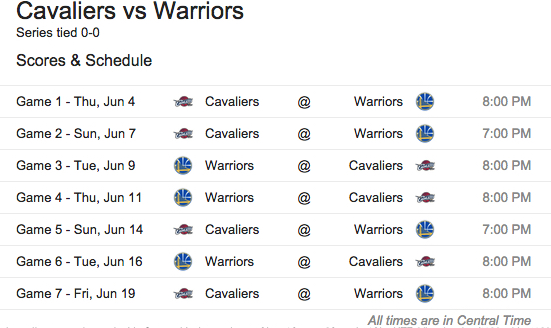
Friday Poll: Cleveland or Golden State?
by JOHN ADAMS •
Two teams left – who wins? The schedule’s immediately below.
Daily Bread
Daily Bread for 5.29.15
by JOHN ADAMS •
Good morning, Whitewater.
Friday will be cloudy, with a probability of thunderstorms, and a high of eighty. Sunrise is 5:20 and sunset 8:24, for 15h 04m 18s of daytime. The moon is a waxing gibbous with 82.8% of its visible disk illuminated.
On this day in 1953, Edmund Hillary and Tenzing Norgay reach the summit:
A series of advanced camps were created, slowly reaching higher up the mountain.[15] Camp II at 19,400 feet was established by Hillary, Band and Lowe on 15 April, Camp III at the head of the Icefall at 20,200 feet on 22 April, and Camp IV by Hunt, Bourdillon and Evans on 1 May.[14]These three made a preliminary reconnaissance of the Lhotse Face on 2 May, and Camp V at 22,000 feet was established on 3 May.[14] On 4 May, Bourdillon and Evans, supported by Ward and Wylie, reached Camp VI at 23,000 feet on the Lhotse Face, and just under a fortnight later on 17 May, Wilfrid Noyce and Lowe established Camp VII at 24,000 feet.[14] By 21 May, Noyce and the Sherpa Annullu (the younger brother of Da Tenzing) had reached the South Col, just under 26,000 feet. The first of two climbing pairs previously selected by Hunt, Tom Bourdillon and Charles Evans, set out for the summit on 26 May using closed-circuit oxygen and successfully achieved the first ascent of the 8,750 m (28,700 ft) South Summit, coming within 100 m (300 ft) of the final summit. They were forced to turn back after becoming exhausted, defeated by oxygen equipment problems and lack of time.[16] On 27 May, the expedition made its second and final assault on the summit with the second climbing pair, the New Zealander Edmund Hillary and Sherpa Tenzing Norgay from Nepal. Norgay had previously ascended to a record high point on Everest as a member of the Swiss expedition of 1952. They reached the summit at 11:30 am on 29 May 1953, climbing the South Col route. Before descending, they stopped at the summit long enough to take photographs and to bury some sweets and a small cross in the snow.[15]
On this day in 1848, Wisconsin enters the Union:
On this date Wisconsin became the 30th state to enter the Union with an area of 56,154 square miles, comprising 1/56 of the United States at the time. Its nickname, the “Badger State,” was not in reference to the fierce animal but miners who spent their winters in the state, living in dugouts and burrowing much like a badger. [Source: “B” Book I, Beer Bottles, Brawls, Boards, Brothels, Bibles, Battles & Brownstone by Tony Woiak, pg. 37]
Here’s the final game in this week’s Cheese Filling series from Puzzability:
|
This Week’s Game — May 25-29
|
|||||
|
Cheese Filling
|
|||||
|
We’ve got string cheese on the menu all week. For each day, we’ll give you three clues, each of which leads to a word. The answers to two of those clues, when placed together in the right order, have the name of a cheese spanning the gap between the answers. When the cheese’s name is removed, the remaining letters, in order, spell the answer to the day’s remaining clue. The clues are presented in random order.
|
|||||
|
Example:
|
|||||
|
Affleck’s Good Will Hunting costar; river of South America; astound
|
|||||
|
Answer:
|
|||||
|
AMAZEDAMON (Damon, Amazon, amaze; the cheese is Edam)
|
|||||
|
What to Submit:
|
|||||
|
Submit just the full string of letters, with the cheese in the middle (as “AMAZEDAMON” in the example), for your answer.
|
|||||
 |
|||||
|
Friday, May 29
|
|||||
|


Animals
Pip the Pug
by JOHN ADAMS •
Pip the Pug is not merely one of the smallest dogs in Britain, but likely in all the world:
more >>Meet Pip, the tiny pug who at just four inches high is one of the smallest dogs in the UK.
At four months old, she weighs only 1lbs 4 ounces – about the same as a bag of sugar.
The miniature pet is so small it can fit into a gravy boat and on long walks will travel around in her owner’s handbag….
Joanne [Astley], 54, decided to start breeding pugs last year, and was delighted when two-year-old Ruby gave birth to a litter of four in January.
But her delight soon turned to shock when she realised that one of the puppies was half the size of the others.
Joanne said: ‘I couldn’t believe it – she was just so tiny.
‘We took her to the vet, but they said that she was fine, apart from a cleft lip, and is just small.
‘We love our little Pip so much – I thought she was going to grow up quickly, but she’s stayed so little.
‘Pip’s about half the size of her sister.’
Mother-of-four Joanne and gas engineer partner Steve Madelin, 56, decided to keep tiny Pip and one of her sisters, Poppy.
Pip, a purebred pug, is almost exactly half the size a four-month-old pug pup should be.
Restaurant, Review
Restaurant Review: Karina’s Mexican Restaurant (Revisited)
by JOHN ADAMS •
Karina’s Mexican Restaurant recently opened on the west side of Whitewater. I reviewed the establishment at its then-downtown location about two years ago.
Karina’s is now located immediately to the west of Subway, in the same building, and east of Rocky Rococo’s. I’m not interested in reviewing those chains, but having returned to Karina’s I’d suggest that either would likely be preferable to Karina’s.
Realtors say that everything depends on location, location, location. Perhaps that’s true, but then when saying so they’re talking about real property, not food.
Location has not improved an overly-full menu (with too many items for this establishment), unattractively presented on the plate, with only sporadically attentive service.
The menu is too thick, and the salsa to thin, so to speak.
I had hoped for a better experience than my prior visits, but time hasn’t changed the fundamentals in need of changing.
My prior remarks remain pertinent to describe Karina’s.
LOCATION: 1170 W Main St, Whitewater, WI 53190 (262) 472-9492. See, Google Map directions linked at the beginning of this review.
PRICES: Main dish, drink, and complimentary chips & too-thin salsa about $10.
RESERVATIONS: Unnecessary.
DRINKS & WINE: Mexican beer, margaritas.
SERVICE: Sporadically attentive.
VISITS: One (as a dinner revisit).
RATING: Fair.

RATING SCALE: From one to four stars, representing the full experience of food, atmosphere, service, and pricing.
INDEPENDENCE: This review is delivered without financial or other connection to the establishment or its owner. The dining experience was that of an ordinary patron, without notice to the staff or requests for special consideration.
Daily Bread
Daily Bread for 5.28.15
by JOHN ADAMS •
Good morning, Whitewater.
Thursday in town will be mostly sunny with a high of eighty-three. Sunrise is 5:20 and sunset 8:23, for 15h 02m 52s of daytime. The moon is a waxing gibbous with 74.9% of its visible disk illuminated.
Today, Thursday morning, Downtown Whitewater’s Board meets at 8 AM. I am often asked about Downtown Whitewater, and my thoughts on their present work. Having watched closely, and heard much, I’ve no immediate answer to offer. The market – that collection of voluntary transactions among countless people each day – will decide the shape and future of Whitewater’s downtown. I’m not sure in which direction some of these forces will lead in our near-future. It’s enough for now to wait and see.
On this day in 1754, George Washington experiences his first combat, in the French and Indian War. He’s victorious, but the engagement is undisciplined, and has been controversial ever since. One is reminded that even a great man, later able to defeat the greatest empire on earth, and later still lead his own new republic ably for eight years, had hesitant and awkward moments:
George Washington, a young lieutenant colonel in the British Army and future president of the United States, leads an attack on French forces at Jumonville Glen on this day in 1754. The battle is later credited with being the opening salvo in the French and Indian War (1754 to 1763).
In the biography His Excellency: George Washington, historian Joseph Ellis recounts Washington’s first combat experience. Washington and 40 colonial troops had been encamped near the French garrison at Fort Duquesne when he received an urgent message to rescue Indian allies in the area who were threatened by French forces. In his official report of the encounter, Washington described how his troops, aided by warriors under the Indian leader Tanacharison, surrounded a detachment of 32 French soldiers near the fort on May 28 and, within 15 minutes, killed 10 of them, including the garrison’s commander, wounded one and took another 21 prisoner.
Controversy surrounded the attack both at the time and after the war. Historical accounts indicate that the French commander, Joseph Coulon De Jumonville had actually tried to surrender but was slain by Tanacharison. Tanacharison’s rash act incited the other warriors to kill and scalp nine other French soldiers before Washington could intervene. Ellis describes Washington as shocked and hapless and writes that he later tried to downplay the incident to his commanding officer. The French vilified Washington as the epitome of dishonor. The Jumonville Glen massacre remains a highly debated subject among scholars. In the aftermath of the encounter, Washington resigned his British army commission and returned to his family’s plantation. In 1775, he returned to military service to lead the Continental Army in the American Revolutionary War.
Here’s the Thursday game in Puzzability‘s Cheese Filling series:
|
This Week’s Game — May 25-29
|
|||||
|
Cheese Filling
|
|||||
|
We’ve got string cheese on the menu all week. For each day, we’ll give you three clues, each of which leads to a word. The answers to two of those clues, when placed together in the right order, have the name of a cheese spanning the gap between the answers. When the cheese’s name is removed, the remaining letters, in order, spell the answer to the day’s remaining clue. The clues are presented in random order.
|
|||||
|
Example:
|
|||||
|
Affleck’s Good Will Hunting costar; river of South America; astound
|
|||||
|
Answer:
|
|||||
|
AMAZEDAMON (Damon, Amazon, amaze; the cheese is Edam)
|
|||||
|
What to Submit:
|
|||||
|
Submit just the full string of letters, with the cheese in the middle (as “AMAZEDAMON” in the example), for your answer.
|
|||||
|
|||||
|
Thursday, May 28
|
|||||
|

Animals, Nature
Cubs Playing in Yosemite
by JOHN ADAMS •
Business, Corporate Welfare, Gluttony, Government Spending
SHINE Fades
by JOHN ADAMS •
Over at the Gazette, there’s a story that, ever so tentatively, lets readers know that the public-money-sucking SHINE project (to produce the molybdenum-99 isotope for nuclear medicine) isn’t faring so well in the marketplace.
SHINE is, after all, the centerpiece of big-government conservatism in Rock County, having received millions in public money to fund a tech venture for about a hundred highly-compensated workers as a supposed replacement for thousands of Janesville jobs lost during the Great Recession. (See, subscription req’d, SHINE regulatory process going smoothly; funding not so.)
The paper offers a lemonade-from-lemons headline if ever there were one: a smooth regulatory process should be a given (as millions in taxpayer dollars have been sunk into SHINE), a mere prelude to the truly important work of convincing private investors to sink almost another hundred-million into the project.
Thinking that private capital investment is secondary, after the regulatory process, is risibly short-sighted. This project will feast or starve in private markets.
SHINE is starving:
Katrina Pitas, SHINE spokeswoman and business development coordinator, said the company has pushed back its plant opening timetable to mid- to late 2018.
Pitas said the delay is because SHINE has not landed major private funding sources for the Janesville facility. She said private investors and venture capitalists have showed a trend of initial interest but then have cooled toward the project.
Having been pushed back again & again, they’ve now set a timetable of “mid-to-late 2018.”
Meanwhile, a competitor is moving forward faster, with a different process that won’t require uranium:
NorthStar, a Beloit-based radioisotope producer that says it could begin handling and shipping Mo-99 this summer, and in 2017 or 2018 could begin producing in Beloit without using uranium [as SHINE’s process will require].
Private markets aren’t secondary, except among an ignorant class of self-promoters who think that they’ve discovered a new way of business.
No, they’ve not: this is the old way of the well-fed, grabbing what they can from common residents, and hoping others won’t notice, or won’t object.
Anderson, Cartoons & Comics
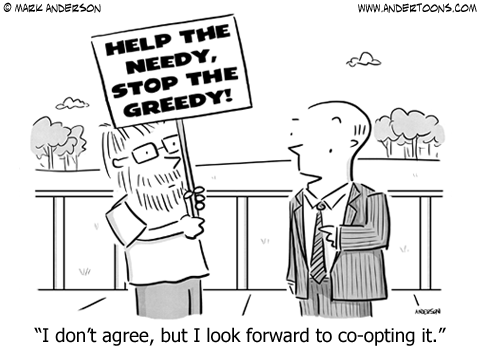
Co-opting
by JOHN ADAMS •
Daily Bread
Daily Bread for 5.27.15
by JOHN ADAMS •
Good morning, Whitewater.
Wednesday brings a probability of morning rain with a high of seventy-nine to Whitewater. Sunrise is 5:21 and sunset 8:22, for 15h 01m 23s of daytime. The moon is a waxing gibbous with 66.1% of its visible disk illuminated.
The Tech Park Board meets this morning at 8 AM, as does Downtown Whitewater at the same time Thursday AM.
On this day in 1937, the Golden Gate bridge opens to pedestrian traffic:
The structure links the U.S. city of San Francisco, on the northern tip of the San Francisco Peninsula, to Marin County, bridging both U.S. Route 101 and California State Route 1 across the strait. The bridge is one of the most internationally recognized symbols of San Francisco, California, and the United States. It has been declared one of the Wonders of the Modern World by the American Society of Civil Engineers.[7]
The Frommers travel guide considers the Golden Gate Bridge “possibly the most beautiful, certainly the most photographed, bridge in the world”.[8] It opened in 1937 and was, until 1964, the longest suspension bridge main span in the world, at 4,200 feet (1,300 m)….
The bridge-opening celebration began on May 27, 1937 and lasted for one week. The day before vehicle traffic was allowed, 200,000 people crossed either on foot or on roller skates.[9] On opening day, Mayor Angelo Rossi and other officials rode the ferry to Marin, then crossed the bridge in a motorcade past three ceremonial “barriers”, the last a blockade of beauty queens who required Joseph Strauss to present the bridge to the Highway District before allowing him to pass. An official song, “There’s a Silver Moon on the Golden Gate“, was chosen to commemorate the event. Strauss wrote a poem that is now on the Golden Gate Bridge entitled “The Mighty Task is Done.” The next day, President Roosevelt pushed a button in Washington, D.C. signaling the official start of vehicle traffic over the Bridge at noon. When the celebration got out of hand, the SFPD had a small riot in the uptown Polk Gulch area. Weeks of civil and cultural activities called “the Fiesta” followed. A statue of Strauss was moved in 1955 to a site near the bridge.[15]
On this day in 1844, a socialist community opens near Ripon. By 1850, human nature took its toll, and ended the project:
On this date the first settler moved to the Fourierite utopian community in what is now Ripon. This communal society was based upon the teachings of Charles Fourier, a French Socialist, who urged the rebuilding of society from its foundation as the only cure for economic hardship. This especially appealed to those suffering from the 1837 Depression.
The communal village was named Ceresco after the goddess of agriculture, Ceres. Also known as the Wisconsin Phalanx, the community thrived for six years, with membership reaching 180 in 1845.
The community officially disbanded in 1850 after many members decided to farm for their own profit. Families gradually left the commune to work and live on their own property. The center of the commune, the “Long House,” remained vacant until the 1930s when people suffering from the Great Depression found shelter and comfort there. Community founder Warren Chase said of the failed community “It was prematurely born, and tried to live before its proper time, and of course, must die and be born again. So it did and here it lies.” [Source: Wisconsin Saints and Sinners by Fred L. Holmes, pg. 94-104]
Here’s Puzzability‘s midweek game in its Cheese Filling series:
|
This Week’s Game — May 25-29
|
|||||
|
Cheese Filling
|
|||||
|
We’ve got string cheese on the menu all week. For each day, we’ll give you three clues, each of which leads to a word. The answers to two of those clues, when placed together in the right order, have the name of a cheese spanning the gap between the answers. When the cheese’s name is removed, the remaining letters, in order, spell the answer to the day’s remaining clue. The clues are presented in random order.
|
|||||
|
Example:
|
|||||
|
Affleck’s Good Will Hunting costar; river of South America; astound
|
|||||
|
Answer:
|
|||||
|
AMAZEDAMON (Damon, Amazon, amaze; the cheese is Edam)
|
|||||
|
What to Submit:
|
|||||
|
Submit just the full string of letters, with the cheese in the middle (as “AMAZEDAMON” in the example), for your answer.
|
|||||
|
|||||
|
Wednesday, May 27
|
|||||
|

Animals, Nature
How Ants Escape Traps
by JOHN ADAMS •
University
Beverly Kopper Selected as UW-Whitewater Chancellor
by JOHN ADAMS •
As anyone might have expected. So predictable, in fact, it would have been silly to expect another choice: this was a process of selection from among a very weak field, and thereby a design that would lead to one probable, internal selection.
(The external candidates might have been found at Greyhound bus terminals or all-night donut shops.)
See, Beverly A. Kopper named new chancellor of UW-Whitewater @ UW System website.
Superficially, the selection solves some problems of the current administration, but simultaneously exacerbates others.