FREE WHITEWATER

Daily Bread for 8.27.14

Good morning, Whitewater.

The middle of our week will be mostly cloudy with a high of seventy-six. Sunrise is 6:14 AM and sunset is 7:38 PM. The moon is a waxing crescent with four percent of its visible disk illuminated.

On this day in 1883, Krakatoa, in the then-Dutch East Indies, explodes:

The combination of pyroclastic flows, volcanic ash, and tsunamis had disastrous results in the region. There were no survivors from the 3,000 people located on the island of Sebesi, about 13 km (8.1 mi) from Krakatoa. Pyroclastic flows killed around 1,000 people at Ketimbang on the coast of Sumatra some 48 km (30 mi) north from Krakatoa.[6] The official death toll recorded by the Dutch authorities was 36,417, although some sources put the estimate at 120,000 or more. Many settlements were destroyed, including Teluk BetungSirik and Serang in Java. The areas of Banten on Java and the Lampung on Sumatra were devastated. There are numerous documented reports of groups of human skeletons floating across the Indian Ocean on rafts of volcanic pumice and washing up on the east coast of Africa, up to a year after the eruption. Some land on Java was never repopulated; it reverted to jungle, and is now the Ujung Kulon National Park….

Global climate

In the year following the eruption, average Northern Hemisphere summer temperatures fell by as much as 1.2 °C (2.2 °F).[9] Weather patterns continued to be chaotic for years, and temperatures did not return to normal until 1888.[9] The record rainfall that hit Southern California during the “water year” from July 1883 to June 1884 – Los Angeles received 38.18 inches (969.8 mm) and San Diego 25.97 inches (659.6 mm)[10] – has been attributed to the Krakatoa eruption.[11] There was no El Niño during that period as is normal when heavy rain occurs in Southern California,[12] but many scientists doubt this proposed causal relationship.[13]

The eruption injected an unusually large amount of sulfur dioxide (SO2) gas high into the stratosphere, which was subsequently transported by high level winds all over the planet. This led to a global increase in sulfuric acid (H2SO4) concentration in high level cirrus clouds. The resulting increase in cloud reflectivity (or albedo) would reflect more incoming light from the sun than usual, and cool the entire planet until the suspended sulfur fell to the ground as acid precipitation.[14]

Global optical effects

The eruption darkened the sky worldwide for years afterwards, and produced spectacular sunsets throughout the world for many months. British artist William Ashcroft made thousands of colour sketches of the red sunsets half way around the world from Krakatoa in the years after the eruption. The ash caused “such vivid red sunsets that fire engines were called out in New York, Poughkeepsie, and New Haven to quench the apparent conflagration.”[15] This eruption also produced a Bishop’s Ring around the sun by day, and a volcanic purple light at twilight.

In 2004, an astronomer proposed the idea that the blood red sky shown in Edvard Munch‘s famous 1893 painting The Scream is also an accurate depiction of the sky over Norway after the eruption.[16]

Weather watchers of the time tracked and mapped the effects on the sky. They labeled the phenomenon the “equatorial smoke stream”.[17] This was the first identification of what is known today as the jet stream.[18]

For several years following the eruption it was reported that the moon appeared to be blue and sometimes green. Blue moons resulted because some of the ash clouds were filled with particles about 1 µm wide—the right size to strongly scatter red light, while allowing other colors to pass. White moonbeams shining through the clouds emerged blue, and sometimes green. People also saw lavender suns and, for the first time, noctilucent clouds.[15]

On this day in 1878, Christopher Sholes patents the typewriter:
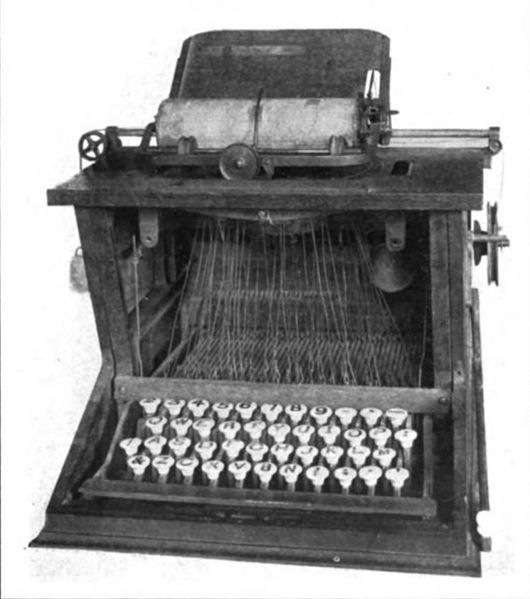
Sholes_typewriter

On this date Christopher Latham Sholes patented the typewriter. The idea for this invention began at Kleinsteuber’s Machine Shop in Milwaukee in the late 1860s. A mechanical engineer by training, Sholes, along with associates Carlos Glidden and Samuel Soulé, spent hours tinkering with the idea. They mounted the key of an old telegraph instrument on a base and tapped down on it to hit carbon & paper against a glass plate. This idea was simple, but in 1868 the mere idea that type striking against paper might produce an image was a novelty.

Sholes proceeded to construct a machine to reproduce the entire alphabet. The prototype was sent to Washington as the required Patent Model. This original model still exists at the Smithsonian. Investor James Densmore provided the marketing impetus which eventually brought the machine to the Remington Arms Company. Although Remington mass-marketed his typewriter beginning in 1874, it was not an instant success. A few years later, improvements made by Remington engineers gave the machine its market appeal and sales skyrocketed. [Source: Wisconsin Lore and Legends, p.41]

Google-a-Day asks a question about art:

In 1861, Louis-Napoléon Bonaparte bought 11,835 artworks for the Louvre, including 641 paintings from what Italian art collector?
Checklist for Evaluating a School Budget Referendum

1.  There’s time to evaluate a proposal.  The November election isn’t far, but it’s not tomorrow, either.  There’s time for a careful assessment. 

2.  Numbers, Figures, Results, Metrics.  Information should be presented fairly, and in context.  Old Whitewater has the mental tic of wanting to look good, regardless of whether performance is good.  They’re not the same thing. 

Analysis demands more than a simple numerology, as though a figure here or there means all the world.  (In any event, where sound reason and true faith appear, a superstitious numerology disappears.) 

The suitable tools of analysis are competitive American standards, not public-relations talking points.  

3.  Substance First.  I’ve argued that government should Lead Substantively, Support Fiscally

As a right, people may say as little or as much as they’d like. 

In my own case, however, if I consider a referendum, I will do so beginning with what I think matters for the curriculum, and thereafter consider what’s needed to achieve those goals. 

A discussion like this isn’t simply about money, but about objectives, where those objectives concern academics, athletics, and art beyond mere top-line results.

Learning is a process, independent of a score.  

Having contended that one should see it this way, I’ll write about it that way, or not at all. 

4.  Schooling, Education, Lifelong Learning.  Schooling (in the classroom), education (as a description of formal learning in all its forms), and lifelong learning are not the same things. 

We hope each leads to the support for, and participation in, the next. 

Along the way, a few will insist that to ask questions about schooling and education – merely to inquire – is evidence of an anti-education bias. 

I’m neither persuaded that’s true, nor deterred by those who facilely insist that it is true.   

My paternal family acquainted me with university life from the time I was a small child.  It was an expected path, and I recall my first visit to campus before I began kindergarten. 

My father and uncle took me to campus, to a football game and thereafter walked me across the university.  They wanted me to see the large number of students, the excitement of the game, and then to show me prominent places nearby.  It was nearly overwhelming for a small boy, those sounds and crowds, but they followed it with a quiet walk past buildings on a late afternoon. 

Yet schooling and education only mean something if one believes in them as something of meaning; from that belief, lifelong learning follows easily.

It’s an easy life to love, not superficially, but deeply. 

It’s not the meaning of metrics, numbers, diplomas, and degrees that matters, but the underlying understanding that comes from and after one’s schooling. 

I’ll not make the mistake of confusing those separate things; it’s a subject that deserves more care than that. 

Whitewater’s ACT Scores and Participation Rates

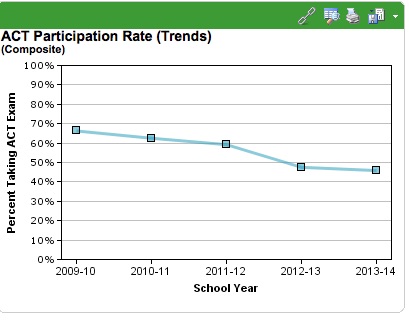
Last week, I wrote about the lower number of students who were taking the ACT at Whitewater High School.  Although the scores are higher, fewer students are taking the test.  That’s to the credit of students taking the test (and those teaching them), but it’s an unfavorable sign for the district.

See, What’s Being Done is More than Just a (Sketchy) Number.

The declining local ACT participation rate is even more stark, and disappointing, than I realized last week.  Of the thirteen school districts with a four-year UW System campus, only Whitewater has seen a decline in the ACT participation rate.   (Whitewater’s participation decline has been a precipitous one: from 66.2% to just 45.8% over the last five testing years.)

Whitewater also has the lowest participation rate of those thirteen peer districts, and is only one of two with a participation rate under 50%. (The other under-fifty district is Green Bay, and even that district saw an increase in the rate over the last five years, and had a higher rate last year than our district.)

The data are available at the Wisconsin Department of Public Instruction website: WI DPI Dashboard.

All of the other districts with UW System four-year schools have a steady or increasing participation rate over this period, as is also true of the Wisconsin statewide average.

Those UW System schools are Eau Claire, Green Bay, La Crosse, Madison, Milwaukee, Oshkosh, Parkside, Platteville, River Falls, Stevens Point, Stout, Superior, and Whitewater.  They’re located, respectively, in Eau Claire, Green Bay, La Crosse, Madison, Milwaukee, Oshkosh, Kenosha, Platteville, River Falls, Stevens Point, Menomonie, Superior, and Whitewater.

WW2
Local participation rates have declined and are
lower than any peer district with a UW System campus.

(I wouldn’t have been inclined to look at these thirteen districts, but remarks last night during a school board meeting inspired me to look more deeply at peer communities. As it turns out, looking at those peer communities only strengthens my original argument.)

Our declining participation rate is contrary to the Wisconsin trend and the trend in peer communities.  Whitewater is even more of an outlier – in an unfortunate way – than I had originally realized.  

True success comes when more students rather than fewer are taking the test, and when that greater number is doing better.

In any event, touting the number alone (without careful reflection that learning is more than a number), or considering the number without context (without appreciating the significance of a participation rate) is a shallow view of learning.

Education should be the drive to lifelong learning, and that’s more than a marketing slogan, let alone one based on participation rates moving in the wrong direction.

Opportunity should be for the many, not the few.  We can and should do better, to move the participation rate up as the state and peer districts have done.

Daily Bread for 8.26.14

Good morning, Whitewater.

Tuesday looks to be partly sunny, with a high of seventy-nine, and a one-third chance of late morning showers.

On this day in 1939, the first MLB game is televised:

…first televised Major League baseball game is broadcast on station W2XBS, the station that was to become WNBC-TV. Announcer Red Barber called the game between the Cincinnati Reds and the Brooklyn Dodgers at Ebbets Field in Brooklyn, New York.

At the time, television was still in its infancy. Regular programming did not yet exist, and very few people owned television sets–there were only about 400 in the New York area. Not until 1946 did regular network broadcasting catch on in the United States, and only in the mid-1950s did television sets become more common in the American household.

In 1939, the World’s Fair–which was being held in New York–became the catalyst for the historic broadcast. The television was one of fair’s prize exhibits, and organizers believed that the Dodgers-Reds doubleheader on August 26 was the perfect event to showcase America’s grasp on the new technology.

By today’s standards, the video coverage was somewhat crude. There were only two stationary camera angles: The first was placed down the third base line to pick up infield throws to first, and the second was placed high above home plate to get an extensive view of the field. It was also difficult to capture fast-moving plays: Swinging bats looked like paper fans, and the ball was all but invisible during pitches and hits.

Nevertheless, the experiment was a success, driving interest in the development of television technology, particularly for sporting events. Though baseball owners were initially concerned that televising baseball would sap actual attendance, they soon warmed to the idea, and the possibilities for revenue generation that came with increased exposure of the game, including the sale of rights to air certain teams or games and television advertising….

Google-a-Day asks a question about tennis:

The 2010 tennis match that lasted 11 hours and 5 minutes beat the previous record for the longest match by how many hours?


WEDC Board Offers Millions to Subsidize Job Cuts

The next time Chancellor Telfer, City Manager Clapper, and CDA Chairman Jeff Knight host Reed Hall of the WEDC in Whitewater, they might wish to ask him a few questions about use of public moneyjob creation, and community development:

The board overseeing the state’s flagship job-creation agency has quietly approved a $6 million tax credit for Ashley Furniture Industries with a condition allowing the company to eliminate half of its state workforce.

As approved by the Wisconsin Economic Development Corp. board, the award would allow the Arcadia-based global furniture maker to move ahead with a $35 million expansion of its headquarters and keep 1,924 jobs in the state.

But it wouldn’t require Ashley to create any new jobs, instead granting the company license to lay off half of its current 3,848 Wisconsin-based workers in exchange for an enterprise zone tax credit, one of the most valuable and coveted state subsidies.

The board’s decision has not been made public because a contract with the company has not been finalized. But in a statement Friday, in response to questions from the State Journal, Ashley Furniture confirmed it is seeking state subsidies that include terms allowing for job reductions….

Via WEDC board OK’d Ashley Furniture getting $6 million tax credit, cutting 1,900 jobs @ Wisconsin State Journal.

And by the way, so we’re all clear, the Walker Campaign got something in return — On Politics: Ashley Furniture owners gave $20,000 to Scott Walker shortly after WEDC vote:

Less than a month after the Wisconsin Economic Development Corp. board approved a $6 million tax credit for Ashley Furniture Industries, the company’s owners gave $20,000 to Gov. Scott Walker’s re-election campaign.

The State Journal reported Sunday the board — led by Walker, who is chairman — approved the tax credits on Jan. 30 for the Arcadia-based company, though the award hasn’t been formally announced because a contract between the state’s flagship job-creation agency and Ashley has not been finalized.

The WEDC’s efforts are both economically harmful and politically ignorant – those who have latched on to this as a local effort have picked a losing issue.

See, along these lines: WEDC Update (subsidizing the outsourcing of jobs to other countries), Local Crony Capitalism via the WEDC (and similar schemes), and The Truth About the Wisconsin Economic Development Corporation.


Daily Bread for 8.25.14

Good morning, Whitewater.

Monday in the Whippet City will bring a one-third chance of thunderstorms and a high of eighty-nine.

UW-Whitewater Chancellor Richard Telfer is scheduled to deliver a state of the university speech today at 10:30 AM.  This evening, the Whitewater Unified School District governance committee meets at 6:30 PM, with a regular meeting following at 7 PM.

On this day in 1835, the Great Moon Hoax begins:

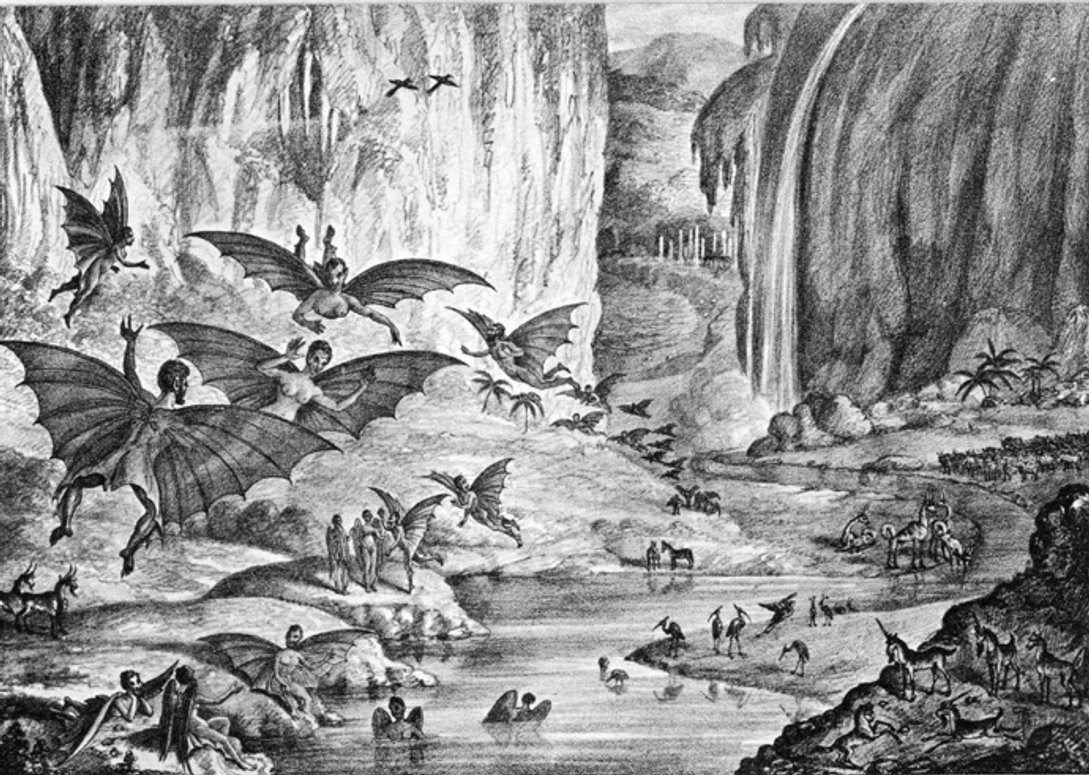
Great-Moon-Hoax-1835-New-York-Sun-lithograph-298px
Great Moon Hoax lithograph of “ruby amphitheater” for The Sun,
August 28, 1835 (4th article of 6).
Via Wikipedia.

The Great Moon Hoax” refers to a series of six articles that were published in The Sun, a New York newspaper, beginning on August 25, 1835, about the supposed discovery of life and even civilization on the Moon. The discoveries were falsely attributed to Sir John Herschel, perhaps the best-known astronomer of his time.[opinion]

The story was advertised on August 21, 1835, as an upcoming feature allegedly reprinted from The Edinburgh Courant.[1] The first in a series of six was published four days later on August 25….

“GREAT ASTRONOMICAL DISCOVERIES
LATELY MADE
BY SIR JOHN HERSCHEL, L.L.D. F.R.S. &c.
At the Cape of Good Hope
[From Supplement to the Edinburgh Journal of Science]”


The articles described fantastic animals on the Moon, including bisongoatsunicornsbipedal tail-less beavers and bat-like winged humanoids (“Vespertilio-homo“) who built temples. There were trees, oceans and beaches. These discoveries were supposedly made with “an immense telescope of an entirely new principle.”

The author of the narrative was ostensibly Dr. Andrew Grant, the travelling companion and amanuensis of Sir John Herschel, but Grant was fictitious.

Eventually, the authors announced that the observations had been terminated by the destruction of the telescope, by means of the Sun causing the lens to act as a “burning glass,” setting fire to the observatory.[2]

Google-a-Day asks a question about geography:

What group of islands in the Pacific are part of the same volcanic zone and was named from the Greek words meaning “small” and “island”?

Vito the Macaw races his owner in Greece

The video below, recorded at Kolimbithres beach of Paros, is from last year.

YouTuber Waterskizone reports in July 2014 that “Well, now he is flying above and in front of me, distances like 5 km and into the village for a coffee…”

Daily Bread for 8.24.14

Good morning, Whitewater.

Sunday in the city will be partly sunny with a high of eighty-five. Sunrise is 6:11 AM and sunset 7:43 PM. The moon is a waning crescent with only one-percent of its visible disk illuminated.

Americans have been to the moon six times, but that hasn’t stopped crackpots from claiming that we’ve never been there. Here’s a video that explains, in just two minutes, evidence that humans have landed and explored the surface of Earth’s only natural satellite:

Via Another Great Way to Prove Moon Hoax Conspiracy Theorists Wrong @ Gizmodo.

On this day in AD 79, Vesuvius erupts:

In AD 79, Mount Vesuvius erupted in one of the most catastrophic and infamous eruptions in European history. Historians have learned about the eruption from the eyewitness account of Pliny the Younger, a Roman administrator and poet.[1]

Mount Vesuvius spewed a deadly cloud of volcanic gasstonesash and fumes to a height of 33 km (20.5 miles), ejecting molten rock and pulverized pumice at the rate of 1.5 million tons per second, ultimately releasing a hundred thousand times the thermal energy of the Hiroshima bombing.[2] The towns of Pompeii and Herculaneum were obliterated and buried underneath massive pyroclastic surges and ashfall deposits.[1][2] An estimated 16,000 people died in the eruption.

One thousand, nine-hundred thirty-four years later, in February 2014, Sony Pictures distributed, Pompeii, a poorly-received box office failure about the natural disaster.

On this day in 1857, Wisconsin panics:

1857 – Panic of 1857

On this date the New York branch of the Ohio Life Insurance and Trust Company failed, launching the Panic of 1857. Stocks plunged; banks and businesses across the nation, including many Wisconsin-based ventures, collapsed. The Panic of 1857 led to a depression that lasted three years until the beginning of the Civil War. [Source: American Memory Today in History]


Daily Bread for 8.23.14

Good morning, Whitewater.

Saturday in Whitewater will be mostly cloudy, with a high of eighty-five, and a one-third chance of afternoon thundershowers.

Yesterday’s FW poll asked if, as is now lawful in California, patrons should be allowed to bring dogs onto restaurant patios. Just over 77% of respondents answered affirmatively, in favor of dogs’ dining out.

Fanny_farmer_cookbook_1996
1996 edition, via Wikipedia.

Cookbook author Fannie Farmer opened a cooking school on this day in 1902:

Fannie published her best-known work, The Boston Cooking-School Cook Book, in 1896. Her cookbook introduced the concept of using standardized measuring spoons and cups, as well as level measurement. A follow-up to an earlier version called Mrs. Lincoln’s Boston Cook Book, published by Mary J. Lincoln in 1884, the book under Farmer’s direction eventually contained 1,850 recipes, from milk toast to Zigaras à la Russe. Farmer also included essays on housekeeping, cleaning, canning and drying fruits and vegetables, and nutritional information

The book’s publisher (Little, Brown & Company) did not predict good sales and limited the first edition to 3,000 copies, published at the author’s expense.[1][2] The book was so popular in America, so thorough, and so comprehensive that cooks would refer to later editions simply as the “Fannie Farmer cookbook”, and it is still available in print over 100 years later.

Farmer provided scientific explanations of the chemical processes that occur in food during cooking, and also helped to standardize the system of measurements used in cooking in the USA. Before the Cookbook’s publication, other American recipes frequently called for amounts such as “a piece of butter the size of an egg” or “a teacup of milk.” Farmer’s systematic discussion of measurement — “A cupful is measured level … A tablespoonful is measured level. A teaspoonful is measured level.” — led to her being named “the mother of level measurements.”

Farmer left the Boston Cooking School in 1902 and created Miss Farmer’s School of Cookery.[3] She began by teaching gentlewomen and housewives the rudiments of plain and fancy cooking, but her interests eventually led her to develop a complete work of diet and nutrition for the ill, titled Food and Cookery for the Sick and Convalescent. Farmer was invited to lecture at Harvard Medical School and began teaching convalescent diet and nutrition to doctors and nurses. She felt so strongly about the significance of proper food for the sick that she believed she would be remembered chiefly by her work in that field, as opposed to her work in household and fancy cookery. Farmer understood perhaps better than anyone else at the time the value of appearance, taste, and presentation of sickroom food to ill and wasted people with poor appetites; she ranked these qualities over cost and nutritional value in importance.