
Size isn’t enough; there’s always a bigger fish…
Education, School District
What’s Being Done is More than Just a (Sketchy) Number
by JOHN ADAMS •
A good discussion about education is one about substantive work in academics, athletics, and art (an expansive curriculum).
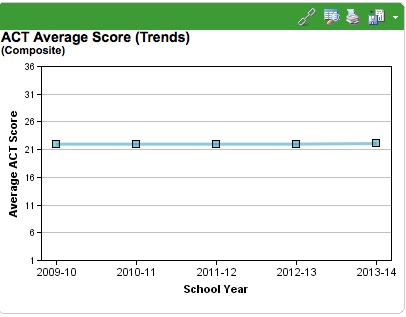
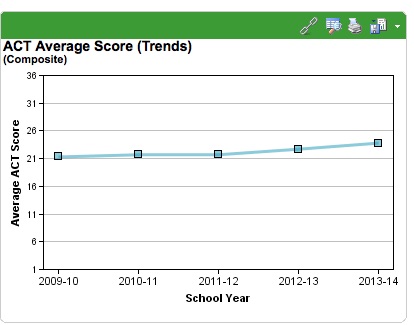
A few days ago, press releases touted the ACT scores of some of our students over the last three years. The data showed progress from 2011 to 2014, as against the statewide ACT average.
They’re good scores; the students who earned them, and those who taught these students, should be proud.
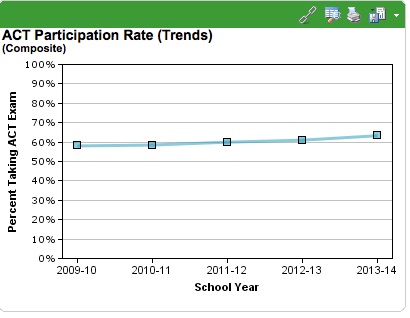
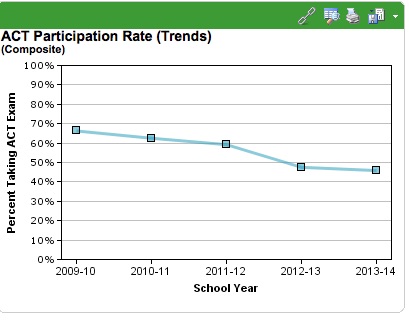
Considering the whole school, as I’ll show, those published results came with a critical omission – although the average ACT at Whitewater High School has gone up, the percentage of students taking the test has fallen significantly.
Whitewater’s better performance comes from a smaller pool of test-takers.
I’ve reproduced the Whitewater High School and the statewide averages, along with the actual participation rates of students’ composite ACT scores, at Whitewater High and statewide, respectively.
Link: WI DPI Dashboard.
What does this mean?
Whitewater’s scores lagged Wisconsin when both school and state participation rates were high; as fewer Whitewater students have taken the test, the school’s scores have gone up.
Locally, test averages have moved in the opposite direction of participation.
(That’s not true for the state: state scores and participation rates have both stayed high.)
Doing well is a personal accomplishment, but it’s easier for a school to do well when the test is confined to a minority of students, rather than when it serves as a measure of most students’ performance.
Pride. An administrator can be proud of those students taking the ACT, but the goal of any administrator should be to move the participation rate up, not let it fall down.
Our schools and community are not meant to be a representation only of a minority; competitive success should be available to all, and within the reach of huge numbers.
Shifting focus? A lower participation rate may be evidence of a shifting focus from substantive academics for college to a non-college focus. There’s an academic and competitive difference between those options.
Straight-forward data. Results should be presented fairly, without omission of crucial facts (such as the decline in ACT participation rates).
Those in eduction, of all fields, should show more care with the forthright presentation of results.
A commitment to education – to being a lifelong learner – is the opposite of sophistry and spin.
In any event, learning over four years, let alone many decades, is more than a single test result.
It matters what made a result possible (what one studied, specifically), and what might do with that knowledge afterward, living in the world.
Cats
Friday Catblogging: Cat Gets a Hug
by JOHN ADAMS •
Poll
Friday Poll: Dogs on Restaurant Patios
by JOHN ADAMS •
In California, they’ve now passed a law allowing dogs on restaurant patios. (Previously, some restaurants would permit the practice, but they risked health code violations in communities that enforced California health codes strictly.)
Now, restaurants can accept patrons with dogs (for outdoor dining) without fear of being cited for code violations.
What do you think?
Daily Bread
Daily Bread for 8.22.14
by JOHN ADAMS •
Good morning, Whitewater.
Friday in town will be cloudy with a high of about eighty-five.
On this day in 1776, the British arrive in New York:
…the British arrive at Long Island, between Gravesend and New Utrecht, with “near twenty four thousand men ready to land in a moment,” according to one observer.
General William Howe’s large army came to Long Island hoping to capture New York City and gain control of the Hudson River, a victory that would divide the rebellious colonies in half. Five days later, on August 27, the Redcoats marched against the Patriot position at Brooklyn Heights, overcoming the Americans at Gowanus Pass and then outflanking the entire Continental Army. The Americans suffered 1,000 casualties to the British loss of only 400 men during the fighting. Howe chose not to follow the advice of his subordinates, however, and did not storm the Patriot redoubts at Brooklyn Heights, where he could have taken the Patriots’ military leadership prisoner and ended the rebellion.
General Washington ordered a retreat to Manhattan by boat. The British could easily have prevented this retreat and captured most of the Patriot officer corps, including Washington. However, General William and Admiral Richard Howe still hoped to convince the Americans to rejoin the British empire in the wake of the humiliating defeat, instead of forcing the former colonies into submission after executing Washington and his officers as traitors. On September 11, Benjamin Franklin, John Adams and other congressional representatives reopened negotiations with the Howe brothers on Staten Island. The negotiations fell through when the British refused to accept American independence.
The British captured New York City on September 15; it would remain in British hands until the end of the war.
Google-a-Day asks a history question:
For whom was the ship, on which the man who served as governor for 12 of the Massachusetts Bay Colony’s first 20 years sailed to the New World, named?
Food
A Way to Great Ribs
by JOHN ADAMS •
Chef John Stage of Dinosaur Bar-B-Que (now nine locations, including one in Chicago) offers his tips in this video. Just watching the video is a mouth-watering experience…
Via The Secret To Making Dinosaur Bar-B-Que’s Famous St. Louis-Style Ribs.
Education, School District
The Visigoths Who Love Music
by JOHN ADAMS •
It was quite some time ago that the Visigoths sacked Rome, acquiring thereafter (if not before) a bad reputation. It’s safe to say that whatever challenges Whitewater faces do not involve rampaging hordes seeking to overturn our social order.
We’ve had parents protesting over possible budget cuts, to music or other programs. You’ll see below, from a Whitewater Unified School District PowerPoint presentation, a full-room of concerned parents this spring, when the district proposed program cuts:
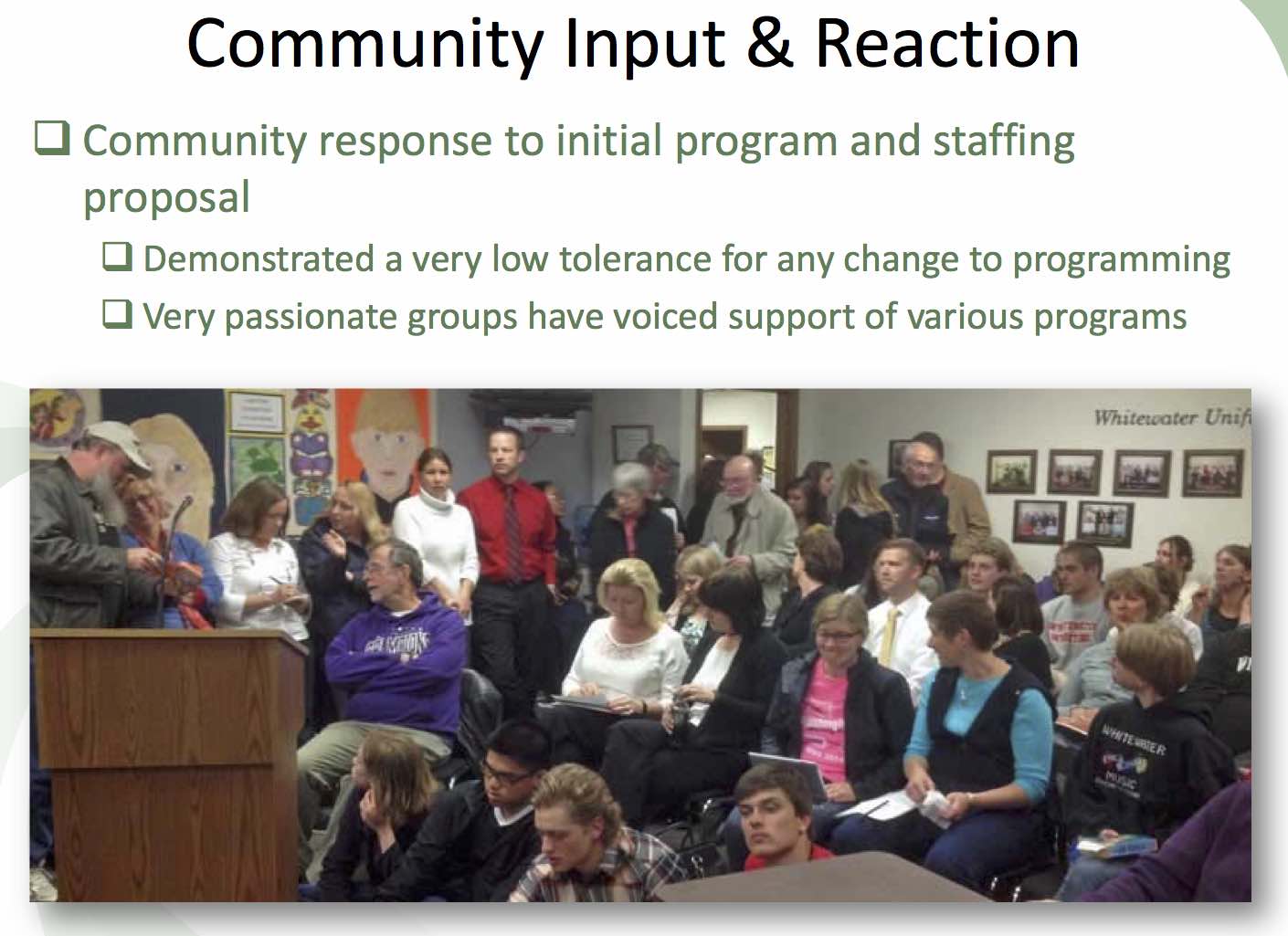
Why were they there? An obvious reason is that they were concerned about program cuts.
But, I’ve written before about those proposed cuts, and it’s also obvious that many parents were unaware about the district’s actual, fiscal condition: “if the district ran into a parental firestorm of surprise and frustration at the end of its budgetary process, then the district’s budgetary process was inadequate.”
(See, along these lines, The Whitewater Schools’ Recent Budget Cuts, and The Whitewater Schools’ Budget Cuts.)
When large groups of people are surprised, it’s most often because leaders have not communicated a difficult message adequately beforehand.
If while writing I fail to make my point, that’s almost certainly my error, not readers’. Responsibility for communicating rests mostly with the speaker, not the audience.
The same is true with leaders in business or government: the burden is on leaders to be clear, well in advance. It is they who should have the necessary information about prospects, and so it is they who have the burden to communicate effectively.
People aren’t stubborn a tenth so often as they are surprised.
We’re now looking at years of structural deficits for our district, but it’s not a sin to say as much.
The sky won’t fall. Lightning won’t strike. Barbarians won’t sack the city (as there are none around, anyway).
Parents may support our music programs, but they aren’t Visigoths, so to speak. It’s a mistake to see opposition from surprise as obdurate.
We’ll manage, and would have managed even better, if we had been clearer about these problems sooner.
A discussion of getting through, however, should be one about the broader, comprehensive curriculum first, about the goals for academic, athletic, and artistic accomplishment.
That’s why this district should Lead Substantively, Support Fiscally.
It’s more than a shame that the biggest story of 2014 for this district may turn out to be a budget referendum. In this year or any year, the biggest story should be what’s being done (that begins every conversation), as that’s what matters most.
Tomorrow: What’s Being Done is More than Just a (Sketchy) Number.
Daily Bread
Daily Bread for 8.21.14
by JOHN ADAMS •
Good morning, Whitewater.
We’ll have an even chance of thunderstorms today, with otherwise cloudy skies and a high of eighty-three.
In Kenya earlier this month, it was reptile v. mammals in a battle over an elephant carcass:
On this day in 1959, America becomes a fifty-state nation:
Hawaii … is the 50th and most recent U.S. state to join the United States. It joined the Union on August 21, 1959. It is the only U.S. state located in Oceania and the only one made up entirely of islands. It is the northernmost island group in Polynesia, occupying most of an archipelago in the central Pacific Ocean.
Google-a-Day asks a question about a narrator:
Who is the narrator of Conrad’s novel that involves a boat trip up the Congo River to Inner Station?
Nature, Science/Nature
Measuring Kepler 93B
by JOHN ADAMS •
School District
A Whitewater Schools 2014 Referendum (Quick Politics of It All )
by JOHN ADAMS •
The Whitewater Schools will likely vote to exceed revenue-caps by something over a million dollars a year for four years. The proposal is in response to projected structural deficits of about a million-and-a-half dollars.
A formal vote is yet ahead, and beyond that there are details and justifications to consider. It’s reasonable to review all the information the district presents.
As a policy matter, there’s time enough to read and then ponder the district’s proposal.
As a political matter, I’ve a few remarks for today and tomorrow.
I’m sure there have been lengthy internal conversations about how to advance a referendum politically (beyond discussions with the residents’ advisory group).
1. November 2014. The key political consideration is that this is a November 2014 gubernatorial-year referendum. The single-most important factor in the referendum’s success will not come from local proponents, but from statewide candidate Mary Burke’s showing in the city proper.
(How close she can come in surrounding towns matters, too, but less so, as it’s Gov. Walker’s territory to win.)
I’ve predicted that Gov. Walker will win statewide, but that Mary Burke will carry the city. (I still think that’s the most likely statewide outcome despite surprisingly close August polls.)
The bluer the electorate in Whitewater proper, the better the chances for a referendum’s success. A referendum victory would require a thank-you card to Ms. Burke, no matter how she does statewide.
2. Conservative Credibility. Conservatives locally are not in control of their own destiny – over years they’ve thrown their credibility away, and now depend on red years elsewhere (or years that aren’t so blue elsewhere) to prevail in the city.
They dribbled away their credibility by backing local big project after big project, and now they’ve no credible claims against multi-million-dollar spending.
They’re big-government ‘conservatives,’ and that’s a losing long-term proposition.
A big-spending conservative is like a clergyman in a cathouse: repulsive and hypocritical, both.
3. Conservative Voices. Even if, within the city, there are conservative leaders who will oppose a referendum (and I think most of them will stay quiet), those who do so will probably offer inarticulate objections based on anti-labor whining.
That’s not the way to contend against spending in an increasingly-blue environment, but they’ll think a bit of carping (in big red letters) is an adequate substitute for a comprehensive assessment of how much spending the district needs.
It’s not; their approach will be ineffectual, if not counter-productive.
This discussion needs to be moved to different ground, to a conversation about what the district truly needs to meet its academic, athletic, and artistic objectives. (That may mean more in some areas, but less in others – distribution matters.)
There are no self-professed, longtime conservative leaders in the City of Whitewater proper who will take that approach. They’ll either stay quiet or mishandle the issue.
That would be, however, the right conversation: what do you want to accomplish for the children of this community, and what do you need to meet those objectives?
What’s gained by the additional spending (or what would be lost without it)?
The only conversation worth having about education is an inquisitive, thoughtful, sharp one, in which arguments are carefully evaluated.
Tomorrow: The Visigoths Who Love Music.
Anderson, Cartoons & Comics
Price
by JOHN ADAMS •

Daily Bread
Daily Bread for 8.20.14
by JOHN ADAMS •
Good morning, Whitewater.
Wednesday in town will be mostly sunny with a high of eighty-three. Sunrise today is 6:07 AM and sunset is 7:49 PM. The moon is a waning crescent with twenty percent of its visible disk illuminated.
The Whitewater CDA Seed Capital Screening Committee meets at 3:30 PM, and the Community Development Authority Board at 5 PM.
On this day in 1911, the first telegram travels around the world by design in a commercial test:
The New York Times sends a telegram message to test how fast a commercial message could be sent around the world. Reading simply, “This message sent around the world”, it left at 7 PM, traveled over 28,000 miles and was relayed by 16 different operators. It arrived back at The Times only 16.5 minutes later. The building where the message originated is now called One Times Square and is best known for where the ball drops on New Year’s Eve.
On this day in 1794, American soldiers win the Battle of Fallen Timbers:
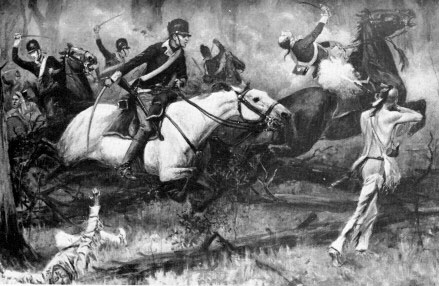
1794 – Battle of Fallen Timbers
On this date American troops under General “Mad” Anthony Wayne defeated a confederation of Indian forces led by Little Turtle of the Miamis and Blue Jacket of the Shawnees. Wayne’s soldiers, who included future Western explorer William Clark and future President William Henry Harrison, won the battle in less than an hour with the loss of some 30 men killed. (The number of Indian casualties is uncertain.)The battle had several far-reaching consequences for the United States and what would later become the state of Wisconsin.
The crushing defeat of the British-allied Indians convinced the British to finally evacuate their posts in the American west (an accession explicitly given in the Jay Treaty signed some three months later), eliminating forever the English presence in the early American northwest and clearing the way for American expansion.
The battle also resulted in the 1795 Treaty of Greenville, in which the defeated Indians ceded to Wayne the right of Americans to settle in the Ohio Valley (although the northwestern area of that country was given to the Indians). Wayne’s victory opened the gates of widespread settlement of the Old Northwest, Wisconsin included. [Source: American History Illustrated, Feb. 1969]
Google-a-Day poses a question about poetry:
In the poem that includes the lines, “This is the dead land, This is cactus land”, to what work is the first epigraph an allusion?
City, Development, Marketing
One Reason a Comprehensive Marketing Plan Can’t Work (Now) in Whitewater
by JOHN ADAMS •
There’s talk, about every six months or so, about launching a comprehensive marketing plan for Whitewater. (This must be version 17.0 by now.)
I’ll set aside the problem of past efforts at marketing the city dishonestly, as though prospects were too dim to see through blatant exaggerations or omissions about life in town. (See, The Failure of Marketing (and the Marketing of Failure)).
There’s another problem: to market the town to good prospects requires presenting it both honestly and differently from the way in which declining town squires insist it must be presented.
Present effectively, and a waning old guard will be alienated or insulted; present as that old guard insists, and few prospects will find the presentation persuasive (or even credible).
Aging insiders would have to set aside their own pride to present Whitewater both honestly and effectively to newcomers. They’d have to learn new tricks.
Even if they’re able to imagine a campaign that would be effective to outsiders (and that’s doubtful), they’ll never launch it as the content of that effort would undermine years of smug insistence that they’re masters at all this.
So, here they are: waste money on a futile effort that appeals only to insiders’ pride, or commit to an effective program that abandons insiders’ tired method in favor of an appeal to motivated newcomers.
It will be nearly impossible for them to overcome their own pride; it would be easier for them to flap their arms and fly.
City, Culture
The Fragmented Audience
by JOHN ADAMS •
Whitewater’s a small town, but it has more than one culture within its nine square miles.
(There’s a separate issue, suitable for another time, about whether it’s legitimate to have more than one culture or method from Whitewater’scity government. It’s not; unlike diverse private life, a representative government cannot legitimately allow its officials and employees different standards from that of the community.)
In private life, however, many combinations are, and should, be possible.
What’s characteristic about Whitewater over these last ten years or so is that a supposedly common view of life here has collapsed. Some see as much; others refuse to see it. Many grew up or arrived with the idea of one Whitewater, but that’s no longer true. Wishing for it will neither obscure change nor restore an older condition.
Consider just a few statements made in town, or from nearby places. For those who made them, they seem perfectly true and reasonable. For others, they seem odd or ill-considered.
- Ongoing businesses that display a window sign for a program entitled, “What you Will Need to Know When You are Ready (or Not) to Sell Your Business.”
- “One of the primary purposes of the next meeting is to ensure the construction site is properly protected in anticipation of UWW students returning to campus.”
- “A major reason for a styled-up front [of a public building costing more than 8 million] was to create curb appeal for the thousands of motorists who travel Highway 51 into the city each week, he said.”
It’s part of Whitewater’s lingering past that some will see them as sensible; it’s part of her transition to something new that others will see these statements as odd. The older group overestimates its size and ability; the newer group underestimates its own.
(Election results reveal change, and because of that the older faction avoids any other accurate, comprehensive surveys of popular opinion, lest the extent of this transition be made more obvious.)
Here we are, in flux.