

A history of Labor Day is available at the the U.S. Department of Labor’s website.
A history of Labor Day is available at the the U.S. Department of Labor’s website.
Good morning, Whitewater.
We’ll have a likelihood of showers this Labor Day, with a high of eighty.
Do peacocks fly? Yes, and they come when called, too:
On this day in 1775, King George refuses the Olive Branch Petition from America:
Richard Penn and Arthur Lee were dispatched by Congress to carry the Petition to London, where, on August 21, they provided Lord Dartmouth, Secretary of State for the Colonies, with a copy, followed on September 1 with the original. However, the King refused to see Penn and Lee or to look at the Petition, which in his view originated from an illegal and illegitimate assembly of rebels.[6]
Instead, on August 23, in response to the news of the Battle of Bunker Hill, the King had issued the Proclamation for Suppressing Rebellion and Sedition, declaring the North American colonies to be in a state of rebellion and ordering “all Our officers … and all Our obedient and loyal subjects, to use their utmost endeavours to withstand and suppress such rebellion.”[6] The proclamation was written before Lord Dartmouth had received the Petition. Because the King refused to receive the Petition, the Proclamation effectively served as an answer to it.[7]
Google-a-Day asks a geography question:
The European country that has a half-submerged church in the middle of its largest artificial lake is located in what peninsula?
My Big Brother from Jason Rayner on Vimeo.
Good morning, Whitewater.
Sunday in town will be mostly sunny, with a high of eighty-three, and southwest winds of five mph. Sunrise today is 6:19 AM and sunset is 7:31 PM. The moon is a waxing crescent with thirty-two percent of its visible disk illuminated.
Sometimes a day at the beach isn’t a day at the beach:
On this day in 1897, a Wisconsin film star is born:
1897 – Actor Frederic March Born
On this date actor Frederic March (Ernest Frederick Bickel) was born today in Racine, Wisconsin. He stared in many successful movies including Dr. Jekyll and Mr. Hyde, The Best Years of Our Lives, Death of a Salesman, and Death Takes a Holiday. [Source: Internet Movie Database]
Pick-me-up info:
Good morning, Whitewater.
We’ll have an even chance of thunderstorms in Whitewater today, with a high of seventy-eight.
On the FW poll question of whether respondents would eat from a subway floor that had been vacuumed with a Bissell product, 86.36% of respondents said they wouldn’t. Bissell Canada brand manager Ravi Dalchand may have done so, but I’d guess there aren’t many who’d follow his lead.
Some good solutions are traditional ones; the method for keeping brush under control proves to be one of them. Chicago’s O’Hare Airport uses a low-tech herd to solve maintenance problems at their high-tech facility:
On this day in 1862, Pres. Lincoln thanks Wisconsin soldiers, among others, for their service in combat:
1862 – (Civil War) Wisconsin troops rest at the White House lawn
The 2nd, 3rd, 5th, 6th and 7th Wisconsin Infantry regiments fought in the Second Battle of Bull Run. By the end of this third day, more than 18,000 soldiers had been killed or wounded and Union forces had been pushed back to Washington, D.C. When the Wisconsin regiments arrived in Washington, they rested on the White House lawn. According to historian Frank Klement, “President Lincoln came out with a pail of water in one hand and a dipper in the other. He moved among the men, offering water to the tired and thirsty. Some Wisconsin soldiers drank from the common dipper and thanked the President for his kindness.”
Capital city firmly under their control.
A quick summary of my views on business would be to say that
(1) private markets are typically superior to government regulation, subsidies, or game-rigging,
(2) government should be impartial to different kinds of businesses,
(3) government ‘business’ or ‘development’ efforts are often self-promoting efforts of officials, bureaucrats, and hangers-on who are parasitic of public money and power,
(4) and if we are to have public spending, it should go to those who are less well-off, not those who are plump, flush, and bloated even now.
This brings me to our local merchants, a topic to which I and others often return. I’ve had doubts about some of their direction, and been supportive of other efforts.
And yet, I see that our small merchants are far more deserving than the projects on which we’ve spent – and mostly wasted – millions.
There was a scheduled downtown cleanup today, from Downtown Whitewater, Inc.
Consider this passage from Jane Jacobs’s Death and Life of Great American Cities:
….storekeepers and other small businessmen are typically strong proponents of peace and order themselves; they hate broken windows and holdups; they hate having customers made nervous about safety. They are great street watchers and sidewalk guardians if present in sufficient numbers….
Although our small city isn’t like the ones about which Jacobs was writing, this passage yet fits us, too. Merchants’ care for their own spaces improves public life for all.
We’ve a perception problem in town, among a few town notables, who believe that an investment in something that sounds tech-oriented is necessarily better than an investment in a store merchant’s or restaurateur’s efforts.
These few would pick bytes, so to speak, over bricks. (And of bricks, they’d go for big ones – however unneeded, expensive, or even environmentally risky – over small ones.)
There are – right now – tens of thousands of programs, applications, and methods privately produced and available for purchase.
Still, somehow, we’re supposed to believe that America needs the next great app, for tens of thousands to publicly-employed, white-collar academics.
Business is the place for business products. Free markets are the place where they should be offered and purchased.
There’s a role for research money at university – indeed, America leads the world in fundamental theoretical and experimental science.
That lead, however, does not come from public subsidies to tech ventures that sound better than they’re ever likely to be.
This brings me back to those who are already in business, private merchants with shops and restaurants in this town.
In the city budget ahead, Whitewater would do well to prioritize support for those who are in private, small brick & mortar businesses, over flashy sounding but dubious tech efforts.
I’d take a shop or a restaurant over big projects, those big projects being mostly wasteful (and, for some yet in planning, harmful even to health and wellness).
Better small bricks over (supposedly) big bytes.

Hello Kitty is not a cat.
You read that right. When Yano was preparing her written texts for the exhibit at the Japanese American National Museum, she says she described Hello Kitty as a cat. “I was corrected — very firmly,” she says. “That’s one correction Sanrio made for my script for the show. Hello Kitty is not a cat. She’s a cartoon character. She is a little girl. She is a friend. But she is not a cat. She’s never depicted on all fours. She walks and sits like a two-legged creature. She does have a pet cat of her own, however, and it’s called Charmmy Kitty.”I grew up with Hello Kitty everything and all I have to say is, MIND BLOWN.
Hello Kitty is British.
Kitty is actually named Kitty White and she has a full back story. She is a Scorpio. She loves apple pie. And she is the daughter of George and Mary White.“She has a twin sister,” adds Yano. “She’s a perpetual third-grader. She lives outside of London. I could go on. A lot of people don’t know the story and a lot don’t care. But it’s interesting because Hello Kitty emerged in the 1970s, when the Japanese and Japanese women were into Britain. They loved the idea of Britain. It represented the quintessential idealized childhood, almost like a white picket fence. So the biography was created exactly for the tastes of that time.”
There’s been some corporate explanation since then, with a spokesperson for the company that created Hello Kitty now claiming that she’s “a personification of a cat.”
Whatever. She’s either a cat or she’s not.
Looks like she’s not. It’s Hello Personification-of-a-Kitty from here on out.
In Toronto, Bissell Canada brand manager Ravi Dalchand demonstrated the supposed effectiveness of a Bissell vacuum by eating from a subway floor cleaned moments before with a Bissell. He wanted to show, of course, how clean Bissell could make even a filthy surface – so clean, in his estimation, that one could eat from it.
Here’s Dalchand in action:
So, would you eat from this subway floor?
Good morning, Whitewater.
Our week ends with an even chance of thunderstorms today, and a likelihood of them tonight. We’ll have a high today of eighty-one, with south winds of five to ten miles per hour.
On this day in 2005, Hurricane Katrina struck land:
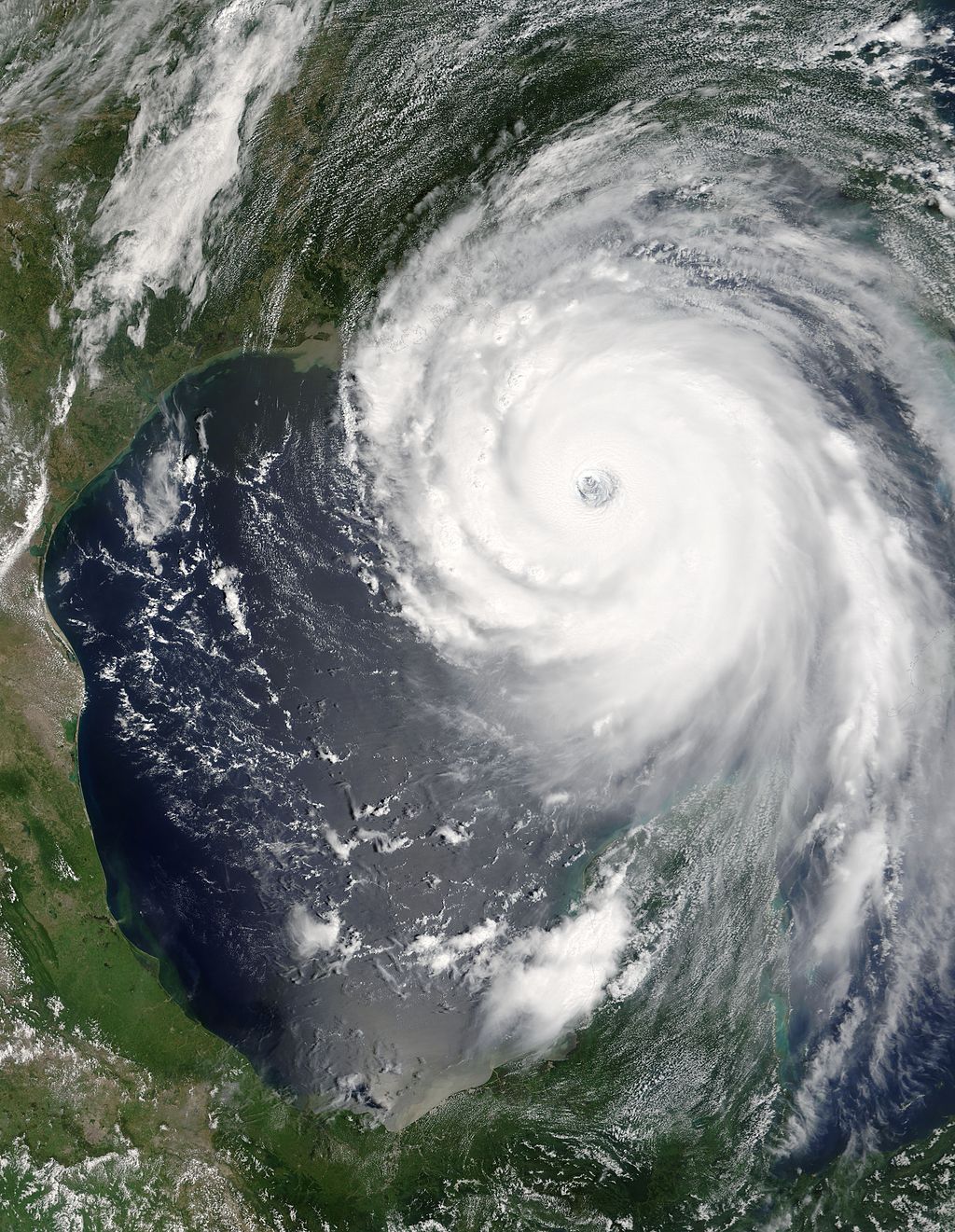
Hurricane Katrina was the deadliest and most destructive Atlantic tropical cyclone of the 2005 Atlantic hurricane season. It is the costliest natural disaster, as well as one of the five deadliest hurricanes, in the history of the United States. Katrina is the seventh most intense Atlantic hurricane ever recorded, part of the 2005 season that included three of the six most intense Atlantic hurricanes ever documented (along with #1 Wilma and #4 Rita). At least 1,833 people died in the hurricane and subsequent floods, making it the deadliest U.S. hurricane since the 1928 Okeechobee hurricane; total property damage was estimated at $108 billion (2005 USD),[1] roughly four times the damage brought by Hurricane Andrew in 1992.[3]
Hurricane Katrina formed over the Bahamas on August 23, 2005, and crossed southern Florida as a moderate Category 1 hurricane, causing some deaths and flooding there before strengthening rapidly in the Gulf of Mexico. The hurricane strengthened to a Category 5 hurricane over the warm Gulf water, but weakened before making its second landfall as a Category 3 hurricane on the morning of Monday, August 29, in southeast Louisiana. It caused severe destruction along the Gulf coast from central Florida to Texas, much of it due to the storm surge. The most significant number of deaths occurred in New Orleans, Louisiana, which flooded as the levee system catastrophically failed, in many cases hours after the storm had moved inland.[4] Eventually 80% of the city and large tracts of neighboring parishes became flooded, and the floodwaters lingered for weeks.[4] However, the worst property damage occurred in coastal areas, such as Mississippi beachfront towns; over 90 percent of these were flooded. Boats and casino barges rammed buildings, pushing cars and houses inland; water reached 6–12 miles (10–19 km) from the beach.
Google-a-Day asks a question about an analogy:
In “Eats, Shoots and Leaves”, what analogy does the author say that grammarians use for the relationship of punctuation to words?
The Wisconsin Economic Development Corporation – it should more accurately be called the Wisconsin Economic Disaster Corporation – had yet another embarrassment this week.
At the WEDC-sponsored ‘Forward Technology Festival‘ in Madison, a local company announced that it was moving…to Ohio. The Journal Sentinel reports that
Aver Informatics Inc., a health information technology start-up, moved from Wisconsin to Ohio because the founder wanted to, not because a big investor required it, the investor said Wednesday.
Kurt Brenkus, Aver’s president and chief executive officer, approached Drive Capital about moving from De Pere to Columbus, Ohio, where the venture capital firm is based, said Chris Olsen, a Drive co-founder…
Olsen was speaking at the Forward Technology Conference at Monona Terrace. The conference is part of the eight-day Forward Technology Festival that runs through Thursday.
Fair enough to move where one wants. It’s more than ridiculous, though, that the WEDC puts on a festival to showcase its local influence, and a business used that forum to justify a move to another state.
The gentlemen of our city who have touted the WEDC have picked a failed, yet still-failing, agency.
Posted in part at Daily Wisconsin; hat tip to James Rowen @ The Political Environment for posting the original story (Oops: WEDC-Sponsored Tech Event Yields Biz Defection News @ The Political Environment).
Previously at FW on the WEDC:
Good morning, Whitewater.
Thursday in town will grow increasingly cloudy, with a four-in-ten chance of afternoon thunderstorms. Sunrise today is 6:15 AM and sunset 7:36 PM. The moon is a waxing crescent with nine percent of its visible disk illuminated.
Whitewater’s Tech Park Board meets this morning at 8 AM. This evening, the Zoning Board of Appeals meets at 6 PM.
At the U.S. Open on Tuesday, Roger Federer demonstrated why he should never be underestimated, and why opponents should never make the mistake of turning their backs on him. Marinko Matosevic learned that lesson:
Google-a-Day asks a geography question:
What active volcano in the U.S. poses a significant threat to air travel between North America and East Asia?
