
Public Meetings
CDA Seed Capital Screening Committee
by JOHN ADAMS •
Daily Bread
Daily Bread for 7.14.14
by JOHN ADAMS •
Good morning, Whitewater.
Monday will be partly sunny, with a one-third chance of scattered showers.
Whitewater’s Planning Commission is listed to meet at 6 PM tonight.
It’s Bastille Day:
The Storming of the Bastille occurred in Paris, France on the morning of 14 July 1789. The medieval fortress and prison in Paris known as the Bastille represented royal authority in the center of Paris. The prison only contained seven inmates at the time of its storming but was a symbol of the abuses of the monarchy: its fall was the flashpoint of the French Revolution.
In France, Le quatorze juillet (14 July) is a public holiday, usually called Bastille Day in English….
On 19 May 1789, Louis XVI convened the Estates-General to hear their grievances. The deputies of the Third Estate representing the common people (the two others were the Catholic Church and nobility) decided to break away and form a National Assembly. On 20 June the deputies of the Third Estate took the Tennis Court Oath, swearing not to separate until a constitution had been established. They were gradually joined by delegates of the other estates; Louis XVI started to recognize their validity on 27 June. The assembly renamed itself the National Constituent Assembly on 9 July, and began to function as a legislature and to draft a constitution.
In the wake of the 11 July dismissal of Jacques Necker, the people of Paris, fearful that they and their representatives would be attacked by the royal military, and seeking to gain ammunition and gunpowder for the general populace, stormed the Bastille, a fortress-prison in Paris which had often held people jailed on the basis of lettres de cachet, arbitrary royal indictments that could not be appealed. Besides holding a large cache of ammunition and gunpowder, the Bastille had been known for holding political prisoners whose writings had displeased the royal government, and was thus a symbol of the absolutism of the monarchy. As it happened, at the time of the siege in July 1789 there were only seven inmates, none of great political significance.
When the crowd—eventually reinforced by mutinous gardes françaises—proved a fair match for the fort’s defenders, Governor de Launay, the commander of the Bastille, capitulated and opened the gates to avoid a mutual massacre. However, possibly because of a misunderstanding, fighting resumed. Ninety-eight attackers and just one defender died in the actual fighting, but in the aftermath, de Launay and seven other defenders were killed, as was the ‘prévôt des marchands’ (roughly, mayor) Jacques de Flesselles.
Shortly after the storming of the Bastille, on 4 August feudalism was abolished and on 26 August, the Declaration of the Rights of Man and of the Citizen was proclaimed.
On this day in 1948, Janesville tries the latest:
1948 – Janesville Sprays for Bugs
On this date, intending to create a bug-free environment, Janesville tested a DDT fogging machine that quickly emitted a “smokescreen of insect-killing fog.” City officials hoped to persuade the county to buy the machine for use by all municipalities or to buy it jointly with Beloit. [Source: Janesville Gazette]
Google-a-Day asks a science question:
If the Saffir-Simpson Scale had existed at the time, the storm described in Erik Larson’s 1999 book would have been rated as what?
Public Meetings
Common Council
by JOHN ADAMS •
Animals, Nature
“Apis Mellifera: Honey Bee”
by JOHN ADAMS •
Animation, Film
Sunday Animation: Girona
by JOHN ADAMS •
GIRONA from Pau Garcia Laita on Vimeo.
Daily Bread
Daily Bread for 7.13.14
by JOHN ADAMS •
Good morning, Whitewater.
Sunday in the Whippet City will be mostly sunny, with a high of eighty-one, and just a one-in-five chance of afternoon showers. Sunrise is 5:28 AM and sunset 8:33 PM. The moon is in a waning gibbous phase with ninety-seven percent of its visible disk illuminated.
They’ve had a season of widespread forest fires in Canada, and the effects of these fires are so clear that they may be seen from space —
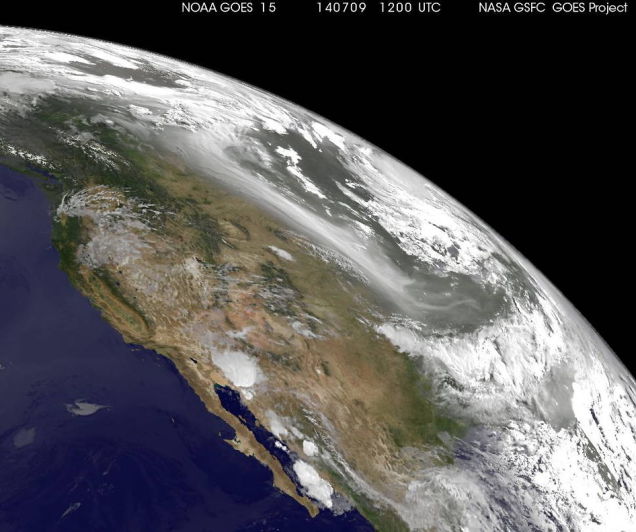
For more about the photograph and the fires, see Smoke From Canada’s Copious Wildfires As Seen From Space.
On this day in 1787, Congress under the Articles of Confederation passes the Northwest Ordinance:

The Northwest Ordinance (formally An Ordinance for the Government of the Territory of the United States, North-West of the River Ohio, and also known as the Freedom Ordinance or The Ordinance of 1787) was an act of the Congress of the Confederation of the United States, passed July 13, 1787. The primary effect of the ordinance was the creation of the Northwest Territory, the firstorganized territory of the United States, from lands south of the Great Lakes, north and west of the Ohio River, and east of the Mississippi River.
On August 7, 1789, President George Washington signed the Northwest Ordinance of 1789 into law after the newly created U.S. Congress reaffirmed the Ordinance with slight modifications under theConstitution. The Ordinance purported to be not merely legislation that could later be amended by Congress, but rather “the following articles shall be considered as Articles of compact between the original States and the people and states in the said territory, and forever remain unalterable, unless by common consent….”[1]
Arguably the single most important piece of legislation passed by members of the earlier Continental Congresses other than the Declaration of Independence, it established the precedent by which the federal government would be sovereign and expand westward across North America with the admission of new states, rather than with the expansion of existing states and their established sovereignty under the Articles of Confederation. It is the most important legislation that Congress has passed with regard to American public domain lands.[2]
Animation
Imaginary Animal Stunts
by JOHN ADAMS •
Daily Bread
Daily Bread for 7.12.14
by JOHN ADAMS •
Good morning, Whitewater.
We have a likelihood of late afternoon thunderstorms today, with a high of eighty-one.
If conventional race cars produce a powerful roar, then what’s the sound of an electric race car?
They sound like something from Star Wars:
On this day in 1984, Mondale chooses Ferraro:
Walter Mondale, the leading Democratic presidential candidate, announces that he has chosen Representative Geraldine Ferraro of New York as his running mate. Ferraro, a daughter of Italian immigrants, had previously gained notoriety as a vocal advocate of women’s rights in Congress.
Four days after Ferraro was named vice presidential candidate, Governor Mario Cuomo of New York opened the Democratic National Convention in San Francisco with an impassioned retort to Republican President Ronald Reagan’s contention that the United States was a “shining city on a hill.” Citing widespread poverty and racial strife, Cuomo derided President Reagan as oblivious to the needs and problems of many of America’s citizens. His enthusiastic keynote address inaugurated a convention that saw Ferraro become the first woman nominated by a major party for the vice presidency. However, Mondale, the former U.S. vice president under Jimmy Carter, proved a lackluster choice for the Democratic presidential nominee.
On November 6, President Reagan and Vice President George Bush defeated the Mondale-Ferraro ticket in the greatest Republican landslide in U.S. history. The Republicans carried every state but Minnesota–Mondale’s home state.
Ferraro left Congress in 1985. In 1992 and 1998, she made unsuccessful bids for a U.S. Senate seat. During President Bill Clinton’s administration, she was a permanent member on the United Nations Commission on Human Rights.
On this day in 1865, with the war won, Wisconsin regiments muster out of service to the Union:
1865 – (Civil War) 16th and 36th Infantry regiments muster out
The 16th and 36th Wisconsin Infantry regiments mustered out. The 16th had participated in the battles of Shiloh, Corinth, Jonesboro, Kennesaw Mountain, Atlanta, Sherman’s March to the Sea, and the siege of Savannah. It lost 399 men during service. The 36th had only mustered in March 23, 1864, and remained around the Washington, D.C., for the duration of its service. Its brief service included the Appomattox Campaign, Hatcher’s Run, and the surrender of General Robert E. Lee. It lost 342 men in a little over a year.
Food, Humor
Cutting a Pineapple with a Spoon
by JOHN ADAMS •
From YouTube’s Cut Dat Commentary Channel, here’s ‘detailed commentary on how to effortlessly cut a pineapple using a spoon’ —
Over at Digg, they’ve other favorites from the same series.
Enjoy.
Cats
Friday Catblogging: Online, Are Goats Replacing Cats?
by JOHN ADAMS •
It seems improbable, but at the Washington Post, Caitlin Dewey contends that Online, goats are the new cats. (No kidding!):
Let’s recap the sheer number of goats who have gone viral in recent months. There was Frostie, the sickly Australian snow goat who learned to walk with the help of a wheelchair. Then there was Gary, the GoPro-wearing muse/sidekick of comedian Jimbo Bazoobi, who somehow has nearly 730,000 fans on Facebook. (His schtick, not to oversimplify it, is basically just the goat.) Then there were the many fascinations of /r/goatparkour, a Reddit forum devoted to kids cavorting like deranged freerunners and the alleged “best thing online” — only rivaled, in truth, by “goat remixes,” a phenomenon that must be seen to be believed.

Miss Dewey cites the growing number of goat remixes, in which short clips of goats bleating are interspersed in music mideos, as in the example below:
I’ll place my bet on cats. Cats: the enduring Internet mascots.
Goats? I sense … mere fad.
Poll
Friday Poll: For New Bucks Arena, Should Public Money Be Used?
by JOHN ADAMS •
The Bucks have new owners (and a new coach, new star player), and they’d like a new arena.
Should public subsidies be used to build one?
Daily Bread
Daily Bread for 7.11.14
by JOHN ADAMS •
Good morning, Whitewater.
Friday in town will be partly sunny with a high of seventy-eight, and south winds of five to ten mph.
On this day in 1914, a baseball legend debuts in the majors:
On July 11, 1914, in his major league debut, George Herman “Babe” Ruth pitches seven strong innings to lead the Boston Red Sox over the Cleveland Indians, 4-3.
George Herman Ruth was born February 6, 1895, in Baltimore, Maryland, where his father worked as a saloon keeper on the waterfront. He was the first of eight children, but only he and a sister survived infancy. The young George, known as “Gig” (pronounced jij) to his family, was a magnet for trouble from an early age. At seven, his truancy from school led his parents to declare him incorrigible, and he was sent to an orphanage, St. Mary’s Industrial School for Boys. Ruth lived there until he was 19 in 1914, when he was signed as a pitcher by the Baltimore Orioles.
That same summer, Ruth was sold to the Boston Red Sox. His teammates called him “Babe” for his naiveté, but his talent was already maturing. In his debut game against the Indians, the 19-year-old Ruth gave up just five hits over the first six innings. In the seventh, the Indians managed two runs on three singles and a sacrifice and Ruth was relieved. His hitting prowess, however, was not on display that first night–he went 0 for 2 at the plate.
Ruth developed quickly as a pitcher and as a hitter. When the Red Sox made the World Series in 1916 and 1918, Ruth starred, setting a record with 29 2/3 consecutive scoreless innings in World Series play. His career record as a pitcher for the Red Sox was 89-46.
To the great dismay of Boston fans, Ruth’s contract was sold to the New York Yankees before the 1920 season by Red Sox owner Harry Frazee, so that Frazee could finance the musical No, No, Nanette. Ruth switched to the outfield with the Yankees, and hit more home runs than the entire Red Sox team in 10 of the next 12 seasons. “The Sultan of Swat” or “The Bambino,” as he was alternately known, was the greatest gate attraction in baseball until his retirement as a player in 1935. During his career with the New York Yankees, the team won four World Series and seven American League pennants. After getting rid of Ruth, the Red Sox did not win a World Series until 2004, an 85-year drought known to Red Sox fans as “the Curse of the Bambino.”
On this day in 1839, a Wisconsinite first receives a patent:
1839 – First patent issued to Wisconsin resident
On this day Ebenezar G. Whiting of Racine was issued patent #1232 for his improved plow, the first patent issued to someone from Wisconsin. Whiting’s improvements consisted of making the mold-board straight and flat which, when united in the center with the curvilinear part of the mold-board, would require less power to drag through the dirt. Whiting went on to serve as Vice President of the J.I. Case Plow Company and received another patent for a steel plow in 1876. [Source: United States Patent and Trademark Office]
Google-a-Day asks about a name:
The completion of what structure in 1971 altered the agricultural significance of the longest river of a country whose ancient name means “black land”?