FREE WHITEWATER

Friday Poll: The Rabbit in the Statue’s Ear

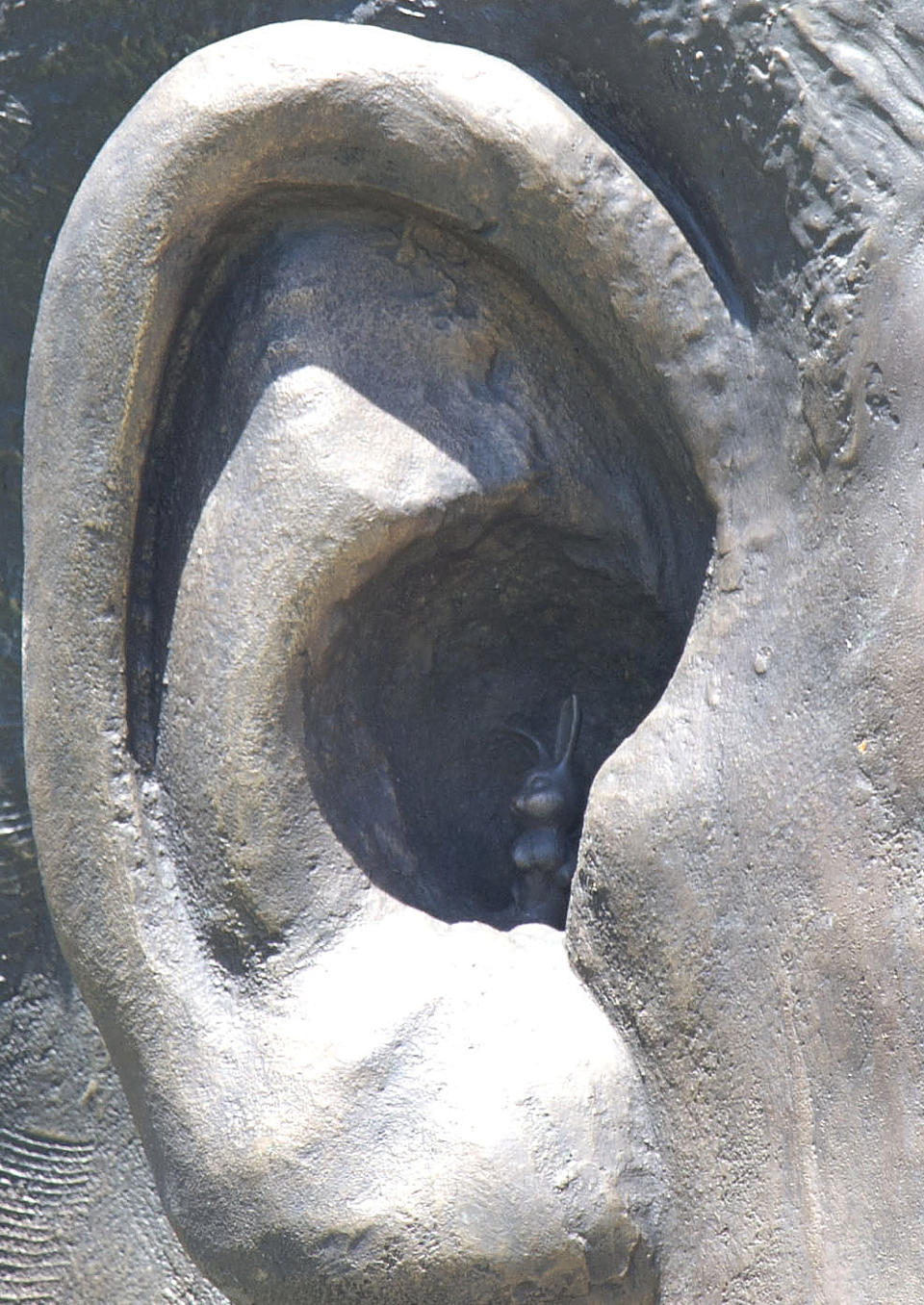
In South Africa, there’s a new, large statue of Nelson Mandela with an unexpected quirk: inside the statue’s ear the sculptors added a small rabbit.

Here’s a photo that shows a tiny addition to the late leader’s right ear:

3d955adc1c1ea603490f6a70670059a9

The artists consider the rabbit their ‘trademark.’

So, should it stay or should it go? I’ll say go, as it’s a embellishment that’s simply an unnecessary distraction from the purpose of the work as a commemoration of Mandela.

What do you think?


Daily Bread for 1.24.14

Good morning.

We’ll have blowing snow throughout the day, with a high of twenty-three, and about one to two inches of snow overnight.

It’s the anniversary of the first sales (from 1935) of beer in a can:

Canned beer makes its debut on this day in 1935. In partnership with the American Can Company, the Gottfried Krueger Brewing Company delivered 2,000 cans of Krueger’s Finest Beer and Krueger’s Cream Ale to faithful Krueger drinkers in Richmond, Virginia. Ninety-one percent of the drinkers approved of the canned beer, driving Krueger to give the green light to further production….

On this day in 1960, Green Country residents meet to discuss a crisis:

1960 – Crisis of Morals in Green County
On this date representatives of civic and service organizations, schools and churches met in Monroe to discuss the “crisis of morals” in Green County, where the number of unwed mothers increased to 40 in 1959. [Source: Janesville Gazette]

Last I’d heard, Green County was still standing, these many decades later.

Puzzability’s Alternative Musicians series ends today, with Friday’s game:

This Week’s Game — January 20-24
Alternative Musicians
Some people can really sing their hearts out. For each day this week, we began with the name of a solo singer who has won a Record of the Year Grammy Award. Then we removed any spaces and punctuation and deleted every other letter, leaving just the odd letters. The day’s clue shows those remaining letters in order.
Example:
MCALAKO
Answer:
Michael Jackson
What to Submit:
Submit the singer’s name (as “Michael Jackson” in the example) for your answer.
Friday, January 24
AYIEOS

Three Motivations for Local Government Intervention (and One That’s Sadly Missing)

In Whitewater, we’ve had any number of local projects, some involving millions, in a town of only thousands.  

Broadly, one may assume three motivations for local intervention: (1) genuine if mistaken efforts at community betterment, (2) the vanity or economic interest of parties to a project, or (3) a desire to prevent demographic and cultural change within the community through regulation.

Of the first, a genuine desire for community betterment, one may say that often the benefits are over-stated, and the costs scarcely stated at all.  Still, the motivation is good-hearted if otherwise ill-considered.

Of the second, motivations from vanity or manipulation of government for the economic gain of only few, we have had too many projects.  These vanity pieces are without legitimate justification, but instead cloaked in sophistry, relying on flawed or deceptive claims. Here lies crony capitalism wearing the garb of ‘progress,’ ‘development,’ and public-private ‘partnerships.’

The third, regulatory attempts to forestall cultural and demographic change, have been around for a while, but now have greater intensity as a few seek to prevent a new, emerging culture for the city.

One sees it, for example, in the strident and reactionary attacks on an emerging, new restaurant scene.  

Sensing that the community wants new opportunities, a few who cannot appreciate culinary diversity seek to ban, or regulate to infirmity, any new proposal.  An Old Guard, mostly without desire or appreciation of new choices, now sees claims of fear, uncertainty, and doubt as its remaining means to assure an unchanging, city-in-amber culture.  

Having lost in the marketplace – because after all a whole class of sharp and smart patrons seeks new possibilities – the Old Guard seeks regulatory obstructionism to stifle the free choices of others.

This is, of course, a sign of their weakness: they’ve nowhere to go except through scheming. They can cause a great amount of short-term damage, but still – for them – the demographic dustbin awaits.     

One can expect the third motivation to grow ever greater as Whitewater’s culture shifts.  

Finally, there’s one motivation of local government action that’s mostly missing: toward the poor and vulnerable.  If we are to have government intervention, here’s a place of legitimate emphasis: it costs less than grand construction schemes, and does more than those schemes ever could.  

We have, if anything, too little of legitimate anti-poverty plans. Contending that crony capitalist projects (e.g., Generac’s bus) are anti-poverty programs is a stretch at best, and unconvincing.  

We’ve three main motivations for government invention that we often don’t need, and not enough motivation for the one kind of intervention of which we could use, candidly, much more.

Daily Bread for 1.23.14

Good morning.

Thursday comes to Whitewater with a chance of flurries and a high of two degrees.

On this day in 1775, British merchants speak against their government’s restrictions on trade with America:

…London merchants petition Parliament for relief from the financial hardship put upon them by the curtailment of trade with the North American colonies.

In the petition, the merchants provided their own history of the dispute between the colonies and Parliament, beginning with the Stamp Act of 1765. Most critical to the merchants’ concerns were the £2 million sterling in outstanding debts owed to them by their North American counterparts.

The merchants claimed that, a total stop is now put to the export trade with the greatest and most important part of North America, the public revenue is threatened with a large and fatal diminution, the petitioners with grievous distress, and thousands of industrious artificers and manufacturers with utter ruin. The petitioners begged Parliament to consider re-implementing the system of mercantile trade between Britain and the American colonies, which had served the interests of all parties in the empire prior to 1764.

Following the Coercive Acts of 1774, the colonies had quickly agreed to reinstate the non-importation agreements first devised in response to the Stamp Act in the autumn of 1765. They threatened to enter non-exportation agreements if Britain failed to meet their demands by August 1775. Because debts the colonies owed British merchants were generally paid in exports, not currency, such an action would indeed have caused tremendous financial loss to the British economy. Non-importation had a comparatively minor impact, because British merchants could and did find other markets. However, no one else would pay the vast debts owed to the merchants by tobacco planters like Thomas Jefferson or New England shipping magnates like John Hancock.

They simply would have been, and later were, better off trading with a free and separate country than having limited opportunities with mere colonies. Free trade is friendly.

Here’s Puzzability‘s game for Thursday:

This Week’s Game — January 20-24
Alternative Musicians
Some people can really sing their hearts out. For each day this week, we began with the name of a solo singer who has won a Record of the Year Grammy Award. Then we removed any spaces and punctuation and deleted every other letter, leaving just the odd letters. The day’s clue shows those remaining letters in order.
Example:
MCALAKO
Answer:
Michael Jackson
What to Submit:
Submit the singer’s name (as “Michael Jackson” in the example) for your answer.
Thursday, January 23

SEYCO

About that iButtonLink Announcement…

An aspiring musician tells his friends that he performed to a standing-room-only crowd at Carnegie Hall. Needless to say, they’re impressed. “It’s great that your songs drew such attendance,” they observe.  

“Why, yes,” the musician replies, “it must have been my music, although I suppose the free tickets and fifty-dollar gift packages might have had something to do with it.”  

In November, to much fanfare, UW-Whitewater proudly announced a new tenant for the publicly-funded Innovation Center. (I’ve reproduced the press release, in full, below.)

In those eight paragraphs and three-hundred seventeen words, one reads about what a great deal it is, how much space they’ll occupy, how long they’ve been in business, and that they’ll move a handful of employees over from East Troy.  

All this is meant to show how very skillful the tech park’s leaders have been in landing someone, anyone, to move into the Innovation Center.  

It’s just that there’s one relevant and material aspect of the relocation that the university’s press release conveniently omits – that iButtonLink also received a one-hundred thousand dollar ($100,000) public loan from Whitewater’s Community Development Authority.  

See, from the 12.18.13 CDA packet, the notes from the 11.20.13 CDA meeting, at Item 8(3), loan approved unanimously.   

Maybe it’s not just the music…

Press release immediately below – 

iButtonLink, a research and manufacturing company focused on networked sensor solutions, is moving its operations to the Whitewater University Innovation Center.

The company signed a five-year lease on Thursday and will occupy five suites (4,063 sq. ft.) on the Innovation Center’s first floor, making it the largest private tenant in the building.

“We are excited at this opportunity,” said Rob Olson, iButtonLink CEO. “For a technology company like ours, the ability to collaborate with the university, the excellent labor pool in Whitewater, and the great support of the community all enable us lead in the ‘Internet of Things’ space.”

“iButtonLink will bring new energy and technological expertise to the community,” said Richard Telfer, UW-Whitewater chancellor. “I am particularly excited about the company’s plans to engage UW-Whitewater students, faculty and staff members in its business operations.”

Much of that collaboration will happen because of iButtonLink’s participation in the Whitewater Incubation Program. The program is designed to provide coaching, mentoring, and support services to businesses linked to the Innovation Center. UW-Whitewater faculty experts and students assist with growth opportunities, business plans, and marketing and branding.

Founded in 2003, iButtonLink produces and distributes high-quality sensors and solutions that can be outfitted to fit any business needs. Products include temperature, humidity, voltage and light sensors, to name a few. iButtonLink serves clients ranging from Fortune 500 companies to small start-ups, and its products have been used in the harshest environments around the world, from the Antarctic to the African savannah.

“iButtonLink is a great addition to the Innovation Center,” said Jeffery Knight, chairperson of the Whitewater Community Development Authority. “They will add a well-established product line and also create a research facility for future product development. Our building and their needs are a perfect fit together.”

Olson said the company and its 10 employees expect to relocate from the current headquarters in East Troy to the Innovation Center sometime in December.

Daily Bread for 1.22.14

Good morning.

Wednesday brings a high of eleven, and a likelihood of morning snow with accumulation of less than one inch. Sunrise is 7:19 AM and sunset 4:55 AM. The moon’s a waning gibbous with 65% of its visible disk illuminated.

At 8 AM, Downtown Whitewater’s board members meet, and at 5 PM there’s a meeting of the Community Development Authority.

It’s the 41st anniversary of the U.S. Supreme Court decision in Roe v. Wade.

Also on this day, in 1998, the Unabomber pleads guilty – “…in a Sacramento, California, courtroom, Theodore J. Kaczynski pleads guilty to all federal charges against him, acknowledging his responsibility for a 17-year campaign of package bombings attributed to the “Unabomber.” ”

Today’s a notable anniversary (from 1964) for cheese-makers, too:

1964 – World’s Largest Block of Cheese Produced
On this date The world’s largest cheese of the time was manufactured in Wisconsin. The block of cheddar was produced from 170,000 quarts of milk by the Wisconsin Cheese Foundation specifically for the 1964 New York World’s Fair. It weighed 34,665 pounds (17.4 tons). The cheese was consumed in 1965 at the annual meeting of the Wisconsin Cheesemakers Association at Eau Claire. A replica is displayed in Neilsville in the specially designed “Cheesemobile“, a semi-tractor trailer in which the original cheese toured. [Source: American Profile, December 16, 2001]

Here’s Wednesday’s Puzzability game:

This Week’s Game — January 20-24
Alternative Musicians
Some people can really sing their hearts out. For each day this week, we began with the name of a solo singer who has won a Record of the Year Grammy Award. Then we removed any spaces and punctuation and deleted every other letter, leaving just the odd letters. The day’s clue shows those remaining letters in order.
Example:
MCALAKO
Answer:
Michael Jackson
What to Submit:
Submit the singer’s name (as “Michael Jackson” in the example) for your answer.
Wednesday, January 22
PICLIS


Steps for Blogging on a Policy or Proposal

For bloggers who cover politics, policy-making, etc., just as would have been true of essayists and pamphleteers in an earlier time, it helps to have a method to one’s writing.  In the paragraphs below, I’ll list steps one should take when approaching a topic.

The steps are in a rough order, but in any method, one sometimes returns to an earlier step, or jumps ahead if necessary.

1. Read.  Often long before writing, there’s reading (and listening).  One reads the documents in a proposal, including contracts, studies, and other supporting materials, and listens to presentations on the proposal.

Reading and listening are more than a study of a particular proposal; they are a reliance on what one has read before, on the topic but also on other topics, perhaps seemingly unrelated at first blush.  In the end, what one reads – if it’s any good – is a review of others’ recounted experiences and analyses.

Rely on the sound foundation of the works of respected authors and researchers.

2.  Walk around.  If writing about a place, try to visit it if possible. Maps may produce a poor understanding of distance, line-of-sight, and the influence of weather. Similarly, if writing about devices, try to find one, to hold it in one’s hand, to learn how it looks and feels.

3.  Write initially.  After reading and listening and walking about or examining a device, start writing.

Sometimes, all that one has read or experienced will offer a definite opinion.

Other times, one may begin merely with a series of questions.  It’s rare that a significant topic inspires just one question.  Questions are both a search for information and an expression of prior, informed understanding.

Publish your questions.

It’s not an exercise of due diligence to ask one weak question, to ignore the need for a responsive answer, or to fail to act after the vague answers one receives (or does not even receive).  Asking a question and doing nothing after getting no answer or a poor answer isn’t an exercise in accountability, but instead an abdication of it.

Politics is littered with those who think that one tepid question is enough, and that the mere asking somehow fulfills one’s duty.  America did not become a great and advanced republic through timid political and scientific inquiry.

4.  Informal requests to officials.  If you’ve a few questions you’d like to ask directly, do so with an announcement of those same questions to your readers.

It’s a mistake to think that private conversations with officials will advance blogging on public issues.  (See, as an example, mention in FREE WHITEWATER from 11.6.13 letting readers know that I would be asking Whitewater’s city manager about particular documents.)

Private discussions always run the risk of being manipulated to officials’ advantage.  If one would like to be a tool or toad of government, then one can always join a fish-wrap community newspaper, where every day is an exercise in sycophancy.

5.  Formal requests.  If an inquiry demands a public records request under state or federal law, go ahead and submit one.  As with an informal request to officials, publish the full request online after you’ve submitted it.  Let readers see what you’re seeking from government, verbatim.

In the same way, publish what you receive in reply to your request.  I’ve come to see that it’s a mistake to leave a government’s reply unpublished. Readers should see the full reply.

Be prepared to follow up.  A reply will likely raise other questions.  Let your readers know those questions, including any subsequent, formal records request.

6.  Litigation.  Never threaten what one is not prepared to do; don’t publish threats (of litigation) in any event.

(There was an odd situation like this a year ago between two Wisconsin bloggers, where one of them taunted the other with the risk of a lawsuit.  It was a sorry affair.  The law is not a threat; it’s a defense.)

When writing about a major topic, think – as best as one can – about where it might lead. Most topics, needless to say and thankfully so, will never be the subject of lawsuits.  For a very few, that might be a possibility.

Consult with a lawyer if you have significant questions, about whether to obtain documents, assure open meetings access, protect a right, or advance a vital public policy.  Conversations on any of these topics will be between the lawyer and the blogger-client, and afterward addressed methodically with sangfroid, that cold calm that’s useful for success.

I’m sure I’ve missed much, but here’s the general method, some steps to be repeated, others never to be reached: (1) read & listen (2) visit places & study objects if possible, (3) write, asking questions where necessary, (4) submit informal requests to government if seemingly fruitful, (5) submit formal requests under the law, (6) consult an attorney for advice on rights under the law or limitations on government action.

Having a method for blogging on policy makes writing better for both blogger and readers. It’s as simple as that.

Daily Bread for 1.21.14

Good morning.

It will be sunny and cold today, with a high of four degrees, and wind chill values between ten and twenty below.

Whitewater’s Alcohol and Licensing Committee meets at 6 PM, and Common Council at 6:30 PM this evening.

We’re not the only ones with interesting weather. A Russian videographer recorded a sundog in Moscow recently. It’s lovely (and more so by contrast with the dull and uniform architecture of the neighborhood):

On this day in 1959, Carl Dean Switzer of the original Our Gang Little Rascals dies in a fight that a jury later determines was justifiable homicide:

Carl Dean Switzer, the actor who as a child played “Alfalfa” in the Our Gang comedy film series, dies at age 31 in a fight, allegedly about money, in a Mission Hills, California, home. Alfalfa, the freckle-faced boy with a warbling singing voice and a cowlick protruding from the top of his head, was Switzer’s best-known role.

On this day in 1935, one Janesville teen seems incorrigible:

1935 – Five Janesville Youths Arrested
On this date five Janesville boys, ages 13-16, were arrested for a string of burglaries, including the thefts of cigarettes, whisky and blankets. While in the police station, one of the boys tried to crack the safe in the chief’s office. [Source: Janesville Gazette]

Here’s Puzzability‘s game for Tuesday:

This Week’s Game — January 20-24
Alternative Musicians
Some people can really sing their hearts out. For each day this week, we began with the name of a solo singer who has won a Record of the Year Grammy Award. Then we removed any spaces and punctuation and deleted every other letter, leaving just the odd letters. The day’s clue shows those remaining letters in order.
Example:
MCALAKO
Answer:
Michael Jackson
What to Submit:
Submit the singer’s name (as “Michael Jackson” in the example) for your answer.
Tuesday, January 21
RBRALC

Frédéric Bastiat’s Gift to Whitewater

Of course, Frédéric Bastiat‘s work offers not one gift but many, and not merely for Whitewater, but for all people in all places. Still, today, one might consider just one essay from his powerful understanding for our small city.

If Whitewater were to look to one place for guidance, on rights, responsibility, and a sound political-economy, then she would do well to look to Bastiat’s That Which is Seen, and That Which is Not Seen (Ce qu’on void et ce qu’on ne void pas). It’s true and beautiful in original and translation (so true and beautiful that one almost imagines it cannot be translated poorly).

(About a century later, Henry Hazlitt wrote Economics in One Lesson as a gloss on Bastiat, of That Which is Seen, and That Which is Not Seen, and really just an introduction to Bastiat for an American audience.)

The introduction to the essay That Which is Seen, and That Which is Not Seen:

In the department of economy, an act, a habit, an institution, a law, gives birth not only to an effect, but to a series of effects. Of these effects, the first only is immediate; it manifests itself simultaneously with its cause – it is seen. The others unfold in succession – they are not seen: it is well for us, if they are foreseen. Between a good and a bad economist this constitutes the whole difference – the one takes account of the visible effect; the other takes account both of the effects which are seen, and also of those which it is necessary to foresee. Now this difference is enormous, for it almost always happens that when the immediate consequence is favourable, the ultimate consequences are fatal, and the converse. Hence it follows that the bad economist pursues a small present good, which will be followed by a great evil to come, while the true economist pursues a great good to come, at the risk of a small present evil.

In fact, it is the same in the science of health, arts, and in that of morals. It often happens, that the sweeter the first fruit of a habit is, the more bitter are the consequences. Take, for example, debauchery, idleness, prodigality. When, therefore, a man absorbed in the effect which is seen has not yet learned to discern those which are not seen, he gives way to fatal habits, not only by inclination, but by calculation.

This explains the fatally grievous condition of mankind. Ignorance surrounds its cradle: then its actions are determined by their first consequences, the only ones which, in its first stage, it can see. It is only in the long run that it learns to take account of the others. It has to learn this lesson from two very different masters – experience and foresight. Experience teaches effectually, but brutally. It makes us acquainted with all the effects of an action, by causing us to feel them; and we cannot fail to finish by knowing that fire burns, if we have burned ourselves. For this rough teacher, I should like, if possible, to substitute a more gentle one. I mean Foresight. For this purpose I shall examine the consequences of certain economical phenomena, by placing in opposition to each other those which are seen, and those which are not seen….

In years past, today, and for years yet ahead, Whitewater’s policymakers would have profitted and will profit by reading and embracing Bastiat’s teaching.

Few have, some will, others won’t.

Those who have, and those who will, by doing so offer much to their fellow residents. All of it is simple and clear, by design to be readily intelligible.

Those who won’t (just as those many over the years who haven’t) will give the city nothing but disappointment and failure, however fancily adorned. When their schemes go awry, they will have only themselves to blame.

A new year begins – the more deeply policymakers think about their choices, the better the city’s prospects. The more superficially they consider their proposals (as some have so embarrassingly done in years past), the more disappointment they will experience, and inflict on their fellow residents.

Even a little Bastiat, properly applied, would go a long way to making the city a better place.

Daily Bread for 1.20.14

Good morning.

We’ll have an even chance of a wintry mix of freezing rain and snow in Whitewater today (with slight accumulation), and a high of twenty-two (before dropping into the teens).

Friday’s FW poll was about the likelihood of victory for each of the NFL’s four remaining teams, and respondents favored Seattle (31.43%) and Denver (28.57%) from among the four. That’s how it turned out, although not without close moments along the way (in the Seattle-San Francisco game, at least).

Google has a new doodle on its webpage for MLK Day:

martin-luther-king-jr-day-2014-5114554967130112-hp
On this day in 1942, officials of the Nazi state meet at the Wannsee Conference, “to ensure the cooperation of administrative leaders of various government departments in the implementation of the final solution to the Jewish question, whereby most of the Jews of German-occupied Europe would be deported to Poland and exterminated.”

The conference followed an earlier, December 12, 1941 meeting at the Reich Chancellery where Hitler met with principal leaders of the regime to authorize extermination of Europe’s Jews (from Goebbels’s diary for December 12, 1941: “With respect of the Jewish Question, the Führer has decided to make a clean sweep. He prophesied to the Jews that if they again brought about a world war, they would live to see their annihilation in it. That wasn’t just a catch-word. The world war is here, and the annihilation of the Jews must be the necessary consequence.”)

Puzzability has a new weekly series, entitled Alternative Musicians:

This Week’s Game — January 20-24
Alternative Musicians
Some people can really sing their hearts out. For each day this week, we began with the name of a solo singer who has won a Record of the Year Grammy Award. Then we removed any spaces and punctuation and deleted every other letter, leaving just the odd letters. The day’s clue shows those remaining letters in order.
Example:
MCALAKO
Answer:
Michael Jackson
What to Submit:
Submit the singer’s name (as “Michael Jackson” in the example) for your answer.
Monday, January 20
FAKIAR