
Daily Bread
Daily Bread for 11.3.13
by JOHN ADAMS •
Good morning.
Sunday will be sunny with a high of forty-nine. The return to standard time now complete, sunrise is 6:32 AM and sunset 4:44 PM.
On this day in 1957, the Soviets launch a dog into space:
The Soviet Union launches the first animal into space—a dog name Laika—aboard theSputnik 2 spacecraft.
Laika, part Siberian husky, lived as a stray on the Moscow streets before being enlisted into the Soviet space program. Laika survived for several days as a passenger in the USSR’s second artificial Earth satellite, kept alive by a sophisticated life-support system. Electrodes attached to her body provided scientists on the ground with important information about the biological effects of space travel. She died after the batteries of her life-support system ran down.
At least a dozen more Russian dogs were launched into space in preparation for the first manned Soviet space mission, and at least five of these dogs died in flight. On April 12, 1961, Soviet cosmonaut Yuri Gagarin became the first human to travel into space, aboard the spacecraft Vostok 1. He orbited Earth once before landing safely in the USSR.
Animals
Doberman and Chickens
by JOHN ADAMS •
Daily Bread
Daily Bread for 11.2.13
by JOHN ADAMS •
Good morning.
Saturday will be cloudy with a high of forty-nine. Sunrise is 7:31 AM and sunset will be 5:46 PM.
On this day in 1947, the Spruce Goose (a term creator Howard Hughes disliked) flies:
….Development of the Spruce Goose cost a phenomenal $23 million and took so long that the war had ended by the time of its completion in 1946. The aircraft had many detractors, and Congress demanded that Hughes prove the plane airworthy. On November 2, 1947, Hughes obliged, taking the H-4 prototype out into Long Beach Harbor, CA for an unannounced flight test. Thousands of onlookers had come to watch the aircraft taxi on the water and were surprised when Hughes lifted his wooden behemoth 70 feet above the water and flew for a mile before landing.
Despite its successful maiden flight, the Spruce Goose never went into production, primarily because critics alleged that its wooden framework was insufficient to support its weight during long flights. Nevertheless, Howard Hughes, who became increasingly eccentric and withdrawn after 1950, refused to neglect what he saw as his greatest achievement in the aviation field. From 1947 until his death in 1976, he kept the Spruce Goose prototype ready for flight in an enormous, climate-controlled hangar at a cost of $1 million per year. Today, the Spruce Goose is housed at the Evergreen Aviation Museum in McMinnville, Oregon.
Cats
Friday Catblogging: If It Fits, I Sits
by JOHN ADAMS •
Poll, Weird Tales
Friday Poll: Would You Want to Know if Someone Once Died in Your Home?
by JOHN ADAMS •
CNN has a story about a website that claims that, for a fee, it can tell prospective home buyers if someone once died in a home those buyers are considering. I’m not vouching for the website, but here’s this week’s question: would you want to know if someone had died in a house under your consideration (or in the house or apartment in which you now live)?
I would be interested in a home’s history, but it would not change a buying decision, I think.
Daily Bread
Daily Bread for 11.1.13
by JOHN ADAMS •
Good morning.
The end of the week will bring scattered showers (a fifty-percent chance) and a high of forty-seven.
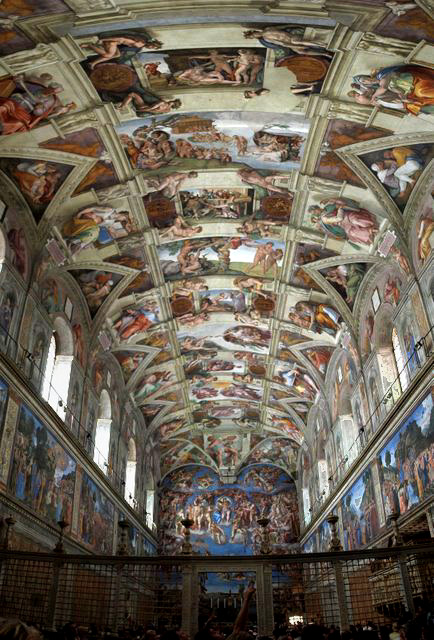
On this day in 1512, the Sistine Chapel ceiling goes on public display.
On this day in 1863, a pen magnate is born:
1863 – George Safford Parker Born
On this date George Safford Parker was born in Shullsburg. While studying telegraphy in Janesville, he developed an interest in fountain pens. In 1891 he organized the Parker Pen Company in Janesville. The company gained world-wide acclaim for innovations like the duo-fold pen and pencil. Parker served as president of the company until 1933. Parker died on July 19, 1937. [Source: Dictionary of Wisconsin Biography, p.280]
Scientific American‘s daily trivia question asks about energy. (Clicking on the question leads to its answer.)
About what percentage of the universe is dark energy thought to comprise?
City, Holiday
Boo! Scariest Things in Whitewater, 2013
by JOHN ADAMS •

Here’s the seventh annual FREE WHITEWATER list of the scariest things in Whitewater for 2013. The 2007, 2008, 2009, 2010, 2011, and 2012 editions are available for comparison.
The list runs in reverse order, from mildly frightening to super scary.
10. Red Foxes. There are few people who don’t find red foxes beautiful; I’d guess that even people accustomed to the bright colors of the tropics would find a red fox’s coat impressive. But when one first appeared on campus, we might have thought that a Martian had encroached on the city, with warnings not to go near it, or feed it, or encourage it to stay.
We’re a rural area; people are familiar with wildlife nearby and know how to conduct themselves. It’s been here for a bit; in time it will move on. We’ll conduct ourselves properly around it until it leaves the area.
Besides, listen to how foxes sound:
9. Planning from Madison. Whether Democrat or Republican, planning from Madison doesn’t work well. When the WisDems controlled state government, Republicans were right to complain that state-initiated planning rested on dodgy ‘Madison Math.’
It did; they were right.
But now the WISGOP’s in Madison, and working on its own state-centric solutions to local issues, and we’re still stuck with planning that doesn’t work well. It’s right-leaning rather than left-leaning, but it’s still planning that’s as ineffectual or counterproductive as it was before.
8. Numbers Policing. Living one’s life with the outlook that every day is another long slog to hold back the tide must be a wearisome outlook. This city has not, and will not, get a handle on property and nuisance crimes until it gives up a perspective that rests on numbers – counting like that simply doesn’t add up.
There’s lip-service to community policing, but little more, by way of understanding or by daily practice. Us against them (with the feeling of us against the world) is a futile approach.
Managing a tide requires one to abandon one’s fear of the water, and to learn to swim in, and through, the ocean.
7. New People. They shouldn’t be scary, but for some they are. That’s too bad, because we’ve no positive future without an influx of new and energetic residents.
6. Consumer Preferences. Tastes change over time. There’s no reason to fear those changing preferences – they’re not imposed from a small elite, but are simply the consequence of thousands of daily, voluntary transactions and encounters between ordinary people.
5. Crony Capitalism & Big Projects. A few, who have much already, use government to amass more for themselves at the expense of common taxpayers. There is nothing good – but much that’s bad – about a Reverse Robin Hood.
Crony capitalism is false capitalism.
It’s not the poor, public safety, or the administration of justice these avaricious few have in mind – it’s their own enrichment.
We could make far better use of this money, with the best option being leaving it with taxpayers who earned it.
Still, all the hours of discussion, hundreds of headlines, and millions of dollars would have been better applied toward working out fusion power, or a cure for a deadly disease, or even a rewrite of the Obstruction rule in Major League Baseball. (By the way, congratulations, Red Sox – the use of that rule in Game 3 didn’t change your happy outcome.)
4. Empty Transit Buses. Just about any project would have been better than this year-and-a-half failed experiment. There’s more about this yet to be decided, and more to be said, next week.
3. Empty Jargon. Somewhere, there must be Rosetta Stone language software for empty jargon (Business-Speaking Made Easy, Conversational Bureaucratese, etc.) There must be, because one hears proposal after proposal where the substance goes no farther than synergy, leveraging, incentivizing, etc.
2. Conditions. For a few, it’s deeply disturbing to read about some of the city’s actual economic conditions. It’s as though citing statistics that describe material life here were akin to spitting inside the Sistine Chapel.
Quick reminder, to those concerned: it’s not like spitting inside the Sistine Chapel.
Anyone walking about knows that we’re a combination of great beauty and occasional economic difficulties. Anyone visiting will see the same, quickly and surely.
1. Fear Itself. I’m no one’s idea of a New Dealer – I think those varied programs actually forestalled better times. (Here I’m writing about economic policy. On foreign policy, it seems clear to me that any president who led America in a war against the Axis powers deserves humanity’s enduring gratitude.)
Still, I deeply admire Roosevelt and the New Dealers’ love for common men and women, their willingness to describe conditions honestly, and their correct assessment that an honest description would lead to better times.
Politics, policy, and sensible planning demand more than an over-use of exclamation points.
We have no reason to fear looking at hard economic facts; being afraid of the reaction of others, being afraid of what people might say, etc. – simply a general fear – is what’s really scary.
We’ve taken accentuating the positive so absurdly far – out of insecurity or pure vanity – that we’ve abandoned the realistic.
We surely do have a brighter future ahead in our small city – there’s no reason to be afraid to discuss in detail our present position and the road ahead.
Daily Bread
Daily Bread for 10.31.13
by JOHN ADAMS •
Good morning and Happy Halloween.
We’ll have a rainy Halloween this year, but also one of mild temperatures, with a high of sixty-two. Trick or Treat in Whitewater is from 4 to 7 PM this evening.
On this day in 1776, King George III speaks publicly in Parliament, for the first time, since the signing of the Declaration of Independence that July:
….in his first speech before British Parliament since the leaders of the American Revolution came together to sign of the Declaration of Independence that summer, King George III acknowledges that all was not going well for Britain in the war with the United States.
In his address, the king spoke about the signing of the U.S. Declaration of Independence and the revolutionary leaders who signed it, saying, “for daring and desperate is the spirit of those leaders, whose object has always been dominion and power, that they have now openly renounced all allegiance to the crown, and all political connection with this country.” The king went on to inform Parliament of the successful British victory over General George Washington and the Continental Army at the Battle of Long Island on August 27, 1776, but warned them that, “notwithstanding the fair prospect, it was necessary to prepare for another campaign.”
Today in 1968 was a good day for the Milwaukee Bucks:
1968 – Milwaukee Bucks Win First Game
On this date the Milwaukee Bucks claimed their first victory, a 134-118 win over the Detroit Pistons in the Milwaukee Arena. The Bucks were 0-5 at the time, and Wayne Embry led Milwaukee with 30 points. Embry became the first player in Bucks history to score 30 or more points in a regular season game. [Source: Milwaukee Bucks]
Scientific American‘s daily trivia question asks about testing. (Clicking on the question leads to its answer.)
Anderson, Cartoons & Comics, Holiday
Halloween 2013
by JOHN ADAMS •

Daily Bread
Daily Bread for 10.30.13
by JOHN ADAMS •
Good morning.
Wednesday in Whitewater will be cloudy with a one-third chance of rain during the day, and a near-certainty of rain Wednesday night. We’ll have a high of fifty-nine.
It’s the anniversary, from 1938, of Orson Welles’s radio broadcast of “The War of the Worlds,” at the time causing some Americans to think an actual Martian invasion was under way.
Welles was both director and narrator of the CBS Radio Mercury Theatre on the Air program.
All of this, of course, was an adaptation of H.G. Wells’ War of the Worlds.
Wikipedia has an article about the broadcast and historians’ differing views of the reaction to it:
http://en.wikipedia.org/wiki/The_War_of_the_Worlds_(radio).
Scientific American‘s daily trivia question asks about extinction. (Clicking on the question leads to its answer.)
Approximately how many species went extinct every year before human impact?
Cats
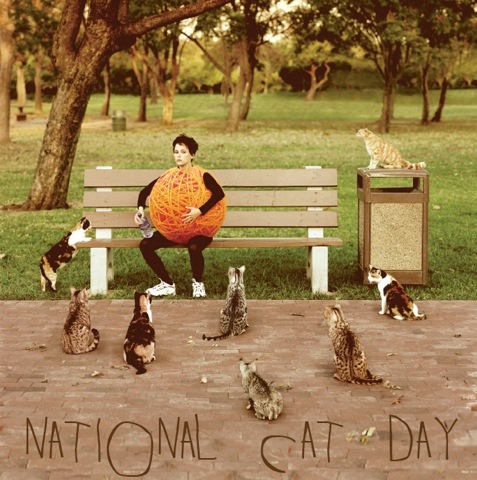
Happy National Cat Day
by JOHN ADAMS •
Development, Economy, Film
What a Film About Janesville Really Says
by JOHN ADAMS •
Much has been said about Brad Lichtenstein’s As Goes Janesville, and it’s usually about how the film depicts Gov. Walker.
There’s much more to the film, though, and particularly interesting to me is how Janesville tries to entice a startup to locate in that city by offering millions in public incentives. The startup, Shine, promises a new method to process a critical isotope for use in medicine. (The isotope is vital and of longstanding use; Shine’s method is new.)
Embedded above is a clip from the film that a YouTube user has uploaded, and I’ve coded the embed to start part way through the film, starting at a scene I find compelling.
As the clip begins, members of the business community and advocates of the Wisconsin Economic Development Corporation try to persuade Sen. Tim Cullen to support millions in tax credits for Shine.
He’s skeptical, and replies after seeing a convoluted chart detailing how the WEDC will supposedly oversee the tax incentives and other public monies. Looking back at the WEDC, it’s all a bad and sad joke, more even than Lichtenstein probably knew when he filmed the scene.
I’m neither a Republican nor a Democrat, so I’ve no partisan water to carry for Sen. Tim Cullen.
As it’s filmed, though, he’s the only one in the room who exhibits the reasoning that one would expect of a community leader.
It’s the kind of reasoning ordinary people have, but that’s washed away in a flood of jargon – empty, mostly – about synergies, innovations, leveraging, etc.
There’s a dare behind many of these terms, in this context: the speaker tries to awe others into believing that what he’s saying is profound, or prepares to insult others for ignorance if they question what’s being said: Oh my, it’s all so difficult and sophisticated and complicated, I’m not sure I could even explain it in a way you’d understand.
Too funny, really, as a contention like that is a lazy man’s effort to forestall examination and criticism of his (quite possibly) flimsy scheme.
Janesville’s had desperate times, and she’ll not recover quickly. She won’t truly recover, though – nor will we – if proposals are hushed and rushed as too many have been.
Daily Bread
Daily Bread for 10.29.13
by JOHN ADAMS •
Good morning.
We’ll have a mostly cloudy Tuesday in Whitewater, with a high of fifty-two, and winds of 5 to 10 mph.
Whitewater’s Fire and Rescue Task Force meets at 6 PM.
On this day in 1929, the stock market crashes:
Black Tuesday hits Wall Street as investors trade 16,410,030 shares on the New York Stock Exchange in a single day. Billions of dollars were lost, wiping out thousands of investors, and stock tickers ran hours behind because the machinery could not handle the tremendous volume of trading. In the aftermath of Black Tuesday, America and the rest of the industrialized world spiraled downward into the Great Depression.
During the 1920s, the U.S. stock market underwent rapid expansion, reaching its peak in August 1929, a period of wild speculation. By then, production had already declined and unemployment had risen, leaving stocks in great excess of their real value. Among the other causes of the eventual market collapse were low wages, the proliferation of debt, a weak agriculture, and an excess of large bank loans that could not be liquidated.
Stock prices began to decline in September and early October 1929, and on October 18 the fall began. Panic set in, and on October 24—Black Thursday—a record 12,894,650 shares were traded. Investment companies and leading bankers attempted to stabilize the market by buying up great blocks of stock, producing a moderate rally on Friday. On Monday, however, the storm broke anew, and the market went into free fall. Black Monday was followed by Black Tuesday, in which stock prices collapsed completely.
After October 29, 1929, stock prices had nowhere to go but up, so there was considerable recovery during succeeding weeks. Overall, however, prices continued to drop as the United States slumped into the Great Depression, and by 1932 stocks were worth only about 20 percent of their value in the summer of 1929. The stock market crash of 1929 was not the sole cause of the Great Depression, but it did act to accelerate the global economic collapse of which it was also a symptom. By 1933, nearly half of America’s banks had failed, and unemployment was approaching 15 million people, or 30 percent of the workforce. It would take World War II, and the massive level of armaments production taken on by the United States, to finally bring the country out of the Depression after a decade of suffering.

Scientific American‘s daily trivia question asks about light. (Clicking on the question leads to its answer.)