
I’ve long been opposed to government’s role in picking winners between big and small businesses, but there’s no doubt that Whitewater’s local merchants – including many small, independent businesses – have much to offer. Why not make this Saturday (and other days, too) their days, choosing them for your destination?
Film
Film: How to Sharpen Pencils
by JOHN ADAMS •
HOW TO SHARPEN PENCILS from Pricefilms on Vimeo.
Official Selection:
2013 Austin Film Festival
2013 SF Docfest
2013 Sidewalk Film Festival (Winner: Best Documentary Short)
2013 Indie Memphis Film Festival (Winner: Special Jury Prize)
2013 Cucalorus Film Festival
A practical and theoretical treatise on the artisanal craft of pencil sharpening. The number one #2 pencil sharpener in the world, David Rees takes viewers through the delicate process of sharpening a pencil by hand.
a film by KENNETH PRICE
written by DAVID REES
camera operator DAVID HAMBRIDGE
sound mixer JUSTIN DRUST
composer FRANCIS DYER
pricefilms.com
twitter.com/pricefilms
2013
Daily Bread
Daily Bread for 11.26.13
by JOHN ADAMS •
Good morning.
For Tuesday, Whitewater will have scattered snow showers in the afternoon, with a high of thirty-one falling to twenty-four by late afternoon.
About yesterday’s snow, I’d say we were under one inch (the National Weather Service station for Milwaukee/Sullivan official record is .7 inches for their location. Admittedly, we might have had more than that, but I think still we were under an inch.)
Whitewater’s Urban Forestry Commission meets at 4:30 PM today.
On this day in 1931, a cloverleaf makes the cover:
The first cloverleaf interchange to be built in the United States, at the junction of NJ Rt. 25 (now U.S. Rt. 1) and NJ Rt. 4 (now NJ Rt. 35) in Woodbridge, New Jersey, is featured on the cover of this week’s issue of the Engineering News-Record. (By contrast, a piece on the under-construction Hoover Dam was relegated to the journal’s back pages.)
With their four circular ramps, cloverleaf interchanges were designed to let motorists merge from one road to another without braking. They worked well enough—and became so ubiquitous as a result—that writer Lewis Mumford once declared that “our national flower is the concrete cloverleaf.” But many of the older cloverleaves were not built to handle the volume and speed of traffic they now receive, and many have been demolished and rebuilt.
There’s a documentary video that includes information on this cloverleaf:
|
This Week’s Game — November 25-29
|
|||||
|
With Thanks
|
|||||
|
It’s all about the stuffing this week. For each day, we started with a word or phrase, added the six letters in the word THANKS, and rearranged all the letters to get a new word or phrase. Both pieces are described in each day’s clue, with the shorter one first.
|
|||||
|
Example:
|
|||||
|
Rosary component; what you might go to hell in
|
|||||
|
Answer:
|
|||||
|
Bead; handbasket
|
|||||
|
What to Submit:
|
|||||
|
Submit both pieces, with the shorter one first (as “Bead; handbasket” in the example), for your answer.
|
|||||
 |
|||||
|
Tuesday, November 26
|
|||||
|


Holiday, Music
Monday Music: Eric Lewis, Thanksgiving
by JOHN ADAMS •
Jazz Pianist Eric Lewis from NPR on Vimeo.
Public Meetings
School Board
by JOHN ADAMS •
Daily Bread
Daily Bread for 11.25.13
by JOHN ADAMS •
Good morning.
We will have a wintry mix of precipitation for Monday, with snow combining with freezing rain, to end by the afternoon. Snow accumulation may be under an inch.
Of snow, most respondents to the FW Friday Poll: Whitewater’s first accumulated snowfall in the 2013-14 season? picked December 16-31 (at 54.76%), with December 1-15 second at 26.19%, November 22-30 at 9.52%, January 1-15 at 7.14%, and January 16-31 at 2.38%.
Whenever it snows, there will be snowflakes, and if snowflakes, then why not photographs of them? For that task, one might turn to How to Photograph Snowflakes – with a Really Cheap Camera:
- Go out onto your porch one night during a light snowfall, and let a flake fall onto a piece of glass. Be patient and discerning.
- Light the snowflake with a flashlight from below the glass, and make sure everything remains steady.
- Get up close—about a centimeter—and stand still and snap photos, letting autofocus take over.
- Combine and average the best photos you take, and add color to bring everything out.
Consider as inducement an example of photographer Alexey Kljatov’s work:

On this day in 1783, the British leave:
…nearly three months after the Treaty of Paris was signed ending the American Revolution, the last British soldiers withdraw from New York City, the last British military position in the United States. After the last Redcoat departed New York, U.S. General George Washington entered the city in triumph to the cheers of New Yorkers. The city had remained in British hands since its capture in September 1776.
Four months after New York was returned to the victorious Patriots, the city was declared to be the capital of the United States. In 1789, it was the site of Washington’s inauguration as the first U.S. president and remained the nation’s capital until 1790, when Philadelphia became the second capital of the United States under the U.S. Constitution….
Puzzability begins a new series this week:
|
This Week’s Game — November 25-29
|
|||||
|
With Thanks
|
|||||
|
It’s all about the stuffing this week. For each day, we started with a word or phrase, added the six letters in the word THANKS, and rearranged all the letters to get a new word or phrase. Both pieces are described in each day’s clue, with the shorter one first.
|
|||||
|
Example:
|
|||||
|
Rosary component; what you might go to hell in
|
|||||
|
Answer:
|
|||||
|
Bead; handbasket
|
|||||
|
What to Submit:
|
|||||
|
Submit both pieces, with the shorter one first (as “Bead; handbasket” in the example), for your answer.
|
|||||
|
|||||
|
Monday, November 25
|
|||||
|

Animation
Sunday Animation: The MoBro’s Guide to Small Talk…in Finland
by JOHN ADAMS •
Daily Bread
Daily Bread for 11.24.13
by JOHN ADAMS •
Good morning.
Sunday will be mostly sunny with a high of twenty-four.
One often hears about a bird’s eye view. What would that be like? Something like this, perhaps —
On 11.24.1824, a beer magnate is born:
1824 – Frederick Miller Born
On this date brewing barron Frederick Miller was born in Riedlingen, Wurttemberg, Germany. In 1854, he migrated to the U.S. and to Milwaukee. In 1855 he purchased the Plank Road Brewery. He operated this business until 1888 when it was incorporated as the Frederick Miller Brewing Company, with Miller as president. Miller died on June 11, 1888. [Source: Dictionary of Wisconsin History]
Public Meetings
Downtown Whitewater Board
by JOHN ADAMS •
Public Meetings
Urban Forestry Commission
by JOHN ADAMS •
Daily Bread
Daily Bread for 11.23.13
by JOHN ADAMS •
Good morning.
We will have a blustery and chilly day, with a high of twenty-two, and wind gusts as high as thirty mph.
I’ve added two additional points to my reply to an editorial about Janesville’s transit bus. See, The Gazette‘s Laughable, Damage-Control Editorial. The program and the editorial defense of it are, both of them, of notably poor quality.
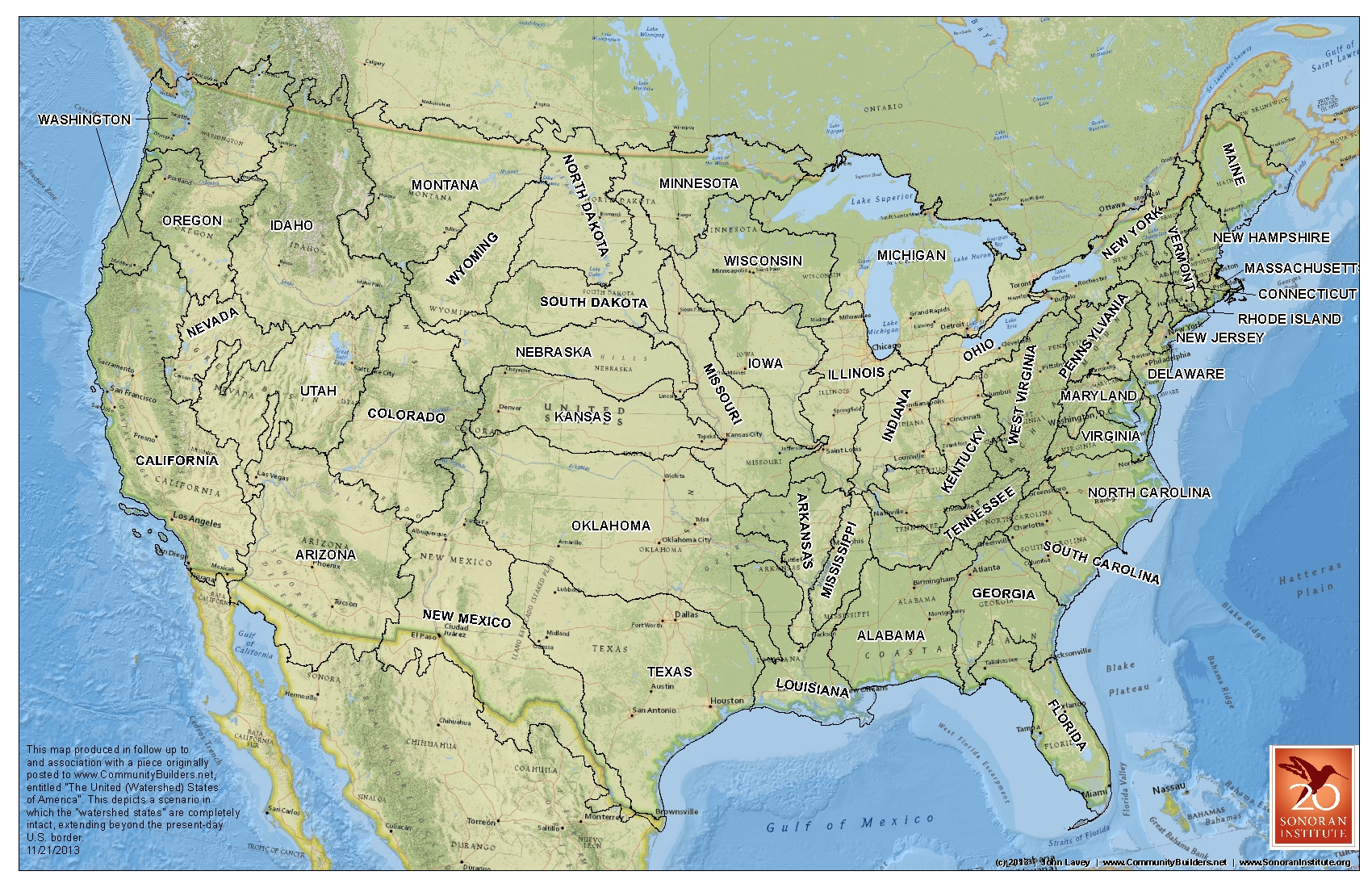
What if one drew the boundaries of states, as John Wesley Powell once suggested, by watersheds and not simply abritrary, straight lines? That’s the basis of a story from Community Builders entitled, The United (Watershed) States of America. John Lavey observes:
Which gets me to my “what if”: What if the Western states were formed around watershed as Powell envisioned? What would that look like and could we speculate on what that might mean for the functioning of modern communities? And since we’re going down that road, let’s ask another what if: What if all of the American states were based around principal watershed, from coast to coast – something even Powell didn’t consider.
Armed with an elementary understanding of GIS and various shapefiles, I set out to create such a map.
Here’s his watershed-boundary map (clicking produces a larger image):
On this day in 1998, a settlement in Wisconsin:
1998 – Wisconsin Enters into Tobacco Settlement
On this date Wisconsin entered into the tobacco “Master Settlement Agreement.” Wisconsin was to receive $5.9 billion over 25 years from leading tobacco product manufacturers. [Source: Tobacco Control Resource Center for Wisconsin]
Corporate Welfare, Government Spending, Local Government, Press
The Gazette‘s Laughable, Damage-Control Editorial
by JOHN ADAMS •
There’s an editorial at the Gazette today (http://gazettextra.com/article/20131122/ARTICLES/131129885/1034) predictably praising continued funding for Janesville’s transit bus to Whitewater. That there’s a bit of crowing in the editorial is unsurprising, but it’s more telling that it’s an error-prone essay that makes basic mistakes about Whitewater’s politics, and omits – perhaps intentionally – a description of the actual discussion that took place in Whitewater.
(See, for an accurate account, The Bus Discussion @ Council Last Night: A Fiasco by Any Definition.)
Update, 11.23.13: Advertising & Video.
Advertising: When the Gazette ran this editorial in favor of their city’s transit bus, why didn’t their editorialist disclose that the paper has benefited from advertisements for the bus? (It would have been easy enough to do: ‘Disclosure: Our newspaper has published advertisements for the ‘Innovation Express.’)
They didn’t bother. It’s another example of that paper’s decline from a proper standard. Here’s a screenshot of their website from earlier this year:

Video: The video of Tuesday’s session is now available, at https://vimeo.com/79914403, with the discussion of the bus taking place beginning @ 58:40. I am confident that those who watch the actual recording of the meeting will see that the Gazette’s editorial is an erroneous and misleading characterization of the discussion.
Needless to say, Gazette readers in Janesville will never see the actual proceedings, and their editorialist knows as much. This gives him the opportunity to spin and distort. And yet, his is not an unlimited opportunity – the recording refutes his sugary characterization, as does my own thorough review of the session, and as does in large part the account from another newspaper, the Daily Union.
The Vote. The Gazette‘s editorialist needs an editor — the vote was 4-2, not 6-2 (Whitewater’s entire Council is only seven people).
The Background. Greg Peck – or whoever wrote this editorial – knows utterly nothing about politics in Whitewater.
The Gazette suggests that a majority was enthusiastic for this idea.
In fact, Council member Jim Winship is a proud Whitewater supporter of the bus, but even Mr. Winship voiced occasional doubts about the situation. On the contrary, there was widespread Council concern about the last-minute fumbling from Janesville Transit’s Dave Mumma, ridership numbers, Generac’s declining contribution, and Mr. Mumma’s dodgy conflation of passenger ‘trips’ and actual riders.
Whitewater even decided to consider the bus project again in August 2014, rather than next November, precisely because of how little confidence anyone had about how the last two Janesville presentations in November have gone.
Council wanted more time as a consequence of less confidence.
Here’s how the editorialist describes Mr. Mumma after the vote: “Still, he sounded diplomatic Wednesday.”
Oh, brother – as though Mr. Mumma has reason to be anything other than feeling and appearing foolish.
Far from looking competent, Mr. Mumma embarrassed himself, his agency, Whitewater’s city manager, and just about anyone else nearby, after he unquestionably led everyone in Whitewater to believe just two weeks earlier that Generac would spend over $47,000 when they made no such promise. (They’re really only funding $18,000 next year, and made clear funding will decline even more in subsequent years.)
Worse, Generac’s vice president of operations felt compelled to contradict openly the Janesville Neighborhood Services Director’s description of how the program even began. Funding documents from the State of Wisconsin’s Department of Transportation corroborate Generac’s account.
These so-called partners were at odds over expected funding and even a description of how the program began.
Battening on Unawareness. Look, the Gazette‘s editorial craftily omits these vital facts from a Janesville readership that understandably doesn’t follow Whitewater’s politics.
It’s an all-is-well editorial. Janesville’s officials made a hash of this, but the Gazette would rather conceal some of the most important events of the meeting than tell its readers a hard truth: love or hate the bus, Janesville’s work on all this has been a stumbling mess.
Why the Gazette‘s in Decline. I’d prefer papers that spoke truth to political power, but that way has slipped away – God, Himself, knows that Janesville now has little resembling that former, worthy model.
This is a paper that threw away its former willingness to question public officials for a politician-advertiser-press partnership when economic and journalistic decline left it with that unsavory option in a futile attempt to forestall yet further decline.
For it all, the Gazette‘s model only intensifies its problems.
Many of Janesville’s struggles come from a mediocre political class – and the Gazette‘s answer is to omit unfavorable truths rather than confront and overcome them.
That’s one reason that, sadly, Janesville’s near-future is unlikely to be better than her present, middling circumstances.
Education, Good Ideas, School District
Rube Goldberg Machines
by JOHN ADAMS •
From Lincoln Inquiry Charter School, there’s a recently-released video of students building Rube Goldberg machines. In their clever work, one finds true innovation:
LINCS Rube Goldberg 2013 – Short Version from Whitewater Community TV on Vimeo.
Business, Corporate Welfare, Government Spending
The New Address
by JOHN ADAMS •
One reads a press release at Walworth County Today (http://walworthcountytoday.com/article/20131122/WC/131129921) about the relocation of an existing private business, iButtonLink, to the Innovation Center.
Here’s where they were:

Here’s where they’ll be:

That’s a nice upgrade, to taxpayer-funded accommodations. It’s also a different definition of private accomplishment, I’d say.