

Charity
Stuff the Bus
by JOHN ADAMS •
Good morning.
Saturday in Whitewater offers a probability of showers in the morning, and a high of sixty-nine.
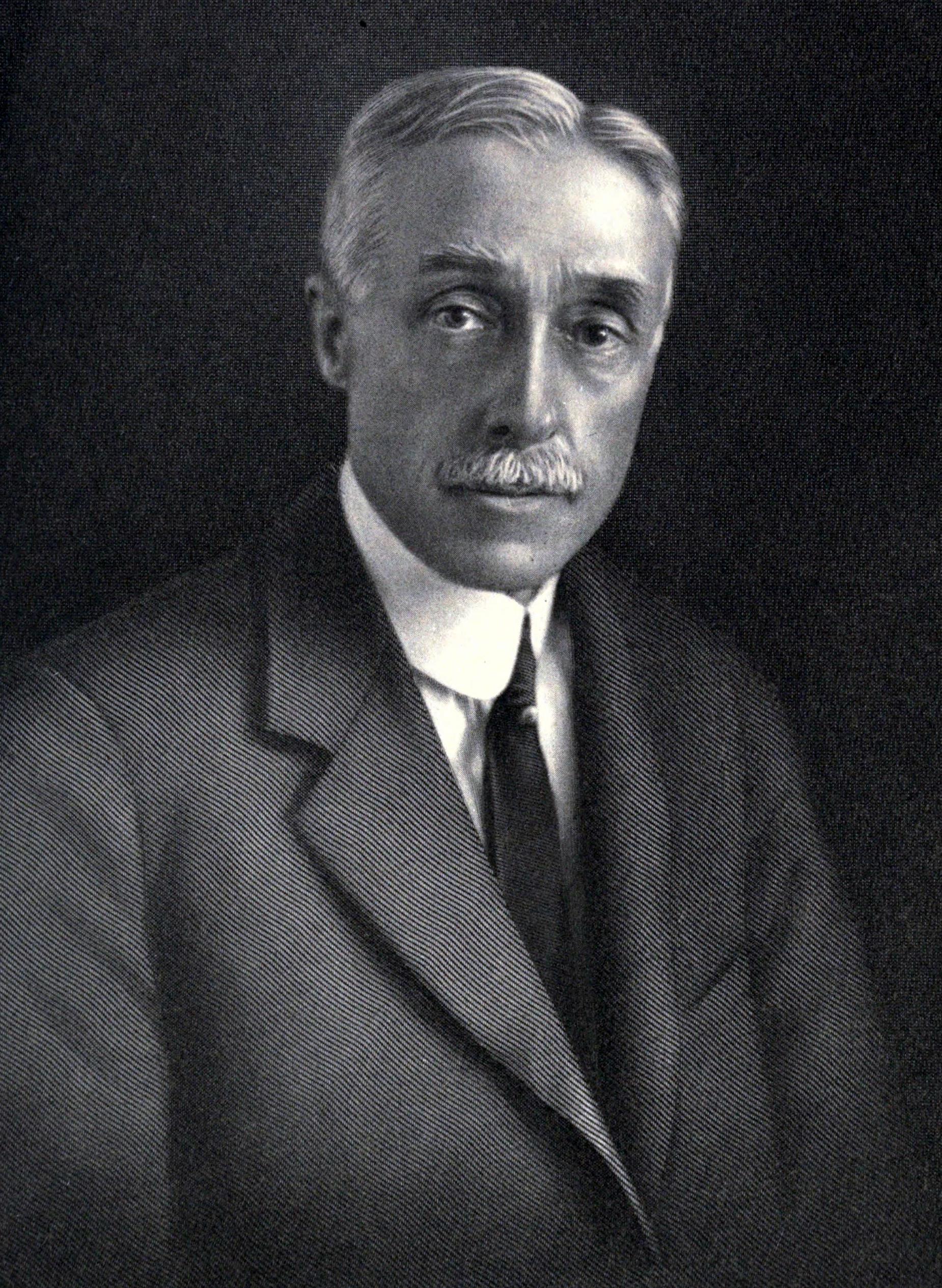
On this day in 1860, Elmer Ambrose Sperry, co-inventor of the gyroscope, is born. His work greatly aided navigation:
To navigate using a magnetic compass requires constant adjustment because of the difference between true north and magnetic north, where a compass needle points. Magnetic north is not a fixed point, and the magnetic declination that a navigator must calculate varies depending where in the world the compass is located.
It makes holding a straight course over distance difficult.
Among the almost 400 patents Elmer Ambrose Sperry was awarded (nearly twice the number Thomas Edison held), was the gyroscopic compass in 1908. His system enabled ships to navigate without using magnetic north, could determine the ship’s position regardless of weather, and was unaffected by steel hulls and superstructures. The system also enabled an effective autopilot system; Sperry’s was called “Iron Mike.”
For present-day tech, here are some tips from David Pogue of the New York Times on time-savers:
From a Serbian zoo:
And, of course, the original white lion cub, from Osamu Tezuka, of his manga and later anime series:
This summer, entrepreneur Kevin Rose awoke to the cries of his dog, Toaster. Rose found his dog on a stairwell outside his apartment, battling (none-too-successfully) a raccoon. Acting to protect his dog, Rose tossed the masked attacker down the stairwell. Video from security cameras recorded the encounter, and Rose placed it on the YouTube (the video became an Internet sensation):
Do you think Rose was justified in tossing the raccoon? I’ll say yes, the circumstances were out-of-the-ordinary, and the trespassing varmint had it coming. What do you think?
Since this time, by the way, Rose believes he’s caught the raccoon that attacked his canine. Here was his Tweet after the capture:
We got him. #missionaccomplished #usa #raccoon.
Good morning.
Friday will bring patchy fog in the early morning, but thereafter a mostly sunny day, with a high near seventy-three.
On this day in 1968, the first manned Apollo mission completes 163 orbits around Earth as a precursor to a lunar mission:
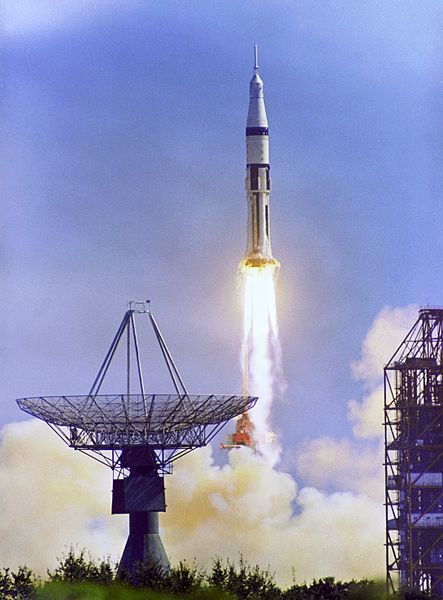
Cape Kennedy, Fla., Oct. 11–Three American astronauts rocketed into orbit today for the first manned test flight of the Apollo spacecraft, which may some day fly men to the moon.
After an almost flawless countdown, a Saturn 1-B rocket roared from the launching pad here at 11:03 A.M., Eastern daylight time, to boost Apollo 7 on its way to a planned 11-day flight circling the earth.
On the ground, officials of the National Aeronautics and Space Administration hailed the launching as a “perfect mission” so far. In orbit, Capt. Walter M. Schirra Jr. of the Navy, the 45- year-old commander, exclaimed, “We’re having a ball.”
Scientific American‘s daily trivia question asks about longevity. (Clicking on the question leads to its answer.)
Over at the Financial Times, there’s a post that has a video of a rally monkey, and the possibilty of a market rally if there’s a House-Obama compromise on the debt-ceiling (and perhaps on the shutdown, too.)
Well, a political pact might spark a rally, but what role does the monkey, himself, play? Most likely none, but why take a chance?
Here’s the video of the rally monkey that the FT‘s embedded, doing his stuff:
Readers may be assured, by the way, that the video is as oddly compelling on the tenth viewing as it is on the first. Enjoy.
The most important offering of a restaurant is food, but following closely are atmosphere and service. In fact, for low-end, commodity offerings, I’d say atmosphere (bright, clean) and service (quick & friendly) are often decisive.
Someone in town mentioned to me that the service at an establishment I’d reviewed favorably months ago was on the decline, from difficulty taking customers’ orders efficiently. I stopped in a few times – not for a follow-up review, but merely to see for myself.
Sure enough: it was a jumble.
That’s too bad, because food isn’t just about food.
A story – true and of my own acquaintance – will illustrate my point. It’s not about a local establishment, nor even a fancy place. It’s about a scientist’s daily visits to a convenience store, of all things, for coffee.
In another state, a prominent scientist commutes to work each day. He’s intelligent, serious, and has completed both undergraduate and doctoral studies at some of the country’s most competitive programs. His work is classified, and so I know only that he’s a naval researcher, whose leadership has likely contributed to continued American naval supremacy.
He has a beautiful, intelligent wife, and daughters equally so. He has all that one might wish. There’s no neediness or insecurity in him.
But for all those advantages, all that authority and responsibility, he has a simple routine he very much enjoys: visiting a particular convenience store when he can, for a cup of coffee. He could buy any beans he might want, or go to any shop he might wish, in the metropolitan area in which he lives, but he doesn’t.
Instead, he stops at a small convenience store where the family owners greet him on each visit, simply with his first name, and exchange pleasant conversation about ordinary matters. These visits are memorable to him, a man not given to over-sentimentality.
Why is that? It’s not the coffee, nor the unique design of the store, but something in the service, the ordinary conversation topics, that’s beyond ordinary to him. It matters to him, and so he returns when he can.
There are shops that make better coffee, no doubt, and ones that sell better beans, but that’s not compelling for him. It’s the ordinary conversation that he finds special, and truly enjoyable.
Service matters, sometimes decisively.
Here’s the third post in a trilogy about residential housing in Whitewater. For the first two posts, see, Old Whitewater Dreams of a Student Rez and The University’s Role in Town-Gown Issues.
Recap: (1) pointing to the northwest corner of the city for student rentals without actual, additional housing in that area is an empty solution, and (2) the university’s planned poorly and focused on the wrong priorities.
But, let’s now be candid: when residents rightly complain about damage to properly, loud noise in the early morning, and public indecency, they’re not raising mere zoning issues, they’re raising criminal ones.
(I’ve been clear that these are crimes, and are wrong. See, for example, The Crude Illegitimacy of Vandalism.)
There are hundreds of millions of Americans, and thousands of campuses, with high-density neighborhoods, and many of them are doing far better than Whitewater’s doing on town-gown issues. It’s simply false – and nutty, actually – to pretend that (1) there’s nothing locally that can be done, (2) it’s all a consequence of high-density housing, or that (3) other college towns aren’t doing better.
Zoning’s often a fig leaf for a real problem that Whitewater simply has not solved, but many other communities have: holding to a failed criminal enforcement strategy leaves the city and campus fighting a losing effort against these crimes.
And yet, and yet, Old Whitewater, that unreconstructed, Old Guard, can’t bring themselves to state this simple truth. They’re so worried, or so doctrinaire, about seeming anti-police that they can’t admit a distinction between choosing among strategies and abject support or opposition to any decisions police leaders make.
So, it’s easier to pretend it’s a civil zoning problem than to admit it’s a failure of criminal enforcement strategies and leadership.
These are leaders who will try the same, attrition-based, keep-them-in-their-place numbers game that hasn’t worked, isn’t working, and won’t work.
It’s not community policing, it’s talking about community policing while treating others as inevitable problems and threats, seeing the world as full of adversaries, relying on raids, ineffectual undercover operations, and having no real rapport with large swaths of the city’s population.
They’ve only more of the same (or worse) to offer.
How do I know this?
Because, by the widespread claims of residents, themselves, conditions are as bad as ever.
Current police leaders have no effective solution, except to (1) insist all is well, (2) complain when residents voice their concerns, and (3) double-down on yesterday’s mistakes and ineffective efforts.
They don’t see critics, they see enemies, problems, threats, etc. They don’t see fellow residents and citizens of the community, they see newcomers, supposed transients, and outside influences.
It’s a hunkered and bunkered leadership mentality – it cannot be concealed believably behind photo ops, press releases, and staged events.
In the clips below, Whitewater Chief Otterbacher and UW-W Chief Kiederlen express their views.
From Chief Otterbacher, her presentation is a combination of grousing that a victimized resident wrote to Common Council and the press, and an evident weariness that this is a long, endless slog with no imagined resolution.
From Chief Kiederlen, it’s almost a speaking-through-gritted-teeth presentation. (Oddly, it’s a presentation where Chancellor Telfer appears and simply introduces Chief Kiederlen, but says nothing of substance otherwise.)
I’d guess neither police leader understands how he or she comes across outside of his or her small circle of like-minded people.
From Common Council on 11.8.12, with Chief Otterbacher (speaking from 5:43 to 11:08):
Common Council Meeting 11/08/2012 from Whitewater Community TV on Vimeo.
From Common Council on 5.21.13, with City Manager Clapper (speaking from 6:00 to 7:09), Chancellor Telfer (speaking from 7:10 to 8:00), and Chief Matt Kiederlen (speaking from 8:01 to 13:00):
Common Council Meeting 05/21/2013 from Whitewater Community TV on Vimeo.
Good morning.
After early morning fog, Thursday will be sunny with a high of seventy-two with southeast winds of around 5 mph.
On this day in 1917, jazz pianist and composer Thelonious Monk is born. He passed away in 1982.
Here’s Straight, No Chaser:
On this day in 1982, the Brewers win the American League Pennant:
1982 – Brewers Win the Pennant
On this date the Brewers won the American League Pennant, securing their spot in the 79th World Series against the National League’s St. Louis Cardinals. The Brewers bounced back from a poor start in the series to become the first team ever to win the League Championship Series after being down 0-2 in the five day series. [Source: Milwaukee Brewers]
Scientific American‘s daily trivia question asks about a space-age first for America. (Clicking on the question leads to its answer.)
The tragedy of Detroit —
Yesterday, I posted on housing density in the city, and the push to move sudent housing to the northwestern part of Whitewater. See, Old Whitewater Dreams of a Student Rez.
A recap: the plan won’t work because (1) student housing is widespread in the center of the city by voluntary choice that cannot be undone and (2) pointing to the northwest corner of the city without actual, additional housing in that area is an empty solution.
(That’s the point of a reservation theme: wanting people to live in an area without market forces, or even state forces, to support housing isn’t a practical solution.)
A longtime reader, very sharp, wrote in reply to yesterday’s post, and one of his points was that I had neglected the university’s role in all this. (He had several very solid points, all appreciated; I wrote yesterday in direct reply to his message.)
He’s right, of course: I seldom write about the university. It’s my mistake.
But what of the university, in all these years of contention over student housing?
The easiest way, really, to think about the university is as a planned community, where some of the consequences of their planning are confined to campus, but other consequences reach far beyond. In this regard, university planning has been a decidedly mixed bag.
There have been unalloyed university successes (new on-campus classrooms, more competitive enrollment, nationally-ranked athletic programs).
There have also been some equally obvious problems: (grant-chasing for a now-struggling tech park building, failure to provide sufficient housing options, a laughable tendency toward exaggeration of faculty and administration accomplishments, and a descent into crony-capitalist schemes that – in the unlikely event that any of them should ever turn a profit – would benefit primarily a few salaried, white-collar academics.
The accomplishments of many the university’s athletes – genuine and enduring triumphs – are among the best of recent achievements. Those young men and women did not pretend to be nationally talented – they truly were and are.
By contrast, the university administration’s tendency toward professional exaggeration – silly insistence that everything is the best, the greatest, in all North America – is embarrassing. Many in the city, knowledgeable and well-read, are neither shocked nor awed by ceaseless puffery. It’s very close to a 24/7 confidence game, the marketing of exaggerations as truths.
The university (1) has seen an increased student demand for residential housing but not committed to similar increases in student housing on campus, (2) has spent money on headline-grabbing projects over additional housing, (3) may not have the money (or the will) to build more housing now.
What’s to be done, if the money’s not there for big construction? (I’m not sure it is, and I’m even more convinced that the city’s fiscal account, weak economy, and hectoring over zoning only further reduce the incentive for additional, high-density private construction.)
Quick suggestions for the university administration:
1. The university will have to advocate for students, and commit to this community, beyond committees that have made no practical difference. There will have to be a day-and-night effort to aid the integration of students into the whole community.
How do I know a few committees have made no practical difference?
Because if they had, we wouldn’t be arguing about zoning and enforcement all these years later.
2. Commit to additional, residential construction near the (public) Starin Residence and the (private) Element.
The university has asked Whitewater for millions in city bonds (municipal debt) to fund the tech park. It’s time to seek money for residential housing from non-city sources.
3. Private works better than public: time to lobby Whitewater to create enterprise-style zoning for construction in the northwest corner of the city. Here’s a goal: the fewest regulations possible in any Wisconsin community for that area.
I heard a councilmember in March declare that he didn’t want Whitewater to wind up like Houston. It won’t; between Houston and our stagnant present there’s ample room for a very low-regulation area.
It’s unpersuasive that Old Whitewater’s stalwarts want building in the northwestern corner if they can’t – or willfully won’t – understand that their regulatory schemes and profligate spending have impaired private capital investment.
Pointing to the northwest corner isn’t enough: there will have to be buildings there.
4. The university should do everything it can to get its faculty to live in town. They work here, why won’t they live here? I’d not compel, but the university’s not even trying. I am well aware of recent academic studies on housing that (a) compared Whitewater with other, nearby towns, and (b) of student housing in particular.
Overall, though, what has the university done to encourage faculty to become residents? Not much, as more and more of them seem to be living beyond Whitewater.
I’d choose Whitewater over any other city, and they would, too, if only there’d be a greater effort. (Telling people sotto voce that it’s better to live in Fort Atkinson is both discouraging and wrong. Whitewater’s the place to live.)
These are hot-button issues, but I don’t write to be popular. I write because I believe these points to be true. I know that the Old Guard prefers to discourage alternative points of view. They may prefer as they wish, but to no avail; they’ll never have that closed and controlled media scene again.
More ahead, tomorrow.
Tomorrow: Zoning Debates are Often Just a Distraction from Failed Criminal Enforcement Strategies.

Good morning.
Our midweek will be sunny, with a high of seventy-one, and south winds around 5 mph.
On this day in 1635, Roger Williams is banished from Massachusetts. He later founds his own settlement:
Religious dissident Roger Williams is banished from the Massachusetts Bay Colony by the General Court of Massachusetts. Williams had spoken out against the right of civil authorities to punish religious dissension and to confiscate Indian land.
After leaving Massachusetts, Williams, with the assistance of the Narragansett tribe, established a settlement at the junction of two rivers near Narragansett Bay, located in present-day Rhode Island. He declared the settlement open to all those seeking freedom of conscience and the removal of the church from civil matters, and many dissatisfied Puritans came. Taking the success of the venture as a sign from God, Williams named the community “Providence.”
Among those who found a haven in the religious and political refuge of the Rhode Island Colony were Anne Hutchinson–like Williams, she had been exiled from Massachusetts for religious reasons–some of the first Jews to settle in North America, and the Quakers. In Providence, Roger Williams also founded the first Baptist church in America and edited the first dictionary of Native-American languages.
Scientific American‘s daily trivia question asks about satellite launches. (Clicking on the question leads to its answer.)
China has built and launched a satellite for which African nation?