
Public Meetings
Parks & Rec Board
by JOHN ADAMS •
Public Meetings
Downtown Whitewater Design Committee
by JOHN ADAMS •
Daily Bread
Daily Bread for 8.25.13
by JOHN ADAMS •
Good morning.
Whitewater will have a sunny Sunday, with a high of eighty-eight. Sunrise was at 6:12 AM and sunset will be 7:41 PM. The moon is in a waning gibbous phase with 75% of its visible disk illuminated.
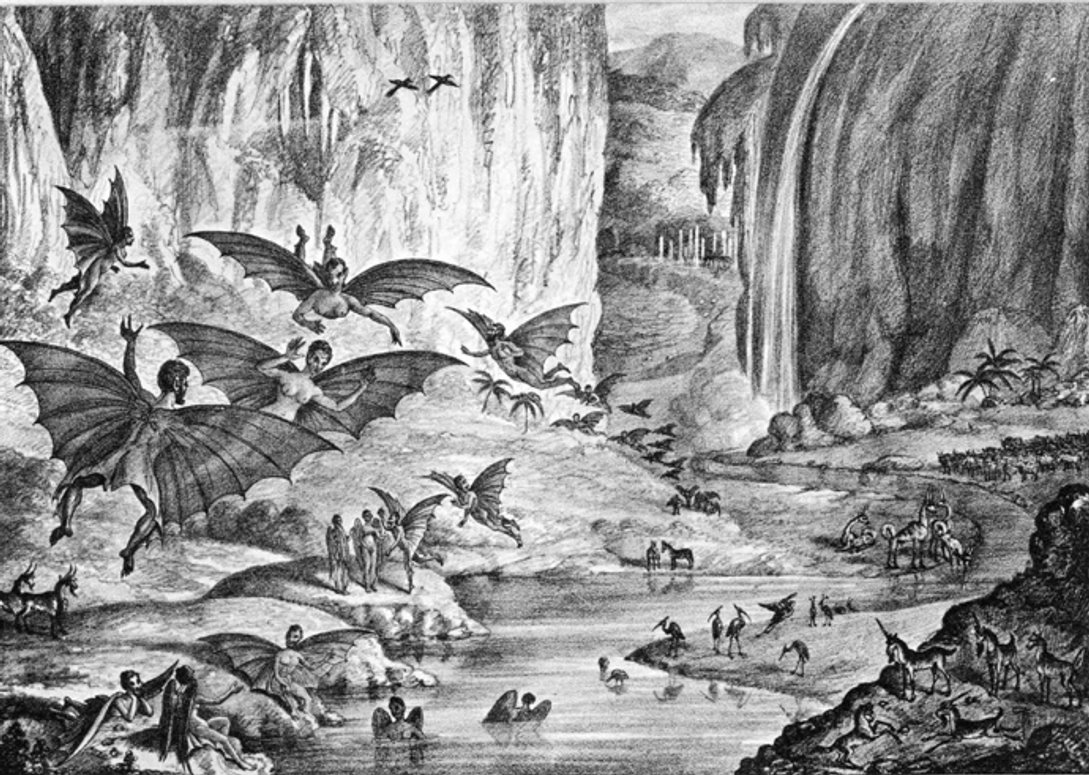
And of the moon, on this day in 1835, a Great Moon Hoax began:
On this day in 1835, the first in a series of six articles announcing the supposed discovery of life on the moon appears in the New York Sun newspaper.
Known collectively as “The Great Moon Hoax,” the articles were supposedly reprinted from the Edinburgh Journal of Science. The byline was Dr. Andrew Grant, described as a colleague of Sir John Herschel, a famous astronomer of the day. Herschel had in fact traveled to Capetown, South Africa, in January 1834 to set up an observatory with a powerful new telescope. As Grant described it, Herschel had found evidence of life forms on the moon, including such fantastic animals as unicorns, two-legged beavers and furry, winged humanoids resembling bats. The articles also offered vivid description of the moon’s geography, complete with massive craters, enormous amethyst crystals, rushing rivers and lush vegetation….
Readers were completely taken in by the story, however, and failed to recognize it as satire. The craze over Herschel’s supposed discoveries even fooled a committee of Yale University scientists, who traveled to New York in search of the Edinburgh Journal articles. After Sun employees sent them back and forth between the printing and editorial offices, hoping to discourage them, the scientists returned to New Haven without realizing they had been tricked.
On September 16, 1835, the Sun admitted the articles had been a hoax. People were generally amused by the whole thing, and sales of the paper didn’t suffer….
Business, Development, Press Release
Small-Town Downtown Forum, Thursday, September 5th in Darien, WI
by JOHN ADAMS •
Please see a press release for a Thursday, September 5th development conference:
On September 5th, UW-Extension and the Village of Darien are hosting the first of three state-wide Small Town Downtown Forums that focus on the unique community and economic development issues and needs in small, often rural communities.
The program will be held at the Darien Senior Center, 47 Park Street, Darien WI, from 12:30 to 4:30 PM.
See http://walworth.uwex.edu/2013/08/06/2013-small-town-downtown-forum/ for complete information.
The keynote presentation will be provided by Stan Gruszynski, USDA Rural Development State Director on new USDA programs that focus on economic vitality in small communities. Village of Darien Administrator Diana Dykstra and UW-Extension Educator Joshua Clements will present a local case study on the Village of Sharon and its community placemaking efforts and successes stemming from cycling, including hosting a large cycling race in the village.
Facilitated roundtable sessions will focus on variety of economic and community development topics, including Downtown Real Estate, Engaging Youth Downtown, Low Cost Ways to Improve Your Community’s Entry and Downtown, and more.
This program is open to the public with small businesses, entrepreneurs, chambers of commerce, municipal leaders and interested citizens encouraged to attend. The registration fee is $10 advance or at the door (see program brochure).
Additional information is available from
Walworth County UW – Extension
100 W. Walworth St.
PO Box 1001
Elkhorn, WI 53121-1001
Phone: 262-741-4951
Fax: 262-741-4955
Office Hours:
8:00am – 5:00pm
Monday – Friday
Daily Bread
Daily Bread for 8.24.13
by JOHN ADAMS •
Good morning.
It’s a beautiful day in Whitewater, with sunny skies, a daytime high of eighty-two ahead, and light winds from the south at 5 to 10 mph.
Ever wonder about when to use who and whom? The Oatmeal.com has you covered:
Easily resolved! How and why to use whom in a sentence – The Oatmeal http://t.co/JLse7exeda
— John Adams (@DailyAdams) August 21, 2013
If you had been living in Pompeii on this day in the year 79, you would have experienced nature’s full fury:
At noon on August 24, 79 A.D., this pleasure and prosperity came to an end when the peak of Mount Vesuvius exploded, propelling a 10-mile mushroom cloud of ash and pumice into the stratosphere. For the next 12 hours, volcanic ash and a hail of pumice stones up to 3 inches in diameter showered Pompeii, forcing the city’s occupants to flee in terror. Some 2,000 people stayed in Pompeii, holed up in cellars or stone structures, hoping to wait out the eruption.
A westerly wind protected Herculaneum from the initial stage of the eruption, but then a giant cloud of hot ash and gas surged down the western flank of Vesuvius, engulfing the city and burning or asphyxiating all who remained. This lethal cloud was followed by a flood of volcanic mud and rock, burying the city.
The people who remained in Pompeii were killed on the morning of August 25 when a cloud of toxic gas poured into the city, suffocating all that remained. A flow of rock and ash followed, collapsing roofs and walls and burying the dead….
According to Pliny the Younger’s account, the eruption lasted 18 hours. Pompeii was buried under 14 to 17 feet of ash and pumice, and the nearby seacoast was drastically changed. Herculaneum was buried under more than 60 feet of mud and volcanic material. Some residents of Pompeii later returned to dig out their destroyed homes and salvage their valuables, but many treasures were left and then forgotten.
Animals, Weird Tales
Motorcyclist Hits Bear at 87 MPH in Canada
by JOHN ADAMS •
The footage shows the view from the biker’s helmet as he is thrown from the vehicle.
According to the Royal Canadian Mounted Police (RCMP) the incident occurred on Highway 7 on June 30, 2013. After ensuring the biker received medical attention the RCMP officer recovered the helmet and camera. To their surprise police watching the video observed the motorcycle going for 0 km/h to over 140km/h in less than 20 seconds….
The report comments that the driver was clearly focused on capturing the speed on his odometer, and did not notice the bear until it was half way across the oncoming lane of traffic….
The biker involved in the incident suffered serious but non-life-threatening injuries in the accident.
The bear walked away unscathed.
Via We’re going on a bear shunt: Speeding motorcyclist hits black bear at 87 mph.
America, City, Law, Local Government
The No-Prior-Discussions, Wheelchair-Access Lawsuit Against Whitewater
by JOHN ADAMS •
Weighty claims require that claimants present their grievances deliberately.
A serious presentation ordinarily includes (1) signaling that one has a grievance, (2) offering a chance for a negotiated resolution, and only later (3) letting others know that one might seek recourse to the courts if negotiations should prove unproductive.
(This last point only applies if one can prosecute a cause of action; bluffing beyond one’s means is a fool’s gambit.)
One reads of a lawsuit against the City of Whitewater for alleged violations of the Americans with Disabilities Act and the Rehabilitation Act, for a claimed failure to provide wheelchair access in parts of the city. The plaintiff, Amy Bleile, is a former Miss Wheelchair Wisconsin. She’s retained an attorney from Birmingham, Alabama who has filed suit on her behalf in the Eastern District of Wisconsin, seated in Milwaukee.
Quick searching shows the case to be captioned as Amy Bleile, Plaintiff, vs City of Whitewater, Wisconsin, docketed at 2:13-cv-942, and filed on 8.20.2013. (I’ve no connection to this plaintiff or to her attorney; I only became aware of the lawsuit yesterday from the article to which I’ve linked, below.)
Oddly, one also reads that neither Plaintiff, Amy Bleile, nor her attorney, Michael A. Chester, contacted the city before filing their federal lawsuit.
From the Daily Union, 8.22.13:
Chester said neither he nor Bleile contacted city officials about the alleged ADA violations before filing the suit, which seeks no damages, but contains a court order requiring the city to remove the barriers to accessibility downtown and at Starin Park.
“We hope the city will collaborate with us, reach an agreement to get the barriers removed in a reasonable amount of time,’ he said.
That’s absurd, really: Attorney Chester makes no effort at discussion before filing suit, but then insists afterward that he’s seeking mere collaboration.
Perhaps lawyers practicing from Alabama define collaboration differently from people in the other forty-nine states of America.
To file suit without prior (close-in-time) contact to a target defendant is a poor practice.
This is apparently inexplicable; there are precious few times one rushes to court without approaching the other side beforehand.
Yet, if one looks at the complaint, one finds that although the Ms. Bleile is seeking only changes in accommodations (actions, not money), her out-of-state attorney is seeking fees for litigating the case, from the City of Whitewater, to be awarded by the court. From Plaintiff’s Complaint, in both Counts I (Paragraph 26) and II (Paragraph 33) one sees a request
….That the Court award reasonable attorney’s fees, costs (including expert fees) and other expenses of suit, to the Plaintiff….
Suing without contacting currently-serving city officials affords plaintiff’s counsel a chance to demand court-awarded attorney’s fees to which he would not be entitled if he had given the City of Whitewater a chance to resolve the case through contact and negotiation before litigation.
The federal dockets also show that five such lawsuits have been filed on behalf of Plaintiff, Amy Bleile, against different defendants, in either the Eastern or Western Districts of Wisconsin. (The first case listed is now closed.)
1 Bleile, Amy (pla) wiedce 2:2013-cv-00636 446 06/06/2013 08/19/2013 Bleile v. Bavaria Equities 1107 LLC
2 Bleile, Amy (pla) wiedce 2:2013-cv-00942 446 08/20/2013 Bleile v. Whitewater, Wisconsin, City of
3 Bleile, Amy (pla) wiwdce 3:2013-cv-00398 446 06/06/2013. Bleile, Amy v. Otis Holdings, LLC
4 Bleile, Amy (pla) wiwdce 3:2013-cv-00399 446 06/06/2013 Bleile, Amy v. Southern Wisconsin Foods Real Estate Holding Company, LLC
5 Bleile, Amy (pla) wiwdce 3:2013-cv-00589 446 08/20/2013. Bleile, Amy v. GE Capital Franchise Finance Corporation
Disability-access claims are serious ones that should not be filed without advance warning. Supposed, unaddressed concerns do not obviate the reasonable step of contacting currently-serving city officials. One has reason to look askance at no-prior-warning lawsuits.
All people should enjoy access to our city.
Non-conformity with federal disability law should, where found, be remedied promptly; plaintiffs’ attorneys who commence lawsuits without prior opportunity for resolution should be undeserving of court-awarded fees.
Cats
Friday Catblogging: Siamese & Cairn
by JOHN ADAMS •
Poll
Friday Poll: Least-Convincing UFO Video Ever?
by JOHN ADAMS •
There’s a recently-posted video on YouTube of a supposed UFO sighting over the Taj Mahal. I’ve embedded it below, and it seems to me to be about as bogus and unconvincing as any UFO video I’ve ever seen. (They typically seem that way to me.) This one, however, looks especially staged.
What do you think?
One can say this much, however, with confidence: the Taj Mahal looks fantastic…
Daily Bread
Daily Bread for 8.23.13
by JOHN ADAMS •
Good morning.
Friday brings a sunny day with a high of seventy-nine and winds at 5 to 10 mph.
On this day in 1784, the State of Franklin declares its independence:
…four counties in western North Carolina declare their independence as the state of Franklin. The counties lay in what would eventually become Tennessee.
The previous April, the state of North Carolina had ceded its western land claims between the Allegheny Mountains and the Mississippi River to the United States Congress. The settlers in this area, known as the Cumberland River Valley, had formed their own independent government from 1772 to 1777 and were concerned that Congress would sell the territory to Spain or France as a means of paying off some of the government’s war debt. As a result, North Carolina retracted its cession and began to organize an administration for the territory.
Simultaneously, representatives from Washington, Sullivan, Spencer (modern-day Hawkins) and Greene counties declared their independence from North Carolina. The following May, the counties petitioned for statehood as “Frankland” to the United States Congress. A simple majority of states favored acceptance of the petition, but it fell short of the two-thirds majority needed to pass, even after the counties’ changed their proposed name to “Franklin” in an attempt to curry Benjamin Franklin’s and others’ favor.
In defiance of Congress, Franklin survived as an independent nation for four years with its own constitution, Indian treaties and legislated system of barter in lieu of currency, though after only two years, North Carolina set up its own parallel government in the region. Finally, Franklin’s weak economy forced its governor, John Sevier, to approach the Spanish for aid. North Carolina, terrified of having a Spanish client state on its border, arrested Sevier. When Cherokee, Chickamauga and Chickasaw began to attack settlements within Franklin’s borders in 1788, it quickly rejoined North Carolina to gain its militia’s protection from attack.
Puzzability‘s current series entitled, Silent Partners, ends today:
“Can we get a little piece and quiet around here? For each day this week, we started with a word and added the letters SH to the beginning to get a new word. The two-word answer phrase, described by each day’s clue, is the shorter word followed by the SH word.”
Example:
Hands out portions of green onions
Answer:
Allots shallots
What to Submit:
Submit the phrase, with the SH word second (as “Allots shallots” in the example), for your answer.
Friday, August 23:
Bush that’s squishy and bendable
Beautiful Whitewater, City, Hip & Prosperous, Local Government, New Whitewater, Open Government
What Standards for Whitewater?
by JOHN ADAMS •
This post is a companion to one from yesterday on rights, entitled, How Many Rights for Whitewater?
Whitewater is a place of great natural beauty, hundreds of years of indigenous and settled living, and a quaint, small-town scene.
If residents of Whitewater should have the same rights as those elsewhere in Wisconsin and America – and so they should and do have – then what can one stay about the standards for politics and policy in the city?
Just as one’s rights should be no less than elsewhere, so also the standards of politics and policy should be the highest standards of Wisconsin, of America, and of the civilized world beyond.
One may put this plainly about standards, in a fashion similar to yesterday’s about rights:
We have reason to love our small town for myriad reasons, but loving a place without expecting – and fighting – for the highest standards is a tepid, pale sort of love.
Often it’s not love at all, but merely desire masquerading as love’s deeper devotion.
For all her many charms, Whitewater brings this risk, one that other small towns face: that practices truly beneath our state or country will be falsely exalted as higher than anywhere else. This may come from neediness, insecurity, self-promotion, laziness, etc.
I’m sure are many reasons; none justify mediocre local practices over excellent state and national ones.
We can be a happy & quaint town while embracing national (and even international) standards. Truly, we can be a happy & quaint, vibrant & prosperous town in no other way.
Pretending that everything that happens here is better than anything else that happens anywhere else is destructive to our politics and policymaking. Fabricating awards and pretending we’re the Center of the Known Universe Where All is Eternally Exceptional™ is beneath us.
It’s a defeatist position: rather than trying to do better, some simply exaggerate how they’re doing. They may also believe that they can do no better than they’re doing.
I’ve neither deference nor respect for these notions. They may doubt what they can do; I know that we are just as capable (and as deserving) of the highest standards of care.
The time a few spend pretending, exaggerating, showboating, grandstanding, and outright lying is time lost to actual accomplishment and progress.
One can always improve, and we can improve our local politics and small city most profoundly when we drink deeply of the clear waters of our advanced, prosperous country.
To do so will be only to our advantage: we will have combined Whitewater’s great natural beauty and quaint small-town scene with the highest standards of politics and policy from all America.
These, also, are the true and high standards that all Whitewater deserves, and so must have.
Anderson, Cartoons & Comics
Texting
by JOHN ADAMS •

Daily Bread
Daily Bread for 8.22.13
by JOHN ADAMS •
Good morning.
We’ve a forty-percent chance of scattered showers today, with a high of eighty-three.
It’s the 151st anniversary of Claude Debussy‘s birth, and Google’s created a musical doodle for the occasion:
On this day in 1861, a future governor of Wisconsin heads into action during the Civil War:
1861 – (Civil War) Future Gov. Lucius Fairchild departs for the front
The Daily Milwaukee Press reported on this day that Company K of the 1st Wisconsin Infantry presented their Captain, Lucius Fairchild, with a ceremonial sword and sash at Camp Scott in Milwaukee. Fairchild was to leave that same afternoon for Washington, D.C., and begin his new appointment as lieutenant colonel of the 2nd Wisconsin Infantry.
Fairchild had a distinguished military career before later serving three terms as governor:
General Fairchild, as a Private in 1858, enlisted in a Wisconsin volunteer militia known as the “governor’s guard”. Under his guidance the militia was titled Company K, 1st Wisconsin volunteers and by 1861, was serving in the Civil War at Falling Waters against the “Stonewall Brigade” of General Thomas J. Jackson. In August 1861, Fairchild was appointed Captain of the 16th US Regulars as well as Major of the 2nd Wisconsin Volunteer Infantry Regiment. The 2nd Wisconsin served in the brigade commanded by General William T. Sherman until the general reorganization of the Union army following the First Battle of Bull Run. Electing to stay with the 2nd Wisconsin Infantry, Fairchild was soon commissioned Lieutenant Colonel and, with his regiment now a part of the famed Iron Brigade within the Army of the Potomac, participated in the Second Battle of Bull Run. One week thereafter, on September 8, 1862, he was promoted to the rank of Colonel of the 2nd Wisconsin Infantry. On February 27, 1863, the Iron Brigade, now under the command of Brig. Gen. Solomon Meredith, was redesignated the “1st Brigade, 1st Division, I Corps”. This gave Fairchild the distinction of being the ranking officer among all commissioned officers within the I Corp of the Army of the Potomac during the Spring and Summer of 1863.
Fairchild and the 2nd Wisconsin Infantry distinguished themselves at the Battle of Antietam, then at Seminary Ridge during the first day of fighting at the Battle of Gettysburg on July 1, 1863, being the first infantry regiment to make close contact with the Confederate Army. During the engagement, at approximately 10:00, the 2nd Wisconsin Infantry delivered a striking blow by capturing very first Confederate General Officer of the war, Brig. Gen. James J. Archer. Almost immediately after this success, the regiment was ambushed by an attack on their right flank, losing seventy-seven percent of their ranks, including most officers. Fairchild was shot in the upper arm, captured, tended to, and released. While recovering from his amputated left arm, Fairchild was commissioned as brigadier general [by] President Abraham Lincoln on October 19, 1863.
Puzzability‘s current series is entitled, Silent Partners:
“Can we get a little piece and quiet around here? For each day this week, we started with a word and added the letters SH to the beginning to get a new word. The two-word answer phrase, described by each day’s clue, is the shorter word followed by the SH word.”
Example:
Hands out portions of green onions
Answer:
Allots shallots
What to Submit:
Submit the phrase, with the SH word second (as “Allots shallots” in the example), for your answer.
Thursday, August 22:
Enthusiastic about the main faith of Japan