
FREE WHITEWATER

Daily Bread for 8.17.13

Good morning.

Saturday in town will be sunny, with a high near 79, and winds of the southeast around 5 mph.

On this day seventy years ago, the Iron Horse confirms why he’d earned the nickname the Iron Horse:

On August 17, 1933, New York Yankees first baseman Lou Gehrig plays in his 1,308th consecutive game, breaking former Yankee Everett Scott’s record for consecutive games played. Gehrig would go on to play in 2,130 games in a row, setting a record that would stand for over half a century.

Henry Louis Gehrig was born June 19, 1903, in New York City, the only child of German immigrants to survive childhood illness. His doting parents stressed education over sports, and he attended Columbia University on a football scholarship and studied engineering….

Gehrig set his endurance record against the Browns in St. Louis more than eight seasons after the streak began on June 1, 1925. He was honored after the first inning, when Browns and Yankees players surrounded him at home plate and he was presented with a silver trophy by American League President William Harridge. The Yankees went on to lose the game in 10 innings, 7-6, in spite of home runs from Babe Ruth and Bill Dickey.

For his career, Gehrig’s offensive output was as extraordinary as his consecutive games streak. The left-handed slugger led the American League in RBIs five times and drove in at least 100 runs 13 years in a row. He led the AL in home runs three times, runs four times and in hitting once. On June 3, 1932, Gehrig became the first player to homer four times in a single game. In the Yankees first golden era, Gehrig batted cleanup, right after Babe Ruth, the bigger star of the two. It was Gehrig, however, who was named American League MVP in 1927, on a Yankee team considered the greatest team in history. He won the award again in 1936, another championship year for the Yankees. In all, Gehrig helped the Yankees to six World Series titles.

In 1938 Gehrig’s batting average dropped below .300 for the first time in his career and he began to experience chronic illness. As his strength continued to dwindle and doctors struggled to diagnose him, Gehrig took himself out of many games. He was eventually diagnosed with amyotrophic lateral sclerosis (ALS), a rare degenerative disease now often referred to as Lou Gehrig’s disease. He retired and was elected to the Hall of Fame in 1939 and died just two years later.

Gehrig spoke six years later at his retirement:
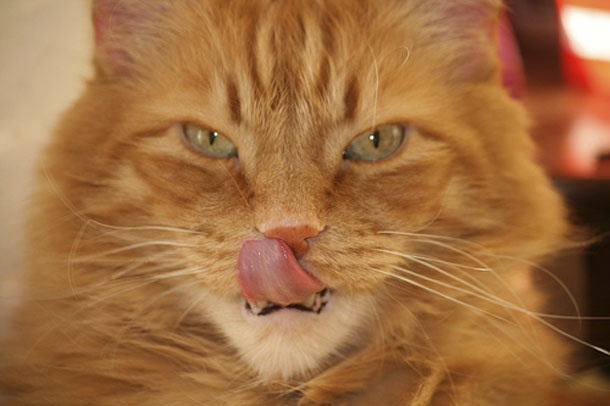
Friday Catblogging: An Unfortunate (But Necessary) Meal

IMG_0043

It’s all a matter of numbers:

A certain number of Englishwomen own cats, some of them are elderly, some will pass away in their homes, some having passed away will go undetected for a bit, some of those expired women will have owned cats, some of those cats will be trapped in their dead owners’ flats, some of those trapped cats will have no other source of sustenance except….

The body of an animal lover was gnawed and eaten by her own cats after she died at home alone, a court heard.

The decomposing corpse of Janet Veal, 56, was discovered on the kitchen floor of her isolated house in Ringwood, Hampshire, on April 4.

Neighbours had raised the alarm having not seen her for some time and noticing that her letterbox was overflowing, Southampton Coroner’s Court was told….

See, Body of woman, 56, who collapsed and died in her home is gnawed and eaten by her own CATS on her kitchen floor

Friday Poll: Aid to Egypt

Egypt descends into sectarian violence. See, for a current account of developments, His Options Few, Obama Rebukes Egypt’s Leaders.

America provides well over a billion in annual aid to that country. Should we continue that financial support while large-scale violence continues? (Assuming we should provide aid at all?)

I’ll say stop, as we’ve aided too many regimes who reject America’s commitment to democracy, and commit themselves only to oppressing their own peoples.

What do you think?


Daily Bread for 8.16.13

Good morning.

Whitewater’s weeks ends with Mostly sunny skies, a high near 78, and north winds of 5 mph.

On this day in 1896, it’s Gold!

While salmon fishing near the Klondike River in Canada’s Yukon Territory on this day in 1896, George Carmack reportedly spots nuggets of gold in a creek bed. His lucky discovery sparks the last great gold rush in the American West….

Regardless of who spotted the gold first, the three men soon found that the rock near the creek bed was thick with gold deposits. They staked their claim the following day. News of the gold strike spread fast across Canada and the United States, and over the next two years, as many as 50,000 would-be miners arrived in the region. Rabbit Creek was renamed Bonanza, and even more gold was discovered in another Klondike tributary, dubbed Eldorado.

“Klondike Fever” reached its height in the United States in mid-July 1897 when two steamships arrived from the Yukon in San Francisco and Seattle, bringing a total of more than two tons of gold. Thousands of eager young men bought elaborate “Yukon outfits” (kits assembled by clever marketers containing food, clothing, tools and other necessary equipment) and set out on their way north. Few of these would find what they were looking for, as most of the land in the region had already been claimed. One of the unsuccessful gold-seekers was 21-year-old Jack London, whose short stories based on his Klondike experience became his first book, The Son of the Wolf (1900).

For his part, Carmack became rich off his discovery, leaving the Yukon with $1 million worth of gold. Many individual gold miners in the Klondike eventually sold their stakes to mining companies, who had the resources and machinery to access more gold. Large-scale gold mining in the Yukon Territory didn’t end until 1966, and by that time the region had yielded some $250 million in gold. Today, some 200 small gold mines still operate in the region.

Puzzability concludes its weekly puzzle series entitled, Tourist Traps:

Tourist Traps
We’re crossing a lot of bridges on our summer vacation. For each day this week, fill in the two-word name of a U.S. tourist destination so that a familiar phrase or compound word is formed by the first word in the clue followed by the first word in the tourist site, and likewise a phrase or word is formed by the second word in the tourist site’s name followed by the second word in the clue.

Example:
GRIND ___ ___ GOAT

Answer:
Stone Mountain

Here’s today’s puzzle:

Friday, August 16

PINK ___ ___ DRESSING

Daily Bread for 8.15.13

Good morning.

Thursday in Whitewater will be partly sunny with a high of seventy-five.

Whitewater’s Tech Park Board meets at 8 AM, Downtown Whitewater’s Design Committee at 3 PM, and the Whitewater Community Development Authority meets at 4:30 PM.

On this day in 1969, Woodstock opens in Bethel, New York:

…the Woodstock Music Festival opens on a patch of farmland in White Lake, a hamlet in the upstate New York town of Bethel.

Promoters John Roberts, Joel Rosenman, Artie Kornfield and Michael Lang originally envisioned the festival as a way to raise funds to build a recording studio and rock-and-roll retreat near the town of Woodstock, New York. The longtime artists’ colony was already a home base for Bob Dylan and other musicians. Despite their relative inexperience, the young promoters managed to sign a roster of top acts, including the Jefferson Airplane, the Who, the Grateful Dead, Sly and the Family Stone, Janis Joplin, Jimi Hendrix, Creedence Clearwater Revival and many more. Plans for the festival were on the verge of foundering, however, after both Woodstock and the nearby town of Wallkill denied permission to hold the event. Dairy farmer Max Yasgur came to the rescue at the last minute, giving the promoters access to his 600 acres of land in Bethel, some 50 miles from Woodstock.

Early estimates of attendance increased from 50,000 to around 200,000, but by the time the gates opened on Friday, August 15, more than 400,000 people were clamoring to get in. Those without tickets simply walked through gaps in the fences, and the organizers were eventually forced to make the event free of charge. Folk singer and guitarist Richie Havens kicked off the event with a long set, and Joan Baez and Arlo Guthrie also performed on Friday night.

Puzzability continues its weekly puzzle series entitled, Tourist Traps:

Tourist Traps
We’re crossing a lot of bridges on our summer vacation. For each day this week, fill in the two-word name of a U.S. tourist destination so that a familiar phrase or compound word is formed by the first word in the clue followed by the first word in the tourist site, and likewise a phrase or word is formed by the second word in the tourist site’s name followed by the second word in the clue.

Example:
GRIND ___ ___ GOAT

Answer:
Stone Mountain

Here’s today’s puzzle:

Thursday, August 15

LADY ___ ___ BOTTOMS

Tidying the Town

A new school year begins, and thousands of students on whom the economy of this city depends are returning to Whitewater. Volunteers, as they’ve done previously, will help tidy up the town. These volunteers have, I think, held similar clean-up efforts in June and July.

It’s a fine idea. (I’ve not been part of those efforts, and deserve no credit for them; one simply notices others’ good work.)

Charitable work like this is important for our small city. One doesn’t have to be an urban theorist to understand that cleaning up matters, but the idea of idea of this sort of small-scale responsibility runs deeply through theorist Jane Jacobs’s Death and Life of Great American Cities.

Whenever I see volunteerism like this, I think of her great & profound book; whenever I read something of Jacobs’s book, I think of small & effective volunteerism like this.

And yet, there’s a sadness in this. A small group of residents commits itself to making Whitewater cleaner and more beautiful, yet not far away another small group of officials schemes to bring trash and toxins to the city as a revolutionary achievement.

These wholly conflicting projects aren’t those of different countries or cities, but a contemporary disparity within a small place. It’s a disparity between a lingering way of the past and a more responsible one of our future. (For more about Whitewater along these lines, see Horses and Automobiles, Contemporaneously.)

These conflicting ways won’t persist beside each other forever. One is fated to wither.

We’ve bumps and obstacles ahead, but I have a firm confidence about how our city will develop: we have a more open, responsible, diligent, and vibrant Whitewater ahead of us – a New Whitewater.

Along the way, there will be much to do.

The Open Government Presentation

Last week, at Common Council, the city heard a presentation from City Attorney McDonell on Wisconsin’s Open Meetings and Public Records Laws.

In the embeded video below, from 1:07:00 to 1:43:03, readers will see that presentation.

(Sadly, it starts off poorly, with a deprecating joke about the subject matter being boring. That’s false, of course: these laws aren’t boing. They’re vital to open and honest government. One simply has to believe and embrace these ideals with the enthusiasm they deserve.)

Common Council Meeting 08/06/2013 from Whitewater Community TV on Vimeo.

For those who would like to review the provisions of Wisconsin’s laws directly, the respective statutes for the Wisconsin Open Meetings Law, Wis. Stat. §§ 19.81-19.98 and Wisconsin Public Records Law, Wis. Stat. §§ 19.31-19.39 are available online.

For a website with supplemental information about these laws, one may consult the site of the Wisconsin Freedom of Information Council.

(This spring, I had the pleasure to attending an awards ceremony honoring Lynn Adelman, now a federal judge, but years ago a state senator and principal author of Wisconsin’s Public Records Law.

By chance, I found myself sitting at Judge Adelman’s table that evening. I was one of many ordinary people attending, but the evening was an extraordinary pleasure: now in his seventies, Lynn Adelman is as sharp and clear in his commitment to open government as anyone in all Wisconsin.)

Daily Bread for 8.14.13

Good morning.

The middle of Whitewater’s week will be mostly sunny with a high of seventy-one, with light, northwest winds of around 5 mph in the afternoon.

On this day in 1945, the Japanese people, themselves, learn that will surrender unconditionally to the Allies:

…an official announcement of Japan’s unconditional surrender to the Allies is made public to the Japanese people.

Even though Japan’s War Council, urged by Emperor Hirohito, had already submitted a formal declaration of surrender to the Allies, via ambassadors, on August 10, fighting continued between the Japanese and the Soviets in Manchuria and between the Japanese and the United States in the South Pacific. In fact, two days after the Council agreed to surrender, a Japanese submarine sank the Oak Hill, an American landing ship, and the Thomas F. Nickel, an American destroyer, both east of Okinawa.

In the afternoon of August 14, Japanese radio announced that an Imperial Proclamation was soon to be made, accepting the terms of unconditional surrender drawn up at the Potsdam Conference. That proclamation had already been recorded by the emperor. The news did not go over well, as more than 1,000 Japanese soldiers stormed the Imperial Palace in an attempt to find the proclamation and prevent its being transmitted to the Allies. Soldiers still loyal to Emperor Hirohito repulsed the attackers.

America receives the news of Japanese surrender with pride, joy, and relief:

Puzzability continues a weekly puzzle series entitled, Tourist Traps:

Tourist Traps
We’re crossing a lot of bridges on our summer vacation. For each day this week, fill in the two-word name of a U.S. tourist destination so that a familiar phrase or compound word is formed by the first word in the clue followed by the first word in the tourist site, and likewise a phrase or word is formed by the second word in the tourist site’s name followed by the second word in the clue.

Example:
GRIND ___ ___ GOAT

Answer:
Stone Mountain

Here’s today’s puzzle:

Wednesday, August 14

MODERN ___ ___ RIGGER

Yet Another Exercise in Standards Beneath Whitewater

It should be a universal truth that Whitewater and Wisconsin deserve a far higher standard of diligence and review than whatever our CDA chairman believes his “gut” tells him would be good for our city and nearby area.

In fact, that kind of intestinally-based level of judgment has failed this city time and again, and is beneath the level of care that any well-organized, reasonable American city deserves.

You’ll see another example of this sort of serial mediocrity in a breathless story at Whitewater’s news site that a recycling company, unable to get a permit to mix toxic substances into (supposedly safe) floor tile, was denied (so far) permitting in Wisconsin. The company now insists it will build in Arkansas.

A company known only to a few, develops an industrial process that the State of Wisconsin won’t even certify, apparently created at a third-tier school far away, using ingredients known to be toxic, with grand financial claims that have no independent verification whatever, and one is supposed to accept it all at face (or stomach) value.

To accept these contentions would require a child-like credulity unsuited to normal men and women. It’s as though any bad idea, however silly or dangerous, should fly into one’s ear, and from ear to brain to keyboard to ordinance.

It’s just another simple-minded attempt to prey on a city’s legitimate economic concerns to stampede acceptance of whatever ill-considered proposal a few unelected men shove forward, including proposals to give themselves additional authority.

Add a logo at the top of the story, I suppose, and suddenly all the necessary and legitimate questions of safety, value, cost, accountability, etc., just melt away.

They don’t, and they won’t.