
Public Meetings
Library Board
by JOHN ADAMS •
Animation, Film
Sunday Morning Animation: Origami of landscape
by JOHN ADAMS •
Origami of landscape from Onohana on Vimeo.
Daily Bread
Daily Bread for 6.16.13
by JOHN ADAMS •
Good morning.
Whitewater has a beautiful Sunday ahead, with sunny skies, a high of eighty-three, and light winds from the northwest at 5 to 10 m.p.h. Sunrise was at 5:16 a.m., and sunset will be at 8:36 p.m. The Moon is in its first quarter.
Today in 1884, a first for America:
On this day in 1884, the first roller coaster in America opens at Coney Island, in Brooklyn, New York. Known as a switchback railway, it was the brainchild of LaMarcus Thompson, traveled approximately six miles per hour and cost a nickel to ride. The new entertainment was an instant success and by the turn of the century there were hundreds of roller coasters around the country.
In Wisconsin history, on this day in 1845,
First [Superficially] Free Public School Opened in Wisconsin
On this date the first free public school in Wisconsin was opened in Southport (now Kenosha). Michael Frank, a member of the Wisconsin Territorial Legislature, introduced bills authorizing the establishment of a Wisconsin public school system in 1843, 1844, and 1845. These attempts were failures so Frank sponsored a bill authorizing Southport to establish a public school supported by property tax dollars. [Source: Wisconsin Mosaic]
Daily Bread
Daily Bread for 6.15.13
by JOHN ADAMS •
Good morning.
Saturday brings a day of scattered showers and a high of seventy-eight to Whitewater.
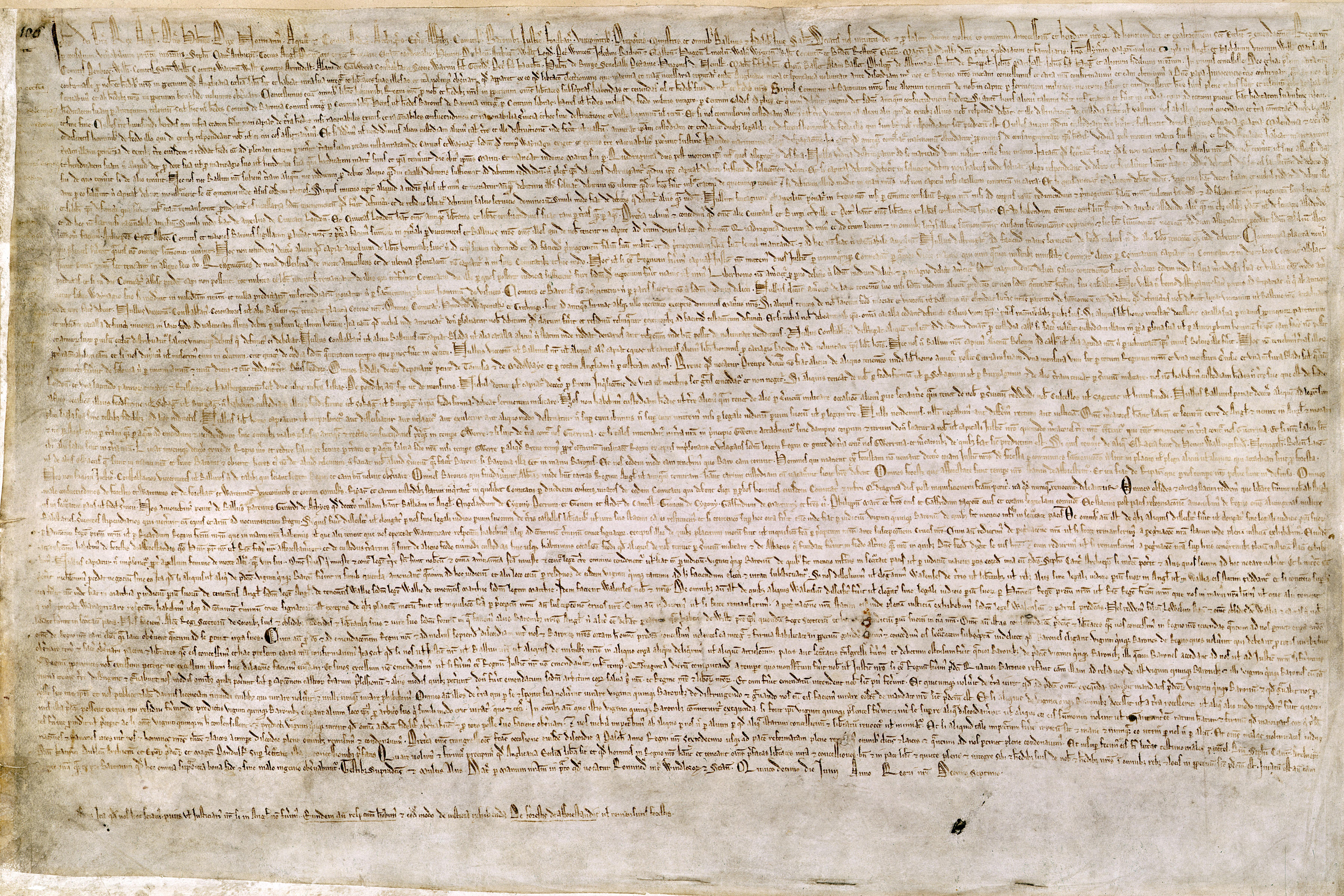
On this day in 1215, King John affixes his seal:
Following a revolt by the English nobility against his rule, King John puts his royal seal on the Magna Carta, or “Great Charter.” The document, essentially a peace treaty between John and his barons, guaranteed that the king would respect feudal rights and privileges, uphold the freedom of the church, and maintain the nation’s laws. Although more a reactionary than a progressive document in its day, the Magna Carta was seen as a cornerstone in the development of democratic England by later generations.
Here’s a link to the text as it remains in force to this day, from the United Kingdom’s legislative website, a service of the British government’s National Archives.
He’s used up one life, but he has eight left — cat survives boa constrictor (with help):
On this date in 1832, The Black Hawk War gets a new commander:
1832 – General Winfield Scott Ordered to Assume Command in Black Hawk War
On this date General Winfield Scott was ordered by President Andrew Jackson to take command at the frontier of the Black Hawk War. Scott was to succeed General Henry Atkinson, thought to be unable to end the war quickly. General Scott moved rapidly to recruit troops and obtain equipment for his army. However, while in New York, the troops were exposed to an Asiatic cholera. Just outside of Buffalo, the first cases on the ships were reported and death often followed infection.
By the time the ships reached Chicago, the number of soldiers had dropped dramatically from 800 to 150, due to disease and desertion. Rather than going on to the front, Scott remained with his troops in Chicago, giving Atkinson a brief reprieve. [Source: Along the Black Hawk Trail, by William F. Stark, p. 90-91]
Cats
Friday Catblogging: Cats v. Fox
by JOHN ADAMS •
Poll
Friday Poll: E-Book or Print Book?
by JOHN ADAMS •
In this world of Kindles, iPads, etc., would you choose a traditional print book or an e-book for reading?
I’ll go with e-book. What do you think?
Daily Bread
Daily Bread for 6.14.13
by JOHN ADAMS •
Good morning.
It’s a beautiful end to the week, with mostly sunny skies, and a high near 75.
On this day in 1777, Congress chooses a flag for the new nation:
During the American Revolution, the Continental Congress adopts a resolution stating that “the flag of the United States be thirteen alternate stripes red and white” and that “the Union be thirteen stars, white in a blue field, representing a new Constellation.” The national flag, which became known as the “Stars and Stripes,” was based on the “Grand Union” flag, a banner carried by the Continental Army in 1776 that also consisted of 13 red and white stripes….
On June 14, 1877, the first Flag Day observance was held on the 100th anniversary of the adoption of the Stars and Stripes. As instructed by Congress, the U.S. flag was flown from all public buildings across the country. In the years after the first Flag Day, several states continued to observe the anniversary, and in 1949 Congress officially designated June 14 as Flag Day, a national day of observance.
Puzzablity has a new weekly theme for June 10-14: “Paternity Test
There’s a bit of a generation gap this Father’s Day week. Each day’s clue is a series of words, each with one letter replaced by a dash. Fill in the missing letters one way to get the first (or only) name of a famous father, real or fictional, then fill them in another way to get the name of a child of his.”
Example:
ADO-E / HO-SEFLY / PA-PER / CHE-K / CHE-RY
Answer:
ADOBE HORSEFLY PAUPER CHECK CHEERY
ADORE HOUSEFLY PAMPER CHEEK CHERRY
Bruce & Rumer (Willis)
Here’s June 14th’s puzzle, the final one in the current series:
RE-ORDING / S-RED / SWE-TER / F-AGRANT / ENTIT-ES / M-SSAGE / WHI-PERING
Anderson, Cartoons & Comics
Reheating
by JOHN ADAMS •

Official Misconduct
The (Also Bad) Alternatives to Concealment
by JOHN ADAMS •
Suppose the owner of a mansion awakes to discover that his many precious paintings have disappeared from the estate’s gallery.
Consider a few, alternative scenarios:
In the first, he walks through empty hallways, all his collection now gone. He finds no one else in the house, and no trace of an intruder. Someone took the owner’s paintings, but the culprit concealed his tracks nicely.
In the second scenario, the owner awakes to find his paintings missing, but he also notices some unusual footprints, a crumpled Hershey Bar wrapper, and a note that says, “Thanks for making it so easy to take all your estate’s masterpieces. I’ve always wanted to steal them.”
In a third scenario, the owner again awakes to find his paintings missing, but he also spots a cart filled with all the valuable paintings, and an intruder, dressed in black and wearing a mask, holding a toy poodle on a leash.
Furious, the owner screams out, “What do you think you’re doing, here?”
The cat burglar promptly replies, “I’m walking my dog.”
Would anyone feel contented, after hearing that explanation?
The theft is wrong in all three scenarios, but there’s a particular temerity in the third situation’s declaration that the visit was really just an innocent dog-walk.
Someone trying to take something valuable, but offering only a ludicrous or trivial justification, is even more troublesome than someone who says nothing or candidly admits to an illegitimate scheme.
That shamelessness is an additional problem, likely to play itself out as often as it can.
Daily Bread
Daily Bread for 6.13.13
by JOHN ADAMS •
Good morning.
It’s a mostly sunny Thursday with a high of seventy-four ahead for Whitewater. Sunrise was at 5:16 a.m., sunset will be at 8:35 a.m., and the Moon is a waxing crescent with 22% of its visible disk illuminated.
On 6.13.1966, the U.S. Supreme Court hands down the Miranda decision:
On this day in 1966, the Supreme Court hands down its decision in Miranda v. Arizona, establishing the principle that all criminal suspects must be advised of their rights before interrogation. Now considered standard police procedure, “You have the right to remain silent. Anything you say can, and will, be used against you in court of law. You have the right to an attorney. If you cannot afford one, one will be appointed to you,” has been heard so many times in television and film dramas that it has become almost cliche.
On 6.13.1923,
1923 – Platteville beaten by Chicago Union Giants
On this date, Platteville’s baseball team was defeated by the Chicago Union Giants, a member of the Negro League. The team, known at this time as the Gilkerson Union Giants, toured Wisconsin and the upper midwest each summer, playing local teams from small towns. The team was so good “that beating them made the season for local teams.” [Sources: Wisconsin Stories and Negro League Baseball Players Association]
Puzzablity has a new weekly theme for June 10-14: “Paternity Test
There’s a bit of a generation gap this Father’s Day week. Each day’s clue is a series of words, each with one letter replaced by a dash. Fill in the missing letters one way to get the first (or only) name of a famous father, real or fictional, then fill them in another way to get the name of a child of his.”
Example:
ADO-E / HO-SEFLY / PA-PER / CHE-K / CHE-RY
Answer:
ADOBE HORSEFLY PAUPER CHECK CHEERY
ADORE HOUSEFLY PAMPER CHEEK CHERRY
Bruce & Rumer (Willis)
Here’s June 13th’s puzzle:
-INX / OVERT-RE / CA-TOR / CONV-CTION / UP-IGHT / -ERILY / W-ISTBAND
Business, Law, Local Government, Official Misconduct, Open Government
How Local Government Has It Easier Than Yelp
by JOHN ADAMS •
Yelp may be a popular website for positing restaurant (and other) reviews, but it has a controversy on its hands. Some businesses are complaining about Yelp’s practice of hiding some reviews behind a link (that is, where one has to click the link to see all posted reviews). Some restaurateurs contend that Yelp hides favorable reviews to punish establishments that won’t advertise on Yelp.
(Yelp denies this, and an academic review of Yelp’s practices suggests that at least there’s no readily-apparent bias in how Yelp displays reviews.)
Yelp has a problem because its formula for displaying reviews is a company secret that breeds suspicion that it’s a rigged formula. (Ironically, Yelp contends that it hides the method by which it assesses reviews to keep businesses from gaming the website’s process).
Local government has it easier, at least in Wisconsin: follow publsihed rules for Open Meetings (Wis. Stats. §§ 19.81-19.98) and Public Records (Wis. Stat. §§ 19.31 – 19.39) and the resulting transparency will reduce suspicion and rumor.
There’s no need to craft a particular strategy to deal with public concerns – the law lays out – and requires – a particular path.
Why, then, if local governments have a mandatory legal framework that should make official conduct more open and reputable, do so many officials tend toward the secretive and hidden?
They do this should they place their own private needs and interests – including a should limitless need for grand tales of their own supposed triumphs – ahead of clear law and good policy. They discard the ready-made framework of the law, and fall into a situation not much different from Yelp.
Officials’ abandonment of good law for selfish private action is both wrong specifically and impractical generally. Just as no official is above the law, so no community deserves conditions beneath the law. That lower condition is one of errors of planning and allocation, and a condition that could have been avoid with the transparency that the law requires.
More about the Yelp reviews controversy:
Daily Bread
Daily Bread for 6.12.13
by JOHN ADAMS •
Good morning.
Wednesday will be a day of showers and thunderstorms in the Whippet City, with a high of seventy-nine. New rainfall will amount to between three-quarters and one inch.
On this day in 1987, Pres. Reagan challenges Soviet ruler Gorbachev:
…in one of his most famous Cold War speeches, President Ronald Reagan challenges Soviet Leader Mikhail Gorbachev to “tear down” the Berlin Wall, a symbol of the repressive Communist era in a divided Germany….
With the wall as a backdrop, President Reagan declared to a West Berlin crowd in 1987, “There is one sign the Soviets can make that would be unmistakable, that would advance dramatically the cause of freedom and peace.” He then called upon his Soviet counterpart: “Secretary General Gorbachev, if you seek peace–if you seek prosperity for the Soviet Union and Eastern Europe–if you seek liberalization: come here, to this gate. Mr. Gorbachev, open this gate. Mr. Gorbachev, tear down this wall.” Reagan then went on to ask Gorbachev to undertake serious arms reduction talks with the United States.
Most listeners at the time viewed Reagan’s speech as a dramatic appeal to Gorbachev to renew negotiations on nuclear arms reductions. It was also a reminder that despite the Soviet leader’s public statements about a new relationship with the West, the U.S. wanted to see action taken to lessen Cold War tensions. Happily for Berliners, though, the speech also foreshadowed events to come: Two years later, on November 9, 1989, joyful East and West Germans did break down the infamous barrier between East and West Berlin. Germany was officially reunited on October 3, 1990.
On June 12th 1899, a devastating tornado in Wisconsin:
On this date the worst tornado disaster in Wisconsin history occured. The storm virtually leveled New Richmond on the day the Gollmar Brothers Circus came to town. At the time, New Richmond was a prosperous town of 2500 people and one of the most scenic places in Wisconsin. On the day of the storm, the streets were filled with residents and tourists waiting for the afternoon circus parade. Shortly after the circus ended, the tornado passed through the very center of town, completely leveling buildings. Over 300 buildings were damaged or destroyed. Massive amounts of flying debris resulted in multiple deaths in at least 26 different families. In all, the storm claimed 117 lives and caused 150 injuries. [Source: National Weather Service]
Puzzablity has a new weekly theme for June 10-14: “Paternity Test
There’s a bit of a generation gap this Father’s Day week. Each day’s clue is a series of words, each with one letter replaced by a dash. Fill in the missing letters one way to get the first (or only) name of a famous father, real or fictional, then fill them in another way to get the name of a child of his.”
Example:
ADO-E / HO-SEFLY / PA-PER / CHE-K / CHE-RY
Answer:
ADOBE HORSEFLY PAUPER CHECK CHEERY
ADORE HOUSEFLY PAMPER CHEEK CHERRY
Bruce & Rumer (Willis)
Here’s June 12th’s puzzle:
YO-EL / CONF-RM / SHRI-K / CLE-TS / SPI-L / ENCO-E