FREE WHITEWATER

Daily Bread for 7.30.13

Good morning.

We’ll have a high of seventy-four with a thirty percent chance of showers today.

On this day in 1863, Henry Ford is born. Upon his death eighty-three years later, the New York Times wrote of him that

Henry Ford was the founder of modern American industrial mass production methods, built on the assembly line and the belt conveyor system, which no less an authority than Marshal Josef Stalin testified were the indispensable foundation for an Allied military victory in the Second World War.

Mr. Ford had many other distinctions. As the founder and unchallenged master of an industrial empire with assets of more than a billion dollars, he was one of the richest men in the world. He was the apostle of an economic philosophy of high wages and short hours that had immense repercussions on American thinking. He was a patron of American folkways and in later years acquired a reputation as a shrewd, kindly sage. But these were all relatively minor compared with the revolutionary importance of his contribution to modern productive processes.

In Wisconsin history, economist Thorstein Veblen is born:

1857 – Thorstein Veblen Born
On this date economist and social commentator Thorstein Bunde Veblen was born in Cato, although some sources place his birth in Valders. He is best known for his book The Theory of The Leisure Class (1899), a classic of social theory that introduced the concept of “conspicuous consumption.” [Source: The Radical Academy]

Puzzability has a series this week, from 7.29 to 8.2, entitled Last Laughs:

Last Laughs

For your amusement this week, we started each day with the name of a TV star who won an Emmy for his or her lead performance in a comedy series. Then we replaced all the letters in each word—except the last letter—with asterisks.

Example:
***Y ****R ****E

Answer:
Mary Tyler Moore

Here’s Tuesday’s puzzle:

***A **Y

The Rolled-Up Newspaper

I was in a Whitewater establishment on Saturday, one that has hundreds of customers a day. On a counter easily visible to patrons sat a two-day-old newspaper, still unrolled and fastened with a rubber band just as when it had been first delivered.

Perhaps someone only delivered Thursday’s paper on Saturday, or – alternatively – no one cared to open Thursday’s paper as it sat unread for two days’ time.

Neither possibility is comforting for print publishing, but I’d guess the worse one is true: the paper sat ignored for forty-eight hours.

There’s the state of print journalism (particularly for an afternoon daily).

Whatever the reason, this is where we are.

Daily Bread for 7.29.13

Good morning.

Monday in Whitewater will be mostly sunny with a high of seventy-five.

Whitewater’s Park & Rec Board meets at 4:30 PM this afternoon.

They’ve seen better days, and I think that the future of space travel will be mostly private flight, but it’s still a memorable date:

On this day in 1958, the U.S. Congress passes legislation establishing the National Aeronautics and Space Administration (NASA), a civilian agency responsible for coordinating America’s activities in space. NASA has since sponsored space expeditions, both human and mechanical, that have yielded vital information about the solar system and universe. It has also launched numerous earth-orbiting satellites that have been instrumental in everything from weather forecasting to navigation to global communications.

NASA was created in response to the Soviet Union’s October 4, 1957 launch of its first satellite, Sputnik I. The 183-pound, basketball-sized satellite orbited the earth in 98 minutes. The Sputnik launch caught Americans by surprise and sparked fears that the Soviets might also be capable of sending missiles with nuclear weapons from Europe to America. The United States prided itself on being at the forefront of technology, and, embarrassed, immediately began developing a response, signaling the start of the U.S.-Soviet space race.

Puzzability starts a new series this week, from 7.29 to 8.2, entitled Last Laughs:

Last Laughs

For your amusement this week, we started each day with the name of a TV star who won an Emmy for his or her lead performance in a comedy series. Then we replaced all the letters in each word—except the last letter—with asterisks.

Example:
***Y ****R ****E

Answer:
Mary Tyler Moore

Here’s Monday’s puzzle:

**Y *****O

Recent Tweets, 7.21 to 7.27

Daily Bread for 7.28.13

Good morning.

We’ve a high of sixty-four ahead today, with a forty-percent chance of morning showers.

On this day in 1914, Austria declares war on Serbia, a month after a Serbian nationalist killed Archduke Franz Ferdinand of Austria and his wife in Sarajevo. The New York Times reports the declaration:

VIENNA, July 28- Upon the issue of the formal declaration of war against Servia today Emperor Franz Josef gave orders for the removal of the Summer Court from Ischl to the capital. His entourage tried to persuade him that Vienna air would not suit him, but the aged Emperor replied:

“I do not want the air of Vienna. I want the atmosphere of headquarters.” The opening of the war has caused the imposition of all kinds of restrictions upon public business. All the railways, of course, are under military control, and the telegraphs are being reserved entirely for the service of the State. The hope is still entertained here that the war will be confined to Austria-Hungary and Servia. The report that Russia and France have intervened in Vienna is incorrect. In official circles here it is maintained that any action by those powers must be supported by the third party to the Triple Entente, namely, Great Britain. It is known that Great Britain and France do not want a European war. Peace among the great powers or war among the great powers must depend on the action of St. Petersburg.

In 1934, a riot kills two in a so-called model Wisconsin village:

1934 – Two killed, 40 hurt in Kohler riot; National Guard occupies town

On this day, the “model industrial village” of Kohler became an armed camp of National Guard cavalrymen after deadly strike-related rioting. The July 27th violence, which killed two Sheboygan men and injured 40 others, prompted the summoning of 250 Guardsmen to join the 200 special deputy village marshals already present.

After striking workers became agitated and began to destroy company property, deputies turned to tear gas, rifles, and shotguns to quell the stone-throwing crowd, resulting in the deaths and injuries. Owner Walter Kohler blamed Communists and outside agitators for the violence, while union leaders blamed Kohler exclusively.

Workers at the Kohler plant were demanding better hours, higher wages, and recognition of the American Federation of Labor as their collective bargaining agent. Not settled until 1941, the strike marked the beginning of what was to become a prolonged struggle between the Kohler Company and organized labor in Wisconsin; a second Kohler strike lasted from 1954 to 1965. [Source: Capital Times 7/28/1934, p.1]

Daily Bread for 7.27.13

Good morning.

It’s will be a mild day in Whitewater, with a high of sixty-three and a one-third chance of afternoon showers. Sunrise was 5:41 AM and sunset will be 8:21 PM. The moon is in a waning gibbous phase with 70% of the its visible disk illuminated.

On this day in 1953, an armistice brings an end to the Korean War, begun three years earlier by Communist aggression:

Tokyo, Monday, July 27–Communist and United Nations delegates in Panmunjom signed an armistice at 10:01 A.M. today [9:01 P.M., Sunday, Eastern daylight time]. Under the truce terms, hostilities in the three-year-old Korean war are to cease at 10 o’clock tonight [9 A.M., Monday, Eastern daylight time]….

The historic document was signed in a roadside hall the Communists built specially for the occasion. The ceremony, attended by representatives of sixteen members of the United Nations, took precisely eleven minutes. Then the respective delegations walked from the meeting place without a word or handshake between them.

The matter-of-fact procedure underlined what spokesmen of both sides emphasized: That though the shooting would cease within twelve hours after the signing, only an uneasy armed truce and political difficulties, perhaps even greater than those of the armistice negotiations, were ahead.

Signers Are Expressionless

The representatives of the two sides were expressionless as they put their names to a pile of documents, providing for an exchange of prisoners, establishment of a neutral zone for the cease-fire and a later political conference that would attempt to settle the tragic Korean questions, unsolved by three years of fighting that caused hundreds of thousands of casualties.

On this day in 1894, fire destroys most of a northern Wisconsin town:

1894 – Forest Fire Destroys Phillips
On the afternoon of this day, a forest fire swept over the Price Co. town of Phillips from the west, destroying nearly all the buildings and forcing 2,000 people to flee for their lives. When the sun came up the next morning, 13 people had been killed, the entire downtown was in ashes, and exhausted survivors were wandering through the ruins in a daze. The fire ultimately consumed more than 100,000 acres in Price County. Much of the town was rebuilt within a year.

‘More Than Sharks Love Blood’

20130726-093352.jpg

How does one explain politicians like Anthony Weiner, Eliot Spitzer, or Mark Sanford? They’ve kept returning no matter how risible their revealed conduct. Their particular motivations are known (if then) only to their families or therapists. It’s possible, though, that a suitable political explanation is available.

In the American version of House of Cards, Congressman Francis Underwood professes that he loves his political wife, Claire, ‘more than sharks love blood.’ It’s quite the description: Underwood’s describing his bond as a feeding instinct. Nothing higher-order about it: he simply needs Claire the way predators need food.

There’s something almost predictable about some politicians expressing that need, because there’s a part of politics (for some) that’s similarly elemental, beneath policy, programs, and philosophy: an insatiable desire to advance oneself, to promote oneself.

Some politics, even small-town politics, runs on the dangerous impulse to advance not a position but a person, not an idea but a man.

On a grand scale, the damage of this impulse is easily understood – most are taught to recognize insatiable ambition at a distance. Close at hand, one’s not so good at spotting its local equivalent. Personality and familiarity distort one’s judgment, and so we foolishly tolerate unprincipled striving, an overweening sense of entitlement, and ceaseless self-promotion.

We’d be foolish, though, to think that ambition of this kind exists only in faraway places, among New Yorkers or those living on the coasts.

It’s closer than that.

Posted also at Daily Adams.

Daily Bread for 7.26.13

Good morning.

We’ve a seventy-percent chance of daytime thunderstorms in Whitewater today, with a high of seventy-five.

On this day in 1775, Benjamin Franklin becomes America’s first postmaster:

William Goddard, a Patriot printer frustrated that the royal postal service was unable to reliably deliver his Pennsylvania Chronicle to its readers or deliver critical news for the paper to Goddard, laid out a plan for a Constitutional Post before the Continental Congress on October 5, 1774. Congress waited to act on the plan until after the Battle of Lexington and Concord on April 19, 1775.

Benjamin Franklin promoted Goddard’s plan and served as the first postmaster general under the Continental Congress beginning on July 26, 1775, nearly one year before the Congress declared independence from the British crown. Franklin’s son-in-law, Richard Bache, took over the position on November 7, 1776, when Franklin became an American emissary to France.

Franklin had already made a significant contribution to the postal service in the colonies while serving as the postmaster of Philadelphia from 1737 and as joint postmaster general of the colonies from 1753 to 1774, when he was fired for opening and publishing Massachusetts Royal Governor Thomas Hutchinson’s correspondence.

Puzzability’s Sun Screens series ends today:

Sun Screens
If you can’t stand the heat, we’ve got just the ticket. For each day this week, we’ll give a three-by-three letter grid in which we’ve hidden the title of a movie that’s set during the summer. Each has 10 or more letters and any number of words. To find the title, start at any letter and move from letter to letter by traveling to any adjacent letter—across, up and down, or diagonally. You may come back to a letter you’ve used previously, but may not stay in the same spot twice in a row. You will not always need all nine letters in the grid.

Example:
F S U
O M A
R E M

Answer:
Summer of Sam

Here’s Friday’s puzzle:

J D P
A E N
Y C I

A View from the International Space Station

iss036e022863

(21 July 2013) Storm clouds over Southern California. Early morning lightning can be seen as a white blotch just to the right of center. The yellow colored area, beneath the grey clouds, which almost shines because of night lights, is part of the highly populated area of Los Angeles and San Diego.

How You, Too, Can Be a Smooth-Talking, Super-Sophisticated Marketeer (Assuming You’d Be Foolish Enough to Want to Be One).

Real marketing is a legitimate pursuit. By contrast, manipulative, smooth-talking, super-sophisticated men & women spend hours convincing others that the next big thing is, in fact, the Next Big Thing.

They declare that millions of taxpayers’ money spent on white-collar projects, while truly needy people receive no benefit whatever, are Astonishing Feats of Global Significance Worthy of Perpetual Praise.

How do these marketeers speak so well and elegantly? What’s their powerful secret?

They’d probably tell you the same thing they whisper to themselves while looking into their mirrors each morning: that they’re naturally gifted, possessed of insights and secrets unknown to mere mortals.

I doubt that’s true, but no matter, Dear Readers: I can show you how to sound just like these undoubted treasures of the age.

Why read closely of works generations before have profitably studied over hundreds, perhaps thousands of years?

Why, even, go the smooth-talking person’s route of whole hours spent scanning trendy magazines for catchphrases to seem insightful?

The Secrets of the Super-Sophisticated Marketeer can be had, or at least mimicked, more quickly and easily.

Better still, you can imitate these great men and women for only $10.50 (plus shipping.).

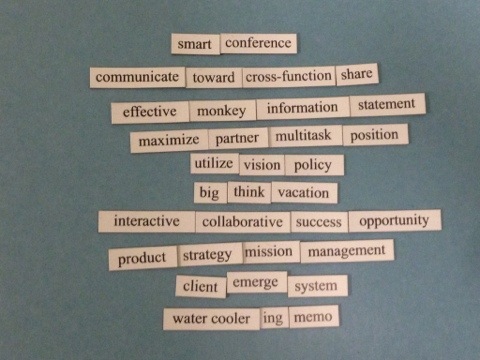
Over at Amazon, they’re selling a small box of refrigerator magnets that will confer on any purchaser the same level of insight and knowledge held by smooth-talking, super-sophisticated, public-project hawking marketeers: The Magnetic Poetry Office Kit.

One would not be spending $10.50 on the kit – the purchase would be an investment in our common future.

Look:

20130725-123327.jpg

Amazing, isn’t it?

These two-hundred or so tiny magnets have on them all the jargon, cant, buzzwords, slang, and argot you’ll need to sound at least as unctuous as anyone who’s ever hawked a publicly-funded boondoggle.

One can mix the letters in countless empty phrases to feign the knowledge others acquired through actual reading.

Here’s just one example, using only a few of the many words the kit provides:

20130725-124010.jpg

Impressive, no?

Soon, you’ll be ready to tackle the heady and high-octane world of marketing crony capitalism and white-collar welfare.

The pleasure’s been mine, I’m quite sure.