FREE WHITEWATER

Daily Bread for 3.9.13

Good morning.

Saturday in Whitewater will be a rainy day with a high of forty. We’ll have 11h 37m of sunlight, 12h 33m of daylight, and somewhere behind the clouds there’ll be a waning crescent moon.

On this day in 1862, the U.S.S. Monitor battles the C.S.S. Virginia:

….one of the most famous naval battles in American history occurs as two ironclads, the U.S.S. Monitor and the C.S.S. Virginia fight to a draw off Hampton Roads, Virginia. The ships pounded each other all morning but their armor plates easily deflected the cannon shots, signaling a new era of steam-powered iron ships.

The C.S.S. Virginia was originally the U.S.S. Merrimack, a 40-gun frigate launched in 1855. The Confederates captured it and covered it in heavy armor plating above the waterline. Outfitted with powerful guns, the Virginia was a formidable vessel when the Confederates launched her in February 1862. On March 8, the Virginia sunk two Union ships and ran one aground off Hampton Roads.

The next day, the U.S.S. Monitor steamed into the Chesapeake Bay. Designed by Swedish engineer John Ericsson, the vessel had an unusually low profile, rising from the water only 18 inches. The flat iron deck had a 20-foot cylindrical turret rising from the middle of the ship; the turret housed two 11-inch Dahlgren guns. The Monitor had a draft of less than 11 feet so it could operate in the shallow harbors and rivers of the South. It was commissioned on February 25, 1862, and arrived at Chesapeake Bay just in time to engage the Virginia.

The battle between the Virginia and the Monitor began on the morning of March 9 and continued for four hours. The ships circled one another, jockeying for position as they fired their guns. The cannon balls simply deflected off the iron ships. In the early afternoon, the Virginia pulled back to Norfolk. Neither ship was seriously damaged, but the Monitor effectively ended the short reign of terror that the Confederate ironclad had brought to the Union navy….
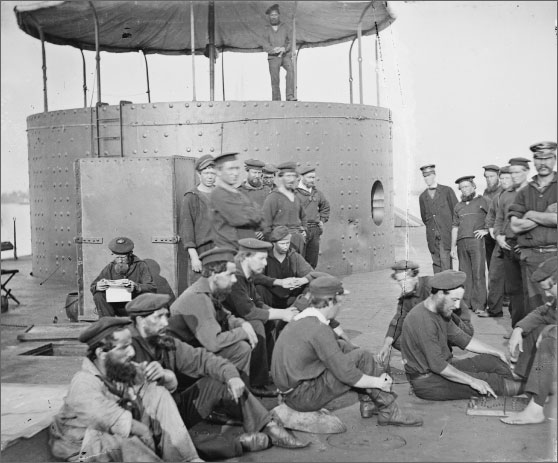
ar_body1

This month, over 150 years later, the “Remains of USS Monitor sailors [were] interred at Arlington National Cemetery.”

Google-a-Day asks a geography and history question: “What was the profession of the pioneer of ‘The Great Silk Road’?”

Daily Bread for 3.8.13

Good morning.

Friday in Whitewater will be a sunny day, with a high of thirty-eight.

On March 8, 1917, before the Bolshevik Revolution, the February Revolution:

In Russia, the February Revolution (known as such because of Russia’s use of the Julian calendar) begins when riots and strikes over the scarcity of food erupt in Petrograd. One week later, centuries of czarist rule in Russia ended with the abdication of Nicholas II, and Russia took a dramatic step closer toward communist revolution…

On March 8, 1917, demonstrators clamoring for bread took to the streets in the Russian capital of Petrograd (now known as St. Petersburg). Supported by 90,000 men and women on strike, the protesters clashed with police but refused to leave the streets. On March 10, the strike spread among all of Petrograd’s workers, and irate mobs of workers destroyed police stations. Several factories elected deputies to the Petrograd Soviet, or “council,” of workers’ committees, following the model devised during the Revolution of 1905.

On March 11, the troops of the Petrograd army garrison were called out to quell the uprising. In some encounters, regiments opened fire, killing demonstrators, but the protesters kept to the streets, and the troops began to waver. That day, Nicholas again dissolved the Duma. On March 12, the revolution triumphed when regiment after regiment of the Petrograd garrison defected to the cause of the demonstrators. The soldiers, some 150,000 men, subsequently formed committees that elected deputies to the Petrograd Soviet.

The imperial government was forced to resign, and the Duma formed a provisional government that peacefully vied with the Petrograd Soviet for control of the revolution. On March 14, the Petrograd Soviet issued “Order No. 1,” which instructed Russian soldiers and sailors to obey only those orders that did not conflict with the directives of the Soviet. The next day, March 15, Czar Nicholas II abdicated the throne in favor of his brother Michael, whose refusal of the crown brought an end to the czarist autocracy.

The new provincial government, tolerated by the Petrograd Soviet, hoped to salvage the Russian war effort while ending the food shortage and many other domestic crises. It would prove a daunting task. Meanwhile, Vladimir Lenin, leader of the Bolshevik revolutionary party, left his exile in Switzerland and crossed German enemy lines to return home and take control of the Russian Revolution.

In Wisconsin history, on 3.8.1950,

1950 – Tydings Committee Hearings Begin with McCarthy

On this date the Tydings Committee began hearings. It was a sub-committee of the Senate Foreign Relations Committee and was charged with investigatingSen. Joseph McCarthy’s allegations of communist activities within the U.S. government. Senator McCarthy entered the hearings at 10:00 a.m. that morning carrying an extremely large brown briefcase, claiming he was “prepared to make big revelations.” [Source: Joseph McCarthy]

Google-a-Day has a question of history and politics: “When the president of Haiti fled the country following a 1991 coup, in what country did he first find asylum?”

Daily Bread for 3.7.13

Good morning.

Whitewater will have a mostly sunny Thursday with a high of thirty-three. We’ll have 11h 30m of sunlight, 12h 27m of daylight, with three minutes’ more light tomorrow.

The Landmarks Commission is set to meet at 6 PM tonight.

On this day in 1876, Alexander Graham Bell patents the telephone.

In Wisconsin history, on 3.7.1811,

Increase Allen Lapham [is] Born

A pioneer naturalist and noted author, Increase Allen Lapham was instrumental in establishing the Milwaukee public high school program. He was one of the founders of Milwaukee Female Seminary in 1848 and served as president of the State Historical Society from 1862 to 1871. Lapham came to Milwaukee in 1836 to serve as chief engineer and secretary for the Rock River Canal Company. He was one of the first authors and map makers in Wisconsin. Among approximately 80 titles in his bibliography, most notable was his Antiquities of Wisconsin, the first book length investigation of Wisconsin’s Indian mounds. Lapham also served as chief geologist for Wisconsin from 1873 to 1875. He founded many educational, civic, and scientific organizations in Wisconsin. You can see many of his writings, letters, maps, and drawings, at Turning Points in Wisconsin History by typing “Lapham” into the search box. [Source: Dictionary of Wisconsin Biography, SHSW 1960, pg. 221]

Google-a-Day asks a question about India: “What two northernmost territories of India lie 1,100 km southeast of Calcutta? (In alphabetical order)”

Restaurant Review: Karina’s Mexican Restaurant


View Larger Map

Karina’s Mexican Restaurant sits on the corner of Main Street in downtown Whitewater. As one sees from the street view above, patrons enter on Main, with seating to both the left and right of the entrance. It’s a large space, and for the occasions when I visited (lunch, dinner), larger than the going patronage seems to require.

The best way, I think, to approach this review is to ask a simple question: what’s an entrée, what’s a principal dish? One might say that it’s a collection of ingredients. Under this thinking, a beef burrito might be the combination of beef, garlic, cumin, hot sauce, lettuce, tortillas, cheese, salsa (itself the combination of several ingredients), etc.

That’s true, of course, but it’s only part of what makes ingredients a dish.

Bronze is an alloy, of copper and tin, for example, but it’s only an alloy when of certain proportions, and when mixed together in a particular way. Sitting the elements next to each other isn’t enough.

In my experience, the ingredients of a dish are present in a meal at Karina’s, but not in the proportions or mixture among them that would produce a notable meal.

The décor is unobjectionable, although I would not have chosen plastic banners, however brightly colored, for display in the main room.

Service seemed to be to be moderately attentive, but somehow reserved and subdued. Others’ experiences may be different.

LOCATION: 137 W Main St, Whitewater, WI 53190 (262) 472-9492. See, Google Map directions linked at the beginning of this review.

OPEN: Mon-Wed until 8, Thr-Sat until 9, Sun closed.

PRICES: Main dish, drink, and complimentary chips & salsa about $10-12.

RESERVATIONS: Unnecessary.

DRINKS & WINE: Mexican beer, margaritas.

SERVICE: Moderately attentive.

VISITS: Two (lunch, dinner).

RATING: Fair.
GoldStarGoldStar

RATING SCALE: From one to four stars, representing the full experience of food, atmosphere, service, and pricing.

INDEPENDENCE: This review is delivered without financial or other connection to the establishment or its owner. The dining experience was that of an ordinary patron, without notice to the staff or requests for special consideration.

Daily Bread for 3.6.13

Good morning.

Whitewater will have a cloudy Wednesday, with a high of thirty-three.

The Whitewater Tourism Council is scheduled to meet at 9 AM.

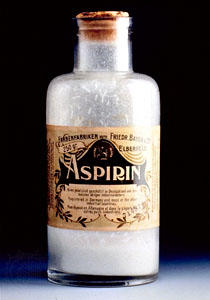
On this day in 1899, Bayer patents aspirin:

aspirinbottle

…the Imperial Patent Office in Berlin registers Aspirin, the brand name for acetylsalicylic acid, on behalf of the German pharmaceutical company Friedrich Bayer & Co.

Now the most common drug in household medicine cabinets, acetylsalicylic acid was originally made from a chemical found in the bark of willow trees. In its primitive form, the active ingredient, salicin, was used for centuries in folk medicine, beginning in ancient Greece when Hippocrates used it to relieve pain and fever. Known to doctors since the mid-19th century, it was used sparingly due to its unpleasant taste and tendency to damage the stomach.

In 1897, Bayer employee Felix Hoffman found a way to create a stable form of the drug that was easier and more pleasant to take. (Some evidence shows that Hoffman’s work was really done by a Jewish chemist, Arthur Eichengrun, whose contributions were covered up during the Nazi era.) After obtaining the patent rights, Bayer began distributing aspirin in powder form to physicians to give to their patients one gram at a time. The brand name came from “a” for acetyl, “spir” from the spirea plant (a source of salicin) and the suffix “in,” commonly used for medications. It quickly became the number-one drug worldwide….

Google-a-Day has a question about a punctuation reference: “In “Eats, Shoots and Leaves,” punctuation marks are compared to what highway safety device, because they keep words from banging together?”

Daily Bread for 3.5.13

Good morning.

Tuesday will bring snow to Whitewater, of about three to five inches during the day, with less than an inch additional this evening.

The city now has a Bicycle & Pedestrian Steering Committee meeting scheduled for 4:30 PM, and a Common Council meeting for 6:30 PM (Update: Canceled).

What does three feet of snowfall look like? It looks like this, from Connecticut:

On this day in 1946, Winston Churchill delivers his “Iron Curtain’ speech at Westminster College in Missouri (Churchill, himself, titled the address ‘Sinews of Peace’). His observation – wholly right – about Soviet intentions comes somehere near the middle of the speech:

….From Stettin in the Baltic to Trieste in the Adriatic, an iron curtain has descended across the Continent. Behind that line lie all the capitals of the ancient states of Central and Eastern Europe. Warsaw, Berlin, Prague, Vienna, Budapest, Belgrade, Bucharest and Sofia, all these famous cities and the populations around them lie in what I must call the Soviet sphere, and all are subject in one form or another, not only to Soviet influence but to a very high and, in many cases, increasing measure of control from Moscow. Athens alone — Greece with its immortal glories — is free to decide its future at an election under British, American and French observation. The Russian-dominated Polish Government has been encouraged to make enormous and wrongful inroads upon Germany, and mass expulsions of millions of Germans on a scale grievous and undreamed-of are now taking place. The Communist parties, which were very small in all these Eastern States of Europe, have been raised to pre-eminence and power far beyond their numbers and are seeking everywhere to obtain totalitarian control. Police governments are prevailing in nearly every case, and so far, except in Czechoslovakia, there is no true democracy. Turkey and Persia are both profoundly alarmed and disturbed at the claims which are being made upon them and at the pressure being exerted by the Moscow Government….

Google-a-Day asks about a Swiss mountain: “What mountain in Switzerland includes three types of glacial erosion, and resembles an ancient Egyptian structure with four specific sides?”

Daily Bread for 3.4.13

Good morning.

Monday will be cloudy with a high of thirty-one.

Whitewater’s Parks & Rec Board meets at 5 PM.

On this day in 1789, government under the U.S. Constitution begins:

The first session of the U.S. Congress is held in New York City as the U.S. Constitution takes effect. However, of the 22 senators and 59 representatives called to represent the 11 states who had ratified the document, only nine senators and 13 representatives showed up to begin negotiations for its amendment.

In 1786, defects in the Articles of Confederation became apparent, such as the lack of central authority over foreign and domestic commerce and the inability of Congress to levy taxes, leading Congress to endorse a plan to draft a new constitution. On September 17, 1787, at the conclusion of the Constitutional Convention in Philadelphia, the new U.S. Constitution, creating a strong federal government with an intricate system of checks and balances, was signed by 38 of 41 delegates to the convention.

As dictated by Article VII, the document would not become binding until it was ratified by nine of the 13 states. The Constitution was thus sent to the state legislatures, and beginning on December 7, five states–DelawarePennsylvania,New JerseyGeorgia, and Connecticut–ratified it in quick succession. However, other states, especially Massachusetts, opposed the document for its failure to reserve powers not delegated by the Constitution to the states and its lack of constitutional protection for such basic political rights as freedom of speech, religion, and the press, and the right to bear arms.

In February 1788, a compromise was reached in which Massachusetts and other states agreed to ratify the document with the assurance that amendments would immediately be adopted. The Constitution was thus narrowly ratified in Massachusetts, followed by Maryland and South Carolina. On June 21, 1788, New Hampshire became the ninth state to ratify the document, making it binding, and government under the U.S. Constitution was scheduled to begin on March 4, 1789.

On September 25, 1789, after several months of debate, the first Congress of the United States adopted 12 amendments to the U.S. Constitution–the Bill of Rights–and sent them to the states for ratification. This action led to the eventual ratification of the Constitution by the last of the 13 original colonies: North Carolina and Rhode Island.

From earlier this year, scenes of an ice shove along Lake Winnebago, topping ordinary snowfall in its unique character: