
Public Meetings
Parks & Rec Board
by JOHN ADAMS •
Recent Tweets, 2.24 to 3.2
by JOHN ADAMS •
Florida man swallowed by sinkhole http://t.co/NtSX5WvaMV
— John Adams (@DailyAdams) March 1, 2013
SCOTT FREE: John Doe probe of Scott Walker aides closed http://t.co/XYhWpkdteV
— John Adams (@DailyAdams) March 1, 2013
Why so high? 6% Rate News Media As Very Trustworthy – Rasmussen Reports™ http://t.co/vfKpcWfTEd
— John Adams (@DailyAdams) February 28, 2013
Endgame: Bradley Manning pleads guilty to 10 charges, still faces June trial | Ars Technica http://t.co/cnUb6z7wfj
— John Adams (@DailyAdams) February 28, 2013
Zombie: The Chinese Bond Meme That Refuses to Die http://t.co/oAKfaH3YBf
— John Adams (@DailyAdams) February 28, 2013
Police Brutality Video Shocks South Africa #murder http://t.co/JW0MTmPRjo
— John Adams (@DailyAdams) February 28, 2013
Not soon enough: What Time Does the Sequester Start? http://t.co/bGnUT95Uwx
— John Adams (@DailyAdams) February 27, 2013
Chart: Generational Attitudes on Sushi and Gay Marriage Correlate Almost Perfectly http://t.co/O8FY4yG9tv
— John Adams (@DailyAdams) February 27, 2013
Circling the Drain: Human Events #printisdead http://t.co/gfYwomOSQb
— John Adams (@DailyAdams) February 27, 2013
Decline? Is America Over Soda? | Atlantic Wire http://t.co/ti4FsFkiz6
— John Adams (@DailyAdams) February 27, 2013
The Other Red Meat: Hippophagy | The American Conservative http://t.co/GNTdDJhizy
— John Adams (@DailyAdams) February 26, 2013
“@reason: Todd Krainin on Shin Dong-hyuk’s Escape from a North Korean Prison Camp http://t.co/E4s26rrias”
— John Adams (@DailyAdams) February 26, 2013
Fear not: Why we need the sequester http://t.co/eF42Gf7ofT
— John Adams (@DailyAdams) February 26, 2013
Yet, everyone raves over their meatballs: Horse meat found in IKEA meatballs http://t.co/8v3Pb5F7J0
— John Adams (@DailyAdams) February 25, 2013
Demise: Why Did DC Comics Have to Kill the Good Robin? http://t.co/wlkvqdD8WT
— John Adams (@DailyAdams) February 25, 2013
Left slams dissenting views: 'Right-Wing Money Putting John Stossel In School Classrooms' Media Matters http://t.co/gcXpRIHEnZ
— John Adams (@DailyAdams) February 25, 2013
Yankees Admit that they are “Baseball’s Evil Empire” http://t.co/B5kqwoq9vS
— John Adams (@DailyAdams) February 25, 2013
@kurt_loder If people would just let Mayor Bloomberg think for them, they'd all be much happier…
— John Adams (@DailyAdams) February 24, 2013
Cartoons & Comics
Sunday Morning Cartoon: Cummulus & Nimbus
by JOHN ADAMS •
Cummulus & Nimbus from we think things on Vimeo.
Daily Bread
Daily Bread for 3.3.13
by JOHN ADAMS •
Good morning.
Sunday in Whitewater brings sunny skies and a high of twenty-eight. We’ll have 11h 19m of sunlight, 12h 16m of daylight, and tomorrow will bring an additional two minutes.
In Friday’s Catblogging post, one saw a video of a backyard bobcat. If one, then perhaps two – here are two pugnacious urban bobcats, in someone’s yard. I’ll leave it to others to decide if the homeowner is lucky or unlucky for his feline visitors:
On this day in 1879, the U.S. Geological Survey is born:
Congress establishes the United States Geological Survey, an organization that played a pivotal role in the exploration and development of the West.
Although the rough geographical outlines of much of the American West were known by 1879, the government still had astonishingly little detailed knowledge of the land. Earlier federal exploratory missions under men like Ferdinand Hayden and John Wesley Powell had begun to fill in the map, yet much remained to be done. Congress decided to transform the earlier system of sporadic federal geological explorations into a permanent government agency, the United States Geological Survey (USGS).
From the beginning, the USGS focused its efforts on practical geographical and geological investigations that might spur western economic development. Since the vast majority of the nation’s public land was in the West, the USGS became one of the federal government’s most important tools for encouraging the exploitation of western natural resources. Congress appointed Clarence King, a brilliant young mining engineer and geologist, as the first director. King, who had previously done considerable work for western mining companies, viewed the USGS as a tool for aiding further mineral exploitation. As a result, the first major reports produced under King’s tenure concerned the economic geology of two important mining districts, Nevada‘s Comstock Lode and Colorado‘s Leadville silver district.
Daily Bread
Daily Bread for 3.2.13
by JOHN ADAMS •
Good morning.
It’s a mostly sunny day with a high of twenty-four, and a north wind at 5 to 10 mph.
Born this day in 1904, Dr. Seuss:
On this day in 1904, Theodor Geisel, better known to the world as Dr. Seuss, the author and illustrator of such beloved children’s books as “The Cat in the Hat” and “Green Eggs and Ham,” is born in Springfield, Massachusetts. Geisel, who used his middle name (which was also his mother’s maiden name) as his pen name, wrote 48 books–including some for adults–that have sold well over 200 million copies and been translated into multiple languages. Dr. Seuss books are known for their whimsical rhymes and quirky characters, which have names like the Lorax and the Sneetches and live in places like Hooterville.
Geisel, who was born on March 2, 1904, in Springfield, Massachusetts, graduated from Dartmouth College, where he was editor of the school’s humor magazine, and studied at Oxford University. There he met Helen Palmer, his first wife and the person who encouraged him to become a professional illustrator. Back in America, Geisel worked as a cartoonist for a variety of magazines and in advertising.
The first children’s book that Geisel wrote and illustrated, “And to Think That I Saw It On Mulberry Street,” was rejected by over two dozen publishers before making it into print in 1937. Geisel’s first bestseller, “The Cat in the Hat,” was published in 1957. The story of a mischievous cat in a tall striped hat came about after his publisher asked him to produce a book using 220 new-reader vocabulary words that could serve as an entertaining alternative to the school reading primers children found boring.
Other Dr. Seuss classics include “Yertle the Turtle,” “If I Ran the Circus,” “Fox in Socks” and “One Fish, Two Fish, Red Fish, Blue Fish.”
Some Dr. Seuss books tackled serious themes. “The Butter Battle Book” (1984) was about the arms buildup and nuclear war threat during Ronald Reagan’s presidency. “Lorax” (1971) dealt with the environment.
Many Dr. Seuss books have been adapted for television and film, including “How the Grinch Stole Christmas!” and “Horton Hears a Who!” In 1990, Geisel published a book for adults titled “Oh, the Places You’ll Go” that became a hugely popular graduation gift for high school and college students.
Geisel, who lived and worked in an old observatory in La Jolla, California, known as “The Tower,” died September 24, 1991, at age 87.
Cats
Friday Catblogging: Backyard Bobcat
by JOHN ADAMS •
Poll
Friday Poll: Extraterrestrial Life?
by JOHN ADAMS •
The Science Channel has a new series, Are We Alone?, beginning this month that considers whether there’s extraterrestrial life in the galaxy. One of the the episodes even assesses how humanity would fare during an invasion of creatures from outer space.
Let’s set a question broadly, including the possibility of any alien life, even simple organisms: Do you think there’s life elsewhere in the galaxy?
I’ll say yes for very simple organisms, but with doubts about whether there is more complicated life, much less other civilizations like our own.
So, what do you think? Is there extraterrestrial life in the galaxy?
Daily Bread
Daily Bread for 3.1.13
by JOHN ADAMS •
Good morning.
Friday brings a high of thirty, with a slight chance of flurries. We’ll have 11h 13m of sunlight, and 12h 10m of daylight, with three minutes more tomorrow.
On this day in 1781, America has her first constitution:
…the Articles of Confederation are finally ratified. The Articles were signed by Congress and sent to the individual states for ratification on November 15, 1777, after 16 months of debate. Bickering over land claims between Virginia and Maryland delayed final ratification for almost four more years. Maryland finally approved the Articles on March 1, 1781, affirming the Articles as the outline of the official government of the United States. The nation was guided by the Articles of Confederation until the implementation of the current U.S. Constitution in 1789.
The critical distinction between the Articles of Confederation and the U.S. Constitution —the primacy of the states under the Articles—is best understood by comparing the following lines.
The Articles of Confederation begin:
“To all to whom these Present shall come, we the undersigned Delegates of the States”
By contrast, the Constitution begins:
“We the People of the United Statesdo ordain and establish this Constitution for the United States of America.”
The predominance of the states under the Articles of Confederation is made even more explicit by the claims of Article II:
“Each state retains its sovereignty, freedom, and independence, and every power, jurisdiction, and right, which is not by this Confederation expressly delegated to the United States, in Congress assembled.”
Less than five years after the ratification of the Articles of Confederation, enough leading Americans decided that the system was inadequate to the task of governance that they peacefully overthrew their second government in just over 20 years. The difference between a collection of sovereign states forming a confederation and a federal government created by a sovereign people lay at the heart of debate as the new American people decided what form their government would take.
On March 1st, 1985, the Bucks get a new owner:
1985 – Kohl purchases Bucks
On this day in 1985 Milwaukee businessman and future United States Senator Herb Kohl purchased the Milwaukee Bucks for 18 million dollars. By 1999 the team was worth an estimated 100 million dollars. [Source: Harvard Business School Bulletin, December 1999].
Animals, Weird Tales
An Unexpected Passenger
by JOHN ADAMS •
Beautiful Whitewater, City, Hip & Prosperous, New Whitewater
Choosing Whitewater
by JOHN ADAMS •

At Whitewater’s last meeting of Common Council, on 2.21.13, there was a discussion about the choosewhitewater.org website, a promotional portal for Whitewater. (The site has been around for a while, slowly adding content or links.) It’s labeled as a joint effort of the city, school district, and university, but it’s easy to see that the site is mostly a university effort.
Stylish, to be sure, but anodyne as most efforts like this are. The websites of the three institutions are similarly attractive (if varying in their features). It’s a multimedia version of a promotional flyer.
There’s no harm in that, of course. Safe is what most brochures are, and this is a site that fits that tried-and-true approach. The community planning mantra to shape a city to ‘live, work, or play’ is augmented to read, ‘Live. Learn. Work. Play.’ The addition of ‘Learn’ is your tell – it’s a campus focus.
For it all, the site is most useful to influence those deciding between Whitewater and another city, rather than simply enticing people to pick up and move. Choose Whitewater is designed to sway those who might be interested in going to school or working here, as against another pending academic or employment opportunity. The benefit to the university of a site like this, for hiring in particular, is clear.
There’s an unspoken message: Choose Whitewater (rather than another school).
It’s not wrong to say that parts of Whitewater are ‘vibrant,’ but the whole city has years ahead before that description will apply, generally. It will be true, one day, but we’re not there, now. Whitewater is now a combination of some who are lively and creative and a smaller number who are unreconstructed and hidebound.
We’ll one day be a premier destination, I’m sure, but it’s unlikely that we’ll ever be (as the website declares we presently are) a ‘premiere’ one. Whitewater is more today and will always be more than a film’s opening night.
Another point, worth making: one grows larger on one’s own, as an independent site, than would be possible as part of a collection of institutionally-backed sites. In fact, the contrast between those two paths only redounds to the benefit of those taking an independent course.
I’m not sure those behind choosewhitewater.org understand this; I’m quite sure it doesn’t matter whether they do.
One certainly should chose Whitewater, for reasons far beyond what any website might suggest. In fact, in choosing our small city, one will be choosing a place in which each newcomer can and will make a great difference.
Whitewater is no finished product, no fixed and decided landscape, but a city that a new generation will shape to their desires and tastes.
I’d hope many will join us, enriching this community in ways yet unknown to current residents. This small and beautiful city has its brightest days yet ahead, open to all who should wish to live here.
Yes, choose Whitewater.
Anderson, Cartoons & Comics
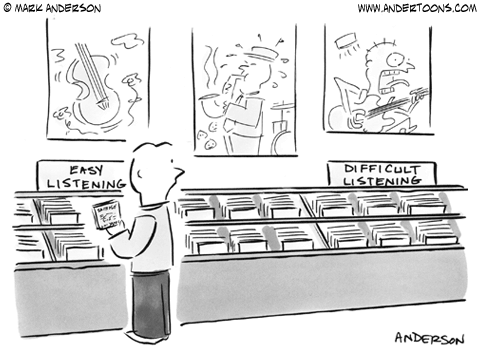
Styles of Listening
by JOHN ADAMS •
Daily Bread
Daily Bread for 2.28.13
by JOHN ADAMS •
Good morning.
It’s a cloudy day with a high of thirty-four for Whitewater.
On this day in 1953, a profound biological discovery:
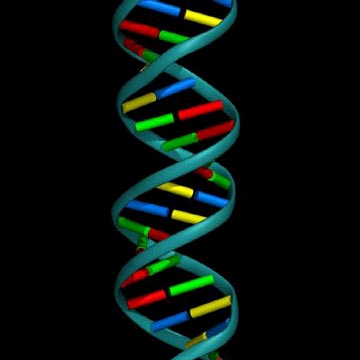
…Cambridge University scientists James D. Watson and Frances H.C. Crick announce that they have determined the double-helix structure of DNA, the molecule containing human genes.
Though DNA–short for deoxyribonucleic acid–was discovered in 1869, its crucial role in determining genetic inheritance wasn’t demonstrated until 1943. In the early1950s, Watson and Crick were only two of many scientists working on figuring out the structure of DNA. California chemist Linus Pauling suggested an incorrect model at the beginning of 1953, prompting Watson and Crick to try and beat Pauling at his own game. On the morning of February 28, they determined that the structure of DNA was a double-helix polymer, or a spiral of two DNA strands, each containing a long chain of monomer nucleotides, wound around each other. According to their findings, DNA replicated itself by separating into individual strands, each of which became the template for a new double helix. In his best-selling book, The Double Helix (1968), Watson later claimed that Crick announced the discovery by walking into the nearby Eagle Pub and blurting out that “we had found the secret of life.” The truth wasn’t that far off, as Watson and Crick had solved a fundamental mystery of science–how it was possible for genetic instructions to be held inside organisms and passed from generation to generation.
Watson and Crick’s solution was formally announced on April 25, 1953, following its publication in that month’s issue of Nature magazine. The article revolutionized the study of biology and medicine. Among the developments that followed directly from it were pre-natal screening for disease genes; genetically engineered foods; the ability to identify human remains; the rational design of treatments for diseases such as AIDS; and the accurate testing of physical evidence in order to convict or exonerate criminals.
Crick and Watson later had a falling-out over Watson’s book, which Crick felt misrepresented their collaboration and betrayed their friendship. A larger controversy arose over the use Watson and Crick made of research done by another DNA researcher, Rosalind Franklin, whose colleague Maurice Wilkins showed her X-ray photographic work to Watson just before he and Crick made their famous discovery. When Crick and Watson won the Nobel Prize in 1962, they shared it with Wilkins. Franklin, who died in 1958 of ovarian cancer and was thus ineligible for the award, never learned of the role her photos played in the historic scientific breakthrough.
Google-a-Day aska about an athlete: “The famous defensive tackle who died during a game against the New York Dragons, played in how many games for the Panthers during his career?”