
Daily Bread
Daily Bread for 9.29.12
by JOHN ADAMS •
Good morning.
A sunny Saturday, with a high of seventy-four, awaits Whitewater. We’ll have very light winds throughout the day, with eleven hours, forty-eight minutes of sunlight, and twelve hours, forty-four minutes of daylight.
On this day in 1957, the Packers dedicated their new stadium:
1957 – Packers Dedicate New Stadium
On this date the Green Bay Packers dedicated City Stadium, now known as Lambeau Field, and defeated the Chicago Bears, 21-17. In the capacity crowd of 32,132 was Vice president Richard Nixon. [Source: Milwaukee Journal Sentinel]
From Google’s daily puzzle, a question about one of Bach’s compositions: “During one of Bach’s cantatas, I sing that I will “shrivel up like a piece of roast goat” if my addiction isn’t satisfied. What voice type am I?”
Beautiful Whitewater
Beautiful Whitewater
by JOHN ADAMS •


CDA, City, Green Energy Holdings, Waste Digesters
The Whitewater Community Development Authority Meeting for 9.27.12
by JOHN ADAMS •
Whitewater’s Community Development Authority met yesterday afternoon, the agenda including both open and closed session discussions (with a return to open session).
The principal topics of the meeting appear below. I’ll address one of particular concern first, and the rest in the order in which they were discussed in public session.
The Waste Digester Proposal.
Following a return from closed session, the CDA passed a unanimous motion to direct the city’s staff to inform the management of Green Energy Holdings that the city was not able to secure additional tax credits for the project site, and that the city is not interested in offering any additional incentives related to the site at this time.
That’s a sound and sensible decision. Our lovely city can do better, and deserves better. The Community Development Authority has acted prudently on behalf of the city. Whitewater would be fortunate to hear nothing more of the proposal.
Their reasons were surely their own; the decision is welcome whatever the basis.
Readers know that I have followed this proposal closely, with both a designated category for the Whitewater proposal and a another, general category about the environmental, municipal-fiscal, economic, and open government aspects of these plants. It’s an understatement to say that I think it’s a mistaken idea.
A thanks to readers for their many messages to me in opposition to this proposal, their shared concern, & their encouragement. I’ve kept up and answered every message directly (that’s my pleasure), but thanks again.
As is true with everyone in the city, one wants the best for Whitewater, as a safe, clean, lovely city.
The Liquor License for the Black Sheep Restaurant.
An increase in our population allows Whitewater to grant (by state law) two additional liquor licenses, and Council recently granted one to the Black Sheep Restaurant near Cravath Lake (210 W. Whitewater St.). That was a good decision, as the issuance of the new license fully complies with Wisconsin law, is good for the restaurant, and ultimately good for other restaurants.
Restaurants are like a flock of birds: there’s health and safety in numbers. Far from undermining each other, a robust group of establishments will help each other, and encourage increased overall patronage.
While Council had issued and assigned the license previously, the CDA followed past practice and awarded a grant for its initial purchase. A past practice that provides modest support to a small restaurant or merchant (rather than a big business) is a reasonable investment.
Best wishes to the chef-restaurateur, Tyler Sailsbery, and his staff.
Land Sale to Trostel
The CDA approved the sale of three acres (within an area of about six acres) to Trostel, in the amount of $35,000 per acre.
Agreement with the Wisconsin Economic Development Corporation for a Seed Fund and an Accompanying Seed Capital Fund Policy Manual.
Readers will find online the documents under consideration at the 9.27.12 meeting about the fund and the policy manual. The process is bound by state laws, regulations, and contractual provisions with the Wisconsin Economic Development Corporation (the successor to the Wisconsin Department of Commerce). Although the WEDC is undergoing a leadership change, Paul Jadin leaving, that change shouldn’t affect the substance of a proposal with Whitewater.
Cats
Friday Catblogging: New research reveals how cats get their stripes (or spots)
by JOHN ADAMS •
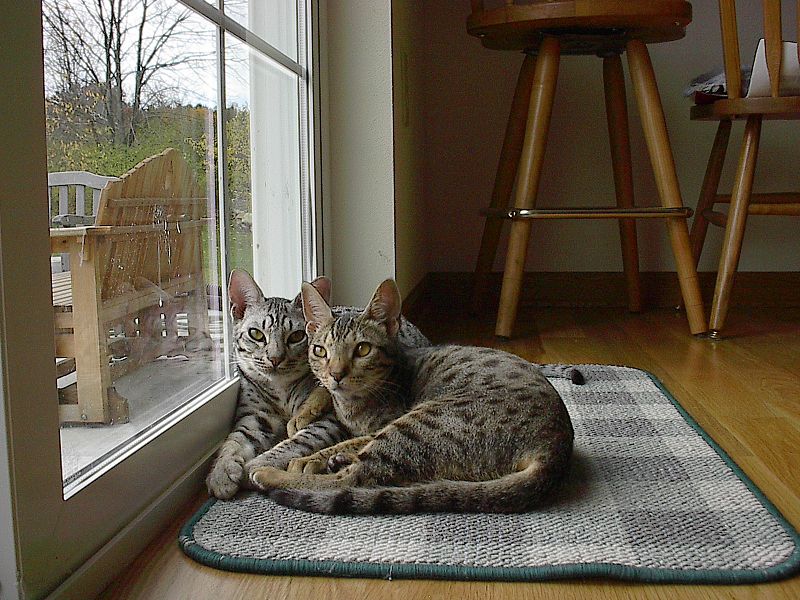
Domestic cats often resemble their larger, wilder counterparts — with black, striped or tawny fur that presumably helps the big hunters blend into the landscape. For scientists, the genes involved in the evolution of cats’ color patterns have been equally well camouflaged. But a new study in Science reveals a mutation shared by housecats and cheetahs, which may explain how the cat got its stripes — or, in this case, its blotches.
The sharp, evenly spaced stripes of the tabby cat are among the most common of coat patterns. In some tabbies, however, the stripes look more like long, irregular swirls. Although fairly common in domestic cats, this pattern (called “blotched” by geneticists and cat fanciers) is unusual in the wild. In fact, cheetahs with the blotched pattern were initially thought to be a separate species: They were crowned with the name king cheetahs to distinguish them from the more common, spotted kind.
See, New research reveals how cats get their stripes – The Washington Post.
Poll
Friday Poll: Will you watch the Presidential Debates?
by JOHN ADAMS •
I asked in an earlier poll if readers would watch the major-party conventions (most respondents said that they would), and here’s a poll about the last big, formal political events between now and November 6th. (Otherwise, it’s campaign ads and speeches as each candidate wishes, with no set schedule as with the conventions or debates.)
Needless to say, I wish Libertarian Party candidate Gary Johnson were part of these debates, but I’ll watch them all regardless. The debates are scheduled for 10.3, 10.11, 10.16, 10.22.
How about you?
Daily Bread
Daily Bread for 9.28.12
by JOHN ADAMS •
Good morning.
Whitewater’s week ends with a sunny day, calm winds at 5 MPH, and a high of seventy. Very pleasant.
On this day in 1941, Ted Williams became the last player to hit .400. These generations later, no one in all baseball has equalled that feat:
On this day in 1941, the Boston Red Sox’s Ted Williams plays a double-header against the Philadelphia Athletics on the last day of the regular season and gets six hits in eight trips to the plate, to boost his batting average to .406 and become the first player since Bill Terry in 1930 to hit .400. Williams, who spent his entire career with the Sox, played his final game exactly 19 years later, on September 28, 1960, at Boston’s Fenway Park and hit a home run in his last time at bat, for a career total of 521 homeruns.
On this day in 1925, in Wisconsin history, a great inventor was born:
1925 – Seymour R. Cray Born
On this date Seymour R. Cray was born in Chippewa Falls. Cray received a BS in Electrical Engineering from the University of Minnesota. He established himself in the field of large-scale computer design through his work for Engineering Associates, Remington Rand, UNIVAC, and Control Data Corporation.In 1957 Cray built the first computer to use radio transistors instead of vacuum tubes. This allowed for the miniaturization of components which enhanced the performance of desktop computers. In the 1960s he designed the world’s first supercomputer at Control Data. In 1972 he founded Cray Research in his hometown of Chippewa Falls where he established the standard for supercomputers with CRAY-1 (1976) and CRAY-2 (1985).
He resigned from the company in 1981 to devote himself to computer design in the areas of vector register technology and cooling systems. Cray died in a automobile accident on October 5, 1996. [Source: MIT and Cray Company]

Google’s daily puzzle asks about an ancient Roman folk remedy (that surely doesn’t work): “What did the ancient Romans believe they could prevent with the herb that sprung from Archemorus’ blood?”
Beautiful Whitewater, Nature
Beautiful Whitewater
by JOHN ADAMS •

Daily Bread
Daily Bread for 9.27.12
by JOHN ADAMS •
Good morning.
Thursday in Whitewater will be sunny and mild, with a high of sixty-five.
Whitewater’s Community Development Authority meets this afternoon at 4:30 PM.
On this day in 1964, the Warren Commission issued its report concluding that Lee Harvey Oswald acted alone in the assassination of Pres. Kennedy.
Sometimes even the largest animals, like a six-hundred-pound sea turtle, require a helping hand. The marine biologists at the New England Aquarium provided that assistance. Here they are in action:
Google’s daily puzzle is about a particular kind of table: “What kind of table was first produced by the 8th Laird of Merchistoun?”
Beautiful Whitewater, Nature
Beautiful Whitewater
by JOHN ADAMS •

Daily Bread
Daily Bread for 9.26.12
by JOHN ADAMS •
Good morning.
It’s a sunny midweek day ahead for Whitewater, with a high of sixty-five.
On this day in 1960, the first televised presidential debate took place in Chicago between VP Nixon and Sen. Kennedy. (The first presidential debate this year will take place on October 3rd in Denver.)
Here’s that debate:
Google’s daily puzzle asks about a king: “I was known as the “Lion of the North,” and died heroically on the battlefield. How many years did the war continue after my death?”
Beautiful Whitewater, Nature
Beautiful Whitewater
by JOHN ADAMS •
Waste Digesters
Introduction to Waste Digesters: The Thin Entering Wedge
by JOHN ADAMS •
In this introductory and general series of posts on waste digesters, I have listed all the organic waste that may be composted (digested) in an anaerobic waste digester. This organic waste may comprise discarded food, partly eaten-food, animal carcasses, or animal & human excrement.
All those ingredients can power an anaerobic digester, and often do, in those places that have them.
There are two reasons that, in this series, I have described the full organic ingredients list for digesters.
First, because this description is more complete, and so more accurate, than one that describes anaerobic digesters in more delicate ways, as though they could process only discarded garden vegetables.
Second, because although the proponents of a digester will often talk in delicate ways, the actual agreements that they execute with unsuspecting towns will specify a digester, but typically place no contractual limits on the contents that may go within it.
One may hear about one ingredient, but yet a community may unwittingly obligate itself contractually to accepting anything and everything that might go into the digester.
That’s the thin entering wedge: a delicate discussion, but later on, an unsavory contractual obligation.
(Of course, even if a community tried to impose a written limitation on the contents going into an anaerobic digester, verification of what was in each truckload, arriving as it would at any time of day or night, would be practically impossible.)
And yet, and yet, imagine a community so foolish that it would execute an agreement without even formally imposing those restrictions at the first instance.
Waste Digesters
Looking for Information on Waste Digesters?
by JOHN ADAMS •
Welcome.
If you’re visting in search of information on commercial waste digesters – of their environmental, economic, municipal-fiscal, and public policy implications — please see my introductory series here @ FREE WHITEWATER. I’ve a dedicated category on them generally, and another category about a proposal to construct one in Whitewater, Wisconsin.
Thanks for visiting – and feel free to look around at all my sites: Daily Adams, Daily Wisconsin, and FREE WHITEWATER.