
Daily Bread
Daily Bread for 10.7.12
by JOHN ADAMS •
Good morning.
Sunday will be a day of decreasing clouds, a high of forty-nine, and northwest winds from 5 to 10 MPH.
On this day in 1774, Wisconsinites all became a bit more French:
1774 – Wisconsin Becomes Part of Quebec
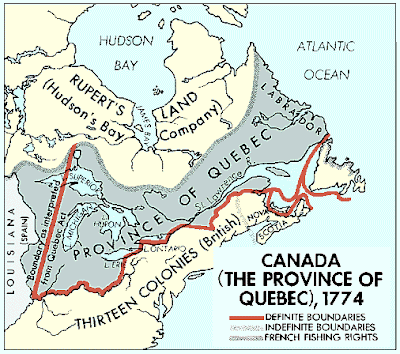
On this date Britain passed the Quebec Act, making Wisconsin part of the province of Quebec. Enacted by George III, the act restored the French form of civil law to the region. The Thirteen Colonies considered the Quebec Act as one of the “Intolerable Acts,” as it nullified Western claims of the coast colonies by extending the boundaries of the province of Quebec to the Ohio River on the south and to the Mississippi River on the west. [Source: Avalon Project at the Yale Law School]
Puzzle-lovers will enjoy the Smithsonian’s Great American History Puzzle:
George Washington’s spies used invisible ink during the Revolution. Abraham Lincoln’s young cryptanalysts cracked the Confederacy’s “Vicksburg Square” cipher during the Civil War. The United States entered World War I after Britain decoded an encrypted message from the Germans inviting Mexico to wage war on America—the so-called “Zimmermann Telegram.” In World War II, the Marines’ Navajo “code-talkers” were crucial to victories in the Pacific theater.
Because puzzle-solvers and code breakers have long been heroes of American history, we present the Smithsonian Great American History Puzzle. The puzzle is a month-long contest conceived by the puzzle master and “Jeopardy!” champion Ken Jennings. The first person to correctly follow all the clues, avoid all the red herrings and uncover all the secrets will win the grand prize: a free trip to Washington, D.C. and a “Secrets of the Smithsonian” tour (created by Smithsonian Journeys and valued at $10,000) behind the scenes of the world’s largest museum and research complex.
Daily Bread
Daily Bread for 10.6.12
by JOHN ADAMS •
Good morning.
Saturday in Whitewater will be mostly sunny and windy, with a high of sixty-three.
On this day in 1866, America saw the first robbery of a moving train:
On this day in 1866, the Reno gang carries out the first robbery of a moving train in the U.S., making off with over $10,000 from an Ohio & Mississippi train in Jackson County, Indiana. Prior to this innovation in crime, holdups had taken place only on trains sitting at stations or freight yards….
As for the Reno gang, which consisted of the four Reno brothers and their associates, their reign came to an end in 1868 when they all were finally captured after committing a series of train robberies and other criminal offenses. In December of that year, a mob stormed the Indiana jail where the bandits were being held and meted out vigilante justice, hanging brothers Frank, Simeon and William Reno (their brother John had been caught earlier and was already serving time in a different prison) and fellow gang member Charlie Anderson.
In Wisconsin history, in 1917 Sen. La Follette delivered a Senate-floor defense of free speech:
1917 – Robert La Follette Supports Free Speech in Wartime
On this date Senator Robert La Follette gave what may have been the most famous speech of his Senate career when he responded to charges of treason with a three hour defense of free speech in wartime. La Follette had votedagainst a declaration of war as well as several initiatives seen as essential to the war effort by those that supported U.S. involvement in the first World War. His resistance was met with a petition to the Committee on Privileges and Elections that called for La Follette’s expulsion from the Senate. The charges were investigated, but La Follette was cleared of any wrong doing by the committee on January 16, 1919. [Source: United States Senate]
Google’s daily puzzle asks about English monarchical intrigue: “The first king to rule the House of Lancaster chose a wife who became unpopular with the people. For what crime was she convicted?”
Public Meetings
Library Board
by JOHN ADAMS •
Public Meetings
Planning Commission
by JOHN ADAMS •
City, Press
The Local Press as a Bad Habit
by JOHN ADAMS •
If local officials (whether elected or appointed) want to be successful, they’ll have to set higher standards for themselves than our local press sets for them.
Successful leaders have been, are, and will always be those who set a better standard for themselves. There’s no partisan ideology in this – the same applies to those of left, right, and center.
I grew up enjoying newspapers, and look fondly on some even now.
We’ve two local dailies nearby, although none from within the city. It’s undeniable, to my eyes, that those papers have covered government officials poorly. For me that means that they’ve not really reported on local politics at all, but instead have fawned over elected politicians and appointed managers. It’s no surprise to any long-time reader that I feel this way.
And yet, and yet – the problem isn’t how I feel, but the damage that sycophantic coverage does to officials, themselves: mediocre coverage creates mediocre leaders, and mediocre leaders produce mediocre work. It encourages them to do less and try less, to settle for shoddy arguments and flimsy claims. Worse, it plays to the vanities of weak-minded officials: they eagerly lap the syrupy concoctions that toadying reporters too gladly serve.
A newspaper story should have some better use than as a page in an official’s scrapbook.
As a rule, local press analysis is poor, the scourcing that newspapers claim is their advantage is non-existent or laughably inadequate, and their quality of composition is wanting.
Coverage of major political initiatives, of policies supposedly worth vast sums, receives no careful review and assessment, but only the most cursory and unthinking acceptance.
It’s not true that this is the best newspapers can do.
Thousands of residents throughout our city, and millions of Americans across this continent, easily meet a higher standard each day than the flimsy coverage our politics receives in the traditional, local press. Americans are among the hardest-working and most competitive peoples in all the world. We are at the forefront of humanity’s accomplishments in science, technology, industry, and art.
Those accomplishments are not the works of a few, but the achievements of over three-hundred million of us, cooperating in countless transactions each day.
Why would any elected or appointed official set aside America’s high standards for the low standards of a local press?
Everyone is free to choose for himself or herself, but not all choices are equally beneficial. Looking outward to the best practices across America (and beyond) is our only sensible, productive, and prosperous approach.
No one in should settle for anything less.
Cats
Friday Catblogging: Cats 101 on Ocicats
by JOHN ADAMS •
Poll
Friday Poll: When’s a Good Time for Stores to Begin Selling Christmas Decorations?
by JOHN ADAMS •
I saw that our local Walmart had a section with Christmas decorations for sale. It’s probably the same with other Walmart stores, and similar retailers. So, today’s question: When’s a good time, in your view, to begin selling Christmas decorations? The question’s not about what should be permissible (I’d say anytime, after all), but what seems fitting to you, as a shopper.
In my case, I’ll answer that November seems a good beginning, after Halloween, and when Christmas is about six weeks away.
What do you think?
Daily Bread
Daily Bread for 10.5.12
by JOHN ADAMS •
Good morning.
Whitewater’s week ends with a mostly sunny day, and a high of fifty-three.
On this day in 1947, Pres. Truman delivered the first televised address from the White House:
President Harry Truman (1884-1972) makes the first-ever televised presidential address from the White House, asking Americans to cut back on their use of grain in order to help starving Europeans. At the time of Truman’s food-conservation speech, Europe was still recovering from World War II and suffering from famine. Truman, the 33rd commander in chief, worried that if the U.S. didn’t provide food aid, his administration’s Marshall Plan for European economic recovery would fall apart. He asked farmers and distillers to reduce grain use and requested that the public voluntarily forgo meat on Tuesdays, eggs and poultry on Thursdays and save a slice of bread each day. The food program was short-lived, as ultimately the Marshall Plan succeeded in helping to spur economic revitalization and growth in Europe.
On this day in 1846, Wisconsin’s first state constitutional convention met:
1846 – First State Constitutional Convention Meets
On this date Wisconsin’s first state Constitutional Convention met in Madison. The Convention sat until December 16,1846. The Convention was attended by 103 Democrats and 18 Whigs. The proposed constitution failed when voters refused to accept several controversial issues: an anti-banking article, a homestead exemption (which gave $1000 exemption to any debtor), providing women with property rights, and black suffrage. The following convention, the Second Constituitional Convention of Wisconsin in 1847-48, produced and passed a constitution that Wisconsin still very much follows today. [Source:The Convention of 1846 edited Milo M. Quaife]
For today’s daily puzzle from Google, some chemistry: “What is produced when the element discovered by Joseph Priestly reacts with the metal manufactured by his “mad” brother-in-law?”
Daily Adams, Presidential race 2012, Wisconsin
Which Romney for Wisconsin?
by JOHN ADAMS •
In January, looking ahead to Wisconsin’s big political year, I thought that Gov. Walker would be recalled in June, and Gov. Romney would win both Wisconsin and the presidency in November. The first prediction was well off-the-mark. (Gov. Walker actually did better in 2012 than he did in 2010.)
The November contest is yet ahead, leaving two of those three predictions still to be assessed. All three, though, were based on the same theory: that a moderate-conservative candidate would do better than a thoroughly conservative candidate in Wisconsin. Of course, Walker might have done even better as a moderate-conservative (rather than a thorough-going conservative), but he did well enough that it’s quibbling to speculate.
The theory may yet hold, however, if Gov. Romney’s delivery in last night’s presidential debate is how he presents himself over the next month. Romney does a poor impression of a die-hard conservative, and when he tries to speak like one, he’s off-putting. (See, Does Mitt Romney Really Want to be President of the United States?, a post describing the trouble that Romney causes himself when he describes America as divided between makers and takers.)
When Romney talks like this, the one thing that he makes is it harder for himself to win.
At the very least, when Romney sounds like he did in his first presidential debate, he improves his chances, assuring a closer race.
That matters nationally, but also in battlegrounds like Wisconsin. The current state of the Wisconsin race favors Obama, and consequently down-ballot Democrats. These local Democrats need all the help the can get when running after re-districting. By contrast, if the presidential race draws closer here, it’s sure to benefit down-ballot Republicans.
Romney doesn’t need to win Wisconsin to help WISGOP candidates, but he needs to bring the race closer than it is now.
He’ll only be able to bring the race closer if he presents himself each remaining day as he did in last night’s debate.
We’ll see.
Also posted on 10.4.12 @ Daily Adams.
Daily Bread
Daily Bread for 10.4.12
by JOHN ADAMS •
Good morning.
Showers are likely today in the Whippet City, with a high of seventy-five.
Whitewater’s Landmarks Commission meets today at 6 PM.
On this day in 1957, the Soviets’ launch of Sputnik into orbit began the Space Age.
Here we are, fifty-five years later:
Google’s daily puzzle asks about rooms in the White House: “In what room of the White House did a U.S. President marry the youngest First Lady?”
Presidential race 2012, US Senate Race 2012
Wisconsin: The State of the Race
by JOHN ADAMS •
There’s a new Marquette Law School Poll today, that shows a continuing double-digit lead for Obama over Romney, but a closer US Senate race between Baldwin and Thompson.
It’s Obama 53, Romney 42; Baldwin 48, Thompson 44.
A few quick impressions –
1. Obama still leads by eleven, on this poll, despite Ryan’s spot on the GOP ticket. That’s not a competitive race.
2. Although Baldwin now leads by less than in the previous Marquette Poll (where she led by 9, 50-41), there are few Wisconsinites who thought she was ever truly ahead of Thompson by that much. This current poll is probably a better measure of where the race is, and where it has been (based on other polls).
The story will be that Thompson’s closer now, but the truth is that pollster Charles Franklin’s latest effort for Marquette is simply closer to others’ polls.
3. Neither Republican is out of the low to mid-forties. That’s especially telling in former Gov. Thompson’s case, despite a long tenure as a popular governor. That native Wisconsinite Thompson and native Wisconsinite Ryan (as the second half of a team) are polling below the high forties is telling. They should both be doing better.
They may yet win, of course, but the GOP is behind the Democrats in both races, despite native sons on the Republican ticket.
That’s the current state of these Wisconsin contests.
For a previous post on the first Wisconsin US Senate debate, see The Baldwin-Thompson U.S. Senate Debate (9.28.12).
Posted on 10.3.12 @ Daily Adams.
City
The Common Council Session for 10.2.12
by JOHN ADAMS •
Tuesday saw a common council session in Whitewater, with topics including recognition of private accomplishments, citizen comments on housing, a municipal budget update, snow removal, council’s approval of the terms for Whitewater’s new City Manager, Cameron Clapper, and discussion of the job posting for a new Director of Public Works.
A few remarks on meeting highlights follow —
Charitable, private accomplishments. Council issued two proclamations, one designating Sunday, October 7th in honor of our local Crop Walk, and a second designating Sunday, November 18th in honor of the Fairhaven Retirement Community’s fiftieth anniversary.
These proclamations came early in the session, and that seems right: among the best work of government is the acknowledgment of private accomplishment. The Crop Walk (beginning at Fairhaven) will raise money to feed hundreds locally and elsewhere. It’s an unalloyed good.
That Fairhaven has endured — and expanded — over fifty years is no small achievement. Our conditions are so very different from 1962, and Fairhaven would not have managed those many years had it not adapted to new conditions, to new expectations.
There’s reason to be proud of the generosity and hard work behind the subjects of each proclamation.
Budget Update. Cameron Clapper (at the time Interim City Manager, by the end of the meeting City Manager) offered updates on the budget process and three topics of interest.
The city administration will offer its budget to the Common Council on 10.9.12, place it online, and then begin presentation of it at the Council session on 10.16.12. Elected representatives and residents will thus be able to think about the budget before the next council session. City Manager Clapper gave notice of three areas of the budget for particular consideration: the city’s public contribution toward the ‘Innovation Express’ (Generac’s bus), municipal funding for Downtown Whitewater, and municipal funding to combat the emerald ash borer (now encroaching upon the city).
There’s time to consider these requests, and the rest of the budget, after it’s publicly available.
There may be more than one budgetary option; it’s encouraging that these options will be balanced.
Citizen Comments on Rental Property in the City. All these years, but still we’ve seen scant progress on controversies over rental houising in the city. We’ve a chance, if only we’d try, for a general resolution of these ceaseless kerfuffles. Is there anyone in the city who wants to keep arguing about this, after so many years have been wasted?
I could battle for my way of thinking for a dozen more years, others could do the same in opposition to that way of thinking, but where will we be? Only where we have been these last several years.
If we could capitalize on changes in personnel, combine it with a more modern outlook, and zoning re-write reform, perhaps we could get past these continuous, contentious debates.
That’s a subject for longer discussion. The motivation for that discussion should be clear enough: we should, and I think can, compromise well enough to put this issue mostly behind us.
Snow Removal. Snow on city sidewalks must now be removed by 8 PM on the evening after it stops falling. Council approved a more reasonable rule — requiring a 24-hour snow removal deadline. The old requirement was a stupid one, contrary to that of other communities’ policies, penalizing late-shift workers, and requiring much more of residents than of the city government.
A New Director of Public Works. One might set the requirements for this job however one wishes, so long as one achieves these two tasks: that projects come in on time, and on (or under) budget. It’s practical accomplishment that matters, from a new leader residing within the city.
A New City Manager. Returning from closed session, Whitewater formally approved a contract with Cameron Clapper as her new city manager. The recruiting process leading to his selection was open, thorough, professional, and smooth. Two attributes matter most: the standards & principles by which one manages, and a temperament that fosters harmony within the municipal administration and inclusion within the city.
It’s not compensation, but guiding principles and equal-treatment of all residents, that’s important. Residents may differ over particular views to no matter: it’s a substantive foundation and fairness toward all that carries the day.
Quite a few have written, asking my opinion of Whitewater’s choice. I’ll answer here as I have privately: I believe it’s a sound choice, and I wish City Manager Clapper the best for his administration.
One may be confident that all the city feels this way.
Daily Bread
Daily Bread for 10.3.12
by JOHN ADAMS •
Good morning.
It’s a partly sunny Wednesday, with a high of seventy, in store for Whitewater.
On this day in 1990, East and West Germany ended forty-five years of division, becoming one, re-unified country:
Then the President, Richard von Weizsacker, drawing on the words of the West German Constitution, proclaimed from the steps of the Reichstag: ”In free self-determination, we want to achieve the unity in freedom of Germany. We are aware of our responsibility for these tasks before God and the people. We want to serve peace in the world in a united Europe.”
If you’ve ever wondered what an astronaut sees at night, here’s a scenic answer:
Google’s daily puzzle asks about a drink, a place, and a language: “You just popped open a bottle of champagne in the country that’s the leading producer of cork. How do you say “happy birthday” like a native?”