FREE WHITEWATER

The Baldwin-Thompson U.S. Senate Debate (9.28.12)

We’ve a competitive U.S. Senate race here in Wisconsin, between former Gov. Tommy Thompson and incumbent Rep. Tammy Baldwin. Recent polls show a Baldwin lead, but everyone in the state sees that this will be a close election on Nov. 6th.

Here’s an assessment of this first debate, on overall impression, format, style, and substance. (The debate begins @ 3:55 on the video, after a dull, seemingly endless introduction from the Wisconsin Broadcasters Association.)

Overall impression.

Both of these candidates want to convey the same idea, to a (likely) small number of impressionable voters: that they care about the middle class. Baldwin does this directly, by saying that she does care about them, but that Thompson does not. Thompson, by contrast, does this indirectly, by reminding that he was re-elected many times during which he reduced taxes and boosted employment.

Neither candidate makes a terrible mistake; neither candidate wins a triumph. It’s unlikely that this debate changed anyone’s mind, but it does give voters an impression: Thompson’s irritated. That impression will be effective if voters recall Thompson’s career favorably, with nostalgia. If they feel he has reason to be irritated, then he gains. If not, then in this debate he’s lost nothing, but gained nothing, either.

Tomorrow’s 10.3.12 Marquette Poll may show a closer race, but I doubt that this debate will be the reason.

The state of the race: while Wisconsin twice voted for Scott Walker within two years’ time, the second time by a larger margin than the first, former Gov. Thompson trails Rep. Baldwin.

That Baldwin’s doing as well as she is represents a true problem for Thompson. This debate didn’t change that.

Format.

It’s two candidates, three panelists, and a moderator, with the worst debate stage in all America. It looks like something from a high-school election: big wooden desks, heavy curtains and banners behind them, candidates seated apart from each other, with a moderator between debaters and panelists. Wisconsinites are a plain-spun people, but this stage isn’t plain – it’s stodgy. The desks look like something rummaged from a yard sale. The floor is a studio’s gray linoleum, reminding everyone that it’s a makeshift studio rather than a proper auditorium.

Style.

Baldwin’s dressed conservatively, speaking steadily but without much inflection, and directly into the camera. Her voice has grown more mature over her political career; she once had a discernibly higher pitch. The change has been good for her, and is typical of someone her age (she’s fifty). She’s not a strong speaker, occasionally glancing at her notes, but she’s able to convey emphasis well-enough.

Baldwin does this in two ways: she speaks directly into the camera, and she’s soft-spoken enough that one is almost pulled in, drawn to hear her complete each sentence. If this were an outdoor debate, she’d been at a great disadvantage; on the cooler medium of television, her understated manner of speaking presents no similar problem.

Being seated helps, too: one expects more force from a speaker who’s standing than from one who’s seated. A seated position calls for reduced energy, and a more measured style of speaking.

Thompson’s GOP rivals in the primary questioned his energy and commitment to the race, but he’s easily energetic enough in this debate. Now aged seventy, he’s let his hair go gray, and he looks better now than he did a year ago. He’s a more conversational speaker than Baldwin, and doesn’t need to glance down at notes while he’s speaking.

Thompson speaks assertively (almost angrily) in this debate, and I’d guess it’s by design. He’s down in the polls (at least by a few points), is older, and wants to show fire, vitality. A feistier presentation must have been a campaign tactic.

It’s not a good fit for Thompson, though, and not a good fit in this format. As for the format, being seated makes an angry mien harder to pull off. It would be much better outdoors, and a bit better standing up. He touts his policy successes as governor, but he does so in an edgy way. I don’t know why: he could make up any ground with a subtler, smoother approach.

Thompson doesn’t look at the camera, but rather the panelists, a contrast with Baldwin’s approach. Since he takes a more assertive, almost dismissive tone, he’s better off looking away; as Baldwin takes a less assertive one, she’s better off looking at the camera.

Neither of these candidates speaks of the other except as ‘my opponent.’ (I counted only one exception.) It’s a sign of the coldness between the two, but also their insecurities as candidates. It’s embarrassing that they won’t use their names or titles. Like the cheesy setting, there’s a second-tier approach in one calling the other ‘my opponent.’ All Wisconsin knows that she’s Rep. Tammy Baldwin and that he’s former Gov. Tommy Thompson. Baldwin & Thompson might as well use the same titles that everyone else does.

Substance.

If substance seems so brief, it’s because this was a debate of briefly stated positions. Although both candidates have held office for years, neither showed more than summary of their respective views. One would not easily guess that one was a longstanding legislator, the other a longstanding governor.

Baldwin would extend some existing (Bush Admin) tax cuts, but not all of them; Thompson would preserve them all.

Baldwin would make cuts in military spending and corporate welfare; Thompson favors wider and more comprehensive cuts, mentioning an across-the-board 5% cut.

Thompson touts his prior accomplishments like BadgerCare, and rejects Baldwin’s support for a single-payer solution. Thompson opposes ObamaCare (the Affordable Care Act); Baldwin supports it, and criticizes only a portion of existing health care law that she says benefits drug companies against consumers.

Thompson supports a harder line against Iran, but then no one is favorable to that dictatorship. Baldwin cites her support for Pres. Obama’s approach. Baldwin wants out of Afghanistan; Thompson questions our present policy as tepid and indecisive.

These a battle here over who’s the bigger spender, with Baldwin parrying attacks on her spending record with charges of insiders’ deals and corporate welfare. How undecided voters see these two tacks will determine the race: Thompson’s insistence that she’s an unreconstructed liberal, and Baldwin’s insistence that he’s a deal-making insider.

Whitewater-Area League of Women Voters October 2012 Newsletter

The Whitewater-Area League of Women Voters’ October 2012 Newsletter has arrived, featuring articles and a calendar of upcoming events.

This latest edition is available as a link on my blogroll, and is embedded below.

Upcoming events:

Date: October 13th (Saturday)
Event: LWVWI Issues Briefing
Where: Crown Plaza Hotel, Madison

Date: October 18th (Thursday)
Event: Public Program, Mike McCabe of Wisconsin Democracy Campaign, Money in Politics
Where: 7 PM, Timmerman Auditorium, Hyland Hall, UWW Campus

Fairhaven Lecture Series:

Mondays at 3 PM, Fellowship Hall, Fairhaven Retirement Center

Oct. 8 Money Talks: Citizens United and its impact on US elections
Jolly Emrey, Assoc. Professor, Economics

Oct. 15 Perspectives from Germany on the US election
Carol Scovotti, Assoc. Professor, Marketing

Oct. 22 Economists reflect on this election season
Jeffery Heinrich, Assoc. Professor, Economics
Stuart Glosser, Professor, Economics
Russell Kashian, Professor Economics

Oct. 29 The 2012 convention speeches compared Corey Davis, Assist. Professor, Communications

State Assembly District 43 Candidate Forum:

October 30th 7:30-9PM Timmerman Auditorium, Hyland Hall, UWW Campus

The League, in partnership with the Whitewater Student Government (WSG), is co-sponsoring a candidate forum for State Assembly District 43 candidates Evan Wynn and Andy Jorgensen on October 30th, 7:30-9PM, in Timmerman Auditorium, Hyland Hall.

Whitewater League Website

www.lwvwhitewater.org

Daily Bread for 10.2.12

Good morning.

Today’s forecast calls for a mostly sunny day, with a high of sixty-eight.

Whitewater’s Common Council meets tonight at 6:30 PM.

On this day in 1919, Pres. Wilson suffered a stroke that significantly reduced his ability to govern (although he remained in office until 1921):

On October 2, 1919, at the White House in Washington, D.C.United StatesPresident Woodrow Wilson suffers a massive stroke that leaves him partially paralyzed on his left side and effectively ends his presidential career….On September 25, he collapsed after delivering a speech in Pueblo,Colorado, and subsequently returned to Washington, where a massive cerebral hemorrhage on October 2 nearly killed him.

Even while incapacitated, however, Wilson continued to influence proceedings regarding the Versailles Treaty. After a long and bitter struggle, the Senate voted on Lodge’s motion to ratify the treaty—but only with a number of amendments attached—on March 19, 1920. Thanks to the senators loyal to Wilson—who remained steadfastly unwilling to accept ratification of any compromised version of the treaty—and those who opposed the treaty in any form, the ratification resolution failed to obtain the necessary two-thirds majority, and the Senate consequently refused to ratify the Treaty of Versailles.

Google’s daily puzzle asks about kings and creatures: “The Spanish king who faced the Jersey Devil abdicated and fled to America following which battle?”

Reason’s Interactive Nanny of the Month: Obama v. Romney

Reason offers us a different kind of Nanny of the Month this month, where we get to pick the winner. At the end of the video, you can click the screen to select either Pres. Obama or Gov. Romney as your pick.

Here’s how it works:

So will you vote for the the pro-drug war, pro-smoking ban, pro-health insurance mandate, pro-Patriot Act candidate who supports cracking down on medical marijuana and online poker? Or maybe you’ll pull the lever (well, click the screen) for the pro-drug war, pro-smoking ban, pro-health insurance mandate, pro-Patriot Act candidate who supports cracking down on medical marijuana and online poker.

Either way freedom loses. But hey, that’s democracy!

Doesn’t matter if you’re under 18, a convicted felon, illegal immigrant or even foreigner who’s never set foot in America–as long as you can click a mouse, you can vote (as often as you like!) in Reason TV’s very special Election Edition Nanny of the Month.

Published on 10.1.12 at Daily Adams.

Daily Bread for 10.1.12

Good morning.

A new month begins, and for Whitewater it begins with a partly sunny day, calm winds, and a high of seventy.

The city’s Parks & Recreation Board meets tonight at 5 PM.

On this day in 1890, Congress created Yosemite National Park:

….an act of Congress creates Yosemite National Park, home of such natural wonders as Half Dome and the giant sequoia trees. Environmental trailblazer John Muir (1838-1914) and his colleagues campaigned for the congressional action, which was signed into law by President Benjamin Harrison and paved the way for generations of hikers, campers and nature lovers, along with countless “Don’t Feed the Bears” signs….

In Wisconsin history, two notable dates from the 1850s:

1851 – First State Fair in Wisconsin
On this date thirteen counties were represented at the first state fair which was sponsored by the Wisconsin Agricultural Society in Janesville. 10,000 people attended the two-day event. [Source: History Just Ahead: A Guide to Wisconsin’s Historical Markers edited by Sarah McBride, p.118]

1859 – Abraham Lincoln Delivers Address in Beloit
On this date Abraham Lincoln, who had been invited by the Beloit Republican Club, delivered a political address in Hanchett’s Hall. [Source: History Just Ahead: A Guide to Wisconsin’s Historical Markers edited by Sarah Davis McBride, p.117]

From Google’s daily puzzle, something of a prominent scientist’s honeymoon itinerary: “I was the first woman to win a Nobel Prize. What activity did Pierre and I love enough to plan our honeymoon around?”

Daily Bread for 9.29.12

Good morning.

A sunny Saturday, with a high of seventy-four, awaits Whitewater. We’ll have very light winds throughout the day, with eleven hours, forty-eight minutes of sunlight, and twelve hours, forty-four minutes of daylight.

On this day in 1957, the Packers dedicated their new stadium:

1957 – Packers Dedicate New Stadium
On this date the Green Bay Packers dedicated City Stadium, now known as Lambeau Field, and defeated the Chicago Bears, 21-17. In the capacity crowd of 32,132 was Vice president Richard Nixon. [Source: Milwaukee Journal Sentinel]

From Google’s daily puzzle, a question about one of Bach’s compositions: “During one of Bach’s cantatas, I sing that I will “shrivel up like a piece of roast goat” if my addiction isn’t satisfied. What voice type am I?”

The Whitewater Community Development Authority Meeting for 9.27.12

Whitewater’s Community Development Authority met yesterday afternoon, the agenda including both open and closed session discussions (with a return to open session).

The principal topics of the meeting appear below. I’ll address one of particular concern first, and the rest in the order in which they were discussed in public session.

The Waste Digester Proposal.

Following a return from closed session, the CDA passed a unanimous motion to direct the city’s staff to inform the management of Green Energy Holdings that the city was not able to secure additional tax credits for the project site, and that the city is not interested in offering any additional incentives related to the site at this time.

That’s a sound and sensible decision. Our lovely city can do better, and deserves better. The Community Development Authority has acted prudently on behalf of the city. Whitewater would be fortunate to hear nothing more of the proposal.

Their reasons were surely their own; the decision is welcome whatever the basis.

Readers know that I have followed this proposal closely, with both a designated category for the Whitewater proposal and a another, general category about the environmental, municipal-fiscal, economic, and open government aspects of these plants. It’s an understatement to say that I think it’s a mistaken idea.

A thanks to readers for their many messages to me in opposition to this proposal, their shared concern, & their encouragement. I’ve kept up and answered every message directly (that’s my pleasure), but thanks again.

As is true with everyone in the city, one wants the best for Whitewater, as a safe, clean, lovely city.

The Liquor License for the Black Sheep Restaurant.

An increase in our population allows Whitewater to grant (by state law) two additional liquor licenses, and Council recently granted one to the Black Sheep Restaurant near Cravath Lake (210 W. Whitewater St.). That was a good decision, as the issuance of the new license fully complies with Wisconsin law, is good for the restaurant, and ultimately good for other restaurants.

Restaurants are like a flock of birds: there’s health and safety in numbers. Far from undermining each other, a robust group of establishments will help each other, and encourage increased overall patronage.

While Council had issued and assigned the license previously, the CDA followed past practice and awarded a grant for its initial purchase. A past practice that provides modest support to a small restaurant or merchant (rather than a big business) is a reasonable investment.

Best wishes to the chef-restaurateur, Tyler Sailsbery, and his staff.

Land Sale to Trostel

The CDA approved the sale of three acres (within an area of about six acres) to Trostel, in the amount of $35,000 per acre.

Agreement with the Wisconsin Economic Development Corporation for a Seed Fund and an Accompanying Seed Capital Fund Policy Manual.

Readers will find online the documents under consideration at the 9.27.12 meeting about the fund and the policy manual. The process is bound by state laws, regulations, and contractual provisions with the Wisconsin Economic Development Corporation (the successor to the Wisconsin Department of Commerce). Although the WEDC is undergoing a leadership change, Paul Jadin leaving, that change shouldn’t affect the substance of a proposal with Whitewater.

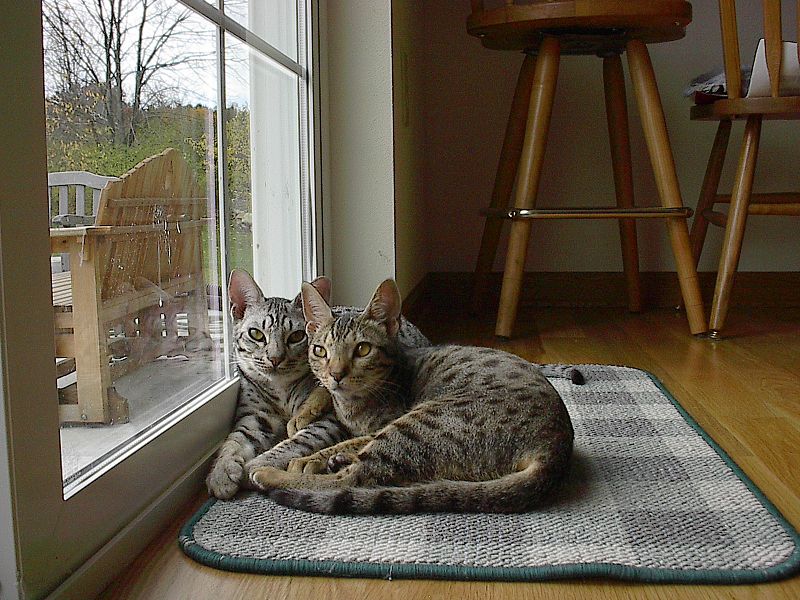
Friday Catblogging: New research reveals how cats get their stripes (or spots)


Ocicats

Domestic cats often resemble their larger, wilder counterparts — with black, striped or tawny fur that presumably helps the big hunters blend into the landscape. For scientists, the genes involved in the evolution of cats’ color patterns have been equally well camouflaged. But a new study in Science reveals a mutation shared by housecats and cheetahs, which may explain how the cat got its stripes — or, in this case, its blotches.

The sharp, evenly spaced stripes of the tabby cat are among the most common of coat patterns. In some tabbies, however, the stripes look more like long, irregular swirls. Although fairly common in domestic cats, this pattern (called “blotched” by geneticists and cat fanciers) is unusual in the wild. In fact, cheetahs with the blotched pattern were initially thought to be a separate species: They were crowned with the name king cheetahs to distinguish them from the more common, spotted kind.

See, New research reveals how cats get their stripes – The Washington Post.