FREE WHITEWATER

Friday Poll: Will you watch the Presidential Debates?

I asked in an earlier poll if readers would watch the major-party conventions (most respondents said that they would), and here’s a poll about the last big, formal political events between now and November 6th. (Otherwise, it’s campaign ads and speeches as each candidate wishes, with no set schedule as with the conventions or debates.)

Needless to say, I wish Libertarian Party candidate Gary Johnson were part of these debates, but I’ll watch them all regardless. The debates are scheduled for 10.3, 10.11, 10.16, 10.22.

How about you?


Daily Bread for 9.28.12

Good morning.

Whitewater’s week ends with a sunny day, calm winds at 5 MPH, and a high of seventy. Very pleasant.

On this day in 1941, Ted Williams became the last player to hit .400. These generations later, no one in all baseball has equalled that feat:

On this day in 1941, the Boston Red Sox’s Ted Williams plays a double-header against the Philadelphia Athletics on the last day of the regular season and gets six hits in eight trips to the plate, to boost his batting average to .406 and become the first player since Bill Terry in 1930 to hit .400. Williams, who spent his entire career with the Sox, played his final game exactly 19 years later, on September 28, 1960, at Boston’s Fenway Park and hit a home run in his last time at bat, for a career total of 521 homeruns.

On this day in 1925, in Wisconsin history, a great inventor was born:

1925 – Seymour R. Cray Born
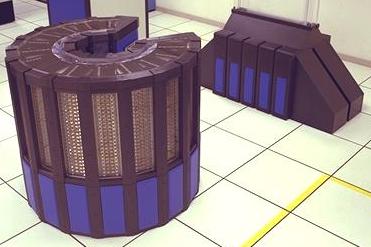
On this date Seymour R. Cray was born in Chippewa Falls. Cray received a BS in Electrical Engineering from the University of Minnesota. He established himself in the field of large-scale computer design through his work for Engineering Associates, Remington Rand, UNIVAC, and Control Data Corporation.

In 1957 Cray built the first computer to use radio transistors instead of vacuum tubes. This allowed for the miniaturization of components which enhanced the performance of desktop computers. In the 1960s he designed the world’s first supercomputer at Control Data. In 1972 he founded Cray Research in his hometown of Chippewa Falls where he established the standard for supercomputers with CRAY-1 (1976) and CRAY-2 (1985).

He resigned from the company in 1981 to devote himself to computer design in the areas of vector register technology and cooling systems. Cray died in a automobile accident on October 5, 1996. [Source: MIT and Cray Company]


Cray-2

Google’s daily puzzle asks about an ancient Roman folk remedy (that surely doesn’t work): “What did the ancient Romans believe they could prevent with the herb that sprung from Archemorus’ blood?”

Daily Bread for 9.27.12

Good morning.

Thursday in Whitewater will be sunny and mild, with a high of sixty-five.

Whitewater’s Community Development Authority meets this afternoon at 4:30 PM.

On this day in 1964, the Warren Commission issued its report concluding that Lee Harvey Oswald acted alone in the assassination of Pres. Kennedy.

Sometimes even the largest animals, like a six-hundred-pound sea turtle, require a helping hand. The marine biologists at the New England Aquarium provided that assistance. Here they are in action:

Google’s daily puzzle is about a particular kind of table: “What kind of table was first produced by the 8th Laird of Merchistoun?”

Daily Bread for 9.26.12

Good morning.

It’s a sunny midweek day ahead for Whitewater, with a high of sixty-five.

On this day in 1960, the first televised presidential debate took place in Chicago between VP Nixon and Sen. Kennedy. (The first presidential debate this year will take place on October 3rd in Denver.)

Here’s that debate:

Google’s daily puzzle asks about a king: “I was known as the “Lion of the North,” and died heroically on the battlefield. How many years did the war continue after my death?”

Introduction to Waste Digesters: The Thin Entering Wedge

In this introductory and general series of posts on waste digesters, I have listed all the organic waste that may be composted (digested) in an anaerobic waste digester. This organic waste may comprise discarded food, partly eaten-food, animal carcasses, or animal & human excrement.

All those ingredients can power an anaerobic digester, and often do, in those places that have them.

There are two reasons that, in this series, I have described the full organic ingredients list for digesters.

First, because this description is more complete, and so more accurate, than one that describes anaerobic digesters in more delicate ways, as though they could process only discarded garden vegetables.

Second, because although the proponents of a digester will often talk in delicate ways, the actual agreements that they execute with unsuspecting towns will specify a digester, but typically place no contractual limits on the contents that may go within it.

One may hear about one ingredient, but yet a community may unwittingly obligate itself contractually to accepting anything and everything that might go into the digester.

That’s the thin entering wedge: a delicate discussion, but later on, an unsavory contractual obligation.

(Of course, even if a community tried to impose a written limitation on the contents going into an anaerobic digester, verification of what was in each truckload, arriving as it would at any time of day or night, would be practically impossible.)

And yet, and yet, imagine a community so foolish that it would execute an agreement without even formally imposing those restrictions at the first instance.

Looking for Information on Waste Digesters?

Welcome.

If you’re visting in search of information on commercial waste digesters – of their environmental, economic, municipal-fiscal, and public policy implications — please see my introductory series here @ FREE WHITEWATER. I’ve a dedicated category on them generally, and another category about a proposal to construct one in Whitewater, Wisconsin.

Thanks for visiting – and feel free to look around at all my sites: Daily Adams, Daily Wisconsin, and FREE WHITEWATER.

Daily Bread for 9.25.12

Good morning.

Our Tuesday will be sunny and warm, with a high of seventy-seven.

On this day in 1957, Pres. Eisenhower federalized the Arkansas National Guard, and sent federal soldiers of the 101st Airborne, to enforce court-ordered integration.

Under escort from the U.S. Army’s 101st Airborne Division, nine black students enter all-white Central High School in Little Rock, Arkansas. Three weeks earlier, Arkansas Governor Orval Faubus had surrounded the school with National Guard troops to prevent its federal court-ordered racial integration. After a tense standoff, President Dwight D. Eisenhower federalized the Arkansas National Guard and sent 1,000 army paratroopers to Little Rock to enforce the court order.

In Wisconsin history on this day in 1961, “Governor Gaylord Nelson signed into law a bill that required all 1962 cars sold in Wisconsin to be equipped with seat belts.”

Google’s daily puzzle asks about a ruler’s crown: “What color was my crown before I united the “two lands” of Upper and Lower Egypt around 3000 BCE?”

An Introduction to Waste Digesters: A Modest Proposal

There’s more than one reason to be concerned about large commercial waste digesters: their environmental risks, their fiscal strain on a municipality’s infrastructure, their exaggerated or illusory economic benefits, and the secretive way they’re promoted by a few insiders.

For these reasons, I’ve a modest proposal: let those within a community who introduce these waste-processing plants live closest to them, and daily walk through the fields spread with their waste, drink the water that comes from them, and breathe deeply of the malodorous gases from them.

Better still, if proponents are so very confident of this waste-disposal scheme, let them have their children play in those fields, drink only the digester’s water, and inhale the gases from the digester plant. Not merely for a day, but instead day after day and year after year, as a regular and unfailing routine.

If the processing of rotten food, partly-eaten food, animal carcasses, and excrement (and all attached to them) offers only benefits and no risks, then proponents should be happy to relocate near a large, commercial digester. Why should other homeowners, their families, schools, retirement communities, parks, a campus, and nearby farms and businesses be alone in proximity to the digester?

A ‘monumental’ deal surely deserves monumental confidence and commitment: let each advocate take pride of place, and move near the digester.

It’s a simple request, and fulfillment just a real estate agent’s call away, after all.

Why live far away, when one could have the honor of being next door?