
Daily Bread
Daily Bread for 9.24.12
by JOHN ADAMS •
Good morning.
Whitewater’s week begins with a sunny day and a high of sixty-nine.
On this day in 1789, America saw her first Supreme Court:
The Judiciary Act of 1789 is passed by Congress and signed by President George Washington, establishing the Supreme Court of the United States as a tribunal made up of six justices who were to serve on the court until death or retirement. That day, President Washington nominated John Jay to preside as chief justice, and John Rutledge, William Cushing, John Blair, Robert Harrison, and James Wilson to be associate justices. On September 26, all six appointments were confirmed by the U.S. Senate.
The U.S. Supreme Court was established by Article 3 of the U.S. Constitution. The Constitution granted the Supreme Court ultimate jurisdiction over all laws, especially those in which their constitutionality was at issue. The high court was also designated to oversee cases concerning treaties of the United States, foreign diplomats, admiralty practice, and maritime jurisdiction. On February 1, 1790, the first session of the U.S. Supreme Court was held in New York City‘s Royal Exchange Building.
The U.S. Supreme Court grew into the most important judicial body in the world in terms of its central place in the American political order. According to the Constitution, the size of the court is set by Congress, and the number of justices varied during the 19th century before stabilizing in 1869 at nine.
Google offers a daily puzzle for stargazers: “If you’re staring at “le casserole” in the night sky, which two stars form the optical double?”
Waste Digesters
An Introduction to Waste Digesters: The Economics of Waste Digesters
by JOHN ADAMS •
If what goes into a digester is foul (and it is), and if what comes out of one is foul (and it is), then what accounts for proposals on their behalf? It is not, and never has been, a consequence of popular desire. There’s a clue in this, worth considering.
Demand.
One knows, after all, that demand is an “economic principle that describes a consumer’s desire and willingness to pay a price for a specific good or service.” So, where are these many consumers who ask, from among all alternatives, that rotting food and animals be trucked into their communities day and night, from faraway places, composted in a vast, foul-smelling building, and then returned to the neighborhood as solids, liquids, and gases?
There are no groups of consumers like that. None.
If given a dozen ways to manage and handle the decaying and the excreted, no sensible person would choose a process that brought it closer to him. This is altogether sensible: the best practice is to transport waste away from cities and towns, away from the ground on which one walks, water that one drinks, and the air that one breathes.
There is no consumer demand for huge waste digesters as a garbage-disposal scheme. There are no crowds clamoring for these devices. Nowhere or anywhere, so to speak. The self-interested few may hawk them; the impartial many have never gathered in their favor.
Subsidies.
A good, private idea will always attract private capital – from banks and investors. America’s economy produces well over over a dozen trillion dollars annually – there is plenty of business capital for large ventures.
One should be wary of big talk, about big deals, but deals that can’t find private investment. Consumers may have hardships, but real capitalists use private capital.
A waste digester deal, while foolishly described as ‘monumental,’ typically involves large sums of public money, from state and federal taxpayers’ dollars, for the means to build a waste and garbage processing operation in a town. Those pushing these deals will rely on municipal grants (taxpayer money), community development grants (taxpayer money), municipal or community development loans (taxpayer money), and federal bonds (public debt) to build their plants.
They’ll also seek to use as much as they can of existing municipal facilites, for treatment and disposal, thus burdening the public’s municipal infrastructure.
So much for private investment: out-of-town businessmen make a private profit processing waste into a town’s environment using that very town’s public resources.
That’s not a private investment; it’s a public mistake.
Employment.
Waste digester proponents talk about the jobs that they will provide, and advocates will promise some jobs here, or some there. An actual enumeration of these jobs is typically missing from their claims. These jobs could only be one of three kinds: those who build the digesters, those who truck refuse and excrement to the digesters, and those who work in the digester plants.
Here one sees that claims of employment are temporary, inflated, or illusory. Those who build the plants will not remain, but will instead move on to other jobs in other places. They are no permanent addition to the labor pool. They are only briefly to be counted.
Those who truck refuse into and from a city each day aren’t new, local workers. They are transitory garbage haulers. Dozens of jobs in a local factory aren’t the same as dozens of garbage haulers, with loads from distant cities, simply driving in and out of a town at all hours. They are over-counted.
But what of those who will work, permanently, at the digester plant? There is the most telling question of all, as these plants may be operated and monitored remotely from an out-of-town headquarters, safely away from the refuse and odors of the host city.
So, for each and every one of these proposals, one should ask: Will this facility be run remotely? If you say it will not be so, can you enumerate the time and roles of each and every fulltime, permanent local job the facility produces?
One may wait a long time for an answer, but even longer for a candid one.
The Successful and Sensible Reject Waste Digesters.
Consider where one finds waste digesters, and one will see the truth about them. It’s only among vulnerable, foolish, and downmarket communities that one finds a large waste digester.
There is no example in all America of a successful and thriving community, a clean and pleasant place, that has welcomed a large, commercial digester. Not one.
The homeowners, parents, merchants, consumers, and residents of enjoyable towns – across this vast country of over three-hundred million – have never wished this for their communities.
A waste digester is not what uplifts a place, but what befalls it.
It’s that simple.
Tomorrow: A Modest Proposal.
Recent Tweets, 9.16 to 9.22
by JOHN ADAMS •
http://storify.com/DailyAdams/recent-tweets-9-16-to-9-22-23
Cartoons & Comics
Sunday Morning Cartoon: The Solid Tin Coyote
by JOHN ADAMS •
Daily Bread
Daily Bread for 9.23.12
by JOHN ADAMS •
Good morning.
Sunday in Whitewater will be sunny and breezy, with a high of fifty-nine, and winds from the west-northwest at 10 to 20 MPH.
On this day in 1779, John Paul Jones won a naval battle in English waters:
During the American Revolution, the U.S. ship Bonhomme Richard, commanded by John Paul Jones, wins a hard-fought engagement against the British ships of war Serapis and Countess of Scarborough, off the eastern coast of England….
In August 1779, Jones took command of the Bonhomme Richard and sailed around the British Isles. On September 23, the Bonhomme Richard engaged the Serapis and the smaller Countess of Scarborough, which were escorting the Baltic merchant fleet. After inflicting considerable damage to the Bonhomme Richard, Richard Pearson, the captain of the Serapis, asked Jones if he had struck his colors, the naval signal indicating surrender. From his disabled ship, Jones replied, “I have not yet begun to fight,” and after three more hours of furious fighting it was the Serapis and Countess of Scarborough that surrendered. After the victory, the Americans transferred to the Serapis from the Bonhomme Richard, which sank the following day.
Jones was hailed as a great hero in France, but recognition in the United Stateswas somewhat belated. He continued to serve the United States until 1787 and then served briefly in the Russian navy before moving to France, where he died in 1792 amidst the chaos of the French Revolution. He was buried in an unmarked grave. In 1905, his remains were located under the direction of the U.S. ambassador to France and then escorted back to the United States by U.S. warships. His body was later enshrined in a crypt at the U.S. Naval Academy in Annapolis, Maryland.
From Google’s daily puzzle, a question about barbers’ poles: “What do the spiral bands on barbershop poles represent?”
City, Press Release
City of Whitewater Selects Cameron Clapper as Next City Manager
by JOHN ADAMS •
Please see a press release from the City of Whitewater about the selection of a new city manager, following a selection process concluding with interviews of finalists earlier today:

PRESS RELEASE
Saturday, September 22, 2012
After interviewing five finalists, the City of Whitewater Common Council has unanimously selected Cameron L. Clapper to serve as Whitewater’s City Manager. Clapper has served as interim City Manager in Whitewater since former City Manager Kevin Brunner resigned in June. Clapper began his employment with the City of Whitewater in April of 2010, serving as Assistant City Manager. Clapper previously served as Assistant to the Administrator in the Village of Waunakee, Wisconsin.
Clapper stated that “It is a thrill and an honor to have been selected by the Common Council to serve as the City Manager. I look forward to serving the community for years to come.”
Common Council President Patrick Singer stated “The Common Council is very pleased to have Cameron Clapper as its next City Manger. Cameron has proved himself to be a hard-working and dedicated individual who will lead Whitewater in the right direction.”
Clapper received his Master of Public Administration degree from Brigham Young University in Provo, Utah and his Bachelor of Arts – International Studies from Brigham Young University, Provo, Utah. Clapper and his wife, Michelle reside in Whitewater, and have three children, Jared, Afton, and Caleb.
The Council will be working on an employment agreement with Mr. Clapper and hope to have a final vote on the appointment at its October 2nd meeting.
Waste Digesters
An Introduction to Waste Digesters: What Comes Out of a Digester
by JOHN ADAMS •
If the process of waste digestion is merely a crude mimicking of animals’ digestion, and if the ingredients of waste digestion are discarded, partly-eaten food, animal carcasses, or animal & human excrement, and all of the chemicals and substances attached to any of them, then there remains an even more astounding truth: what comes out of a digester.
Just as with animals’ excretions of feces, urine, and of flatulence, waste digesters produce solids, liquids, and gases. The surprising truth is that the production of foul-smelling methane for sale entails dumping the digester’s resulting solids onto the ground, pouring its water into the environment, and often breaching its gases into the air by burning.
However odd and absurd it seems, the results of composting discarded and masticated food, the rotting carcasses of rendered animals, and animal & human excrement are returned to the environment. They are returned as solids, liquids, and gases, with added risk of the chemicals & diseases to which the digester’s original contents may have come into contact.
Sludge (‘BioWaste’ or “BioMass’).
A digester, like a stomach, does not digest food into neat canisters for ready transportation or storage. The composting process doesn’t produce tiny cans of cooking fuel. It produces, principally, a solid mixture of the dark and foul contents of the digester, itself: sludge. Truck after truck dumps load after load into the digester, and those contents do not stay there forever. Out they must come, in time, as cheeseburgers come out of people: as a mostly solid but wholly unpleasant substance.
To make room for more, these solids have to be dumped somewhere, somehow. They’re often spread on the ground. Although that seems like an ordinary process of fertilization, it’s hardly so: this is not, and will never be, the compost from one’s garden. Containment of disease causing agents, pathogens, is a constant concern of waste digestion.
So much so, that it’s a national focus of the USDA’s National Agricultural Biosecurity Center’s Consortium. See, Carcass Disposal: A Comprehensive Review. National Agricultural Biosecurity Center’s Consortium (August 2004).
From Chapter 7 on Anaerobic Digestion, Section 4.2, on Risk of Contamination:
If the end products of anaerobic digestion (biosolids) are applied to land without pathogens being sufficiently reduced, the pathogens may pose a risk of contamination. Human beings and animals can be contaminated after being exposed to variable quantities of pathogens, as shown in Table 7. The infective dose depends on the type of pathogen and health of the host. Indeed children, older people, and people with compromised immune system are at greatest risk.
(Emphasis added.)
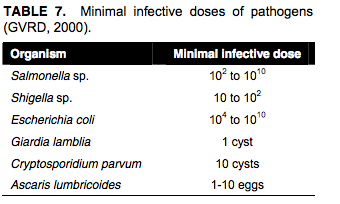
Generally, sludge accumulates in the bottom of the digester. Consequently, all pathogen agents capable of surviving in the digester could still be found in the end product several months after the introduction of pathogens in contaminated carcasses.
Careful research has established how long these pathogens might survive in the environment. Again, from the Consortium report, page 14:
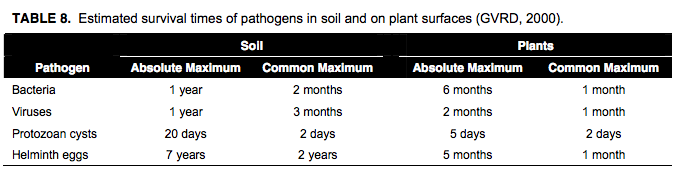
Days, months, years.
One will not want to walk over those fields anytime soon.
Liquids: ‘Water, water every where, Nor any drop to drink’
Not merely solids, but liquids, too, will come from a digester. Proponents of these devices will look carefully for a way to dispose of the liquids from them. Perhaps they’ll seek to burden an existing municipal water facility with the additional, vast flow of water from the digester. They may likewise seek the entitlement to use an existing municipal permit from the state to allow final discharge into a nearby stream or creek.
This is especially troublesome in those areas (like much of Wisconsin) with karst areas, areas with bedrock that is easily dissolved by water, after which there are numerous cracks, sinkholes, and ways for water to seep down into the ground, and into people’s wells. Limestone is like this.
This is true for both liquids and solids in karst areas – they can contaminate the environment more easily than in areas with less porous bedrock.
Gases.
What, then, of the methane gases these digesters produce? They are produced, but not alone: other gases come from a digester, too. Even methane, while produced, isn’t always used – it’s sometimes burned off, when demand is low (as when competing natural gas is cheap) or when necessary despite demand.
Here, from Lusk, P. (1998). Methane Recovery from Animal Manures: A Current Opportunities Casebook. (3rd Edition. NREL/SR-25145. Golden, CO: National Renewable Energy Laboratory. Work performed by Resource Development Associates, Washington, DC., is a table from page 3-12 showing the gases a digester produces:
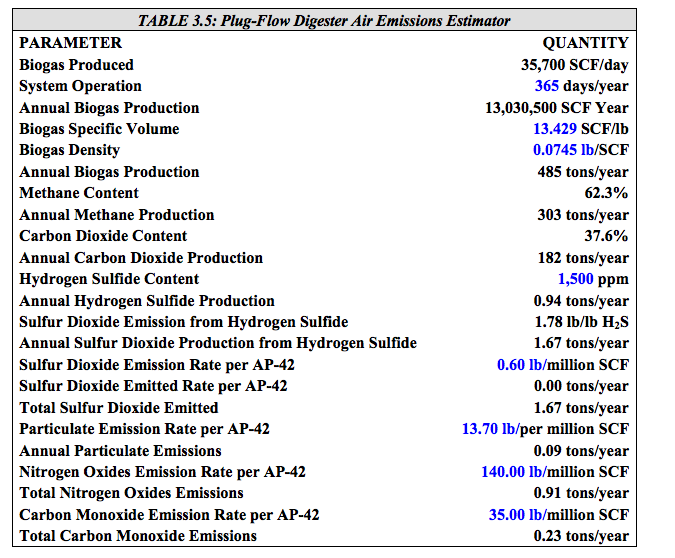
Methane, carbon dioxide, hydrogen sulfide, sulfur dioxide, nitrogen oxides, carbon monoxide.
There you are – not in some faraway place, but in your own city or town.
Tomorrow: The Economics of Waste Digesters.
Daily Bread
Daily Bread for 9.22.12
by JOHN ADAMS •
Good morning.
Whitewater’s Saturday will bring occasional showers, mostly in the morning, and a high of sixty.


The city has a treat today: it’s the second day of Pig in the Park, at Whitewater’s Cravath Lakefront. It’s a full schedule of tasty and fun activities:
Saturday September 22, 2012
Athletics
8:00 am to 9:00 am 5K
9:30 am to 10:00 am Fit Kid Shuffle
PigAsso
10:00 am to 4:00 pm Arts & Crafts
10:00 am to 4:00 pm Commercial
Specialty
11:00 am to 3:00 pm Chop’s Motorcycle Show
12:00 pm to 2:00 pm Barbecue contest judging
12:00 pm to 8:00 pm PigPen – Mechanical Bull, Gladiator Joust &
Bungee Run
Refreshments
10:00 am to 10:00 pm Beer & Wine Garden
10:00 am to 10:00 pm PigNic Garden
Eating Contest
11:00 am to 11:30 am Pizza
4:00 pm to 4:10 pm Corn on the Cob
4:20 pm to 4:30 pm Hot Wings
Motorcycle Burn Out’s
12:00 pm
1:00 pm
2:00 pm
Music
12:00 pm to 3:00 pm Paul Filipowicz Bluesman
4:30 pm to 7:30 pm Blackwater
8:00 pm to 11:00 pm Tombeau Road
On this day in 1862, Pres. Lincoln issued the Emancipation Proclamation.
Google’s daily puzzle asks about an invention: “Following my discovery of methane, I invented a device that many people use every day. What’s it called?”
City
On Whitewater’s Candidates’ Forum for City Manager
by JOHN ADAMS •
Update, 9.22.12: Embedded below is the video of the Friday evening candidates’ community forum.
City Manager Candidates Forum 09/21/2012 from Whitewater Community TV on Vimeo.
Original post from 9.21.12:
Earlier this evening, Whitewater held a candidates’ forum for her open city manager position. There are five candidates, and it’s likely that Council will pick one of them by tomorrow afternoon.
Whitewater is in need of something different from her last two municipal administrations. The earlier of the two ended with a bang, the more recent with a whimper. Both were celebrated when they began; either would have done better to manage humbly and inclusively. These last four or so years, in particular, have been mostly wasted – a city in need of basic management has been littered with big schemes and tiny results.
A few observations on the community forum, held in the municipal building, and lasting a bit over an hour —
1. Traditional and Conventional. All of the candidates are professional public administrators, are committed to that work, and have studied public administration at one time or another. Most are about the same age, and from their answers, all have a (mostly) similar outlook. Four of the five are near the end of their careers, I’d guess. These are all men (and they are all men, by the way) who see the world as public officials would see it; there’s is shared a government-to-outside perspective. The similarities in the selection of finalists are almost certainly by design. It’s a group meant to be heavy on experience, of a certain type.
2. Understated. At least in these interviews, each candidate was even-spoken, steady, and almost subdued. Although this was understandably a long day for them, there’s a value in hearing candidates after a long day: some working days will be long, too. One gets a better sense of their reserves of energy and enthusiasm. No one was ebullient or powerfully expressive, but instead simply moderate in expression.
3. Inside or outside? Whitewater has a choice to make: inside or outside? Will the next city manager take a highly-visible or a low-profile role? Either approach can be successful, but only if both possibilities are grounded in true humility, fairness, and respect for honest analysis and practical accomplishments. A pyramid-builder is of no use, but much harm, to a small city. Generally, the more traditional and conventional the candidate, the better a low-profile role will be.
4. Who decides? Who will play the leading role, of policymaker, in the city? Will it be the city’s common council or her city manager and his staff? All correctly deferred to common council as the legitimate policymaker, but the proof is in the pudding. There will always be the risk of bureaucratic mission creep, a few months or a year after a new city manager is in the job. That kind of overreaching has been bad for the city; trying more of it will produce the same disappointing results.
5. Development success stories. Most of the candidates described development success stories as ones in which prospective businesses got tax breaks, federal or state grants, the buying out of homeowners to clear the way for business expansion, etc. No. Those are bad ideas, but predicable ones for men who see the world from a government-out perspective. It’s also an approach of reduced prospects: there’s less an less public money to invest (really, to waste) on big businesses that want big handouts.
The people of Whitewater don’t owe big-talking and big-scheming businesses a dime of their money, or their public obligation (as municipal debt). Public money should be , first and foremost, for public safety and care of the poor. Real capitalists use true, private capital; the rest are frauds and burdens on their less fortunate neighbors.
Those near the end of their municipal careers may look back to days when government could impose on taxpayers again and again. There’s no more to take; they won’t be able to manage that way in the decade ahead
6. A Distressed Tax Incremental District. Whitewater is one the very few communities in Wisconsin to have a distressed tax incremental district. All the candidates but one seemed to know that we are one of the unfortunate few. The fifth answered a question about TID 4 with a general reply that supposed tax incremental districts are designed to overcome an area’s distress. That’s correct, that is their intended purpose. It’s just that they’re seldom so sparingly used – it’s often a spending scheme used too often, that promises too much and delivers too little.
And so, here we are.
How to fix a distressed TID? Most of the candidates proposed refinancing (reasonable if possible) or borrowing from other TIDs that might be doing better. It’s this second idea that’s really and truly mistaken. Borrowing from other TIDs compounds a city’s troubles. (For more about TIDs in the city, here’s a search link to earlier posts.)
The only viable, longterm solution is to find the growth in private investment that the TID was designed to attract as the very reason for its creation.
7. A Chance to Do Better. In these candidates, Whitewater has a chance to do better. I wrote earlier, when posting about the finalists, that I wished them all well. These have been hard years for the city, but we can – and I believe we will — do better. Practical, matter-of-fact, day-in day-out management would do us a world of good.
I hope, as everyone here does, for the best for our city.
Waste Digesters
An Introduction to Waste Digesters: What Goes Into a Digester
by JOHN ADAMS •
Waste digesters take organic waste (and any substances, chemicals, or concoctions attached to that waste) and process it through composting (‘digestion’). Although a few describe these ingredients as ‘clean and green,’ that’s false: they’re mostly brown and entirely foul. Nor are these ingredients assured to be natural: they will inevitably include the unnatural, concocted chemicals and pollutants with which the natural ingredients will have come into contact.
Organic Ingredients.
Of the organic ingredients, digesters take in discarded and masticated food, the rotting carcasses of rendered animals, animal excrement, or even human excrement. Take it in they do, in large amounts: a commercial operation will require dozens of full truckloads of waste – perhaps fifty or more – each day. As the digester operates both day and night, these trucks will travel great distances at all hours to deposit their contents. The filth and dead animals of other places, far from the host city, will be carted to the digester at a continuous, relentless pace.
In this way, a waste digester reverses the tried-and-true method of waste disposal: instead of taking rotting food, flesh, and excrement to places far away from people’s homes, they bring that waste from faraway places near the very homes in communities with digesters.
A digester reverses all experience, and even the habits of animals: it’s natural to stay away from rotting substances and excrement. There’s never been, in all the history of the world, a successful culture that brought these substances closer to their homes. Not one.
In all history, there’s never been a culture that wished to be nearer to waste, or have their children closer to it. Not one.
The Organic Ingredients’ Other Ingredients.
Perhaps the strong of stomach and confused of mind are unconcerned about the excrement and rotting things that go into a digester. Perhaps. That’s not all that goes through a community’s streets, day and night, into a digester: it’s not only those rotting things, but each and every thing of which those rotting things may be contaminated.
If discarded food, then it’s also what went into it: pesticides, plant diseases, fertilizers, additives, dyes, with whatever unnatural genetic modifications that food underwent.
If partly-eaten, masticated food, then it’s also all those substances that went into the food during eating: whatever those consuming it took with the food, including any infections or viruses they may have had, or medicines they may have been given. Few would happily hold the half-chewed remains a burger found on the street, or comfortably carry the masticated patties in their pockets.
If excrement, that organic matter includes everything those animals ate or touched and then excreted: their medicines, their diseases whether bacterial or viral, and their meals of whatever unhealthy and chemically-enhanced kind.
Some of these other ingredients are themselves organic, but dangerous; others are inorganic and dangerous.
Not Simply Plants.
Though one will hear that digesters process food waste (with an emphasis on vegetables), that’s only part of what they consume. (There’s a way in which talking about food waste is a feint, a distraction from the full ingredients’ list in waste digestion. Even if food, the food itself is only part of the contents: it’s every unnatural thing in the food, of course.)
Despite rosy claims, the contractual agreements for waste digesters won’t specify the exclusive use of ‘really-clean vegetables’ or ‘perfectly fine but uneaten food.’ Of course not – the full truckloads are crammed with whatever can go into the digester, whether plants or animals or excrement.
In it all goes.
With so many truckloads, day and night, how would one verify their contents, anyway? Even if one could verify that only the certain things went in, one would have no way to know the contents’ contents, so to speak (of contaminants, etc.).
If these things are trucked into a town, and then into a digester, where do they go thereafter?
Tomorrow: What Comes Out of a Digester.
Cats
Friday Catblogging: Why Do Cats Always Land On Their Feet?
by JOHN ADAMS •
Poll
Friday Poll: A Wild Card Spot for the Brewers?
by JOHN ADAMS •
Update: the poll’s now open –
It’s been a long season for the Brewers, with months of it spent under .500, but now they’ve a chance for a wild card entry into the post-season.
Do they make it into October as a wild card team? They’ve missed so many opportunities this season, that instinct suggests to me that they won’t, but I’ll still answer that they do, because late September is baseball’s time for enduring hope.
What do you think?
Daily Bread
Daily Bread for 9.21.12
by JOHN ADAMS •
Good morning.
The week ends for Whitewater with a likelihood of showers and a high of fifty-nine.
There is a reception for city manager candidates today at 4 PM, and a community forum at 6:30 PM today:
4:00 p.m. – 5:30 p.m. COMMUNITY RECEPTION – MEET AND GREET
Innovation Center Atrium, 1221 Innovation Drive in Whitewater –
Candidates will meet members of the Whitewater Community6:30 p.m. – 8:30 p.m. COMMUNITY PUBLIC FORUM
Candidates will respond to questions from the Whitewater community.
The forum will be held in the Council Chambers in the Municipal Building at 312 West Whitewater Street.
Whitewater’s Pig in the Park begins this evening and continues tomorrow at the Cravath Lakefront.
On this day in 1780, Benedict Arnold betrayed America:
On this day in 1780, during the American Revolution, American General Benedict Arnold meets with British Major John Andre to discuss handing over West Point to the British, in return for the promise of a large sum of money and a high position in the British army. The plot was foiled and Arnold, a former American hero, became synonymous with the word “traitor.”
From Google’s daily puzzle, a question about ancient chemistry: “What did the ancients call the chemical element that’s often used as a vulcanizing agent?”