FREE WHITEWATER

Recent Tweets, 7.8 to 7.14

13 Jul
@DailyAdams
Amazon same-day delivery: How the e-commerce giant will destroy local retail Slate Magazine http://slate.me/SkAIrv

13 Jul
@DailyAdams
UFO sightings are more common than voter fraud | Mother Jones http://bit.ly/Nr0W9V

13 Jul
@DailyAdams
57 new food items at WI State Fair this year, including pork donut http://bit.ly/Mr261R #porkdonut

13 Jul @DailyAdams
Joe Paterno, at the end, showed more interest in his legacy than Sandusky’s victims Washington Post http://wapo.st/NqgcE4

12 Jul @DailyAdams
Team USA will be dressed in uniforms made in China ABC News http://bit.ly/Lio3Fb #embarrassment

12 Jul @DailyAdams
Wisconsin leads the nation in mink-pelt production http://bit.ly/LijN8P #badbusiness

12 Jul @DailyAdams
Romney’s Bain Story Is Falling Apart? Could he really be foolish enough to lie about his departure? http://bit.ly/Nsg0os

11 Jul Libby Jacobson @LibbyJ
http://Whitehouse.gov petition to make the TSA follow the law. #SignItMaybe? http://bit.ly/P14W2J
Retweeted by John Adams

11 Jul @DailyAdams
Indeed it should: “@CatoInstitute: #TSA Should Follow the Law – http://j.mp/MihpAh

10 Jul @DailyAdams
That’s the size of it: Holder Calls Voter ID Laws ‘Poll Taxes’ http://bit.ly/LNnNLa

9 Jul @DailyAdams
Krugman contrasts Romneys George and Mitt http://www.nytimes.com/2012/07/09/opi

9 Jul @DailyAdams
Law Enforcement Requests for Cell Phone Records at All-Time High http://bit.ly/MWagEL #surveillancestate

9 Jul Cato Institute @CatoInstitute
NEW Podcast: USDA, Organics and ‘Big Food’ http://j.mp/RQxdsJ (h/t @COBrown)
Retweeted by John Adams

Poll: Favorite Music

Today’s poll asks about one’s favorite music. I’ve added some of the most common genres from the Billboard charts, with a category for other.  Multiple selections are possible.

It’s a mix of jazz, blues, and scattered pop tunes for me.

What are your favorites?


Daily Bread for 7.13.12

Good morning.

This Friday the 13th brings Whitewater a high of ninety-two, with a 40% chance of thunderstorms in the afternoon.

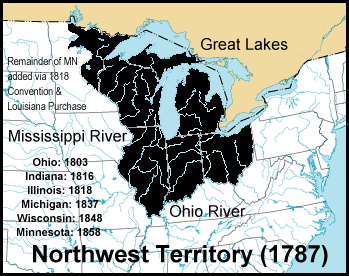
On this day in 1787, the Congress established the Northwest Territory:

On this date the Northwest Ordinance was passed by the Continental Congress. The ordinance provided for the administration of the territories and set rules for admission as a state. The Northwest territory included land west of Pennsylvania and Northwest of the Ohio River, which encompassed present day Ohio, Indiana, Illinois, Michigan, parts of Minnesota and of course Wisconsin. [Source: Indiana Historical Bureau]

Via Wisconsin Historical Society and Wikipedia.

Google’s daily puzzle asks about the Ancients: “Gegania, Veneneia, Canuleia, and Tarpeia were considered the first four to do a particular job. What was the penalty if they didn’t do their primary
duty correctly?”

Daily Bread for 7.12.12

Good morning.

It’s a hot Thursday for Whitewater, with a high of ninety-four, and a light wind, at five to ten miles per hour, in the morning.

On this day in 1984, Walter Mondale named Geraldine Ferraro his vice presidential running mate.


The Wisconsin Historical Society recalls that in 1995, Wisconsin and the Midwest faced scorching temperatures that year, too:

From July 12-15, 1995, the Midwest was subjected to a deadly outbreak of hot and humid weather responsible for 141 deaths in Wisconsin. According to the Milwaukee Journal-Sentinel, this was the “greatest single event of weather-related deaths in Wisconsin history.” Most of the fatalities happened in the urban southeast counties of the state, and at one point several Milwaukee-area hospitals were unable to admit more patients.

Milwaukee Temperatures (from the Milwaukee Journal Sentinel): July 12: Hi=91, Lo=65 July 13: Hi=103*, Lo=78 July 14: Hi=102, Lo=84 July 15: Hi=92, Lo=69 July 16: Hi=88, Lo=68 *Some communities reported highs as high as 108. Heat Index values were 120-130 degrees.

NOAA’s Natural Disaster Survey Report on the outbreak is available at http://www.weather.gov/os/assessments/pdfs/heat95.pdf  [Source: Milwaukee Journal Sentinel]

Our recent heat wave seems at least as impressive in temperatures, although thankfully without so much harm.

Anglophiles will like today’s daily puzzle from Google: “Two people show up to your dinner party wearing coronets. One has 16 silver balls around its rim, the other only six. According to the British Peerage System, who gets the better seat?”


Go Curiosity!

NASA’s Administrator, Charles Bolden, has recorded a video for the employees of his agency, encouraging them to share excitement over the Curiosity rover’s upcoming August 2012 landing on Mars. It’s called, ‘Go Curiosity.’

The video announces a press kit available to NASA employees, so that they can talk about the mission with friends and neighbors.

There is reason to be excited – the rover is larger than others before it, and will be able to perform a more thorough series of experiments than earlier ones. America remains at the forefront of planetary exploration; we’ve reason for pride.

I’m not sure what to make of the video, though: does NASA have an employee enthusiasm problem? It’s hard to tell. Administrator Bolden speaks about the project in a way that seems to hope (but not expect) that NASA employees will be excited.

They should be – the exploration of the natural order offers an increase in knowledge, and the experience of beauty, even when one explores a world so distant and forbidding.

Go Curiosity!

Published originally on 7.11.12 at Daily Adams.

Questions for the Press about a Proposal with Green Energy Holdings

This week, I’ve posted a series of general questions about a proposed deal with Green Energy Holdings for a waste digester. See, Preliminary & General Questions about a Proposal with Green Energy Holdings and Questions for the CDA about a Proposal with Green Energy Holdings. (For a comprehensive list of all posts about this proposal, FREE WHITEWATER now has a designated category.)

In the Whitewater area, to my knowledge, there’s been one story, in the nearby Daily Union, published about the proposal.

In addition to the thirty questions I’ve published about the deal (nineteen general and eleven about the Community Development Authority’s role), here are several more specific to that newspaper story.

1. Why does the story’s lede erroneously say that the “Whitewater Common Council has finalized a preliminary development agreement” when that’s not true?

The agreement went to the Community Development Authority. There was nothing yet ‘finalized.’ Is saying that a preliminary development agreement has been finalized simply a transparent effort to make this proposal seem an accomplished fact?

2. Why does the story say that the agreement had to go to the Planning Commission, but omit the next step before the Community Development Authority? Did the reporter know the correct procedural sequence? If not, why didn’t he check?

3. If the story says that the proposal has to go the Planning Commission for review — even if that wasn’t the accurate sequence — then why bother with calling anything ‘finalized?’ (Perhaps my follow-up question under No. 1 provides an answer.)

4. Why does the story’s slug say that the plant will create a specified number of jobs, when in Paragraph 1 it’s merely “expected” to bring that number of jobs, and in Paragraph 25 it’s what they are “projecting” and “a projected number” from Green Energy Holdings?

Did the reporter ask how likely GEH thought its projection was? Did the reporter ask on what basis GEH was making its projection?

It’s clear in Paragraph 25 that then-city manager Brunner relies on what “[t]hey [GEH] are projecting.” Did the reporter ask if the city had made its own, independent assessment? (After all, in his Weekly Report of 6.22.12, the city manager said he worked on this for nine months.)

Did the reporter ask what the city manager did to assess this project independently during that time?

If he did, why is there no published statement about those supposed municipal efforts? If the reporter didn’t ask, why didn’t he ask?

5. The story describes a supposedly ‘monumental’ deal first announced to the community in June, yet set to begin construction quickly in August. Doesn’t that seem odd to the reporter?

So little information and so many grand claims. Why so few newspaper questions? In fact, why basically no true questions at all?

6. Brunner is quoted as saying that if the deal doesn’t reach a specified level of investment as incremental property value, then GEH will make a payment in lieu of taxes.

Lots of unasked (at least, unpublished) newspaper questions:

a. Why doesn’t the reporter ask about the difference between a possible increase in value and the much smaller payment in lieu thereof that would be only a taxable amount on the unrealized value?

b. Did the reporter ask how Brunner independently assessed the proposed dollar figures for increases in value?

c. Did the reporter ask how GEH established its projection for value?

d. The estimated total value is three times the supposed guarantee (that’s not really a guarantee of value anyway). Why didn’t the reporter ask about the vast range?

7. There’s mention about worm farming as a 22-billion-dollar-a year industry. Did the reporter ask what fraction of that value might accrue to Whitewater?

If he did ask, why wasn’t that figure reported? What would be the basis of any estimate, assuming there is one? Who made that estimate?

If these questions weren’t even asked, or if they don’t have answers, isn’t the grand national figure published in the story just fool’s gold?

8. Brunner is quoted as saying that “[t]his is exactly why we created the Innovation Center…” Why doesn’t the reporter ask about the actual, lawful federal basis for the taxpayer money used for the Innovation Center?

One can read about that basis online, to “…create jobs to replace those lost in the floods of 2008 and those lost from recent automotive plant closures.”

Is that what this proposal does?

9. Why so little information about how many plants GEH now has: locations, how long in business, number of workers at each, types of digesters, community reception, etc.?

It’s claimed as a big deal – why no company history, portfolio, prospectus for the public? Did the reporter even ask? If he did, what was the answer?

10. In an economy beset this last decade by financial scandals, dodgy accounting, and hollow claims about all sorts of projects, why wouldn’t the reporter ask about independent accounting assessments, offered from the developer and by the city?

Doesn’t every American city deserve open, up-front, information about the use of its resources?

Why would a real and legitimate newspaper accept unverified assertions of authority from politicians and business people? “Because I said so,” “trust me,” “I know what I’m doing,” and “in my years of municipal experience” aren’t a substitute for independent accounting and responsible, professional, open government.

11. The McClatchy newspapers have a motto, “Truth to Power®.” It’s inspiring. Isn’t that how a newspaper should approach government, on behalf of the public?

What’s your motto?

Shouldn’t it be something more than “All the News That’s Fit to Bolster and Re-Elect?”

Daily Bread for 7.11.12

Good morning.

It’s a sunny Wednesday ahead for Whitewater, with a high temperature of about eighty-eight.  There will be fifteen hours, six minutes of sunlight today, and sixteen hours, fourteen minutes of daylight.

On this day in 1979, the Skylab space station crashed back to Earth, having earlier been abandoned.

Also on this day, in 1804, Aaron Burr killed Alexander Hamilton in a duel:

In Wisconsin history on this date, the Wisconsin Historical Society writes that in 1839, the

First patent [was] issued to Wisconsin resident

On this day Ebenezar G. Whiting of Racine was issued patent #1232 for his improved plow, the first patent issued to someone from Wisconsin. Whiting’s improvements consisted of making the mold-board straight and flat which, when united in the center with the curvilinear part of the mold-board, would require less power to drag through the dirt. Whiting went on to serve as Vice President of the J.I. Case Plow Company and received another patent for a steel plow in 1876. [Source: United States Patent and Trademark Office]

Google’s daily puzzle tests one’s geography: “What is the difference in latitude between Rome, Oregon and the capital city of the Apennine Peninsula?”