FREE WHITEWATER

Daily Bread for 11.23.11

Good morning.

Whitewater’s Wednesday looks to be mostly sunny, with a high temperature of forty-six.

Margarine’s not just a butter (but not better) substitute — it was once a serious crime in America’s Dairyland, as the Wisconsin Historical Society recalls:

1909 – Janesville Man Convicted for Selling Oleo

On this date A.E. Graham of Janesville was put on trial for selling oleo as butter. Oleo, an early form of margarine, was outlawed in the dairy state of Wisconsin. On January 27, 1910, he was found guilty in federal court and sentenced to 18 months in Fort Leavenworth Prison. [Source: Janesville Gazette]

Not just a crime, but a federal one, and time in a federal prison, for A.E. Graham.

Daily Bread for 11.22.11

Good morning.

It’s drizzle and a high temperature of forty-one ahead for Whitewater today.

About a half-century later, America naturally still recalls the assassination of Pres. Kennedy on this day in 1963, and also remains transfixed by Abraham Zapruder’s 8mm film from that day.  Memorable, but for tragedy.

Here’s Google’s puzzle for today: “You’re standing on the beach soaking up some rays at the Earth’s 2011 aphelion. What day of the week is it?”

Thanksgiving News Update from the Institute for Justice

Here’s a holiday recap of projects ongoing at the Institute for Justice:

Happy Thanksgiving! We wanted to send you a quick update on what the Institute for Justice has been up to over the past month.

Live in Connecticut? Want brighter teeth? It’s a felony for anyone but a licensed dentist to offer teeth-whitening services. Watch our entertaining video about our lawsuit here.

Sorry, Governor Haley Barbour – in response to your veto in 2009, voters overwhelmingly approved eminent domain reform, making Mississippi the 44th state to pass legislation in response to Kelo. (Arkansas, Hawaii, Massachusetts, New Jersey, New York, and Oklahoma – we’re looking at you!)

Hello, Sunshine State! IJ launched its new Florida chapter with a lawsuit challenging Hialeah’s anti-competitive street vendor laws.

Check out IJ’s first historical mini-documentary about how the 14th Amendment protects your liberties from government tyranny.

Daily Bread for 11.21.11

Good morning.

Awaiting Whitewater is a partly sunny day with a high temperature  of forty-five.

We’ve any number of protests in Wisconsin these days, but there’s nothing new about protests among us, as the Wisconsin Historical Society recalls a notable campus protest in 1968:

On this date, 96 African-American students were arrested for occupying the university president’s office to protest the University administration’s refusal to commit to adding more black teachers, classes in African-American history, black speakers on campus, and a black cultural center. Although the students were jailed and suspended from the University, within a year many of their ideas were implemented, including adding black literature and history classes and opening an Interracial Cultural Center. View more information in the Dictionary of Wisconsin History. [Source: UW-Oshkosh Web site, “Do Your Thing,” http://www.uwosh.edu/archives/bt/about.htm]

I know only a little about Singapore, but apparently chicken rice is a famous national dish in that country.  Whatever limitations that nation may have, the food does look wonderful —

more >>

Recent Tweets, 11.13 – 11.19

Too funny (because too predictable) EU bans claim that water can prevent dehydration – Telegraph tgr.ph/tVOKaQ
19 Nov

Supercommittee at impasse as deadline approaches Washington Post wapo.st/rR2foK
19 Nov

‘Near Poor’ – Not Quite in Poverty, but Still Struggling – t.co/Pu5j9Bv9 nyti.ms/rTVhsx
19 Nov

Answer: No @jackshafer: Justices to Decide if Lying Journalist [Stephen Glass] Fit to Practice Law bit.ly/sAr6GD
18 Nov

Oh, brother: Ryan Gosling fans protest People’s decision to name Bradley Cooper the Sexiest Man Alive bit.ly/v6bJJl
18 Nov

On Occupy Whitewater, Wisconsin 11.17.11 #occupy freewhitewater.com/?p=18928
18 Nov

About 200 gather at UW-Whitewater’s Hyland Hall for speakers at #occupywhitewater
17 Nov

Someone was bound to find a way – Has Apple Made Programmers Cool? – Slashdot bit.ly/rUezx4
17 Nov

Of course they are: TSA Declares Banned-in-Europe Airport X-Rays ‘Completely Safe’ bit.ly/sQOpx7
16 Nov

Oh, brother Gingrich Said to Be Paid at Least $1.6 Million by Freddie Mac- Bloomberg bit.ly/rAMLTA
16 Nov

No to public money for private project: Madison council votes down $16 million in TIF for Edgewater bit.ly/rraTpr
16 Nov

The War on Immigrants » FREE WHITEWATER bit.ly/vGXWKW
15 Nov

Chance of 2012 U.S. recession tops 50 percent: Fed Reserve paper reut.rs/tLk7mH
14 Nov

The Misuse of Law Enforcement Against Peaceful Protesters

I may have my doubts about the Occupy movement’s platform (such as it is), but I’ve none about the aggressive use of law enforcement against peaceful protesters: that use is wrong, being both offensive and contrary to America’s political tradition.

The Huffington Post offers up a video of excessive use of force against seated protesters in California:

On Friday, a group of University of California, Davis students, part of the Occupy Wall Street movement on campus, became the latest victims of alleged police brutality to be captured on video. The videos show the students seated on the ground as a UC Davis police officer brandishes a red canister of pepper spray, showing it off for the crowd before dousing the seated students in a heavy, thick mist.

This incident recalls the earlier infamous pepper spraying by a New York Police Department official of several women who were seated and penned in. The UC Davis images are further proof that police continue to resort to brutal tactics when confronting Occupy activists. One woman was transported to a hospital to be treated for chemical burns.

This is a shameful abuse of authority, where no one threatens the police or other officials. Almost as bad, it’s the misuse of state resources to decide a peaceful political question, to tip the scales fundamentally against one group. As it was wrong to use dogs against civil rights protesters, so it is wrong to use chemicals against seated and peaceful Occupy protesters.

Excessive force against those committing simple acts of civil disobedience is a disgrace and shame to this country.

DNR Establishes Anti-Poacher Hotline

I saw that the WI DNR has established an anti-poacher hotline. Not a bad idea, and especially nice to see that (as with similar hotlines) the state readily embraces a principle of anonymity:

Help the wardens protect your natural resources and wildlife from poachers and violators. If you see anything suspicious during the pending 9-day gun deer hunting season, call the DNR Violation Hotline at 1-800-TIP-WDNR, or #367 by cellular (free for U.S. Cellular customers).

You also can text: TIPWDNR [space], followed by the tip to 847411 (tip411)

You can remain anonymous. This hotline number is staffed 24 hours a day, every day.

Weekend Poll & Comment Forum: Would you ever run for governor?

Beyond recalls, or any recent election, consider this simple question: Would you ever run for governor? Good year, bad year, any year: would you venture that campaign?

In my own case, I’ve no ambition for any political office, let alone a statewide one. (I am also reminded of William F. Buckley’s quip when he ran for mayor of New York City as a third-party candidate in the ’60s. When asked what he would do if he actually won, Buckley replied that he’d demand a recount.)

I’ve a poll and comment forum below. Comments will be moderated against trolls and profanity; otherwise have at it.


On Occupy Whitewater, 11.17.11

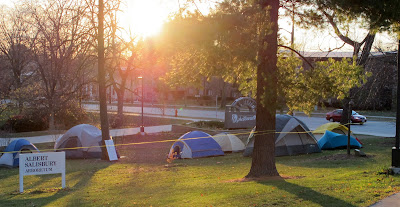
There was an Occupy Whitewater protest and rally on November 17 through this morning. Some attended a protest yesterday, a GOP counter-demonstration, a talk with three Democratic politicians, or camped over. The photograph above is from the morning of the eighteenth, with tents from those sleeping overnight occupying Whitewater.

As one could tell, from the picture and my own observations of the night before, Whitewater, Wisconsin, and America are still standing. Anyone worried about a protest like this as a particular problem has worried needlessly. If the city had a dozen more protests, left right, or center, we’d be no worse off. On the contrary, we’d be far better off.

I’ll offer remarks on both Occupy Whitewater’s agenda generally and the politicians’ speeches from last evening. Although there’s a stated connection (that it’s all part of the same event), these are really two different events. The Occupy movement has sprung up across America, but only Wisconsin has (most probably) gubernatorial and legislative recall elections still ahead. In the protests last winter and spring, the recall election this summer, and in the recall campaign now underway, Wisconsin’s situation is decidedly different from that of other places.

The speeches from Reps. Jorgenson and Barca, and Sen. Erpenbach last night were crafted with the recall campaign in mind, and so they were not typical ‘Occupy’ speeches, although they shared a few more nebulous grievances and rhetorical flourishes of that nationwide movement.

Occupy, generally. There’s a grab-bag of complaints behind the Occupy movement, although the kind term for that scattered approach is eclectic combination of serious concerns. The movement’s greatest rhetorical triumph — and here I’m being serious — has been to hit upon the idea of a contrast between 99% of Americans and another 1% of them. It’s both easier and more powerful to talk about 99% or the tiny remainder outside that majority than to offer concrete policy suggestions.

There’s the risk — already realized, I think — that those attending will too often sound like a twenty-first century re-enactment of William Jenning Bryan’s Cross of Gold speech.

About Occupy’s concern with ‘multinational’ corporations — how universal is that worry, anywhow? Most want iPods and iPads, like searching with Google, and flying to see relatives via Boeing’s latest designs. Do you think those aren’t multinational corporations?

There are, as well, the odd and unpolished rhetorical references along the way (that common people are left with ‘scraps’ while the rich eat ‘cake’). There are many suffering in America, but no one thinks that 99% of Americans are dining on scraps. The poor are a multitude as it is; their numbers need not be exaggerated. (The rhetoric is awkward, in any event – the proper contrasts are to scraps and steak, or crumbs and cake. The mixing of the contrasts reminds one of a buffet.)

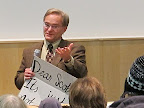
The Democratic Politicians: Reps. Jorgensen and Barca, Sen. Erpenbach.

The second part of yesterday’s events comprised speeches last evening from three Democratic legislators, before an audience of about two-hundred in Hyland Hall. A few of those in attendance were Republican supporters of Gov. Walker, and some of those supporters heckled the politicians now and again. The speeches and heckling were all managed without any grievous fuss – Wisconsinites are outspoken but almost always peaceful. Whatever our views, we are not a violent people.

These legislators have Occupy on their minds, but no doubt with a clear focus on a recall, recall elections, and legislative races (Jorgensen and Barca) in November. I’ll offer a few marks on each of the three (focusing much on the style of the legislators).

Andy Jorgensen, now of the 37th Assembly District. Jorgensen hails from Fort Atkinson, and following redistricting may run for the 43rd District seat, against incumbent Evan Wynn.

Jorgensen comes to politics from an automotive labor union, I think, and listening to him one hears a speaker suited to deliver an address to working people, with energy and sincerity. One can easily imagine him speaking to workers on a floor, or at an outdoor rally. He’s an animated speaker who would likely prefer, and do better, addressing a crowd standing up, so that he could move around a bit.

For most of a campaign, where Jorgensen would be in that setting, I think he’d do well. Rep. Wynn is not that sort of speaker; he’s quieter, and better suited to a more constrained setting, as one finds at many community debates (table, candidates seated, microphones, written questions from a moderator). Wynn acquitted himself well in that setting in the last election, as he was mostly non-plussed despite some sharp barbs from then-incumbent Rep. Kim Hixson.

Debates won’t decide the 43rd’s contest, but a candidate debating Wynn will have to forgo broader flourishes, and simply and calmly paint him as out of touch. That’s an oft-noted skill that Reagan had – he would offer tough criticism (particularly when he did radio commentary before becoming president) in an even and matter-of-fact tone.

Wynn is sure to use a series of expressions in use among Tea Party activists, and a candidate opposing him should immerse himself or herself in that language, deciding in doing so what to adopt and what to reject (and in the rejecting, to reply in a pithy, epigrammatical way.)

Jorgenson’s a man who doesn’t look like he prefers wearing a suit, and that’s probably an advantage in this district, in an upcoming race. Fancy is the last thing anyone will want. Shirt and tie will be preferable to coat and tie.

Jorgensen’s best line of attack from last night — that Gov. Walker and the GOP did not run on the proposals they have now enacted. It’s a huge problem for the GOP — Gov. Walker looks sneaky to many independents and moderate Republicans, not just to die-hard Democrats.

Note to the GOP hecklers in the crowd: I don’t think that there’s anything wrong with heckling, and it was all managed well enough. Consider, though, what it means to wear a quotation from Ronald Reagan on your shirts: Reagan, completely unlike Walker, ran on his intended agenda. Reagan was entirely clear in what he wanted, and he campaigned that way. Gov. Walker may see Reagan as a model, and you may too, but there are very few people otherwise who truly think Walker is like Reagan (at any point in Reagan’s extraordinarily accomplished public career).

Rep. Peter Barca. Assembly minority leader Barca spoke briefly, and of the three incumbents to speak, he was almost professorial. He dresses that way, and has that sort of manner. He’s an effective speaker, but I doubt that he would make the most of a contrast with Gov. Walker in a race between the two. Barca is like Mayor Barrett in that regard: solid, surely, but not someone that Walker couldn’t manage in debates. (Walker’s neither a great speaker nor debater, except in this regard: he’s able to take advantage of an opponent – no matter how smart or sincere – who looks, literally looks, to represent politics as usual.)

Barca had a thoughtful, kind moment when he talked about a sign that used only Gov. Walker’s first name and mentioned that he thought protesters should call him Gov. Walker to respect the office. He’s right, of course: I might refer to Walker as Walker or Gov. Walker, but it seems inappropriate to me to call him Scott. (I wouldn’t call Pres. Obama ‘Barack,’ or Pres. Bush ‘George’ either.)

Barca wants to contend that Gov. Walker is out of step, because he’s out of step with the substantive policies of past Wisconsin administrations. There’s a risk to this (one that Sen. Erpenbach avoids). There’s procedure and substantive policy, and they’re not the same. If people are uncomfortable with Walker — and polls suggest a majority are — it’s not because he’s not a liberal Democrat and won’t endorse liberal programs. They’re uncomfortable because he seems presumptuous and disrespectful to settled tradition, procedure, and the generally conciliatory nature of Wisconsin’s political and social culture.

Walker’s greatest liability isn’t programmatic (although I think that many of his Republican programs have been wrong for liberty and individual rights), but rather that he seems a bull in this Dairyland china shop.

Sen. Jon Erpenbach. One of the ‘Fab Fourteen’ who left Wisconsin to deny the GOP a quorum, Sen. Erpenbach almost certainly will run against Gov. Walker in a recall. Whether he’ll best other Democrats I don’t know, but he would be a tough challenger for Walker. Erpenbach is a former radio personality, and he speaks smoothly, conversationally, and yet with charisma and confidence. Dressed in coat, open collar, and jeans, he matched the occasion well in style and manner.

Erpenbach’s evidently both articulate and knowledgeable, and his comfort in front of an audience will serve him well in contrast with Gov. Walker (who has not Reagan’s but rather Nixon’s skill in front of audience or camera).

Erpenbach’s biggest hit of the night — that procedurally and culturally, Gov. Walker is a radical and extreme departure from past Republicans and Democrats (and Erpenbach cleverly lists past leaders of both parties by name). This is the line that Barca would do better to embrace – that the problem isn’t simply any given policy, but the imperious behavior of the Walker Administration time and again, as a deeper and graver risk.

A discussion of tax fairness, whatever the limitations of Erhenbach’s dubious understanding of tax savings, would work to his advantage against Gov. Walker. The GOP is sure to talk about tax savings, but rather than ignore the issue, Erpenbach seeks to re-frame it.

I have no idea if — as seems likely — the recall that will go forward will have Erpenbach at its helm. He would be a formidable opponent for the governor, and would easily hold his own in debates or on the stump. (The GOP will see this, too, and one could expect that Erpenbach would be the target of third-party’s personal attacks. Erpenbach’s staff must anticipate that line of attack; his evident charisma will attract opponents’ attention.)

I hear so often that Democrats wish Feingold would run, although he won’t; they may have options just as strong, if not more so, elsewhere.

Daily Bread for 11.17.11

Good morning.

It’s a windy day that lies ahead for Whitewater, but a balmy forty-seven degrees, too.

I see that the last open day for Whitewater’s compost site this season will be November 26th.  Steady yourselves.

The Wisconsin Historical Society notes that on this day in 1930,

federal agents and county deputies raided Otto Matschke’s home, north of Beloit, and seized an illegal still and 300 gallons of contraband moonshine. [Source: Janesville Gazette November 19, 1930, p.1]

Had agents not raided Matschke’s home, can you imagine the risk to Beloit, to Wisconsin, and to all America? How would we have ever made it through the Depression, faced the Soviets, landed on the moon, or developed the most technologically-advanced society in human history? The alternatives, it seems, leave us only to contemplate the abyss, and wonder.

Google’s puzzle for the day has an international flavor: “The first vending machines in the United States dispensed a product that’s currently banned in Singapore. What is it?”


Fallone on the “Original Intent of the Recall Power.”

The governor, lt. governor, and as many as four state senators face recall elections next year. So is use of the recall power against these incumbents consistent with Wisconsin law? There’s an answer in a solid post at the Marquette Law Faculty blog from Edward Fallone entitled, The Original Intent of the Recall Power.

(Fallone, himself, takes no position on the recall of Gov. Walker, but merely considers the legitimacy of recalls generally.)

He assess the contention that Wisconsin recall elections are justified in only limited circumstances (“Recalls are designed as special interventions when elected officials become guilty of serious malfeasance in office or when they engage in illegal actions or indulge in offensively immoral behavior”) and concludes that

This statement is objectively false. The recall provisions contained in the Wisconsin State Constitution were never intended to be limited in such a fashion. The original design of the right of recall is, in fact, intended to permit voters to recall elected officials for virtually any reason so long as the procedural mechanisms of the State Constitution are followed.

Surveying national and Wisconsin commentary at the time the recall power became part of our law, Fallone finds in our history ample evidence that there was no intent to circumscribe the recall power, as there was, by contrast, with use of the impeachment power:

Not surprisingly, the actual text of Article XIII of the Wisconsin Constitution reflects the history outlined above. In a previous post, I listed the many reasons why the text of the Wisconsin Constitution itself is inconsistent with any limitation of the recall power to instances of criminal or ethical wrongdoing. First, the right of recall in Article XIII, Section 12, is guaranteed by the text without any limitation on the use of that power. We should not read a narrow limitation into the text without any language to support such a limitation. Second, instances of “corrupt conduct” or the commission of crimes and misdemeanors by elected officials is specifically made subject to the separate impeachment provisions of Article VII. We should not read a general grant of power to be duplicative of a more specialized constitutional provision, because it is improper to read any constitutional provisions as surplusage.

Third, the differences between impeachment and recall are significant. Impeachment, for serious offenses, can occur quickly. Recall elections take a long time, and seem ill suited as a means of removing serious transgressors. By the same token, impeachment is a vehicle whereby legislators un-do the choice of the electorate, so it is appropriate to limit the impeachment power to serious offenses. In contrast, recall is the action of the electorate to un-do its own choice, thereby making a lower standard for removal appropriate. Finally, serious allegations of wrongdoing trigger due process rights to defend oneself, which is the case in an impeachment proceeding. The lack of a vehicle for the recalled official to defend himself in Article XIII indicates that the recall power is not dependent upon any allegation of wrongful conduct.

The entire post, and his earlier one to which I have provided a link from within the excerpt above, are well worth reading.

One may dislike the recall power, but it’s only through ignorance or misrepresentation of our history and law that one would contend the Wisconsin Constitution’s right of recall is limited to certain, expressly-stated circumstances.