FREE WHITEWATER

Poll and Comment Forum: Android or iPhone?

Ok, smart readers: here’s a question about smartphones. (‘Smart readers’: that’s all of you, with the exception of anyone visiting who thinks Whitewater’s Tax Incremental District 4 has actually been managed well.)

I use an Android phone, and it’s one in a series of Android phones I’ve used since the launch of that operating system. (Before that I was a longtime BlackBerry user.)

Now, though, I wonder: should I jump ship to the iPhone 4s?

Droid or iPhone? I’ve a poll and comment forum on the topic, and your opinions are my enrichment.


Comments will be moderated against profanity and trolls; otherwise, have at it.

State Journal blasts arrest of Journal Sentinel reporter

Officials’ foolish over-reaching:

We’re not anti-cop. Far from it. We’re actually very much pro-law and order. Some of our best friends are police officers, and we admire the difficult work done by the men and women who keep our communities safe.

But the decision by Milwaukee police officers Wednesday to arrest a Journal Sentinel photographer who was simply doing her job is inexcusable. Were it not so offensive the arrest would be laughable….

Via Editorial @ Wisconsin State Journal.

Friday Catblogging: Cat v. Kid

I’m sure to get complaints about this week’s catblogging photo – an animation of a spat between a small child and a feline. Some will blame the cat, others the child, still others will wonder where the parents are (after all — it wasn’t another cat that filmed this conflict).

Daily Bread for 11.4.11

Good morning,

It’s a sunny day with a high of fifty-four ahead.

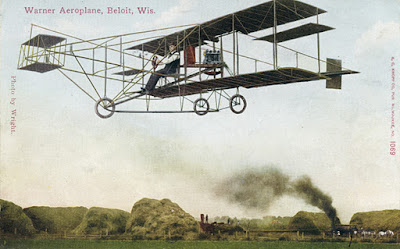
The Wisconsin Historical Society notes that this day marks the anniversary from 1909 of the

Nation’s First Commercially Built Airplane

On this date in Beloit, a plane was assembled and built by Wisconsin’s first pilot, Arthur P. Warner. This self-taught pilot was the 11th in the U.S. to fly a powered aircraft and the first in the U.S. to buy an aircraft for business use. Warner used it to publicize his automotive products.[Source: History Just Ahead: A Guide to Wisconsin’s Historical Markers]

The Journal Sentinel covered the centennial of Warner’s flight in 2009. See, First state flight to be commemorated in Beloit.


Photo courtesy of Wisconsin Historical Society

More Americans in Dire Poverty, But There’s a Way Out

Disconcerting economic data have this advantage: they’re a useful reminder of work ahead, and a spur to greater zeal.

Best fiscal choices in times of poverty: spending cuts (beginning with elimination of leadership posts) to fund a reduction in taxes, return of most tax money to taxpayers and businesses, with second source of expense savings going to temporary assistance to the poor. It’s cut, return, support.

America will bounce back, but changing course will help us bounce back more quickly.

Anyone contending it’s business as usual in cities and towns across America is either confused or deceptive.

New census data paint a stark portrait of the nation’s haves and have-nots at a time when unemployment remains persistently high. It comes a week before the government releases first-ever economic data that will show more Hispanics, elderly and working-age poor have fallen into poverty.

See, full story from the Associated Press.

Daily Bread for 11.3.11

Good morning,

High winds and morning rain visit the Whippet City today, with a high temperature of fifty-one. I’m sometimes asked why I write briefly about the weather each morning. There are three reasons. First, it’s a holdover from a long-ago comparison I made between the Farmers’ Almanac and National Weather Service forecasts. Second, it gives faraway readers an idea of what conditions are like here on any particular day. (Questions received about the city range from weather to politics to how many cows we have.) Third, it’s simply a rhetorical scene-setter for my morning post.

More about that scene: it’s a new moon, and we’ll have 10h 14m of sunlight and 11h 13m of daylight.

There’s a Police Commission meeting in town tonight, beginning at 6 PM, with both open and closed sessions (the closed session taking part in the middle of the meeting, for interviews of police captain candidates). The meeting agenda is available online.

Good news –

Recently released statistics show the state produced 219 million pounds of cheese in September, up one percent from that month a year ago. That production accounted for one-fourth of the nation’s cheese output.

Wisconsin may have her share of problems, but she’s still – and I would guess forever will be — America’s leading cheese-producer. We’ll not be bested. See, Wisconsin still tops the nation in cheese production.

The Shrewd Mr. Flynn

I wrote yesterday about the press battle between the Milwaukee Journal Sentinel and Milwaukee’s Police Chief Flynn. Conflicts like this often lead to wagon-circling, a self-defeating response. See, The Predictable, Dead-End Response.

And yet, Flynn is sure to have a second term, something unusual for Milwaukee, but common in most departments. Commonly, police commissions go with what they know: they favor incumbents or internal candidates. The advantage an incumbent or internal candidate has is nearly overwhelming.

If that should be so — and it is — what does that say about open applications processes, and the nature of the chief’s role?

On processes. For open processes, it’s not any given outcome, but the process itself, that matters. That process is a general good, but also has occasional practical benefits. Each and every word of a candidate’s application statements may be used as a standard by which to measure conduct in office after his selection. Did he do what he said he would do? Were those words, instead, all just the rhetoric of the moment, the mere parroting of platitudes and pale promises?

There’s a value in measuring actions against good practices, and another value in measuring words against actions.

On the chief’s role. Flynn’s looking for a second term, and he’ll get one, and he has done so shrewdly. Like him or not, the Journal Sentinel sees that Flynn’s a politically clever, nationally-recognized chief. He didn’t get that way by being obvious or outwardly fawning toward Milwaukee’s police commission.

Flynn knows what small-town pols and bureaucrats can’t quite grasp – that a chief’s authority doesn’t depend on shows of closeness with a police commission, but on the public’s direct and immediate support for community safety. Flynn doesn’t need his hand held, nor does he need to make a show of holding anyone else’s hand.

If anything, a smarmy relationship between commission and chief only reveals conflicts of interest, failures of oversight, and embarrassing neediness. Rather than serving the interests of good policing, it only serves as another avenue of legitimate criticism.

Flynn may have made a dozen mistakes, but he’s not made any of the avoidable mistakes that mediocre, dull leaders make. It’s one of the reasons that, unlike middling leaders, he’s likely to survive (even now!) with his standing mostly intact.

Reason’s Nanny of the Month for October 2011

It’s an international edition this month, and the winner is the European Union, as that vast bureaucracy has regulated children’s activities from “baby rattlers (which have brand-new noise restrictions) to blowing up balloons (not to be done by tots under age eight!).”

Daily Bread for 11.2.11

Good morning,

It’s a rainy day with a high temperature of fifty-four for Whitewater today.

Whitewater’s an old Midwestern town, and her Landmarks Commission meets this afternoon at 5 PM. The Commission’s agenda for the meeting is available online.

Wired has an article about humanity’s domination of the planet. In Making Sense of 7 Billion People, Brandon Keim writes that

According to a back-of-the-envelope calculation, there are about 1.7 million other top-level, land-dwelling, mammalian predators on Earth. Put another way: For every non-human mammal sharing our niche, there are more than 4,000 of us.

In short, humans are Earth’s great omnivore, and our omnivorous nature can only be understood at global scales. Scientists estimate that 83 percent of the terrestrial biosphere is under direct human influence. Crops cover some 12 percent of Earth’s land surface, and account for more than one-third of terrestrial biomass. One-third of all available fresh water is diverted to human use.

Altogether, roughly 20 percent of Earth’s net terrestrial primary production, the sheer volume of life produced on land on this planet every year, is harvested for human purposes — and, to return to the comparative factoids, it’s all for a species that accounts for .00018 percent of Earth’s non-marine biomass.

We are the .00018 percent, and we use 20 percent.

Astounding. If we are so very influential among all of the natural order – and we are –  we might expect more of ourselves for the exercise of such unrivaled power over other creatures.

We often don’t, but we should.


The Predictable, Dead-End Response

Writing about the feud between Milwaukee’s Chief Flynn and the Milwaukee Journal Sentinel, Bruce Murphy writes that

Experts on police departments will tell you that criticism from outside inevitably results in everyone on the force circling the wagons.

That’s very true. So true and predictable, that it’s more predictable and regular than Old Faithful has ever been. It’s why I’ve mentioned previously that bad organizations often don’t get better, they get worse.

One might think that failed leaders would see this, and would correct past mistakes through a routine of openness and new ideas. They don’t; typically they huddle more closely together. Mostly, this is because weak leaders would prefer the easy path of a small, sycophantic cadre to the better, but harder, scene of a dynamic organization. (It’s also because they isolate and delude themselves from growing criticism.)

In drawing ever closer and inward, the members of a weak organization only compound their mistakes and deficiencies.

The best option for a community is, of course, organizational reform. The second best, though, is exactly the organizational wagon-circling of which Murphy writes. Huddling together only exacerbates existing problems, speeds decline, and makes the case for reform stronger.

One would prefer the first option; as a reformer, one would still readily accept the second, knowing the eventual result is reform.

Via Inside Milwaukee.

Residency and the Decline of a Small-town Elite

Small-town Whitewater has a residency requirement for public leadership positions in city government. It’s a sign of the decline of Whitewater’s town squires that they cannot consistently enforce a rule of their own making

Ironically, although I don’t support Whitewater’s mostly narrow and short-sighted town fathers, I’ve supported the residency requirement for two reasons.

First, it applies to leaders who should set an example of living in the community they serve, enjoying its benefits and sharing its burdens. If they’re compensated from the community, they should live in the community that taxes residents for that compensation.

Second, it’s a lawful requirement now, that should be applied equally and fairly to all who fall within its range. (I’d even apply this rule to interim leaders, on the same first reason, listed above.) The residency rule for leaders doesn’t say sometimes, maybe, or when someone feels like following the rules. Within the city – for services and tax purposes — actually means within the city, not kinda, sorta close by.

(If the rule changes, so be it; as long as it’s in force, all leaders should have to comply with it equally.)

Imagine how absurd it would be for someone to say he’d pay his taxes a year from now, or maybe a year after that, or thereafter if Whitewater’s Common Council thought it absolutely necessary.

Similarly, if he ran a stop sign into an empty oncoming street, no one would excuse him for being, well gosh, just halfway out into the road. On the contrary, it would be the municipal offense of the century that a common person did something like that. If he lived near the city, no one would allow him to vote in city elections just because he kinda, sorta lived near the city line.

Although some of Whitewater’s leaders have long been in the habit of making exceptions for themselves, the real story here is that Whitewater’s leaders cannot assure the enforcement of simple rules they, themselves established. Residency was supposed to be evidence of a commitment to Whitewater, to the ‘exceptional’ quality of life here, to all that these leaders had uniquely achieved.

Yet, they lack even the confidence to insist on their own standards. (If they’d really wanted those standards enforced, they would have chosen a better negotiator for the city’s position, too.)

Residency rules? Here today, gone tomorrow.

A stodgy town faction’s ability to enforce even its own standards? Just plain gone.

Gov. Walker’s Actual Political Standing in Wisconsin (October 2011)

I’m not a Walker supporter, because Gov. Walker’s far from libertarian.

If one is a Walker supporter – as the Wisconsin Policy Research Institute surely is – it’s right to see Walker’s political prospects honestly. Despite a bit of spin in a WPRI narrative, a recent poll commissioned and published by WPRI reveals Gov. Walker’s weak political standing.

He’s underwater – 42% approve, 56% disapprove:

11. Now let’s turn to the political scene here in Wisconsin. Overall, do you strongly approve, somewhat approve, somewhat disapprove, or strongly disapprove of the way Scott Walker is handling his job as Governor of Wisconsin?

Strongly approve 24
Somewhat approve 18
Somewhat disapprove 11
Strongly disapprove 45
Don’t know / Refused 2

These results, by the way, are more reliable than airy talk about how well the governor’s policies are being received, or results from dodgy pollsters that partisans reflexively prefer. WPRI has a preference, of course, but they’ve nonetheless candidly published results inauspicious to their own camp.

Via The Wisconsin Policy Research Institute.