FREE WHITEWATER

Friday Poll and Comment Forum: Is Home Ownership Still Part of the American Dream?

If fewer Americans by percentage own homes, is owning a home still part of the American Dream?

Three quick assumptions: (1) there is an American Dream, a set of goals most people in this society have, (2) that set of goals includes (or included) home ownership, and (3) those goals may be common even if they don’t matter to everyone. (Some people will decide against homes or cars, for example, even if they could buy one.)

So, what do you think?

I’ve a poll and forum for comments below. The post will remain open until Sunday morning. Comments will be moderated against profanity and trolls; otherwise, have at it.


Census: Housing bust worst since Great Depression

Nationwide, the homeownership rate fell to 65.1 percent – or 76 million occupied housing units that were owned by their residents – from 66.2 percent in 2000. That drop-off of 1.1 percentage points is the largest since 1940, when homeownership plummeted 4.2 percentage points during the Great Depression to a low of 43.6 percent. Since 1940, the number of Americans owning homes had steadily increased in each decennial census due to a mostly booming economy, favorable tax laws and easier financing. The one exception had been 1980-1990, when ownership remained unchanged at 64.2 percent.

Despite declines everywhere, one sees a bright spot: our part of the country is still stronger in percentage of residents owning a home than other regions:

Homeownership rates decreased in each region of the country over the last decade. Midwesterners were most likely to own a house, at 69.2 percent, followed by Southerners at 66.7 percent, Northeasterners at 62.2 percent and Westerners at 60.5 percent.

Via Associated Press.

For an earlier post on the housing crisis, see The Mortgage Meltdown, Robo-Signing, and Foreclosures. As a people, we have always prided ourselves on a high rate of homeownership, and declines in the number of homeowners by percentage are (generally, I think) a bad thing.

Perhaps that makes me seem old-fashioned: the AP story on the census includes the  view that many Americans no longer look on home ownership favorably (“The changes now taking place are mind-boggling: the housing market has completely crashed and attitudes toward housing are shifting from owning to renting,” said Patrick Newport, economist with IHS Global Insight. “While 10 years ago owning a home was the American Dream, I’m not sure a lot of people still think that way”).

Case by case, homeownership may not make sense for some people, but I find it troubling that our society might shift from a strong property-owning model (and just as troubling that there’s so great a gap between the races in homeownership).

Daily Bread for 10.7.11

Good morning.

It’s a mostly sunny day, with a high temperature of eighty degrees, as Whitewater eases into the weekend.

The Wisconsin Historical Society recalls that briefly, although now nearly forgotten, was Wisconsin’s time as part of Quebec:

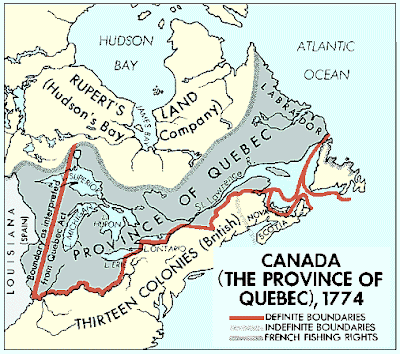
On this date B[in 1774] Britain passed the Quebec Act, making Wisconsin part of the province of Quebec. Enacted by George III, the act restored the French form of civil law to the region. The Thirteen Colonies considered the Quebec Act as one of the “Intolerable Acts,” as it nullified Western claims of the coast colonies by extending the boundaries of the province of Quebec to the Ohio River on the south and to the Mississippi River on the west. [Source: Avalon Project at the Yale Law School

Philosopher Matt Zwolinski on ‘Bleeding-Heart Libertarians,’ The Poor, and Social Justice

I’ve posted before on libertarian professor Matt Zwolinski’s left-of-center libertarianism (see, from the Daily Caller, Seven reasons progressives should be more libertarian).

Here’s a video where he discusses so-called ‘bleeding heart’ libertarianism. Although I don’t think of myself as more of a left or more of a right-of-center libertarian, there’s nothing in Zwolinski’s emphasis on social justice that I wouldn’t support. (I think he’s surely mistaken to deprecate natural-law libertarianism, but that’s a different matter.)

In any variety, libertarianism offers genuine hope to the poor and distressed, free from the self-interested schemes and machinations of government officials, each successive scheme only increasing the misery and reducing the liberty of our fellow citizens.

Most libertarians naturally care about social justice, beginning in their steadfast support of the rights and equal opportunities of each and every person. From our concern for individuals comes also our concern for society.

We are not – and we should never be – reticent about our concerns for the poor or disadvantaged.

Daily Bread for 10.6.11

Good morning.

It’s a sunny day ahead for Whitewater today, with a high of seventy-eight.

There’s a Police Commission meeting tonight at 6 p.m.  The agenda is available online.

Well, it’s a game five in the Brewers-Diamondbacks series, although I erroneously thought the Brewers would win in four.   That leaves the 27.03% who answered last week’s poll that they’d win in five, or the 10.81% who answered that this wasn’t their year, with a chance to be right about how the series will go.

Scientists at Duke University are working to create artificial limbs for people so that recipients  will be able to feel the sensation of touch when using those prosthetics.  A step in that research involves testing the technology on primates. The Duke researchers have had preliminary success with animals.  See, Monkeys Control Virtual Limbs With Their Minds:

Although real-life brain-controlled prosthetics that enable a person to, say, pick up a pencil continue to improve for amputees, limbs that can actually feel touch sensations have remained a challenge. Now, by implanting electrodes into both the motor and the sensory areas of the brain, researchers have created a virtual prosthetic hand that monkeys control using only their minds, and that enables them to feel virtual textures.

How’s that new Congress doing?

If the question is how well it’s controlling spending, the answer is that it’s doing great work a terrible job:

Republicans took over the U.S. House last November, and as a result, government spending finally dropped.

Whoops….Government spending actually increased!

They haven’t reported the final numbers yet, but FY 2010 spending was $3.456 trillion, and FY 2011 spending was most recently projected to come in at $3.597 trillion. That’s a 4% increase.

Remember, there was no budget passed last year. That means that most of the FY 2011 spending occurred with the approval of the newly-elected Republicans….

Daily Bread for 10.5.11

Another sunny day, with a high of about seventy-seven, for Whitewater.

Whitewater’s Landmarks Commission meets today, at 5 p.m.  The agenda is available online.

On this day in 1846,

Wisconsin’s first state Constitutional Convention met in Madison. The Convention sat until December 16,1846. The Convention was attended by 103 Democrats and 18 Whigs. The proposed constitution failed when voters refused to accept several controversial issues: an anti-banking article, a homestead exemption (which gave $1000 exemption to any debtor), providing women with property rights, and black suffrage.

The following convention, the Second Constitutional Convention of Wisconsin in 1847-48, produced and passed a constitution that Wisconsin still very much follows today. [Source: The Convention of 1846 edited Milo M. Quaife]

We should have adopted the constitution proposed at the first convention.


Tenure as Curse and Code

Generally, a long tenure in a job or office is a bad thing – too much time in one place, without enough exposure to other people and practices. It’s a stagnant pool, as against the more vigorous environs of rushing waters. Most people see this, and understand this, easily. They move willingly from one position to another, in one organization to another, as part of a longer career. In fact, talented Americans expect to move from company to company.

Often, employees (public or private), don’t realize that when they say they’ve been in the same job for thirty years’ time, they may be offering an implicit line of self-criticism. After all, having been there so long, why haven’t they done better for their employers or the public? All those years, and yet the product’s still shoddy, or the service is still poor. That doesn’t redound to a tenured-employee’s credit; it’s proof only of his mediocrity.

This is how tenure is a curse.

(In rare cases where an organization’s excellent, of course, this needn’t apply.)

If it should be true that boasts of tenure are empty or are counter-productive, then why does one hear those boasts so frequently?

There are two key reasons. First, some tenured employees are so insulated and cosseted that they’re simply ignorant of what the wider world thinks about tenure, or a dozen other things. They don’t know, so to speak, what they don’t know.

There’s a second reason some employees harp on tenure, despite the bad reception that those claims have with most people. It’s because they’re not concerned about most people, but only a much smaller audience that does care about tenure. These employees have sized up their situations, and have concluded that it doesn’t matter what most people think, as long as a core audience hears what the core audience wants (or needs) to hear.

So, the claim of tenure isn’t intended for everyone (about whom the employee doesn’t care), but only for some (about whom the employee cares very much).

If that smaller, treasured group believes that tenure is important, then that’s what the employee will emphasize. It’s in this way that claims of tenure are words in code: I am what you are, and we are all that matters. The greater group, the greater society, be damned.

That’s a gamble, but one that many insiders and town fathers are prepared to make: indifference to many, for the sake of attentiveness to, and support from, a far smaller few.

It pays off, but with ever-diminishing returns. (Some insiders know this, too, but once they’ve started down the road of satisfying a few, they find the path grows only narrower.)

Reason’s Nanny of the Month for September 2011: San Juan Capistrano City Attorney Omar Sandoval

If you thought that home Bible study (or other, similar gatherings) would never be banned in America, then you would find yourself … mistaken.

Below is the description accompanying the September video. The Fromms are right to seek redress.

Nanny of the Month turns two years’ old this October, and the busybodies who want to mind your own business show no signs of letting up.

Take formerly dog-friendly New York City which has banished man’s best friend from any establishment that serves food or alcohol (and that includes outdoor patios!). Then there’s Michigan Gov. Rick Snyner who’s tackling childhood obesity by introducing a statewide database to keep anonymous tabs on kiddies’ weight.

But the this very special nanny comes to us from a California city that is fighting (and fining) a couple that hosts Bible studies at home. Presenting Reason.tv’s Nanny of the Month for September 2011: San Juan Capistrano City Attorney Omar Sandoval!

The city slapped Chuck and Stephanie Fromm with fines totalling $300 for violating a municipal code which prohibits religious, fraternal, or nonprofit organizations from meeting on residential property without a conditional use permit (CUP). The Fromm’s gatherings can attract as many as 50 people and the city says that causes parking problems, but the Fromm’s disagree saying there is plenty of parking in their semi-rural neighborhood where large homes sit on even larger lots (the Fromm’s lot includes a corral, barn, and large lawn). The Fromms have held their gatherings since 1994 and say their neighbors support them, except for one woman whose recent complaint sparked city action.

The city is threatening to impose steeper fines if the Fromms continue their un-permitted gatherings, claiming that “zoning and building codes treat residences differently than places of public assembly because of public welfare and safety reasons.”

The Fromm’s are appealing the fines and refuse to apply for a CUP because they could face thousands of dollars in expenses that could include conducting traffic studies and making their home wheelchair accessible.

Next stop is Superior Court.

‘Secret inquiry gets closer to Walker’

Hall and Spicuzza (with Barbour) on byline for recap of John Doe corruption probe now onging out of Milwaukee County District Attorney’s office:

….the judge overseeing the John Doe investigation released documents showing that nearly a dozen people, including Walker spokesman Cullen Werwie and campaign fundraiser Rose Ann Dieck, had received immunity from prosecution in exchange for their testimony.

John Doe investigations are secret proceedings in which witnesses can be compelled to testify about possible criminal matters. Immunity grants, which must be given in open court, can be for witnesses in jeopardy of being criminally charged themselves.

Because those involved are typically barred from discussing such investigations, much about the case remains a mystery. But recent developments suggest the probe into Milwaukee County staffers, launched about 17 months ago, may be creeping closer to Walker himself….

State Journal‘s been chasing the Journal Sentinel on this story, and publication indicates unwillingness to cede coverage (and almost certain suspicion that other shoes will drop).

Via Wisconsin State Journal: Secret inquiry gets closer to Walker.