FREE WHITEWATER

Daily Bread for 10.14.11

Good morning.

A windy day with a high temperature of sixty-one awaits Whitewater.

Ninety-nine years ago,

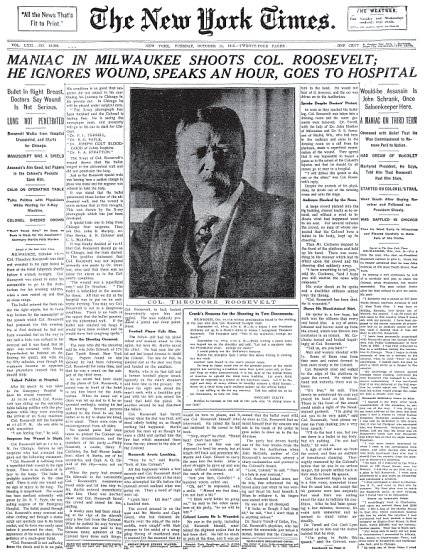
On the night of October 14, 1912, Theodore Roosevelt was shot in Milwaukee. Roosevelt was in Wisconsin stumping as the presidential candidate of the new, independent Progressive Party, which had split from the Republican Party earlier that year. Roosevelt already had served two terms as chief executive (1901-1909), but was seeking the office again as the champion of progressive reform. Unbeknownst to Roosevelt, a New York bartender named John Schrank had been stalking him for three weeks through eight states. As Roosevelt left Milwaukee’s Hotel Gilpatrick for a speaking engagement at the Milwaukee Auditorium and stood waving to the gathered crowd, Schrank fired a .38-caliber revolver that he had hidden in his coat.

Roosevelt was hit in the right side of the chest and the bullet lodged in his chest wall. Seeing the blood on his shirt, vest, and coat, his aides pleaded with him to seek medical help, but Roosevelt trivialized the wound and insisted on keeping his commitment. His life was probably saved by the speech, since the contents of his coat pocket — his metal spectacle case and the thick, folded manuscript of his talk — had absorbed much of the force of the bullet. Throughout the evening he made light of the wound, declaring at one point, “It takes more than one bullet to kill a Bull Moose,” but the candidate spend the next week in the hospital and carried the bullet inside him the rest of his life.

Schrank, the would-be assassin, was examined by psychiatrists, who recommended that he be committed to an asylum. A judge concurred and Schrank spent the remainder of his life incarcerated, first at the Northern Hospital for the Insane in Oshkosh, then at Central State Hospital for the criminally insane at the state prison at Waupun. The glass Roosevelt drank from on stage that night was acquired by the Wisconsin Historical Museum. You can read more about the assassination attempt on their Museum Object of Week pages.

Source: Wisconsin Historical Society.

Daily Bread for 10.13.11

Good morning.

It’s a rainy day in store for Whitewater, with thunderstorms and a high temperature of sixty-three.

Today’s a better day than yesterday: we’re closer to free trade with friendly countries than we were before.  Bloomberg reports the good news:

The U.S. Congress approved free- trade agreements with South Korea, Colombia and Panama, bringing an end to years of stalemate and offering what supporters said was the biggest opportunity for exporters in decades.

The bills go to President Barack Obama, who spent two years seeking to broaden Democratic support for pacts revised from initial agreements reached by his predecessor. The South Korea deal, the biggest for the U.S. since the North American Free Trade Agreement in 1994, removes duties on almost two-thirds of American farm exports, and phases out tariffs on more than 95 percent of industrial and consumer exports within five years.

See, Biggest U.S. Free-Trade Accord Since ’94 Passed – Bloomberg.

From Africa, there’s a happy story about the rescue of a poached baby gorilla:

As part of an undercover operation, five rangers from DRC’s Virunga National Park posed as buyers after receiving a tip that a baby gorilla was for sale.

The park’s spokeswoman LuAnne Cadd told MSNBCthe culprits could be linked to zoos in India and Russia, along with independent private owners looking for pet baby gorillas.

With only 786 mountain gorillas left on Earth due to poaching, hunting and disease, rangers and park officials fear there could be more they aren’t saving.

Update 4: On Edgerton, Wisconsin’s Former Police Dog

There was a follow-up story in the Janesville Gazette about Edgerton’s former police dog, an animal that bit two people (one a police officer from another department, the other an office worker) before it was finally sent away. The cost of settling injuries to the police officer (apparently the lesser of the two injuries) was $39,000. That’s only a settlement cost: the injury to the officer and the community is greater, of course (lost time, lost community reputation, etc.).

The story notes that the canine was a washout as police dog, but that’s only part of the problem. Reading though earlier stories, there’s a human problem in all this: a chief’s desire for a dog that small-town Edgerton didn’t need, the obvious inability of the department to handle the dog properly (they’re not pets or toys, and they don’t belong in administrative offices), and the failure of police commissioners and others to reject a bad idea like this one in the first place.

That’s part of this story, too: when police commissioners go along with every dumb idea, supporting for the sake of supporting, and grinning along the way like so many Cheshire Cats, they fail other people and their community.

Help like that’s no help at all, but they can’t see that.

For more on this story, see prior posts (with links to news coverage): On Edgerton, Wisconsin’s Police Dog, Update: On Edgerton, Wisconsin’s Police Dog (Goodbye to the Biter), Update 2: On Edgerton, Wisconsin’s Police Dog (Return to Service?), Update 3: On Edgerton, Wisconsin’s Police Dog (Doggone and Dog Gone!), and Small-town Bureaucratic Persistence in Edgerton, Wisconsin.

Daily Bread for 10.12.11

Good morning.

It’s a rainy day here in Whitewater, with a high temperature of seventy-four. It’s also likely the last seventy-degree day this month. More seasonable temperatures return tomorrow. October will again be…October.

There’s a meeting of Whitewater’s Tech Park Board today, with an agenda available online. Agenda item 10, in closed session, includes consideration of “Potential Building and Conference Room Naming Rights.” Oh, brother: there’s someone who’d pay to have his name associated with this project? That’s too funny.

I’m all in favor: get as much as you can for these rights, and then use the money to start paying back the taxpayers and residents who spent millions in grant money and municipal debt to give CESA 2 a much nicer building.

It won’t be easy, though: most people want to place their names on libraries, schools, and hospitals, but they tend to avoid naming rights for flop houses, clip joints, and speakeasies.

There’s better news elsewhere. A Google doodle – the art that sometimes appears in the place of the search engine’s ordinary logo — today celebrates what would have been Gumby creator Art Clokey‘s birthday. Very sweet.

Visit to a Truck-Food Paradise

I was recently in a spot that had a long row of food trucks, offering traditional fare from around the world. There were a half-dozen trucks, and I’m told that often there are many more. Patrons were in line at each of them, people from every walk of life. A diverse selection, for a diverse clientele: that’s America. This is no better market, no greater opportunity, than among us.

There’s a social aspect of this that regulators don’t understand: lunch trucks have become fashionable. When regulators jump to defend incumbent restaurateurs, they’re not just defending the status quo; they’re also advancing the social prejudices of middling, narrow people against a disparate, capable, sophisticated clientele. Regulators are too ignorant to see how out-of-style they are.

Trucks like these will draw desirable customers.

The supposed regulatory justifications (health, safety) are bunk and junk: the trucks’ customers are as capable and discerning as any state or municipal regulator. (I’ve understated the comparison as a kindness to bureaucrats. Put candidly, the patrons are surely far more capable than dull and dim prohibitionists, who restrict not on reasonable grounds but on social bias, cronyism, or ignorance. One tires of hearing phony health and safety objections that a clever child would reject as implausible.)

Sadly, there’s a campaign against food trucks in parts of our country, a campaign that conspires to restrict the rights of vendors and customers to sell and to eat what they want. Imagine that: in America, we are supposed to believe that an adult may be told what he or she can eat. (Next: we will be told what we must eat.)

If sadly, then also fortunately: there are others who will not endure these restrictions without a response. The time is long since past for citizens to look about and say: we endure your restrictions with equanimity no longer. It’s off to court, to seek redress against the liberties of citizenship that middling bureaucrats impose.

Citizens, not subjects; individuals, not objects of others’ schemes and plans.

From that row of trucks, I found an especially popular one, and had a nice lunch, of fresh ingredients, well-prepared and pleasantly-served. The truck looked sharp, and the cook was friendly.

A nice lunch, indeed. Nice, and worth fighting over.

See, also, Defending Street Vendors, Food Trucks, and Consumer Choice, Institute for Justice Defends the Rights of Street Vendors, the IJ Clinic on Entrepreneurship, and the My Streets, My Eats initiative.

The Tragedy of Urban Renewal

There are few worse tragedies than ones that come about by our own hands. New York City has seen more than her share of tragedies, of all sorts, and so-called urban renewal has been one of them. These experiments are mostly over for major cities, but the impulse behind them still persists, plaguing others as it once plagued New Yorkers.

Below is part of the description accompanying the embedded video:

In 1949, President Harry Truman signed the Housing Act, which gave federal, state, and local governments unprecedented power to shape residential life. One of the Housing Act’s main initiatives – “urban renewal” – destroyed about 2,000 communities in the 1950s and ’60s and forced more than 300,000 families from their homes….

New York City’s Manhattantown (1951) was one of the first projects authorized under urban renewal and it set the model not only for hundreds of urban renewal projects but for the next 60 years of eminent domain abuse at places such as Poletown, New London, and Atlantic Yards. The Manhattantown project destroyed six blocks on New York City’s Upper West Side, including an African-American community that dated to the turn of the century.

The city sold the land for a token sum to a group of well-connected Democratic pols to build a middle-class housing development. Then came the often repeated bulldoze-and-abandon phenomenon: With little financial skin in the game, the developers let the demolished land sit vacant for years….

Daily Bread for 10.10.11

Good morning.

It’s a mostly sunny day for Whitewater, with a high temperature of seventy-seven degrees.

Whitewater’s Park and Rec Board meets tonight at 5 p.m. The agenda, with the only principal item being the 2012 budget, is available online.

The Wisconsin Historical Society recalls a Brewers victory for this day in 1982:

1982 – Brewers Win the Pennant

On this date the Brewers won the American League Pennant, securing their spot in the 79th World Series against the National League’s St. Louis Cardinals. The Brewers bounced back from a poor start in the series to become the first team ever to win the League Championship Series after being down 0-2 in the five day series. [Source: Milwaukee Brewers]

These twenty-nine years later, the league’s different, but the goal’s the same.

Recent Tweets, 10.2 – 10.8

Beast Mode: Brewers to NLCS after dramatic victory in 10th –bit.ly/ovW5GF

Roenicke rejects ‘do or die’ label for Game 4 He’s right: it’s more like do or get really sick #BeatAZ – bit.ly/nC6xnE

The war on small farmers: Raw Milk Raids and Court Cases Enter New Territory bit.ly/pkblnh

Bernanke Says Economic Recovery Close to Faltering – ABC Newsabcn.ws/qfYbAL

Because it’s private sector that produces: State jobs hotline for businesses produces few leads so far bit.ly/qjHe3q

Secret inquiry gets closer to Walker bit.ly/oWlAil

Going to a Protest? Tips to Prepare Your Digital Camera

From Wired‘s How-To Wiki, here are some good tips for photographers. (These tips work just as well for protests on the right or left, by the way!)

One key reminder, for those who take pictures with a smartphone: there’s a lot of risk in losing all your contacts and email if someone takes the phone from you, or if you drop it in a crowd.

I’d only recommend a smartphone for spur-of-the-moment pictures.  If you have time to prepare before going to a protest, don’t take a device that has important information on it.

If you must use a smartphone, look around for a program that remotely locks or erases the phone should you lose it.  There are programs like this for both Android and Apple smartphones.

A simple digital camera is a much better, cheaper choice.

Wired‘s tips include preparing the camera’s settings and memory card, and adding a ‘return if found photo,’ among other good ideas.

See, Wired How-To Wiki.