FREE WHITEWATER

Alzheimer’s Association Introduces In-Depth Training for Family Caregivers in Elkhorn

Alzheimer’s Association Introduces In-Depth Training for Family Caregivers

-Six Week Course to Offer Education on Caring for an Older Adult-

The Alzheimer’s Association will be offering “The Savvy Caregiver” a six-week program designed to provide clinical level education and training for family caregivers. The series will be held on consecutive Wednesdays beginning April 13, 2011 through May 18, 2011 from 3:30 to 5:30 p.m. at People’s Bank, 837 N. Wisconsin Street in Elkhorn. This workshop is open to family members who are providing care for a loved one with Alzheimer’s disease or a related dementia.

The Savvy Caregiver training program is a unique approach to family caregiver education. The central concept is the notion of strategy. Throughout the program caregivers are urged to learn, develop and modify strategies to accomplish the goal for their particular caregiving situation. Participants will come away with increased personal knowledge, skills to assess abilities of a loved one with dementia, confidence to set and alter caregiving goals, strategies to manage activities of daily living, and perspective on the course of Alzheimer’s and other related dementias.

Advance registration is required. The cost to attend is $30, which includes a caregiver manual and CD. To register, please contact Bonnie Beam Stratz at 920-728-4088 or send an email to bonnie.beam@alz.org.

The Alzheimer’s Association is the leading voluntary health organization in Alzheimer’s care, support and research. Our mission is to eliminate Alzheimer’s disease through the advancement of research; to provide and enhance care and support for all affected; and to reduce the risk of dementia through the promotion of brain health. Our vision is a world without Alzheimer’s. For more information about Alzheimer’s disease and local services visit www.alz.org/sewi or call the Alzheimer’s Association 24/7 Helpline at 800-272-3900.


Daily Bread for 3.21.11

Good morning,

It’s the first full day of spring, and Whitewater’s forecast calls for an increasingly sunny day, with a high temperature of fifty-six degrees.

The Wisconsin Historical Society notes that yesterday, March 20th, was the Republican Party’s founding, in Ripon:

1854 – Republican Party Founded

On this date Free Soilers and Whigs outraged by the passage of the Kansas-Nebraska Act, met in Ripon to consider forming a new political party. The meeting’s organizer, Alvan E. Bovay, proposed the name “Republican” which had been suggested by New York editor Horace Greeley. You can see eyewitness accounts of the meeting, early Republican campaign documents, and other original sources on our page devoted to Wisconsin and the Republican Party. Though other places have claimed themselves as the birthplace of the Republican Party, this was the earliest meeting held for the purpose and the first to use the term Republican. [Source: History of Wisconsin, II: 218-219]


Recent Tweets, 3.13 to 3.19

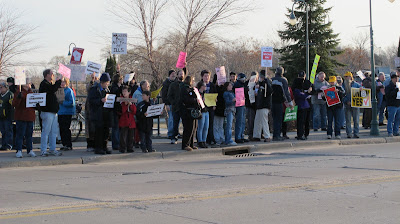
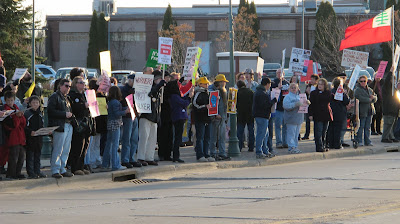
Scenes from a Whitewater Union Rally, 3.18.11 | FREE WHITEWATER http://bit.ly/e4tyQ8
19 Mar

RT @TheAtlantic: Incredible photos from the 2011 Iditarod sled dog race: http://theatln.tc/eejyIy New from @in_focus
18 Mar

Badgers v. Belmont at 6:27 p.m.
17 Mar

Microsoft lands on list of world’s “most ethical” companies Probably on list of crappiest products, too http://bit.ly/ghIR9s
16 Mar

Simple and Reasonable Compliance with the Law | FREE WHITEWATER https://freewhitewater.com/?p=15357
16 Mar

Innovation Center embarrassment: photo of unfinished ‘laboratories’ section of building looks more like someone’s unfinished basement
16 Mar

Satellite Photos – Japan Before and After Tsunami – Interactive Feature – NYTimes.com http://nyti.ms/hUbaND
13 Mar

Capitol Protest clip 3.12.11 » DAILY WISCONSIN » http://bit.ly/hcTFoL
13 Mar

DAILY WISCONSIN » Scenes from Capitol Protest 3.12.11 http://bit.ly/eaEpDw
13 Mar

Wired Reviews Office Toys

If you collect office toys, Wired has a video you’re sure to enjoy. It showcases some of the latest toy guns and arrows that are — supposedly — suitable (or at least safe) for the office. Purchase and use at your own risk…

We’re a playful people, and these gadgets are simply a consequence of that happy disposition.


more >>

Friday Comment Forum: A Banner for Protesters?

Here’s the Friday open comments post.

Tea Party groups commonly use the Gadsden Flag at their rallies; for union protesters, what would be a suitable flag or symbol? Alternatively, should they avoid any symbol?

The use of pseudonyms and anonymous postings is, of course, fine. Although the comments template has a space for a name, email address, and website, those who want to leave a field blank can do so. Comments will be moderated, against profanity or trolls.

Otherwise, have at it.

I’ll keep the post open through Sunday afternoon.

Gadsden and Taunton Flags

The Tea Party found its banner in the Gadsden flag, but I don’t know whether the union protesters will come to adopt a flag of their own. I saw that protesters at the Capitol were flying the Tautnon flag, used by patriots in Taunton, Mass.

The flag symbolized their hope for liberty and equal rights as part of Britain (“union”), before additional injuries drove them to call for independence.

The contemporary use of the flag in support of collective bargaining plays on the word union with a new meaning.

It’s notable that the original use of the flag showed that Americans were patient and hopeful, and sought liberty proudly and patiently before Britain’s repeated abuse made independence necessary.

In that way, contemporary use of the Taunton flag draws upon Americans’ historic hopes for compromise and peace.

Daily Bread for 3.18.11

Good morning,

It’s a partly sunny and mild day ahead for Whitewater, with a high of fifty degrees.

In our schools today, it’s Coffee with the Principal at 8:30 a.m., and Spirit Day at the middle school.

Quick note: I’ve had a fair number of questions about the possibility of new contracts for district employees.  Just as a charter school is measured by its charter, so a contract is measured by its terms; there’s not much to say without those details.

The Wisconsin Historical Society recalls that on this day in 1954,

Parker Pen Employees Win Wage Increase
On this date employees of Parker Pen in Janesville won a 5-cent-an-hour wage increase in contract negotiations. After the raise, male employees made a base pay of $1.95 an hour while their female counterparts were paid $1.62 an hour. [Source: Janesville Gazette]

Parker no longer has a factory in Janesville; the company dominated American pen manufacture for decades in the middle of the twentieth century.

Japanese Resilience through Evolving Policies

Jesse Walker’s latest article at Reason is entitled, Resilient Japan: Three lessons from the week’s disasters. Here’s Walker’s assessment of Japan following natural and human disaster:

An 8.9 earthquake, a 33-foot tsunami, a series of crises at their battered nuclear plants: The people of Japan have withstood the last week with admirable tenacity. There’s no shortage of lessons the rest of the world can learn from what we’ve been seeing. Here are three of them….

Walker offers reasons Japan’s doing as well as she is, under terrible circumstances, and the third of them is the most important:

3. Resilient policies evolve; brittle policies are imposed….

Japan’s rules are far from perfect, but they evolved through experiment and experience, a process that Lawrence Vale and Thomas Campanella summed up in their 2005 book The Resilient City. Public authorities may try to introduce sweeping new plans after a disaster, they wrote, but “larger urban patterns are not easily or readily altered.”

More often, “particular building codes or practices may change in an effort to limit future vulnerability.” Japanese cities are dense, organic orders whose jumbled layouts are notoriously opaque to outsiders; the country’s citizens have a long history of resisting plans that would substantially reshape the city.

But over the last century they have incrementally altered their codes. Before 1965, skyscrapers were banned altogether, but with advances in engineering the government finally relented and allowed them to appear.