
Recent Tweets, 9-26 to 10-2
by JOHN ADAMS •
Frogs bring color – and danger – to Milwaukee Public Museum – JSOnline http://bit.ly/dhajf7
5:54 AM Sep 30th
RT @reasonmag: Faking the Pledge: How Republican promises of fiscal sobriety ring hollow http://ow.ly/2LDtQ
10:45 AM Sep 29th
CatoInstitute: Buckley opposed War on Drugs – why don’t today’s conservatives? Harvard economist J Miron makes case: http://lat.ms/cncXcG
10:39 AM Sep 29th
New Dealers would be outraged: Whitewater’s Innovation Center from the Perspective of the New Deal » FREE WHITEWATER http://bit.ly/cptM52
10:28 AM Sep 29th
BBC News – Iran jails pioneering blogger for ‘anti-state activity’ http://bbc.in/9f16JJ
2:23 PM Sep 28th
Unemployment May Be Headed Up Despite Growth – Real Time Economics – WSJ http://bit.ly/b4rtsd
10:05 PM Sep 27th
Banks Keep Failing, No End in Sight – WSJ.com http://bit.ly/cyjNlx
2:54 PM Sep 27th
RT @js_watchdog: No Quarter: DA running two John Doe investigations that could impact governor’s race (http://bit.ly/bGe7TG)
9:30 AM Sep 27th
Investigations target Walker donor, aide – JSOnline http://bit.ly/a8le9h
8:01 AM Sep 27th
Stimulus Made Economic Crisis Worse, `Black Swan’ Author Taleb Says – Bloomberg http://bit.ly/cXKc9L
7:04 AM Sep 27th
For Americans, One Recession, Two Impacts http://bit.ly/8XPSEi
6:45 AM Sep 27th
davidgumpert: Fair treatment of raw milk from Time Mag Sept. 20 issue–takes issue with CDC data on illnesses & deaths. http://bit.ly/dpej6i
9:28 PM Sep 26th
Cartoons & Comics
Sunday Morning Comic: Pearls Before Swine
by JOHN ADAMS •

Daily Bread
Daily Bread for Whitewater, Wisconsin: 10-1-10
by JOHN ADAMS •
Good morning,
The forecast for Whitewater today calls for a chance of showers with a high temperature of seventy degrees.
It’s a teacher development day, so students in the Whitewater Unified School District are free-range students today. Play responsibly.
Intermittent computer problems are likely to interfere with the FW Friday Comment Forum. Today makes two weeks without one, and I’m sorry for the gap. The feature will return next week.
Thanks very much to the readers who made September a great month at FREE WHITEWATER. If only a few people visited, I would consider myself fortunate. Your visits, messages, and readership leave me fortune, indeed.
Have something you’d like to say? I prefer reading your messages to writing my own posts. Feel free to drop me a line at
Libertarians, Politics
U.S. Senate Candidate Ron Johnson: Republican or Libertarian?
by JOHN ADAMS •
The Milwaukee Journal Sentinel‘s All Politics Blog asks: Johnson: Republican or Libertarian?
So, which is it? Is Ron Johnson, United States Senate candidate from Wisconsin, a Republican or a libertarian?
He’s a Republican. Johnson apparently quotes from Ayn Rand occasionally, but that doesn’t make him a libertarian. It makes him someone who quotes from Ayn Rand occasionally.
(By the way, Rand’s often the writer people quote when they want to sound sympathetic to libertarians. Anyone who grew up in the movement knows well that Rand had, to put it mildly, both intellectual and personal limitations. A liberty-oriented view of the world neither begins, nor ends, with Rand. There have been countless great men and women who have argued for liberty-oriented principles.)
I’d say that John McAdams, a professor at Marquette University quoted in the post, has it just right — that Johnson would probably vote as other Republicans vote, and that it’s most accurate simply to “call him a conservative.”
Government Spending, Taxes/Taxation, Wisconsin
Cato Institute’s 2010 Fiscal Policy Report Card on America’s Governors
by JOHN ADAMS •
The Cato Institute has released its 2010 Fiscal Policy Report Card on America’s Governors, and Wisconsin fares poorly in the report. I’ve be a sometime critic of the outgoing Doyle Administration’s policies, but candidly, his Republican predecessors (Thompson, McCallum) left the state’s finances in poor condition, too. The return of a Republican to the governor’s mansion would offer no assurance of meaningful improvement. See, Milwaukee Journal Sentinel: Next Wisconsin Governor Faces Big Deficit.
Cato describes Wisconsin’s predicament as among the worst in America. A Wisconsin problem is an acute local problem for any small town that depends heavily, as Whitewater does, on state support.
The full document appears below.
Fiscal Policy Report Card on America’s Governors: 2010, Cato Policy Analysis No. 668
Cycling
Reuters: Cycling’s Contador Faces Two-Year Ban
by JOHN ADAMS •
Alberto Contador, winner three times of the Tour de France (most recently this July), tested positive for a small amount of the banned substance clenbuterol, used to treat breathing problems.
If the test result stands, the International Cycling Union could still reduce the sanction to a year’s ban for unintentional consumption.
Law
Second Amendment Rights (and implicitly First Amendment rights, too)
by JOHN ADAMS •
Earlier this month, Madison police cited two men (of a group of five) for obstruction of justice for failing to identify themselves to officers at a Culver’s restaurant. The men were openly carrying firearms, as Wisconsin law allows.
(One can’t openly carry a gun anywhere, but it’s lawful to carry one in a Culver’s, for example. Carrying a concealed weapon, by contrast, is not generally allowed in Wisconsin.) See, Obstruction charges to be dropped in gun case but all five men will be cited.
(Note: I certainly think it’s odd to want to carry openly a gun in a Culver’s restaurant. It’s not something I would ever do. Nonetheless, open carrying is, and should be, lawful apart from someone’s mere opinion on the matter.)
Madison’s Police Chief, Noble Wray, was right to instruct his office to withdraw the obstruction of justice charges — the refusal of the men to identify themselves in these circumstances was no crime under Wisconsin law. Unfortunately, he instead directed his office to charge all five men with disorderly conduct, on the (impossible) theory that
….Wray said that after further investigation all five men, who are members of the gun-rights group Wisconsin Carry, would be cited for disorderly conduct because the caller, a 62-year-old woman, along with a second patron interviewed this week told police they were disturbed by the armed men.
Predictably, the City of Madison is now being sued for violations of citizens’ federal constitutional rights. See, Gun rights group files federal lawsuit over Culver’s incident.
Wray has made the City of Madison’s position worse, not better — the city’s new theory leads to the conclusion that a citizen commits disorderly conduct anytime someone finds his lawful actions or lawful words unsettling. There’s a federal trial court case that seems to support the City of Madison’s position (concerning open-carrying of guns in a Walmart), but it’s not likely to survive appeal. (One can see that the City of Madison suspects its position is weak, as the city attorney will have no comment on the merits.)
Disorderly conduct requires more than the peaceful exercise of rights; citing the citizens at Culver’s on this basis will allow gun-rights advocates to contest these charges in federal court, and spur them further to seek appeal of any adverse trial-court ruling.
A charge of disorderly — allowed to stand — would implicate rights beyond Second Amendment gun rights. Is a person’s First Amendment right to speech, for example, subject to criminal prosecution when another person feels that the speech is unsettling, rude, disturbing, odd, etc.? One need not, after all, even speak audibly to exercise a first amendment right — a sign, banner, button, or bumper sticker carrying a political or message is speech under the First Amendment, too. Can government charge you with a crime because another person is, simply, offended because of your yard sign, button, or bumper sticker?
The answer’s no, and must be no, in a free society. I’d guess, soon enough, we’ll hear a similar answer concerning the disorderly conduct charges in the Culver’s open-carrying case.
Daily Bread, Nature
Daily Bread for Whitewater, Wisconsin: September 30, 2010
by JOHN ADAMS •
Good morning,
Today’s forecast for Whitewater calls for a sunny day with a high temperature of sixty-nine degrees.
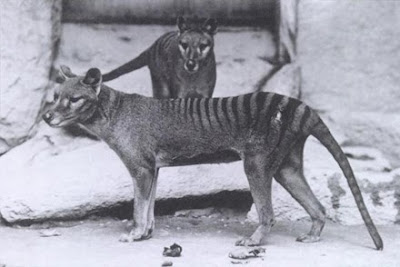
Over at Wired, there’s a hopeful story entitled, “Third of ‘Extinct’ Mammals May Still Be Alive.” Mammals supposed extinct from habitat loss are more likely to have survived than mammals presumed extinct due to invasive species or hunting. Brian Switek writes that
Categorizing a mammal species as extinct has rested upon two criteria: It has not been seen for more than 50 years, or an exhaustive search has come up empty….
In order to determine how often extinct species had been rediscovered, University of Queensland scientists Diana Fisher and Simon Blomberg created a dataset of 187 mammal species that have been reported extinct, extinct in the wild, or probably extinct since 1500, as well as those which have been rediscovered. They also looked at historical data on the threats that caused species to become extinct — or brought them close to it — including habitat loss, introduced species and overkill by humans.
It turns out that rumors of the extinction of more than a third of these species have turned out to be premature, the scientists report in Proceedings of the Royal Society B Sept. 29. At least 67 species — a little more than a third of those presumed to be extinct — were later found again. And in most cases, these were animals that had been hardest hit by habitat loss.
Books, Review
Tom Rachman’s The Imperfectionists
by JOHN ADAMS •
I’ve read Tom Rachman’s The Imperfectionists twice — once in hardcover, and once on the Kindle. (A particularly astute recommendation brought the book to my attention.) While thinking about the book, I decided to search for information on the author, and came across a review in the New York Times. It surprised me, a bit, to see that the reviewer, a professional author and reviewer, had also read the book twice. Rachman’s first novel is worth reading a second time, both for serious authors and for small-town bloggers.
Many of the books that I read these days are straightforward, often inartful, works of non-fiction: histories, politics, topics in science, etc. That’s a reading list common to many, with too little fiction in the diet.
The Imperfectionists breaks that poor habit, and in a powerful way: it’s a fine story of life at an English-language newspaper in Rome. The story proceeds as each chapter describes a member of the paper’s staff, characters carefully presented in all their eccentricities. The novel presents them subtlely, as credibly eccentric, with an insight and tenderness that makes descriptions of them memorable.
Publisher, editor-in-chief, reporter, copy editor, financial officer — one-and-all are intriguing, often sad, characters. The novel first chapter begins with has-been reporter Lloyd Burko, facing professional, personal, and financial decline. Burko manages all three with a mixture of waning ability and waxing desperation. (He puts one of his adult children, from one of many marriages, into a terrible predicament just to get a story and paycheck. The episode comes near the beginning of the book, and the account of Burko’s conniving is an enticement to read on, reluctant to put the book down.)
I’ll write no more about the story, except to say how very enjoyable — clever and touching by turns — The Imperfectionists was.
(I’ve a new book I’m now reading about — of all things — French cooking. I’ve tried to learn a bit of cooking, and someone recommended Edouard de Pomiane’s book to me, as it’s easy for anyone to understand. We’ll see.)
City, Economy, Government Spending, Innovation Center/Tech Park, Poverty
Whitewater’s Innovation Center from the Perspective of the New Deal
by JOHN ADAMS •
I posted yesterday about Whitewater’s Innovation Center, in a post entitled, Whitewater’s Innovation Center: Grants and Bonds.
The more one looks at the project, the emptier it seems. Attempts to justify the multi-million dollar public expenditure — on their own, apart from any other consideration — are exercises in embarrassing hyperbole. Attempts to answer objections to the project are particularly absurd, and only highlight how weak is the case in its favor.
There’s a greater problem than the project’s emptiness — it’s the inability to see clearly the city in which the project is taking so much time and money. Whitewater, Wisconsin, now population 14,454, is a struggling rural town, with large numbers of poor children.
Although I am a critic of much public spending, when I think of a model of public spending that at least properly considered actual conditions, I often think of Franklin Roosevelt. (For a critique of Roosevelt’s New Deal, one should consider Amity Shlaes’s excellent Forgotten Man.)
Much is made of Roosevelt’s sunny temperament, but that’s not why he’s admirable. He’s admirable because no matter how dubious Roosevelt’s spending (to my mind), he and his administration never lost sight of common and poor people. His efforts to control utilities were misguided, for example, but they had a clear and admirable aim: to provide electrification for common people. Roosevelt cared for the condition of ordinary Americans.
The contrast with current city projects, ones that Whitewater has backed over the last decade, is astonishing. When one looks at a project like the Whitewater Innovation Center, it’s of utterly no value to the many poor people in our small city. Not only does it have no chance to achieve the stated goal of the funding — it also has no chance of addressing the actual and difficult conditions that real people in our real town face.
No chance at all.
If Roosevelt’s committed and serious team were to see projects like the Innovation Center, I think they’d be astounded at how unsuited it is to the problems our town faces. This project offers no balm to prior economic or natural calamity. Looking around at poverty, unemployment, and economic uncertainty, the New Dealers would have been more far more practical, and (I think) outraged at this kind of spending.
One may hear that, since the money was offered (more, in fact, than our city administration asked), we should take what we can, because otherwise someone else would.
It was selfish to take money better suited to more realistic projects, merely because we could. Much of America’s fiscal predicament begins with states and local governments taking whatever they can, and figuring out what to make of it later. (Funds unused would not be lost to America, but could be reallocated to other initiatives more suited to these difficult times.)
That is, though, a fiscal problem. The greater problem is one of principled leadership — that men should not take for themselves what would (in other places) help other people, more fittingly and truly.
Daily Bread
Daily Bread for Whitewater, Wisconsin: 9-29-10
by JOHN ADAMS •
Good morning,
The forecast for Whitewater, now officially having a population of 14,454, is for a sunny day with a high temperature of seventy-three degrees.
Whitewater’s Urban Forestry Commission meets tonight, at 5 p.m. The meeting agenda is available online.
President Obama was in Madison yesterday, at the University of Wisconsin-Madison for a speech, and the Capital Times has a link to a video of the scene, with parts of his speech. I’m not sure how the speech was covered in other parts of the country, but it was a notable event here.
Pres. Obama has his share of critics (on spending, particularly), but I have neither understood nor joined in the harsh rhetoric directed against him. Watching his remarks, I find others’ apparent personal dislike for him puzzling; he’s both formidable and personable, I think.
Cats, Weird Tales
Video: Potty-Training Your Cat
by JOHN ADAMS •
Update: For those interested in both cats and odd slice of life stories, I can think of no better combination than this video from the Onion’s AV club. (H/t to the Huffington Post.) Formatting’s now been fixed.
Potty-training Your Cat
Link: http://www.avclub.com/articles/pottytraining-your-cat,45653/