FREE WHITEWATER

Reason.tv: Anyone Care About Economic Liberty Anymore? George Thomas on the 14th Amendment

George Thomas of Claremont McKenna College discusses economic liberties. Reason.tv’s interview is a solid contribution to the topic. I have embedded the video, and a description of it, below.

(By the way, if you’re looking for those who take economic liberties seriously, there’s no better place to start than the “merry band of litigators” at the Institute for Justice, a civil liberties public interest firm dedicated to defending economic liberty.)


Link: http://www.youtube.com/watch?v=je-a-0jPhtg

To take the original meaning of the Fourteenth Amendment seriously is to take economic liberties seriously,” says George Thomas, an associate professor of government at Claremont McKenna College.

Thomas notes that, for most of our nation’s history, there wasn’t a rigid distinction between civil and economic liberties. The Bill of Rights treated them all as fundamental rights, and, as can be seen in the famous passage, the Fourteenth Amendment continued this tradition: “No State shall make or enforce any law which shall abridge the privileges or immunities of citizens of the United States; nor shall any State deprive any person of life, liberty, or property, without due process of law; nor deny to any person within its jurisdiction the equal protection of the laws.”

Thomas explains that the separation between civil and economic liberties began during the Franklin Roosevelt era, when various economic liberties seemed to be written out of the Constitution. He shows how recent Supreme Court decisions, such as in Kelo v. City of New London, which granted governments wider economic domain powers, and McDonald v. Chicago, which extended the Second Amendment right to “keep and bear arms” to states and localities, figure in to how America defines and protects fundamental rights and economic liberties.

Approximately 10 minutes. more >>

Los Angeles Times: 41 White House Aides Owe $831,000 in Back Taxes – And They’re Not Alone

Apologists of big government wonder why there’s a gap between governors and the governed, why voters are dissatisfied. It’s because some bureaucrats behave as though the normal relationship is between rulers and ruled, and governors and governed.

Dozens of White House aides owe a total of eight-hundred thousand dollars in back taxes.

Nationally, federal workers owe over a billion dollars in back taxes.

Astonishing.

See, Los Angeles Times: 41 White House Aides Owe $831,000 in Back Taxes – And They’re Not Alone

Alaska Senator Lisa Murkowski’s Libertarian Credentials: None

There’s some talk about whether Republican U.S. Senator Lisa Murkowski, defeated in her party’s Alaska primary, should run as a Libertarian. To support this effort, a few dumb-as-a-doornail libertarians are trying to talk up Murkowski as a candidate on the LP line.

She’s not a libertarian, and so she doesn’t belong on a ballot as a candidate of the LP. She’s a big-government Republican, that particularly noxious political species.

Murkowski voted to spend hundreds of billions to fund the Troubled Asset Relief Program. That’s the opposite of a libertarian and a Libertarian Party candidate.

She’s just another desperate incumbent willing to say anything to convince gullible people that she’s not as foolish as she truly is.

Her father, a governor, apponted her to a United States Senate seat – she’s reaped enough from that nepotism for a lifetime.

She doesn’t deserve a possible reprieve from the LP.

Senator Murkowski’s Libertarian Credentials.

Small-town Bureaucratic Persistence in Edgerton, Wisconsin

Over in Edgerton, Wisconsin, a place even smaller than my town of Whitewater, there’s been a sensible decision to “hold off on discussions over buying a new police dog until fall 2011, when the city plans for its 2012 budget.” See, Edgerton Delays Dog Decision.

Edgerton’s former police dog bit a police officer from another department, and an Edgerton city worker, before being sold. I’ve written before about the mess that was Edgerton’s former K-9 program. See, Update 3: On Edgerton, Wisconsin’s Police Dog (Doggone and Dog Gone!).

It’s just embarrassing that Edgerton’s police chief, Tom Klubertanz, and Alderman Ken Westby, won’t let this issue go. Edgerton is a small town, and few small towns have police dogs, because they’re a big commitment. That’s why one finds K-9 units in large cities or in counties, rather than small towns. Responsible, prudent small-town policing doesn’t require a police dog, and in fact, would shy away from one because the commitment is just a distraction from other priorities.

My own small town of Whitewater (pop. 14, 296) is bigger than Edgerton (approx. 5,000), but still wouldn’t be suited to a canine unit. That’s a role that nearby counties can, and have, undertaken.

There’s a persistence in this that defies the reasonable or the practical. It’s an exercise in insisting, again and again, on the unpersuasive and unbelievable. Why anyone would double down this way my seem puzzling.

I don’t know why a few in Edgerton carry on; readers can guess that these few and I don’t travel in the same circles.

Beyond Edgerton, though, it’s all too easy for bureaucrats or politicians to lose touch with now ordinary people think . They surround themselves with toadies, sycophants, and boot lickers (a few of each, I’d guess), and all they hear is (1) how wonderful they are and (2) how evil or stupid their critics are. When they encounter a setback, they refuse to consider that they might have been wrong; instead, their circle of supporters tells them, “These savages don’t deserve someone so serene and sublime as you are, Your Grace. Still, would you not consider trying again, so that they may now see the error of their ways , and support your loving, careful, and brilliant proposal? Please, sir, give them another chance.”

But the same ordinary and sensible people see the same senseless and odd proposal, and say: “Can you believe this guy’s wasting our time yet again? What the heck?”

That’s the gap between cocooned officials and sensible constituents.

Friday Comment Forum — The Wisconsin September Primary

Here’s the Friday open comments post.

Today’s suggested topic is your candidates for the upcoming September 14th Wisconsin primary election for governor, lieutenant governor, and U.S. Senator. Here are my picks, depending on party preferences. (I’m a libertarian and Libertarian, rather than a Democrat or Republican.)

If voting among Democratic choices, I’d pick:

GOVERNOR – DEMOCRATIC
TOM BARRETT

LIEUTENANT GOVERNOR – DEMOCRATIC
NO PICK

US SENATOR – DEMOCRATIC
RUSS FEINGOLD

Barrett and Feingold are, in effect, unchallenged (although there’s more than one candidate on the primary ballot for the Democratic nominee for governor). Both are likely to be better on some, but not all, civil rights than their Republican opponents. Both are likely to be worse on some, but not all, economic issues than their Republican opponents.

If voting among Republican choices, I’d pick:

GOVERNOR – REPUBLICAN
MARK W NEUMANN

LIEUTENANT GOVERNOR – REPUBLICAN
NO PICK

US SENATOR – REPUBLICAN
RON JOHNSON

I’d easily pick Neumann over Walker, simply because Walker’s handling of the Milwaukee County Behavioral Health Division’s abuses, incompetency, and misconduct convinces me that Walker’s just another scheming, manipulative, selfish, unprincipled careerist.

As for Johnson, he’s the sure winner, and he’s a pick based on inevitability in the primary.

If voting among Libertarian choices, I’d pick:

LIEUTENANT GOVERNOR – LIBERTARIAN
TERRY VIRGIL

He’s the only Libertarian choice — we didn’t field a candidate for governor. Such is the state of our party (the LP).

These primary picks are that only — I’m undecided among the major party candidates in November. Although, as one can guess, Walker’s selection as the Republican nominee would make it easier for me to decide in November.

The use of pseudonyms and anonymous postings are, of course, fine.

Although the comments template has a space for a name, email address, and website, those who want to leave a field blank can do so. Comments will be moderated, against profanity or trolls. Otherwise, have at it.

I’ll keep the post open through Sunday afternoon.

Daily Bread for Whitewater, Wisconsin: 9-10-10

Good morning,

Whitewater’s forecast for today calls for a breezy day with a high temperature of seventy-degrees.

At Washington School today, it’s Eagle Day & Spirit Day.

Wired has a story about a discovery by the Seahorse Trust:

The Seahorse Trust, after years of surveying the fish in British waters, has finally found, measured and photographed a baby seahorse, which is also called a fry.

Despite finding many adults, plenty of pregnant males (female seahorses transfer their eggs to the male, who fertilizes them in his pouch) and juveniles, the trust had previously failed to find any babies.

Baby seahorses are left entirely on their own after being born, and rarely survive long enough to become an adult. Due to their premature independence and underwater predators, less than one in a thousand will survive into adulthood. Not good odds, even though about 100-200 eggs are hatched at a time.

But the trust finally found a fry in the waters at Studland in Dorest. Despite poor weather and only 3 feet of visibility, scientists spotted a tiny seahorse clinging on to a piece of seagrass. They managed to measure the 1.6 inch creature, and snap the photograph above, before the baby returned to the sea bed.

….unfortunately, seahorses are under threat around the world as they’re popular as pets, souvenirs and in Chinese medicine. An excess of 20 million of the critters are taken from the sea each year….


The 4cm fry being measured on the seagrass. Image courtesy The Seahorse Trust.

La Crosse Tribune: Romanian Senators Reject Tax on Witches and Fortune Tellers

The rejected legislation was contradictory: it called for both taxes on income from fortune-telling and liability for wrong predictions. Liability for wrong predictions would put fortune tellers out of business, so there’d soon be no income to tax.

(If witches’ predictions were really any good, they’d be using those supposed powers in a field with better pay and benefits than garden-variety fortune-telling.)

In any event, however dubious their trade, it’s better they’re free from state taxation.

See, Romanian witches win tax fight for now.

Dockside Inspections, a Lost Decade, and Municipal Obstructionism

Years ago, in the 80s, when trade with Japan was controversial, Americans leveled legitimate criticisms about how Japan used dockside inspections of cargo as a way to prevent importation of foreign goods. The regulations were often small, and although rational individually, they were collectively irrational and counter-productive. By inhibiting free trade, Japan’s insidious protectionism actually harmed the Japanese economy and punished Japanese consumers.

Those years were a heady time for Japan. Aging executives believed that the decade ahead was sure to be a good one, and they must have felt that they had put behind the failed militarism of their youth for commercial conquest. Many Japanese were sure their nation was destined to dominate the global economy.

It didn’t work out that way: the 90s were a ‘lost decade’ for Japan. So certain of herself only a few years earlier, Japan’s bubble burst, and although she spent wildly in the 90s to spark a recovery, on public project after public project, Japan stagnated rather than grew.

The Japanese who established a regimen of anti-competitive inspections in the 80s were probably as sure of themselves as any men in modern times. The world was just destined to be theirs…

A quarter-century later, the world may be many things, but Japanese-dominated it’s not. If self-assurance alone shaped destiny, then the confidence of those Japanese leaders and executives would have made our world their world today.

Although Whitewater, Wisconsin isn’t Japan (!), I am occasionally reminded of Japanese hubris and dock-side inspections when I listen to a Whitewater Common Council session. A new idea is met with that same sort of subtle obstructionism. One will near that there will need to be a comparison to other communities, a study on the proposal, a study on the study on the proposal, a call for a task force, an assembling of the task force, a task force report, and then a study of the results of Whitewater’s task force compared with those of other communities silly enough to send proposals to task forces.

It’s what, after all, sensible people are just supposed to do.

It’s not, of course, what sensible people really do, when they want to consider an idea; it’s what obstructionists do when they want to cast an idea into the darkness, to be forgotten.

It’s an effective way to kill a proposal, in Whitewater, Washington, or Tokyo. Politicians and bureaucrats will be using the same techniques generations from now. And yet, they’ll impoverish their communities the same way.

This question remains for the bureaucrats and obstructionist politicians of my small town (and elsewhere): What have you done to allow us to overcome slow growth, unemployment, and child poverty? Why are we still beset with these conditions? Why, despite all your grand projects, built on taxes and on millions in public debt, are people still struggling?

Even in more prosperous times for America, why was Whitewater beset with such high child poverty — far above that of neighboring places or of America?

No groundbreaking, no press release, no fawning newspaper story, no skewed survey results, no distorted statistics, can hide the truth of actual, longstanding, difficult conditions in our small city.

Whitewater-Area League of Women Voters September 2010 Newsletter

The Whitewater-Area League of Women Voters’ September 2010 Newsletter is now available, and the latest issue includes a calendar of upcoming LWV events. The most-recent copy of the LWV newsletter is available as a link on my blogroll, and is embedded below, with coding through Google.

A selection of upcoming events for the Whitewater-Area League — the newsletter offers still more events and information —

Date: September 11 (Saturday)
Event: LWV Board Meeting
Where: Irvin Young Library, White Memorial Room, 11AM

Date: September 16 (Thursday)
Event: “Economic Benefits of Technology Park,” Bud Gayhart speaker
Where: Municipal Building, Council Chambers, 7 PM

Date: October 16 (Saturday)
Event: Candidate Forums for State Assembly District 43 and State Senate District 15.
Where: Municipal Building, Council Chambers, Tentative pending availability of candidates, times TBA

Date: October 21 (Thursday)
Event: “Status Report on Clean Energy Jobs Act” speaker TBA
Where: Municipal Building, Council Chambers, 7 PM

Fairhaven Lecture Series

The Fall 2010 Fairhaven Lecture Series, sponsored by the UW-W Office of Continuing Education, will look at biography as a literary form, look at the life and times of some of history’s most famous, infamous, and barely famous figures, and even take a biographical look at the life a famous city. All lectures are open to the public at no charge and are held on Mondays at 3 p.m. in the Fellowship Hall of the Fairhaven Retirement Community, 435 West Starin Road. Guest / street parking is adjacent to the building.

September 20 — The Pleasures and Pains of Reading and Writing Life Stories. Rebecca Hogan, Professor of Languages and Literatures
September 27 — Six Degrees of Stanley Milgram: The Man Who Shocked the World. Elizabeth Olson, Assistant Professor, Psychology

Daily Bread for Whitewater, Wisconsin: 9-9-10

Good morning,

Whitewater’s forecast for today calls for a partly sunny day with a high temperature of seventy-degrees.

Whitewater’s Landmarks Commission meets today from 9:30 to 10:30 a.m. The agenda is available online.

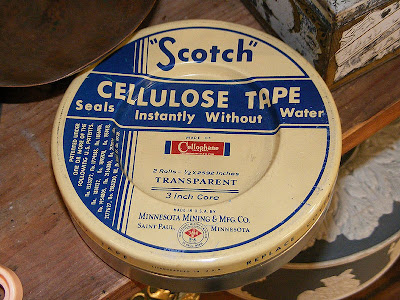
Yesterday was a great day for American ingenuity: Sept. 8, 1930: Scotch Tape Starts Sticking. Wired recalls the product’s introduction —

3M begins marketing the first waterproof, transparent, pressure-sensitive tape after employee Richard Drew figures out how to coat strips of cellophane with adhesive.

Initially sold by the St. Paul, Minnesota, company as a moisture-proof seal for bakers, grocers and meatpackers, the product quickly got repurposed during the Depression by money-strapped consumers who used the tape as a cheap home-repair tool.

“Cellophane Tape” picked up the “Scotch” tag, according to legend, when a St. Paul car dealer became annoyed because the cellulose ribbons originally only had adhesive on the borders. Slagging 3M (known in those days as the Minnesota Mining & Manufacturing Co.) for being stingy, he invoked Scotland’s penny-pinching reputation and dubbed the product “Scotch tape.”

The name stuck.