FREE WHITEWATER

Monthly Archives: August 2011

Rhinelander benefits from the… Hodag


For more on the Hodag —

March 22nd is the birthday of Eugene Shepard, of whom the Wisconsin Historical Society offers an account —

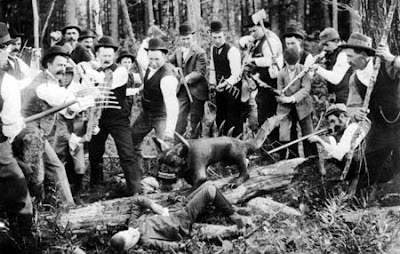
…Eugene Shepard was born near Green Bay. Although he made his career in the lumbering business near Rhinelander, he was best known for his story-telling and practical jokes. He told many tales of Paul Bunyan, the mythical lumberjack, and drew pictures of the giant at work that became famous. Shepard also started a new legend about a prehistoric monster that roamed the woods of Wisconsin – the hodag.

Shepard built the mythical monster out of wood and bull’s horns. He fooled everyone into believing it was alive, allowing it to be viewed only inside a dark tent. The beast was displayed at the Wausau and Antigo county fairs before Shepard admitted it was all a hoax. [Source: Badger saints and sinners, by Fred L. Holmes, p.459-474]


The hodag’s become the mascot for Rhinelander, Wisconsin, and  a music festival, the Hodag County Festival, that carries the animal’s name (34th annual festival held July 7-10, 2011).

Recent Tweets, 8.14-8.20

New York Times describes Wisconsin Supreme Court as ‘A Study in Judicial Dysfunction’ nyti.ms/nX1EpX

Lunatic Alert™: Arizona sheriff promises Obama-eligibility probe – via equally nutty WorldNetDaily bit.ly/rqBoMR

A prime aim of the growing Surveillance State – bit.ly/ciwJzl Mobile bit.ly/ppBV11

PolitiFact’s silly, picayune critique of Rep. Baldwin’s statement about recalls taking place in reddest parts of state bit.ly/oH9tXD

How Richard Nixon Inspired the Libertarian Party « FREE WHITEWATER bit.ly/ncdbE3

Only insanity is thinking defense will work: Wheeler police chief uses insanity defense against child abuse charges bit.ly/nXorO7

During Whitewater’s Police Chief Search « FREE WHITEWATER bit.ly/qNWlQo

For those who have almost everything: Owning Your Own ‘Chupacabra’ – Fox Point-Bayside, WI Patch bit.ly/pCDGLJ

The Wisconsin Reporter’s Incredible, Ignorant Enthusiasm « FREE WHITEWATER freewhitewater.com/?p=17536

As expected, Dem Sen Bob Wirch retains seat in recall vote – JSOnline bit.ly/o3HnvJ

WisconsinReporter.com tweet after 17% of vote ‘Steitz building a commanding lead’ just embarrassing boosterism Wirch wins easily

Copyright t[r]oll hit again Righthaven defendant wins second attorney’s fee award – VEGAS INC bit.ly/nrX5RU

Story’s not funding, it’s unwillingness to recuse Prosser’s recount got ample funding – JSOnline bit.ly/pQkEgN

Weak story leaves politicians’ assumptions unchallenged Racine officials fear being ‘inundated’ with group homes bit.ly/npp0pW

The Best Way to Create Jobs: Free Markets in Capital and Labor

Here’s New York Mayor and businessman Michael Bloomberg talking about the best way to create jobs. He’s right that fewer immigration restrictions actually boost American employment.

There’s much more to be said about all this, but a scheme of labor restrictions isn’t just socially disruptive, and an example of over-criminalization.  Restrictions impoverish America; free private flows of capital and labor enrich America.  


Friday Poll and Comment Forum: Cats or Dogs?

Here’s a question that I’ve not yet offered, and that’s overdue: Cats or Dogs?


FREE WHITEWATER has catblogging, but no dogblogging. Generally, I’d pick cats, recognizing that a good dog counts for a lot, even if cats are particularly fascinating (and worthily independent). So, for me, cats over dogs, but not by much — just a whisker. As for my own dog, I’d not make the choice, as he’s a very sold and sharp canine.

Here you go: which do you prefer?


Comments will be moderated against profanity and trolls; otherwise have at it. This post will be open until Sunday morning.

Daily Bread for 8.19.11

Good morning.

It’s a mostly sunny day ahead, with a high temperature of eighty-six awaiting Whitewater.


ScienceNews.org reports on a study about the insidious effects of one’s own stress on others, in a post entitled, Early stress is contagious in adulthood: A zebra finch’s tough childhood shortens both its life and its mate’s. Susan Milious reports that

Among the regrettable things one might catch from a long-term mating partner, add the life-shortening effects of stress in childhood.

Chickhood stress is bad for zebra finches. Nestlings dosed with stress hormones tend to die earlier in adulthood even if they enjoy plentiful food in predator-free lab quarters after maturity.

And so do those unfortunate nestlings’ mates, a new study finds. Zebra finches, which form strong pair bonds, somehow manage to transmit their own risks of stress-shortened life span to their partners.

“It’s like giving them a disease,” says evolutionary ecologist Pat Monaghan of the University of Glasgow in Scotland.

The study involves only birds, not humans, but other experiments are likely in an effort to see how widespread sress’s effects may be.

How Richard Nixon Inspired the Libertarian Party


Surprising, but true: It’s Richard Milhous Nixon, America’s thirty-seventh president, who offered the inspiration. Nixon certainly didn’t directly encourage the party; his proposal for economic regulation convinced a few ordinary-yet-extraordinary Americans that they’d had enough federal meddling in citizens’ lives, thanks very much.

Here’s what happened, in 1971 (at a time when Nixon was about a year away from a landslide presidential victory):

On August 15, 1971, President Richard Nixon gave a speech announcing what would be known as his “New Economic Policy.” The speech led directly to the formation of the Libertarian Party.

In the speech, Nixon announced two measures that were of particular concern to libertarians. First, a government-imposed freeze on wages and prices. Second, and end to the convertibility of dollars to gold.

Nixon said, “I am today ordering a freeze on all prices and wages throughout the United States for a period of 90 days.”

Libertarians saw both of these actions as betrayals of the principles on which the United States was founded.

This speech has often been cited as the critical moment that ignited the formation of the Libertarian Party.

In his history of the libertarian movement, Radicals for Capitalism, Brian Doherty writes that the late David F. Nolan “was working for an ad agency in Denver and happened to have a handful of libertarian-minded friends over that day when Nixon hit the airwaves with his wage and price controls announcement. They all agreed: It was time for a third party…a Libertarian Party.”

Nolan and several others formally created the Libertarian Party in Colorado Springs on December 11, 1971.

It says much — and much that’s creditable to him, I think — that Nolan founded the party despite the strength, in both major parties, of regulatory zeal. Nolan wasn’t a situational man, assessing chances for victory, and trying to fit in. He was a principled man, beginning a new party at a time when its ideas were far less accepted than they are today.

There were libertarians in American before 1971, and even libertarians before Americans started to use the term with any frequency (in the 1950s). The odds were long back then, but Nolan was — to his credit — undeterred.

Still, David Nolan owed Richard Nixon the assist.

During Whitewater’s Police Chief Search

We’re in the midst of a police chief search (candidate and August 26th forum information available online), but like the mid-point of many searches, there’s only a bit to say.

Open Over Closed. An open process is better, in-and-of-itself, than a closed one. Open is the right course.

Outcomes matter. No matter how fine the process, it’s an outcome that will affect residents of Whitewater, for years ahead.

Open processes yield superior outcomes over many iterations. Although an open process is the right one, like free market transactions, open processes yield superior outcomes to closed ones over many iterations. There’s no certainty that a single search, or a single market transaction, will be the right or efficient one; it’s a process extended over many searches that produces superior results. I’ve no idea how this search will turn out.

Commentary is a response, not a reflex. During his long tenure, then-Chief Coan never understood that bad policies produce bad news, and that the solution will always be a better policy. All those proud headlines, grandiose claims, etc., and for it all….the same disappointments and mistakes, time and again. Introspection would have changed that, but there’s no evidence he was a leader inclined to reflect that way, to adjust in a productive, practical way. More of the same got him only more of the same.

Where is this going? I don’t know. Those so inclined can watch the latest Police Commission meeting, hoping to see a few predictive tea leaves. I’ve seen the meeting, but without any interest in guessing at an outcome.

After this search is done, and there’s a selection, the next day will be … the next day.

One would hope, to borrow Pres. Harding’s term, that after so many years, we’ll see a return to normalcy. We’ll be better off if we do see as much, but that’s an outcome yet ahead.

Daily Bread for 8.18.11

Good morning.

It’s a mostly sunny day, with temperatures in the low eighties in store for Whitewater, if weather.com has anything to say about it.

Wired offers a striking collection of rare animal photos in a story entitled, Wild Close-Ups of Rare Mammals From Huge Camera-Trap Study. Here’s just one, of over a dozen, from several locations:


Ocelot: Volcan Barva, Costa Rica. [High resolution]

Image: Conservation International/Tropical Ecology Assessment and Monitoring Network/Organization for Tropical Studies

Anne Hathaway’s Lil’ Wayne Style Paparazzi Rap

I caught this via The Atlantic Wire, and they’re right that it’s brilliant, but it’s confident and unabashed, too.  Hathaway’s  confidence in the trying of something is noteworthy and admirable.  We’re in danger of becoming an oh-so-serious, earnest, and proper people.  I don’t believe that the danger will come to pass– I’m a great optimist in America.

The best way to forfend that sad seriousness and dull fate, though, is to encourage creative, clever risk-taking.  So very welcome and well-done.

Anne Hathaway’s Lil’ Wayne Style Paparazzi Rap – Conan on TBS – YouTube.

more >>

How Politicians, Bureaucrats Pretend They’re Offering Competitive Solutions

A cunning bureaucrat, or a Texas politician, may tell his constituents that he’ll propose charging user fees, rather than using general tax funds, for basic services. He’s sure to contend that this approach makes the services offered more competitive.

That’s nonsense, of course. The same government monopoly would exist as before, with the same lack of private competitive alternatives, and so with the same inefficiency and mediocrity. Different people may pay different amounts for government services, but they’re still paying for a government monopoly.

Over at the national Libertarian Party, Wes Benedict writes about how Texas Gov. Rick Perry tried to dupe his fellow Texans this way, over a toll-road plan. Benedict explains:

Last week I issued a statement that included a criticism of Texas Governor Rick Perry’s support for toll roads. Several people asked for an explanation about my stance on toll roads and I can understand why.

The Libertarian Party platform says “We seek to divest government of all functions that can be provided by non-governmental organizations or private individuals.” Private toll roads could fit that bill. Some free-market think tanks have promoted toll roads as a positive option.

Don’t privately-run toll roads sound more libertarian than government roads?

So what’s up? Why am I opposed to toll roads?

If we were talking about an open system where private companies compete with each other to build roads, buying their own right-of-way, taking the risks and earning the profits, I’d be a supporter.

But that’s absolutely not what we’re talking about. In almost every case, “toll roads” are a mechanism where government remains in charge, but manages to take more of your money.

It’s a slick sales job to fool people.

In Texas, the plan was for a single private monopoly company to get the concession to build and maintain roads. No competition allowed. Even the government couldn’t compete. That meant that the government would intentionally allow the traditional non-toll roads to decay, and they would lower the non-toll speed limits, in order to fulfill their agreement. But don’t think for a minute they would lower the gas taxes and other taxes used for those roads. You’d be paying just as much tax, and the government would intentionally be delivering less.

You might end up having to drive on the toll road, where the owning company (thanks to its government-guaranteed monopoly) could charge you however much it wanted.

I’m all for corporate profits — but not when it’s a government-guaranteed monopoly.

It was also very questionable how much the private company was “taking the risks.” If things didn’t work out, it was very likely that the government would bail out the private company with tax dollars, and then take over the road. (While continuing to levy both taxes and tolls.)

I don’t want our state and federal governments to have more revenue and more debt. I want them to have less of both. I also don’t want them picking out their cronies’ companies to be the big beneficiaries of monopoly concessions. I hate it when politicians dictate winners and losers.

I don’t want the government to increase the financial burden on citizens, in order to create an illusion of privatization. Tolled highways can cost twice as much to build per added lane-mile as non-tolled roads, and ten times more than ground-level thoroughfares.

In the northeast, many people have listened to politicians talk about how tolls were only going to be charged until the road was paid for, and then the tolls would be removed. Yet somehow, the road never quite got paid for, or they changed the rules, and the tolls remained indefinitely.

One more thing: In Texas, Rick Perry planned to use eminent domain to seize huge amounts of private land for the toll road network. I strongly disagree with eminent domain seizures.

Unfortunately, the government almost completely controls the building and maintenance of roads in America. And it’s really hard, if not impossible, to privatize it “a little bit.” That just ends up making it more complicated, corrupt, and expensive.

Maybe someday, someone will come up with a toll road plan that really makes sense from a Libertarian point of view. Rick Perry absolutely failed to do that in Texas.

Wisconsin Reporter: Incredible, Ignorant Enthusiasm

I wrote yesterday about a new group of sham news sites, and mentioned the Wisconsin Reporter as among them. (If I had a dime for every time that website misspelled something, and later claimed the misspelling was just a typo, I’d have…lot and lots of dimes.)

That’s not their big problem, of course: the big problem is that it’s a political website pretending to offer original, conventional reporting. Actually, the site is a collection of political talking points dressed as news. There’s an embarrassing and ignorant boosterism to it all. Consider this tweet from the site’s Twitter account, while reviewing early returns of the Wirch-Steitz recall race:

Now 17% of SD 22 polls reporting and Steitz isn’t just hanging around, he’s building a commanding lead – 55% to 45% over entrenched Wirch.

As widely expected, Wirch won in a landslide; when all votes were counted, he defeated Steitz 58%-42%.

Wisconsin Reporter tweeted on a ‘commanding lead’ after only 17% of the votes were in, and before (as was evident) Wirch’s large base of Kenosha had reported any votes. There are people, having arrived in the state only a day or two before, who would have had better sense.

This tweet isn’t sound analysis, it’s silly, incredible cheerleading. I’m not bothered by the political leanings of a website, if it provides sound, reliable analysis. I’ve no reason to think Wisconsin Reporter understands, let alone offers, that analysis.

Nonetheless, the Franklin Center’s free to spend a lot of money in Wisconsin for a lot of nothing. They’re foolish, though, to think serious men and women will rely on the object of their patronage.