FREE WHITEWATER

Monthly Archives: May 2012

Daily Bread for 5.8.12

Good morning.

It’s a mild day ahead for Whitewater, with a high of sixty-six, and a slight chance of rain in the afternoon.

All America watches Wisconsin’s election day, and awaits the contest ahead in the next month. A day on which people vote always feels better than a day otherwise.

After Germany signed a surrender the previous day, this day in 1945 was celebrated across Europe as VE Day.

Google’s daily puzzle offers a question about Prohibition: “If a man lives in the city that lifted prohibition on March 1st of 1989, and he was born the year it banned beer, how old is he?”

Note: A connectivity glitch of some sort this morning at FW, but easy enough to bounce back. more >>

Daily Bread for 5.7.12

Good morning.

Whitewater’s Monday will see a day of scattered showers and a high of sixty-seven.

On this day in 1945, Nazi Germany  “signed an unconditional surrender at Allied headquarters in Rheims, France, to take effect the following day, ending the European conflict of World War II. ”  The New York Times story on that surrender reported that “The War in Europe is Ended! Surrender Is Unconditional; V-E Will Be Proclaimed Today; Our Troops on Okinawa Gain.”

How adaptable is Wisconsin agriculture?  Very.  Over at the Wisconsin Happy Farm, they’ve a picture of crop-dusting by helicopter.

The Wisconsin Historical Society recalls that  on this day in 1956,

35th Million Vehicle Produced at GM Plant

On this date General Motor’s Chevrolet Division produced its 35th million vehicle, a gold ’57 Bel Air sport coupe, or “hardtop,” at the Janesville plant. For photos and stories about Wisconsin’s automotive industry, visit the page devoted to Automobile Culture at Turning Points in Wisconsin History. [Source: Janesville Gazette]

Google asks a question about distance and travel times in their daily puzzle: “How many days would it take you to walk from SJC to STL?”

Help Bring a Film to Life! Your Chance to Support Filmmaker Sean Williamson’s Heavy Hands

Update 5.6.12, 4:43 PM CDT – Today was a good day, thanks to the support of over one-hundred fifty backers, each playing an important role.


Update 5.6.12 – There’s time left until just after 4 PM CDT, to make this fund-raising drive a success, with more yet to go. If you’ve not had a chance, there’s still the occasion to join others, and help fund a film (something good in, and of, itself – and also great fun – you can honestly say you financed a film, after all).

Original post

There are few aspects of American culture that are, in fact, more American than film-making. Here’s your chance to help make a film — really — by supporting a local filmmaker.

Whitewater filmmaker Sean Williamson is almost finished his film — Heavy Hands. He’s using kickstarter.com to raise the last of the money needed to finish the film.

Link to Pledge Page.

Sean has a goal of $15,000, and is at about $13,000 as of this post.  A kickstarter like this allows a filmmaker to set the dollar amount that’s needed to finish a film, and then people can pledge — in amounts of their choice — to help fund the film.  If the filmmaker does not meet his goal, he or she receives none of the money — the pledges are only collected if the contributions reach the target goal.

His kickstart ends Sunday afternoon just after 4 PM CDT.

I am confident we can put Sean over his goal.

I’ve contributed, and I hope you do, too.

TRAILER


SEAN SPEAKS ABOUT THE FILM

In my debut feature I’m following in the footsteps my favorite directors (Sam Raimi, David Lynch, Jim Jarmusch) by creating a challenging and stylish narrative.

Heavy Hands follows Anti-hero Jimmy Lee as he deals with the repercussions of a thoughtless and selfish act. Set in a harsh country landscape, Heavy Hands is a scary, funny and sexy picture filmed in Wisconsin, New York, Kansas and Colombia on super 8mm stock.

WHY KICKSTARTER?

I’ve been working on this film for going on three years and have used every interesting and unique actor, location or resource I could. Now it’s time to really bring it home. Closing funds I raise through Kickstarter will help me finish editing, sound and any additional shooting that needs to be done. I’ll also be looking to enlist the services of one bigger name professional actor/actress.

I know this film can be great. I need these finishing funds to bring the vision of this film full circle.

SEAN’S GOALS FOR HEAVY HANDS

I want as many people to see and enjoy the film as possible. That’s really the bottom line. In the end I want to use the success of this film as the start of something bigger – not just for people in Milwaukee but for all the talented people I grew up with in Walworth County and all the people I’ve met in my travels. So let’s do this. Let’s make it happen.

SEAN’S MOST RECENT WORK

Update: Trainer videotaped hitting horse to be cited for animal abuse

Here’s an update on the story that prompted last week’s poll, Animal Abuse or Necessary Technique?, about a trainer recorded hitting a horse with a plastic bat.

Seventy-seven percent of respondents thought that kind of treatment was abusive, about fifteen percent weren’t sure, and nearly eight percent said it wasn’t.

Dane county officials will cite the trainer (if they can find her) for animal abuse. Their reasoning:

“We’ll issue the citation if we can find her,” said Doug Voegeli, Dane County’s director of environmental health.

Voegeli said Plasch met the two criteria — unnecessary pain and excessive pain — required in order to be cited for animal abuse. He said the decision was made after he reviewed the video and consulted with animal service officers from his department.

“We felt there were other methods that could be used” to load the horse, Voegeli said.

Friday Poll: Most-Awaited Summer Films

Summer is a season of blockbusters films, and Hollywood’s seen things that way at least since Jaws, a generation ago.

This summer, some big-screen adventures await: The Avengers (today, 5.4), Men in Black III (5.25), The Amazing Spider-Man (7.3), and The Dark Knight Rises (7.20).

Of these big-budget films, which looks good to you (multiple answers are possible)? Poll and trailers below —


Daily Bread 5.4.12

Good morning.

Whitewater’s weeks ends as a mostly cloudy day, with a high of sixty-four.

Google’s daily puzzle asks about textile-making: “What style of cloth weaving is named for the world’s oldest continuously-inhabited city?”

The Wisconsin Historical Society recalls that on this day in 1873,

1873 – Progressive Governor John James Blaine [Was] Born

On this date John James Blaine was born in the town of Wingville in Grant County. A politician, governor, and U.S. Senator, Blaine attended public schools in Montfort, and received a law degree from Northern Indiana University. He was admitted to the Wisconsin bar in 1897 and practiced briefly in Montfort before settling in Boscobel. A Progressive Republican, he served as Boscobel’s mayor for four terms and was elected to the State Senate in 1909. It was there that he gained prominence by leading investigations into the campaign expenditures of Wisconsin Senator Isaac Stephenson, attempting to block Stephenson’s re-election.

A zealous advocate of progressivism and the ideals embraced by Robert M. La Follette Sr., Blaine was one of the organizers and vice-president of the Wilson National Progressive Republican League. After running unsuccessfully for governor in 1914, Blaine was elected state attorney in 1918.

In 1921, he became governor and held this office for three consecutive terms. During his tenure Blaine promoted progressive labor legislation, fostered a campaign to eradicate bovine tuberculosis, and signed the nation’s first law giving equal rights to women.

In 1926, he won the Republican nomination for U.S. Senate where he served from 1927 to 1933, becoming one of the leaders in the effort to repeal prohibition. He died on April 16, 1934. [Source: Dictionary of Wisconsin Biography, SHSW 1960, pg. 39]

Reason’s April 2012 ‘Nanny of the Month’

The accompanying narrative from Reason:

We’ve got Georgia Gov. Nathan Deal demanding clean urine in exchange for welfare benefits (a bad idea that also doesn’t work as advertised, but hey, at least the boozers are safe!), North Carolina regulators busting a blogger for praising the paleo diet (an offense that can get you tossed in the clink!), but this month the freakiest controllers come to us from a Brazilian city where public schools have begun tracking thousands of 4-to-14-year-olds with GPS-embedded uniforms. (At least they’re not tagging the kiddos’ ears!)

Funny about ear-tagging: someone is sure to insist that if you can embed an identification chip in a pet, then you can/should/simply must embed a tracking device inside each human child. Expected arrival stateside of proposals like that: six to twenty-four months, tops.

Originally published on 5.3.12 at Daily Adams.

Daily Bread for 5.3.12

Good morning.

It’s a cloudy day with a high of seventy-nine, and likely thunderstorms, ahead for Whitewater.

The History Channel recalls that it’s Machiavelli‘s birthday (born in 1469) today.

Often misunderstood, always compelling.

In our history, from the records of the Wisconsin Historical Society, a birthday of a famous Wisconsin resident:

1898 – Golda Meir Born

On this date, Golda Meir (nee Mabovitch) was born in Kiev, Russia. Economic hardship forced her family to emigrate to the United States in 1906, where they settled in Milwaukee. She graduated from the Milwaukee Normal School (now University of Wisconsin-Milwaukee) and joined the Poalei Zion, the Milwaukee Labor Zionist Party, in 1915. In 1921, she emigrated to Palestine with her husband, Morris Myerson, where they worked for the establishment of the State of Israel. Meir served as Israel’s Minister of Labor and National Insurance from 1949 through 1956 and as the Foreign Minister until January of 1966. When Israeli Prime Minister Levi Eshkol died suddenly in 1969, Meir assumed the post, becoming the world’s third female Prime Minister. She died in Jerusalem on December 8, 1978. [Source: Picturing Golda Meier]

Google’s daily puzzle takes us to Italy long before Machiavelli: “What document changed the familial status of the Roman emperors associated with Quinctilis and Sextilis?” more >>

Video for the Democrats’ Recall Forum @ UW-Whitewater

I posted earlier about the Democrats’ recall forum on 4.25.12 at UW-Whitewater. I’m not a Democrat, but it was an event well-worth attending. All four Democratic candidates for governor, and other office-seekers, were there.

For my posts on the evening, see The Democrats’ Recall Forum @ UW-Whitewater and The Democrats’ Recall Forum @ UW-Whitewater (Compas and Jorgensen edition).

If you didn’t have an chance to be there, you can still see the presentations. Democrats can get another look at their candidates, and Republicans can see the field that’s striving to take on Gov. Walker. It’s always better to see something in the original than rely solely on newspaper or television accounts. (You’ll also be able to check my assessment of the night against your own opinion.)

Go Native!

Whitewater has many well-manicured lawns, and on a few of them, some honey bee hives. The lawns are lovely, and the honey bees (despite depleted aggregate numbers from colony collapse disorder) are good pollinators.

But what if there’s something different, perhaps even better, than conventional lawns and common honey bees? There is something different — and perhaps even better — if one would only go native.

In place of a regular lawn, however carefully kept, one could grow a natural lawn. Whitewater’s municipal code includes provisions allowing natural lawns at less than 50% of one’s property not covered by buildings, or more than that subject to review and aproval. (There are also provisions for what sort of plants one may have within a garden of whatever size.)

20120502-110526.jpg

Best bets: Review the ordinance fully, take note of the prohibited plants list, and keep the garden under 50% of your unoccupied property, thereby avoiding review from Whitewater’s Director of Public Works (who should have better things to do with his time in any event).

I’ll establish a natural lawn someday – I think it would be lovely, and I’ve marked it as a longterm goal.

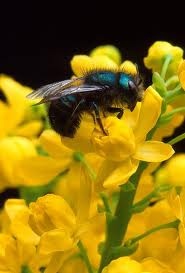
But there are other native possibilities one can pursue, including raising highly-efficient native bees in place of honey bees. I’ve thought about this now and again, and a recent article in the Wall Street Journal (of all places) about native bees rekindled my interest. See, Urban Buzz: A New Bee That Sips Sweat.

Acompanying the story is a short video about urban bees —

Although the story’s about a new species of sweat bee, Lasioglossum gotham, it also considers the general benefits of native bee species —

We’ve neglected the native bees because the honey bee was so successful,” said entomologist Anne Averill at the University of Massachusetts in Amherst who is conducting a $3.3 million federal study of native bees in 10 states. They hope to expand the role of native bees in agriculture.

Not a single native plant in North or South America actually needs a honeybee to survive, so long as native bees thrive, museum and university entomologists said. Untended and largely unnoticed, native bees play a role in pollinating cash crops such as tomatoes, cranberries, alfalfa and squash. They are more prevalent among farmers’ fields than previously believed, often more effective than honeybees as pollinators and more resistant to the problems that have decimated honeybees in the U.S. and Europe, several studies show

For more about orchard mason bees – a good choice — see Denise Shreeve’s account of those bees, a native species. Shreeve writes that

Orchard mason bees are native to the entire North American continent and are amazingly efficient pollinators, especially of early fruit and nut trees. (It takes only 250 OMB’s to pollinate one acre of commercial apple orchards. It would take 25,000 honey bees to accomplish the same task.)

After completing a honey beekeeping course a few years ago, and realizing how many chemicals it takes to keep them alive [she’s referring to supplements, medications, etc.], I decided to research native bees as an alternative. It’s been a fascinating project and I know that our native bees (there are over 20,000 different species in North America alone) can certainly take up the slack as our honey bee populations decline. Since they are cavity nesters like blue birds, and cannot drill their own nesting holes, I decided to help grow their populations by designing bee houses for them, similar to blue bird trails that are so popular now.

So, why not consider orchard mason bees?

Push a bit farther from the conventional, into a world of natural lawns and native bee species, and the city would look even better (and pollination would be more robust) than now.

Well worth undertaking.

20120502-111038.jpg
more >>