
Author Archive for JOHN ADAMS
Animation, Film
Sunday Animation: Omelette
by JOHN ADAMS •
Daily Bread
Daily Bread for 8.2.20
by JOHN ADAMS •
Good morning. 
Sunday in Whitewater will be partly cloudy with late afternoon rain and a high of seventy-nine. Sunrise is 5:48 AM and sunset 8:13 PM, for 14h 24m 21s of daytime. The moon is a waxing gibbous with 98.6% of its visible disk illuminated.
On this day in 1939, Albert Einstein and Leo Szilard write a letter to Franklin D. Roosevelt, urging him to begin a project to develop a nuclear weapon.
Recommended for reading in full —
Caroline E. Janney writes The next Lost Cause?:
The Lost Cause offered former Confederates and their descendants a salve for the past. According to this mythology about the Civil War, the South was the victim, even in defeat. Confederate armies were not vanquished on the battlefield but overwhelmed by insurmountable Union resources; Confederate soldiers were heroic martyrs, none more so than Robert E. Lee; defense of states’ rights, not slavery, caused the war; and African Americans were “faithful slaves,” loyal to their masters and the Confederate cause. Through distortions and omissions, White Southerners constructed a version of history that absolved them of blame. Although they were a defeated minority, they organized to spread their message through monuments, literature, film and textbooks across the country — where it dominated for more than a century, shaping partisan politics, American culture and, of course, race relations.
Even as Confederate monuments tumble this summer, we may be witnessing an attempt to form a new lost cause. Today, President Trump describes his opponents as “unfair,” the pandemic sapping his popularity as a “hoax,” the polls that show him losing to Joe Biden as “fake,” and the election in which he’ll face ultimate judgment in November as “rigged” or potentially “stolen.” His defenders are already laboring to cast him as a righteous, noble warrior martyred by traitors and insurmountable forces. They rely on the same tools that were used to promulgate Confederate myths: manipulating facts, claiming persecution, demonizing enemies and rewriting history. In other words, Trump is laying the groundwork to claim moral victory in political defeat — and to deny the legitimacy of the Democratic administration that would displace him.
Jason Gale and Sybilla Gross report Winter virus surge Down Under shows Europe, U.S. what may come:
Deep into the Southern Hemisphere winter, Australia’s second-most populous city Melbourne is experiencing a virus resurgence that dwarfs its first outbreak back in March. The state of Victoria on Thursday reported a high of 723 new infections — nearly 200 more than its previous record set a few days earlier.
The surge epitomizes a disturbing pattern: that subsequent COVID-19 waves can be worse than the first, particularly when the conditions — like people sheltering from colder weather in enclosed spaces — are ripe for transmission. Epidemiologists, who have warned about a possible autumn resurgence in the Northern Hemisphere, are closely watching the situation in Australia.
Rebecca Leber asks Could Trump Have Another Reason for Banning TikTok?:
In June, Trump held a rally in Tulsa, in spite of public health experts’ warnings. (There was a subsequent spike in coronavirus cases there.) Before the rally, hundreds of K-pop fans and TikTok teens pranked the campaign by registering for the free tickets, with no intention of showing up. When the campaign could only fill a fraction of the 19,000-seat stadium in a Republican stronghold, the TikTok teens claimed victory: “best senior prank ever.”
Trump was furious that there were so many empty seats, and, quite possibly, resentful that TikTok teens had outsmarted his campaign.
Making Mind-Blowing Rube Goldberg Machines:
more >>Daily Bread
Daily Bread for 8.1.20
by JOHN ADAMS •
Good morning.
Saturday in Whitewater will be partly cloudy with a high of seventy-eight. Sunrise is 5:47 AM and sunset 8:14 PM, for 14h 26m 37s of daytime. The moon is a waxing gibbous with 95.0% of its visible disk illuminated.
On this day in 1944, the Warsaw Uprising against the Nazi German occupation begins.
Recommended for reading in full —
Timothy Snyder writes Trump’s ‘Delay the Election’ tweet checks all 8 rules for fascist propaganda:
Just before 9 this morning, President Trump wrote this and pinned it to the top of his Twitter feed: “With Universal Mail-In Voting (not Absentee Voting, which is good), 2020 will be the most INACCURATE & FRAUDULENT Election in history. It will be a great embarrassment to the USA. Delay the Election until people can properly, securely and safely vote???”
With this tweet, the president both revives fascist propaganda and exploits a new age of Internet post-truth: He follows a trail blazed by fascists, but adds a twist that is his own.
A fascist guide to commentary on elections would have eight parts: contradict yourself to test the faith of your followers; tell a big lie to draw attention from basic realities; manufacture a crisis; designate enemies; make an appeal to pride and humiliation; express hostility to voting; cast doubt on democratic procedures; and aim for personal power.
Trump achieves all eight with admirable concision in this one tweet. He decries voting by mail, but praises absentee ballots, which are nothing else but voting by mail. The blatant contradiction, the test of faith for the true believer, is there right at the beginning, a gatekeeper for the rest of the tweet.
The big lie, in all capitals, is that the coming elections will be the most inaccurate and fraudulent in history. Historically speaking, the greatest source of inaccuracy and fraud in our elections is the suppression of African American votes, which is bad now but has been much worse. Of course, this is not at all what Trump means, and that is the point of a big lie: to replace a familiar reality with a nonexistent problem.
Tyrants in general and fascists in particular like to manufacture crises. Something that is true but of limited significance is transformed into an emergency that requires breaking all the rules.
Jim Swift writes Where Does Joe Biden Go to Get His Apology? (‘The right mocked Biden for correctly predicting Trump might seek to delay the election’):
more >>Joseph Robinette Biden Jr., at a fundraiser: “Mark my words, I think he is gonna try to kick back the election somehow, come up with some rationale why it can’t be held.”
Let’s take a trip down memory lane and look back at how some on the right reacted.
At the Washington Examiner, my friend Jim Antle wrote a story on April 28 with the headline: “‘He’ll seize power!’ ‘He’ll postpone the election!’ The Trump schemes that never happen.”
Antle, a keen observer of politics, writes that there is no mechanism for this to happen absent Congress.
Here’s Antle quoting Jonathan Turley: “Georgetown University law professor Jonathan Turley calls the idea the ‘ultimate conspiracy theory’ and ‘little more than constitutional mythology, used for political advantage.’”
To be clear, Turley is talking about Biden here.
Kakistocracy, Seven Deadly, Sloth, Trump, Unfit
Impotus Americanus
by JOHN ADAMS •
Conspiracy Theories, Culture, Disinformation, Education, Social Media
Facebook Discussions as Displays of Ignorance, Fallacies, and Marginal Literacy
by JOHN ADAMS •
In communities in the Whitewater area, assorted Facebook pages (particularly) are a significant means of messaging about politics, culture, etc. Too often, these messages are evidence of ignorance, fallacies, and are poorly written (to the point of only marginal literacy). Over time, as these rural communities have suffered relative economic decline, they have also experienced a cultural slippage that shows itself in these Facebook discussions.
Someone who wanted to write seriously about politics and society in rural America would read widely from these discussions, but would not wade into them. (There’s a difference between studying soil erosion and wallowing in mud.)
At the Pew Research Center, of a broader social media national survey, Amy Mitchell, Mark Jurkowitz, J. Baxter Olipahant, and Elisha Shearer write that Americans Who Mainly Get Their News on Social Media Are Less Engaged, Less Knowledgeable (‘Those who rely on social media for news are less likely to get the facts right about the coronavirus and politics and more likely to hear some unproven claims’):
A new Pew Research Center analysis of surveys conducted between October 2019 and June 2020 finds that those who rely most on social media for political news stand apart from other news consumers in a number of ways. These U.S. adults, for instance, tend to be less likely than other news consumers to closely follow major news stories, such as the coronavirus outbreak and the 2020 presidential election. And, perhaps tied to that, this group also tends to be less knowledgeable about these topics.
One specific example is exposure to the conspiracy theory that powerful people intentionally planned the COVID-19 pandemic, which gained attention with the spread of a conspiracy video on social media. About a quarter of U.S. adults who get most of their news through social media (26%) say they have heard “a lot” about this conspiracy theory, and about eight-in-ten (81%) have heard at least “a little” – a higher share than among those who turn to any of the other six platforms for their political news.
….
Despite this, Americans who get their political news mostly through social media express less concern about the impact of made-up news. Roughly four-in-ten of this group (37%) say they are very concerned about the effects on made-up news on the 2020 election, lower than every other group except for those who turn mainly to local television (at 35%). Those who rely on other platforms express higher levels of concern, including 58% of those who mainly turn to cable TV.
Cats
Friday Catblogging: Black-Footed Cats
by JOHN ADAMS •
Alysia Gray Painter reports Black-Footed Kittens Thriving at Safari Park:
Black-footed cats are among “the world’s smallest cats,” with an adult weight ranging between two and three pounds. That means at birth a kitten will rock the scale at a few ounces, making these wee and wild ones truly extraordinary animals.
Daily Bread
Daily Bread for 7.31.20
by JOHN ADAMS •
Good morning.
Friday in Whitewater will be partly sunny with a high of eighty-one. Sunrise is 5:46 AM and sunset 8:15 PM, for 14h 28m 51s of daytime. The moon is a waxing gibbous with 89.1% of its visible disk illuminated.
On this day in 1790, the first U.S. patent is issued, to inventor Samuel Hopkins for a potash process.
Recommended for reading in full —
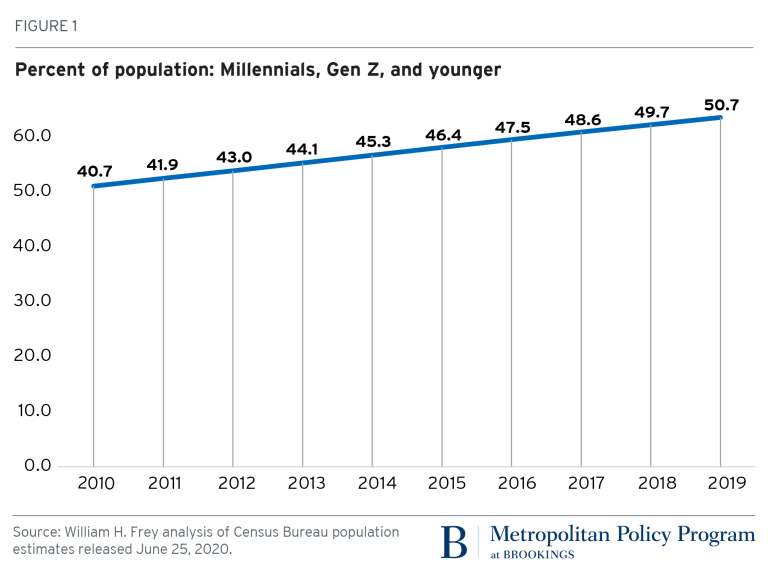
William H. Frey writes Now, more than half of Americans are millennials or younger:
A close examination of detailed age data released by the Census Bureau last month reveals a startling fact: More than half of the nation’s total population are now members of the millennial generation or younger. The data shows that the combined millennial, Gen Z, and younger generations numbered 166 million as of July 2019, or 50.7% of the nation’s population—larger than 162 million Americans associated with the combined Gen X, baby boomer, and older cohorts.
To many Americans—especially baby boomers themselves—this news may come as a shock. For them, the term “millennial” has been associated with a youthful, often negative, vibe in terms of habits, ideology, and politics. Now, the oldest millennial is 39, and with their numbers exceeding those of baby boomers, the millennial generation is poised to take over influential roles in business and government.
But the current political environment suggests this takeover could be contentious. Millennials and their juniors (Gen Z and younger) are more racially diverse than those that preceded them, with nearly half identifying as a racial or ethnic minority. Social, economic, and political fissures between millennials and older, whiter generations are well known; there is no question that in his screeds against illegal immigrants, voter fraud, political correctness, and the like, President Trump has preyed on the fears of older whites about the nation’s changing racial demography—a strategy he continues to follow.

Marc Fisher writes Three presidents embrace the struggle for rights. Trump suggests postponing the election:
Three presidents spoke in poetry, paying tribute to a fallen hero who believed — often against evidence to the contrary, including the cracking of his skull by state troopers — that America was good, its people driven by love to do right by one another.
One president, the current commander in chief, did not attend the funeral of Rep. John Lewis but instead spoke of dark forces in the country and suggested that the United States not hold its next presidential election on time.
….
Barack Obama, George W. Bush and Bill Clinton put on masks and traveled to Atlanta’s Ebenezer Baptist Church to say goodbye to a civil rights leader and Democratic House member who preached change, progress and hope. Donald Trump stayed home, spending the morning watching TV and tweeting, holding fast to his program of conflict, nostalgia and restoration.
Blastoff – NASA’s Perseverance rover launches to Mars:
more >>Conspiracy Theories, Coronavirus, Documentary
Conspiracy Theories: A Frontline Documentary and Coronavirus Disinformation
by JOHN ADAMS •
Of Alex Jones & Roger Stone, Frontline’s United States of Conspiracy describes how “trafficking in conspiracy theories went from the fringes of U.S. politics into the White House. [It’s an] investigation of the alliance among conspiracy theorist Alex Jones, longtime Trump associate Roger Stone and the president — and their role in the battle over truth and lies.” The full film is embedded below.
Of the coronavirus, Zeeshan Aleem writes Covid-19 conspiracy theories are being fed by institutions meant to inform the public (‘Sinclair Broadcast Group planned to allow a coronavirus conspiracy theory to air. It’s part of a worrying trend’):
Conspiracy theories about the origins of the coronavirus have swirled around discussion of the pandemic since it began. Such theories tend to proliferate during times of crisis, as people search for elusive explanations at a time of tremendous uncertainty. But there’s also something else that’s keeping them alive: Institutions in American life entrusted to inform the public have been amplifying them.
The latest example of this phenomenon was a controversial decision by Sinclair Broadcast Group, which owns one of America’s largest local television networks. The company planned to air a new interview with discredited researcher and conspiracy theorist Judy Mikovits, who suggests — despite all evidence and research stating otherwise — that one of the Trump administration’s top scientists, Dr. Anthony Fauci, may have created the coronavirus.
Sinclair was fiercely criticized for its decision to give Mikovits a platform on an episode of America This Week initially set to air on its local stations this weekend, and after facing pushback from progressive watchdogs like Media Matters and influential journalists, the company announced that it would delay broadcasting the episode so it can bring “together other viewpoints and provide additional context.”
As things stand, Sinclair may still air a newly edited version of the episode, giving Mikovits a broadcast platform. (Sinclair did not respond to a request for comment.) Even if the company ultimately decides to kill the episode, serious damage has already been done. The episode was placed on the show’s website, and the controversy alone has brought a new wave of attention to Mikovits’s bizarre and widely debunked conspiracy theories about the virus, giving her fearmongering about Covid-19 a broader audience.
Daily Bread
Daily Bread for 7.30.20
by JOHN ADAMS •
Good morning.
Thursday in Whitewater will be partly cloudy with a high of eighty-one. Sunrise is 5:45 AM and sunset 8:16 PM, for 14h 31m 03s of daytime. The moon is a waxing gibbous with 81.1% of its visible disk illuminated.
On this day in 1974, Pres. Nixon releases subpoenaed White House recordings after being ordered to do so by the Supreme Court.
Recommended for reading in full —
Peter Whoriskey reports First he got $4 million in COVID-19 relief loans. Then he bought a Lamborghini:
One of the first things David T. Hines bought when he got $4 million in COVID-19 relief loans from the feds for his supposedly ailing South Florida moving business was a super-luxury Lamborghini Huracan Evo, authorities say.
Needless to say, the Italian-made sports car — purchased by Hines in May for $318,497 — was not on the list of permissible expenses under a Small Business Administration loan program meant to protect employees and cover other legitimate costs like rent during the coronavirus pandemic.
Hines, who was arrested Friday, also spent thousands of dollars on dating websites, jewelry and clothes, along with stays at high-end hotels such as the Fontainebleau and Setai on Miami Beach.
The SBA’s Payroll Protection Program totaling nearly $650 billion was approved by Congress as part of the CARES Act after the coronavirus struck the nation in March, but Hines’ and other similar fraud cases are starting to pop up in South Florida and other parts of the country. The PPP loans are forgiven by the government if they are properly used by businesses. Congress is considering another major SBA loan infusion as the raging pandemic continues to hurt the U.S. economy.
Federal investigators linked the Lamborghini to Hines, who appeared in Miami federal court on fraud and other charges Monday, after he was involved in a hit-and-run accident on July 11. Miami police impounded his car, and now prosecutors plan to seize it.
….
According to a criminal complaint, Hines’ four South Florida moving businesses applied for seven SBA loans totaling $13.5 million through the Bank of America, saying the money would be spent on at least 70 employees with a monthly payroll of $4 million. The bank approved three of his applications, totaling $3,984,557.
Molly Roberts writes The delusional experiment of sports during a pandemic:
The Miami Marlins clubhouse is crawling with the coronavirus. At least 17 players and coaches have tested positive for covid-19; the Philadelphia Phillies, plus their umpiring crew and stadium staff, await results after their dust-up with the infected Floridians; the New York Yankees were in lockdown before heading to Baltimore.
That’s the box score only after opening weekend — yet Major League Baseball says it’s not planning on cutting short its already stunted season.
Meanwhile, the entire National Basketball Association has gone to Disney World.
The show must go on, apparently, because we don’t know what we’d do without it. We’re looking to sports for a grand reprise of our regular lives in a very irregular summer.
The illusion starts with a delusion: that it’s really possible to wipe away risk altogether amid a pandemic. Next come the efforts to pretend, at least for nine sweet innings or four quarters, that there’s no pandemic at all.
What we learned from Amazon, Apple, Google and Facebook’s Capitol Hill testimonies:
more >>Politics, U.S. Senate
Trump Stooge
by JOHN ADAMS •
Culture, Freedom of Speech, Politics, Protests, Race
Widespread, Continuing National Support for Racial Justice Protests
by JOHN ADAMS •
Steven Long and Justin McCarthy of Gallup report Two in Three Americans Support Racial Justice Protests:
WASHINGTON, D.C. — About two in three Americans (65%) support the nationwide protests about racial injustice that followed the death of George Floyd at the hands of Minneapolis police in late May. Half say they feel “very” (23%) or “somewhat connected” (27%) to the protests’ cause. Black Americans, young adults and Democrats are among the most likely groups to support and feel connected to the protests.
The latest results are based on a June 23-July 6 survey conducted by web using the Gallup Panel, a probability-based panel of U.S. adults, in English. Learn more about the findings from this survey and others at the Gallup Center on Black Voices.
Majorities of most subgroups support the protests, with Republicans (22%) a key exception. Republicans are also least likely to report feeling connected to the protests, with 14% saying they feel very or somewhat connected to the cause.
While small majorities of White Americans and adults aged 50 and older support the protests, fewer in these groups report feeling connected to them.
One sometimes hears that the public cannot manage more than one topic at a time, but continuing support for these protests during a pandemic and a recession shows that view is off-the-mark: Americans are more than able to address several major concerns in the same months. More to the point, addressing seemingly disparate concerns at the same time may truly represent a general, underlying desire for social and economic renewal.
Daily Bread
Daily Bread for 7.29.20
by JOHN ADAMS •
Good morning.
Wednesday in Whitewater will be partly sunny with a high of eighty-four. Sunrise is 5:44 AM and sunset 8:17 PM, for 14h 33m 13s of daytime. The moon is a waxing gibbous with 71.8% of its visible disk illuminated.
The Whitewater Unified School District’s board meets via audiovisual conferencing in closed session at 6:15 PM and open session at 7:00 PM.
On this day in 1958, Pres. Eisenhower signs into law the National Aeronautics and Space Act, which creates the National Aeronautics and Space Administration.
Recommended for reading in full —
Peter Whoriskey reports PPP was intended to keep employees on the payroll. Workers at some big companies have yet to be rehired:
But a closer look at three large companies that received millions from the $517 billion program shows that some companies have not retained most of their staff on the payrolls.
The Fairmont Grand Del Mar in San Diego, a luxury hotel owned by a group led by Richard Blum, a private equity chief and the husband of Sen. Dianne Feinstein (D-Calif.), received $6.4 million from the program. The hotel has been closed and most of its hundreds of workers are unemployed and unpaid, union officials said. To maintain their health insurance, workers send money back to the company.
A large group of restaurant companies operating under the umbrella of Orlando-based Earl Enterprises — including Planet Hollywood International, Bertucci’s and Buca di Beppo — similarly received loans in amounts ranging from $26 million to $54 million, according to the federal data, but in the places most affected by the coronavirus pandemic, the restaurants employ only limited crews. The rest of the staff is unemployed and unpaid, employees said.
And the Omni Hotels & Resorts, owned by Texas billionaire Robert Rowling, were approved for multiple loans from the program — one for each of 15 hotels — totaling $30 million to $71 million. But seven remain closed, and at those, most workers are on unpaid furloughs, union officials said.
Eric Tucker reports US officials: Russia behind spread of virus disinformation:
Russian intelligence services are using a trio of English-language websites to spread disinformation about the coronavirus pandemic, seeking to exploit a crisis that America is struggling to contain ahead of the presidential election in November, U.S. officials said Tuesday.
Two Russians who have held senior roles in Moscow’s military intelligence service known as the GRU have been identified as responsible for a disinformation effort meant to reach American and Western audiences, U.S. government officials said. They spoke to The Associated Press on condition of anonymity because they were not authorized to speak publicly.
The information had previously been classified, but officials said it had been downgraded so they could more freely discuss it. Officials said they were doing so now to sound the alarm about the particular websites and to expose what they say is a clear link between the sites and Russian intelligence.
Between late May and early July, one of the officials said, the websites singled out Tuesday published about 150 articles about the pandemic response, including coverage aimed either at propping up Russia or denigrating the U.S.
World’s largest fusion project being assembled in France:
more >>Republicans, Trump
Republican Voters Against Trump: Former Trump supporter explains why she must vote for Biden this November
by JOHN ADAMS •
While not a member of a political party, one can still sympathize with – and support – the many thousands of additional Republicans each day who reject Trumpism.
“A vote for anyone other than Biden is a vote for Trump … Please, for the love of all Americans, do the right thing.”
Check out hundreds of stories of anti-Trump Republican voters at https://rvat.org
If you’d like to tell your story, submit a video at https://rvat.org/tell-your-story
To get involved in the project, go to https://rvat.org/get-involved
To help support their mission, go to https://rvat.org/donate